


July 10, 2026
The Regulatory Architecture That Unlocked a Decade of Blocked Trade
The Australia India uranium deal, finalised in 2026, represents far more than a routine trade announcement. Nuclear commerce operates on a fundamentally different logic to conventional resource exports. Where most commodity trades require little more than a contract, a shipping manifest, and a willing buyer, uranium crosses borders only after navigating an intricately layered compliance architecture spanning national legislation, bilateral treaty instruments, and international verification frameworks.
For over a decade, the legal intent to trade uranium between Australia and India existed on paper while the operational mechanism remained absent. The 2014 civil nuclear cooperation agreement established the framework, but framework alone cannot authorise a shipment. What was missing was the Administrative Arrangement — a complementary instrument that converts treaty language into a functioning export pathway, complete with chain-of-custody obligations, reporting protocols, and safeguards compliance triggers.
The delay was not bureaucratic inertia. It reflected a genuine and substantive non-proliferation concern rooted in India's status outside the Nuclear Non-Proliferation Treaty. Unlike NPT member states, India maintains both civilian and military nuclear programmes, which required additional safeguards architecture before Australian uranium could lawfully enter the supply chain.
When big ASX news breaks, our subscribers know first
How the Three-Layer Compliance System Actually Works
Most analysts focus on the headline outcome of the Australia India uranium deal without examining the compliance machinery that makes it function. The system operates across three distinct layers, each serving a non-redundant verification purpose:
- Layer 1 – Bilateral Treaty: Defines the permitted scope of use, specifically restricting Australian uranium to peaceful civil power generation with no military application.
- Layer 2 – IAEA Safeguards: Provides independent third-party verification that material is not diverted. For India, this applies specifically to designated civilian facilities under the country's separation plan, which formally divides its civilian and military nuclear infrastructure.
- Layer 3 – Administrative Arrangement: Operationalises the export mechanism, establishing shipment-level documentation, end-use tracking requirements, and critically, a right-of-return provision allowing Australia to recall material if safeguards conditions are breached.
A key detail often overlooked is that Australia's bilateral safeguards agreement with India closely mirrors the architecture applied to Australian uranium exports to China. The precedent suggests the system is workable, but also that its effectiveness depends entirely on IAEA access and India's continued adherence to its civilian facility separation commitments. Furthermore, understanding the broader uranium market dynamics helps contextualise why this architecture matters to investors.
The commercial value of the India deal will only be realised if Australia's domestic policy environment supports the capital investment required to expand uranium production capacity. The agreement opens the market. It does not guarantee supply.
From 2014 to 2026: A Timeline of Regulatory Milestones
| Milestone | Year | Significance |
|---|---|---|
| Civil nuclear cooperation agreement signed | 2014 | Established legal intent for uranium trade |
| Prolonged safeguards compliance negotiations | 2014–2025 | Prevented commercial export pathways from activating |
| Administrative Arrangement finalised | 2026 | Activated export mechanism under IAEA oversight |
| First commercial export shipments | TBD | Subject to supply contracts and India's reactor build schedule |
India's 100 GW Nuclear Target: What the Numbers Actually Mean
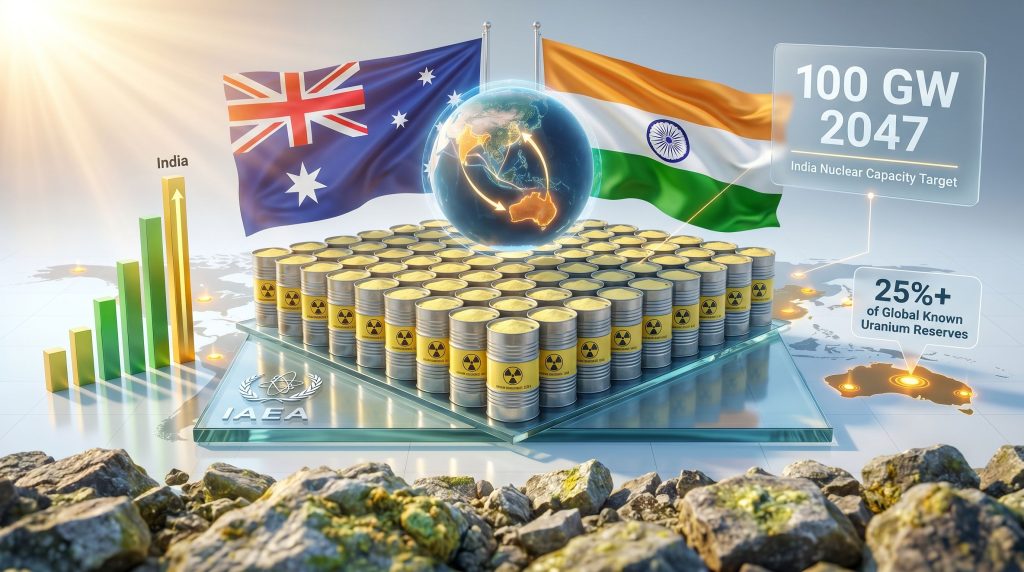
India's stated ambition to reach 100 gigawatts of nuclear energy capacity by 2047 is frequently cited but rarely contextualised. At the time of writing, India operates approximately 7.5 GW of installed nuclear capacity across its fleet of pressurised heavy water reactors and light water units. Reaching 100 GW therefore requires an expansion of more than 13 times current capacity within roughly two decades.
This is not an incremental upgrade. It is a structural transformation of India's energy system, driven by several converging pressures:
- A population of approximately 1.4 billion people generating sustained electricity demand growth that renewable intermittency alone cannot satisfy.
- Coal dependence that remains politically and economically entrenched, making nuclear power one of the few dispatchable low-carbon alternatives available at scale.
- India's commitment under international climate frameworks to significantly expand non-fossil fuel power generation capacity.
- Energy security logic that favours fuel source diversification over reliance on any single import partner.
Critically, India cannot realistically achieve its nuclear ambitions using domestic uranium resources alone. The country's indigenous uranium deposits are relatively modest in both grade and scale, and its existing mines have historically operated below nameplate capacity due to ore quality constraints. This structural deficit is precisely why adding Australia as a supply partner carries strategic weight that extends well beyond the commercial terms of any individual contract. According to the AFR, this arrangement is poised to significantly boost nuclear exports between the two nations.
Australia's Reserve Position: Strategic Asset or Stranded Opportunity?
Australia holds more than 25% of the world's identified uranium resources, a geological endowment that makes it the single largest reserve holder globally. The key producing regions include South Australia, home to Olympic Dam and the Beverley and Four Mile operations, alongside historical production from the Northern Territory's Ranger mine, which has since transitioned to rehabilitation. In addition, understanding global uranium reserves provides essential context for evaluating Australia's competitive position.
Yet there is a persistent and underappreciated gap between Australia's resource endowment and its production market share. Despite holding the world's largest reserves, Australia has not historically been the world's largest uranium producer. Kazakhstan has dominated production volumes for years, while Canada's Athabasca Basin operations, including the high-grade Cigar Lake mine which has recorded ore grades exceeding 14% U3O8, have maintained a premium position in terms of concentrate quality.
Comparing Australia's Active Export Markets Pre- and Post-2026
| Export Market | Pre-2026 Status | Post-Administrative Arrangement |
|---|---|---|
| United States | Active | Active |
| United Kingdom | Active | Active |
| European Union (via Euratom) | Active | Active |
| Japan | Active | Active |
| South Korea | Active | Active |
| China | Active | Active |
| India | Blocked | Pathway now activated |
The addition of India to this list is significant not because it immediately shifts production volumes, but because it introduces a buyer with long-duration structural demand that could support mine development financing decisions over a 20 to 30-year horizon.
Why New Mine Development Faces Headwinds
A less-discussed dimension of the Australia India uranium deal is the domestic supply-side constraint. Even with the export pathway now open, translating that opportunity into actual production requires navigating:
- Capital intensity: Uranium mine development typically requires 7 to 15 years from discovery to first production, demanding patient institutional capital with multi-decade return horizons.
- Regulatory approval timelines: Environmental assessment processes for new uranium mines under Australian federal and state legislation are among the most thorough applied to any mining commodity.
- Tax and royalty settings: Industry participants have flagged that current fiscal frameworks applied to uranium production in some jurisdictions may reduce the competitiveness of Australian material against lower-cost international producers, particularly from Kazakhstan and Namibia.
- Sovereign perception risk: Despite Australia's long record as a reliable resources exporter, periodic political debate around uranium policy can introduce uncertainty that slows capital allocation decisions.
However, broader uranium supply-demand volatility may ultimately pressure new mine development forward as utilities seek supply security.
The US-India 123 Agreement: Why Precedent Matters
To appreciate the significance of the Australia India uranium deal, it is useful to benchmark it against the US-India Civil Nuclear Cooperation Agreement, commonly known as the 123 Agreement, finalised in 2008. That deal marked the first time a major nuclear supplier formally recognised India's civilian nuclear programme as eligible for international trade, despite India's non-NPT status.
The 123 Agreement effectively unlocked the Nuclear Suppliers Group's willingness to grant India a country-specific exemption, which in turn enabled bilateral nuclear trade agreements with multiple supplier nations including France, Russia, Canada, and eventually Australia. Without the US-India deal creating this precedent, the safeguards architecture underpinning the 2026 Administrative Arrangement would likely not exist in its current form.
This context matters for investors. The Australia India uranium deal did not emerge from a regulatory vacuum. It is the downstream consequence of nearly two decades of non-proliferation diplomacy, and its durability is reinforced by the broader international consensus that India's civilian nuclear programme warrants integration into the global supply chain. Furthermore, uranium market trends suggest growing institutional interest in uranium as energy security concerns deepen globally.
The Broader Strategic Picture: Investment, Defence, and Trade Diversification
The uranium arrangement was announced alongside a package of bilateral commitments spanning defence cooperation, maritime security, cyber capabilities, and critical technology partnerships. Separately, AustralianSuper confirmed an additional $500 million investment in India's National Investment and Infrastructure Fund, bringing its total exposure to approximately $3.3 billion.
The Business Council of Australia also confirmed plans to lead a senior trade delegation to India in December 2026, signalling institutional momentum behind trade relationship deepening that extends beyond the resources sector.
These parallel developments matter because they reinforce the uranium arrangement's durability. Bilateral resource trade agreements are most stable when embedded within broader strategic relationships that create mutual dependencies across multiple domains. The depth of Australia-India engagement across defence, infrastructure, and finance reduces the probability that uranium trade could be disrupted by a single policy disagreement.
The next major ASX story will hit our subscribers first
Australia's Domestic Nuclear Contradiction
One of the more politically charged dimensions of the Australia India uranium deal is the domestic policy inconsistency argument. Australia currently maintains a federal prohibition on nuclear power generation, yet exports uranium to countries that operate civilian reactor fleets. Opposition figures have characterised this as a fundamental contradiction, arguing that supporting nuclear energy as a clean power source overseas while excluding it from the domestic electricity market lacks coherent policy logic.
The Albanese government's position rests on a regulatory distinction: uranium export licensing operates under a separate legislative framework from domestic electricity market regulation, and the two policy settings are legally independent. The government has framed the India arrangement primarily as a trade measure and emissions-reduction initiative, consistent with its existing export relationships with Japan, South Korea, and China.
Whether or not the domestic nuclear debate intensifies as a result of the India deal, it remains largely separate from the commercial outlook for Australian uranium producers. What matters to the investment case is the external demand signal — and on that measure, India's 100 GW ambition by 2047 represents one of the most significant structural demand additions the uranium market has encountered in a generation. Moreover, the US ban on Russian uranium further reinforces the case for diversified Western-aligned supply from nations like Australia. As ABC News reports, Australia's agreement to sell uranium to India ends a long-standing stalemate that had persisted for well over a decade.
FAQ: Australia India Uranium Deal Explained
What activated the export pathway in 2026?
The finalisation of an Administrative Arrangement between the two governments, which operationalised the export pathway originally established under the 2014 civil nuclear cooperation agreement by introducing the shipment-level compliance, reporting, and safeguards documentation required for lawful trade.
Why did it take over a decade to reach this point?
India's non-NPT status created a complex non-proliferation challenge. Resolving it required designing a bespoke safeguards architecture that satisfied Australian export legislation, IAEA verification requirements, and bilateral treaty obligations simultaneously.
How much uranium will Australia export to India initially?
No specific volumes, pricing, or timelines were disclosed at the time the Administrative Arrangement was formalised. Commercial quantities will be determined through negotiations between Australian producers and Indian nuclear utilities.
What is India's current nuclear capacity versus its 2047 target?
India operates approximately 7.5 GW of installed nuclear capacity. Its target of 100 GW by 2047 implies an expansion of more than 13 times current capacity over roughly two decades.
Does Australia produce enough uranium to supply India at scale?
Australia holds over 25% of global uranium reserves but currently operates a limited number of active mines. Meeting expanded demand will require significant new mine investment, subject to regulatory approvals, capital availability, and domestic fiscal policy settings.
Is Australia's domestic nuclear ban affected by this deal?
No. The export arrangement operates under separate legislation from Australia's prohibition on domestic nuclear power generation. The two policy settings are legally distinct.
This article is intended for informational purposes only and does not constitute financial or investment advice. Uranium market forecasts, demand projections, and mine development timelines involve significant uncertainty and should not be relied upon as the basis for investment decisions. Readers should conduct independent research and seek professional advice before making any investment.
Want to Capitalise on the Uranium Boom Before the Market Catches Up?
Discovery Alert's proprietary Discovery IQ model delivers real-time alerts on significant ASX mineral discoveries — including uranium opportunities emerging from structural demand shifts like India's 100 GW nuclear expansion — turning complex resource data into actionable investment insights. Explore how historic mineral discoveries have generated substantial returns on Discovery Alert's dedicated discoveries page, and begin your 14-day free trial today to position yourself ahead of the broader market.