June 8, 2026
The Architecture of Obligation: Why Australia's New Gas Rules Could Backfire
Energy security policy rarely fails through bad intentions. It fails through poor design. Across global LNG markets, the tension between export competitiveness and domestic supply adequacy has never been straightforward to resolve, and Australia's attempt to codify that balance into a permanent statutory framework is testing this reality in real time. The proposed Australia domestic gas supply obligation sits at the intersection of sovereign energy policy, long-term capital markets, and bilateral trade relationships, making it one of the most consequential regulatory experiments currently underway in the Asia-Pacific energy sector.
Understanding the true implications of this framework requires looking beyond the headline reservation percentage and examining what the architecture of annual ministerial discretion, ambiguous compliance mechanics, and unresolved infrastructure obligations actually means for the future of Australian LNG investment.
When big ASX news breaks, our subscribers know first
From Reactive Safeguard to Permanent Structural Obligation
The history of Australian domestic gas policy has largely been shaped by reactive instruments rather than pre-emptive structural design. The Australian Domestic Gas Security Mechanism, introduced in 2017, was never meant to function as a standing obligation. It was a conditional backstop, activated only when domestic shortfall forecasts crossed a defined threshold. East coast gas agreements that followed operated on voluntary, negotiated terms with limited enforceability.
The proposed Domestic Supply Obligation represents a fundamental departure from this tradition. Rather than waiting for market failure to trigger intervention, the DSO embeds a permanent, rules-based reservation requirement directly into the national gas supply architecture. The distinction is not merely administrative. It signals a shift in how the federal government conceptualises its role within gas markets, moving from referee to active participant in supply allocation decisions.
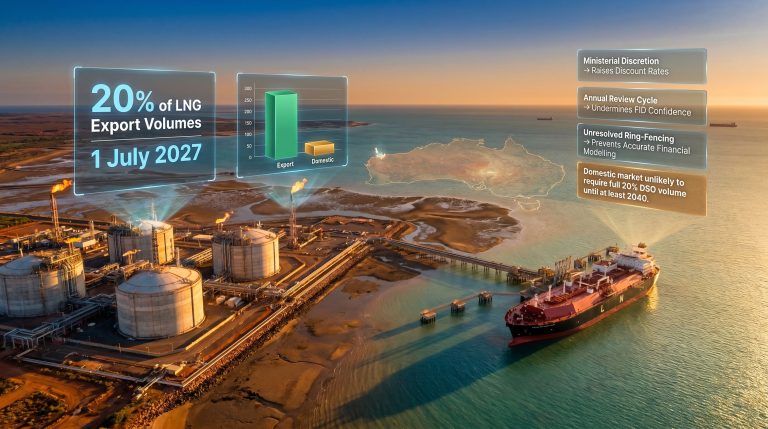
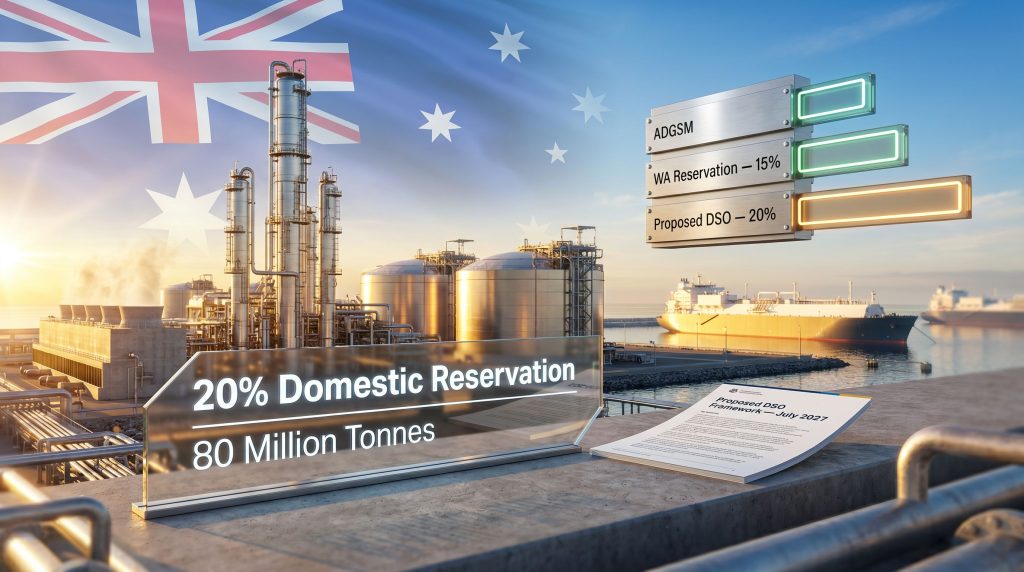
The comparison with Western Australia's longstanding reservation policy is instructive but incomplete. WA has required producers to set aside 15% of LNG export production for domestic use since 2006, and the policy is widely regarded as having contributed to the state's relatively stable domestic gas prices. The proposed national DSO proposes a higher threshold of 20% of total LNG export volumes, but applies it within a governance architecture that differs significantly from WA's more streamlined approach. Furthermore, Australia's resource and energy exports face mounting pressure as this regulatory shift introduces new layers of uncertainty for producers.
| Mechanism | Scope | Trigger | Obligation Type |
|---|---|---|---|
| ADGSM | East Coast | Activated by shortfall forecast | Conditional / reactive |
| East Coast Gas Agreements | East Coast | Voluntary / negotiated | Non-binding commitments |
| WA Domestic Gas Reservation Policy | Western Australia | Permanent | 15% of production reserved |
| Proposed DSO Framework | National | Permanent / annual review | 20% of LNG export volumes |
The Ministerial Discretion Problem and Its Investment Consequences
Analysis from Wood Mackenzie identifies the reliance on annual government reviews as one of the framework's most structurally destabilising features. LNG projects are capital-intensive assets with investment horizons spanning two to three decades. Committing billions of dollars to upstream development requires regulatory certainty that extends well beyond annual political cycles.
When annual ministerial approvals determine how much gas an operator can export in any given year, the effective investment calculus for new project development changes materially. The cost of capital rises to compensate for regulatory risk. Final investment decisions get deferred. And in a globally competitive LNG supply landscape, Australian projects begin to look less attractive relative to alternatives in the United States, the Middle East, or East Africa.
Industry Insight: Wood Mackenzie's analysis of the draft framework found that initial policy announcements generated widespread confusion among industry participants at the Australian Energy Producers conference in Adelaide, with the subsequent consultation paper only partially resolving the concerns raised.
This is not abstract concern. Capital allocation decisions for Australian LNG already compete with jurisdictions offering greater regulatory stability. Consequently, when the rules governing how much gas an operator can export are subject to annual political recalibration, long-term planning becomes structurally compromised. The broader geopolitical risk landscape compounds these pressures, as shifting alliances and trade tensions further complicate investment decision-making across the Asia-Pacific region.
The Grandfathering Illusion: Protection With a Hidden Liability
One of the more technically complex aspects of the DSO framework involves its treatment of existing LNG export contracts. The government's stated position is that contracts already in force will be respected. On the surface, this appears to provide a meaningful commercial protection for operators with long-term offtake agreements in place.
The reality is considerably more nuanced. The draft framework introduces a mechanism by which exporters can accumulate so-called DSO debt when domestic supply obligations are not met, regardless of whether the reason for non-compliance is the honouring of a pre-existing export contract. This DSO debt carries forward into subsequent compliance periods, compounding obligations over time.
Practically, this means operators may be required to either source additional domestic gas volumes or acquire spot LNG cargoes on international markets to offset accumulated shortfalls. Both pathways impose real commercial costs. The spot cargo option, in particular, introduces significant price risk depending on prevailing international LNG market volatility at the time of purchase.
Critical Risk Flag: The grandfathering protection offered by the draft DSO does not prevent the accumulation of compliance liabilities. Exporters honouring existing long-term contracts in good faith could still face mounting DSO debt, creating a contingent financial obligation that existing contract protections do not extinguish.
This design gap transforms what should be a clean legal protection into a contingent liability with undefined boundaries. Industry legal teams are expected to scrutinise this mechanism closely during the consultation period closing on 30 June 2026. The Australian government's domestic gas supply framework outlines the broader policy intent, though many operators remain concerned that the commercial mechanics have not been sufficiently resolved.
Infrastructure Gaps: The Physical Impossibility Problem
The DSO's domestic supply ambitions rest on an infrastructure assumption that current market conditions do not support. Offshore gas production in southern Australia is on a trajectory of material decline through the 2030s. As southern fields diminish, Queensland basin supply becomes increasingly central to meeting east coast demand, particularly in Victoria and South Australia.
The problem is that existing east coast pipeline infrastructure is not configured to transport northern Queensland gas volumes to southern markets at the scale a 20% DSO obligation would require. New pipeline capacity involves multi-billion dollar capital commitments and regulatory approval processes that extend well beyond the framework's proposed July 2027 commencement date.
The draft framework does not clearly resolve a fundamental question: who funds and constructs the infrastructure necessary to physically fulfil DSO obligations? Without binding infrastructure investment provisions, the policy creates a legal obligation that the physical supply chain may be incapable of satisfying within the required timeframes. This is not a minor administrative gap. It is a structural mismatch between policy ambition and operational reality.
Quantifying the Oversupply Risk
The policy's demand calibration deserves careful scrutiny. Australia has consistently ranked among the world's two largest LNG exporters, with annual export volumes exceeding 80 million tonnes in recent years. A blanket 20% reservation applied uniformly across all LNG projects could generate domestic supply volumes that substantially exceed near-term east coast market demand.
Wood Mackenzie's modelling suggests this demand-supply gap would persist for a considerable period, with the full obligation across all LNG projects not justifiable by market demand until at least 2040. Years of structural oversupply within the domestic market carry consequences that cut against the policy's own objectives. In addition, the commodity price impacts flowing from an artificially oversupplied domestic market could erode producer margins across the sector.
Policy Catch-22: A domestic reservation framework designed to strengthen gas availability could paradoxically suppress the price signals necessary to justify new upstream investment, ultimately constraining the long-term supply it seeks to protect.
Suppressed wholesale gas prices reduce the commercial viability of greenfield and brownfield gas field development. For smaller and mid-tier producers without the balance sheet resilience of major integrated operators, prolonged price compression removes the margin that makes new production economically rational. The investment incentive paradox embedded within the 20% obligation is arguably the DSO's most underappreciated risk.
The next major ASX story will hit our subscribers first
The Western Australia Compliance Architecture Problem
Western Australia's domestic gas reservation policy has operated since 2006 and is embedded deeply into the state's LNG project approval conditions. The proposed national DSO raises unresolved jurisdictional questions about how WA obligations interact with the new federal framework.
The critical ambiguity centres on whether WA-sourced supply could count toward east coast DSO compliance. Three scenarios emerge, each with distinct market implications:
| Scenario | Implication |
|---|---|
| WA supply allowed to offset east coast DSO obligations | Reduces effective domestic supply to eastern markets; undermines policy intent |
| Uniform national rule applied without regional differentiation | Risks significant oversupply in WA market; weakens investment signals in both regions |
| Separate regional compliance frameworks maintained | Increases administrative complexity; creates compliance cost burden for multi-region operators |
None of these outcomes is straightforwardly acceptable. The draft framework has not resolved this question, and the choice of design will carry materially different commercial consequences for producers operating across multiple Australian basins.
Project-Level vs. Participant-Level: A Compliance Design Fault Line
Among the unresolved commercial questions within the draft DSO, the distinction between project-level and participant-level obligation structures stands out for its complexity. The draft framework has not definitively established which unit of measurement governs compliance.
This distinction is not technical housekeeping. Participant-level obligations allow operators with multiple projects across different basins to net their compliance positions across a portfolio. Project-level obligations impose discrete compliance requirements on each individual asset, regardless of how the operator's broader portfolio performs against its DSO threshold.
For large integrated operators with diversified Australian upstream portfolios, the difference in compliance cost could be substantial. For single-project operators or joint venture participants with limited portfolio flexibility, project-level obligations could present compliance challenges that are effectively insurmountable without acquiring third-party supply.
Key Ambiguities Requiring Resolution Before July 2027
- Compliance unit definition: Project vs. participant-level obligations and how portfolio netting functions
- DSO debt mechanics: Accumulation methodology, carry-forward periods, and defined discharge pathways
- Infrastructure responsibility: Funding obligations for new pipeline capacity required to fulfil domestic delivery requirements
- Cross-regional offsets: Whether WA-sourced supply can satisfy east coast DSO compliance thresholds
- Spot cargo obligations: Specific conditions under which international spot cargo purchases satisfy domestic supply shortfalls
- Price discovery: How domestically reserved volumes are priced, and whether regulated or market-based pricing applies
Japan, South Korea, and the Reputational Dimension
The DSO's implications extend beyond Australian market dynamics into bilateral trade relationships that have underpinned the country's LNG export growth for decades. Japan and South Korea collectively represent Australia's two largest LNG export markets, with relationships built on long-term offtake agreements that provide both supply certainty for buyers and revenue predictability for Australian producers.
Northeast Asian LNG buyers are already actively diversifying supply portfolios toward US Gulf Coast projects, Middle Eastern exporters, and emerging East African sources. Global tariff disruptions have accelerated this diversification trend, as procurement teams managing multi-decade supply strategies increasingly factor sovereign risk into their decision-making. Regulatory frameworks that introduce ambiguity around Australia's capacity to honour long-term export commitments, even indirectly through DSO debt accumulation mechanisms, will be evaluated through precisely this lens.
Investor Perspective: Global energy majors allocating upstream capital compare Australian regulatory environments directly against alternatives. Frameworks that embed ministerial discretion into long-term investment horizons and leave compliance mechanics unresolved will be weighted against more stable jurisdictions when final investment decisions are made.
Three Scenarios for What Comes Next
Scenario 1: Well-Calibrated Framework
Demand-linked reservation thresholds replace fixed percentage mandates. Infrastructure investment obligations are codified with clear funding allocation. Grandfathering protections achieve legally enforceable certainty rather than policy-statement status. Result: Improved domestic supply security with manageable consequences for upstream investment.
Scenario 2: Poorly Defined Implementation
Ministerial discretion remains unconstrained. DSO debt mechanics stay ambiguous. Infrastructure gaps go unaddressed. Result: Elevated sovereign risk, deferred upstream investment, and potential domestic supply contraction by the mid-2030s as the price signals for new development deteriorate.
Scenario 3: Regulatory Stalemate
The consultation process produces irreconcilable positions between industry and government. The policy is delayed or substantially redesigned post-2027. Result: Prolonged uncertainty suppresses new project commitments while the existing ADGSM continues operating by default.
What Industry Submissions Will Prioritise
With the consultation period open until 30 June 2026, industry submissions are expected to focus on several interconnected themes. Legal analysts at Allens have published detailed commentary on the proposed scheme, highlighting the compliance architecture gaps that operators are likely to contest most vigorously during the review period.
- Clearer legal definitions for compliance unit structures at both project and participant level
- Binding infrastructure investment provisions or defined exemption pathways
- Transparent DSO debt accumulation and discharge rules with defined carry-forward limits
- Demand-calibrated reservation thresholds rather than fixed percentage mandates
- Explicit and coordinated treatment of WA obligations within the national framework
- Grandfathering protections with legally enforceable boundaries, not merely policy commitments
The Australian Energy Producers conference in Adelaide earlier in 2026 provided an early indication of where the fault lines sit within industry response. The breadth of concerns raised across operators of different sizes, geographic exposure, and portfolio configurations suggests the consultation process will generate detailed and technically complex submissions that may require substantial policy recalibration before a workable final framework emerges.
The Australia domestic gas supply obligation represents a genuinely significant policy ambition. The goal of structuring permanent, predictable domestic supply access is commercially and strategically sound in principle. However, whether the framework as currently drafted can achieve that goal without undermining the upstream investment environment it depends upon is the central question the next twelve months of consultation will need to answer.
Readers seeking ongoing coverage of Australian gas market regulation and upstream project developments can explore industry reporting published by Petroleum Australia at petroleumaustralia.com.au.
Want to Stay Ahead of Major ASX Resource and Energy Discoveries?
Discovery Alert's proprietary Discovery IQ model scans ASX announcements in real time, delivering instant alerts on significant mineral discoveries and turning complex resource data into actionable investment insights — explore historic discovery returns on Discovery Alert's discoveries page to see what early positioning can mean for investors, and begin a 14-day free trial at discoveryalert.com.au to secure a market-leading edge.