
June 8, 2026
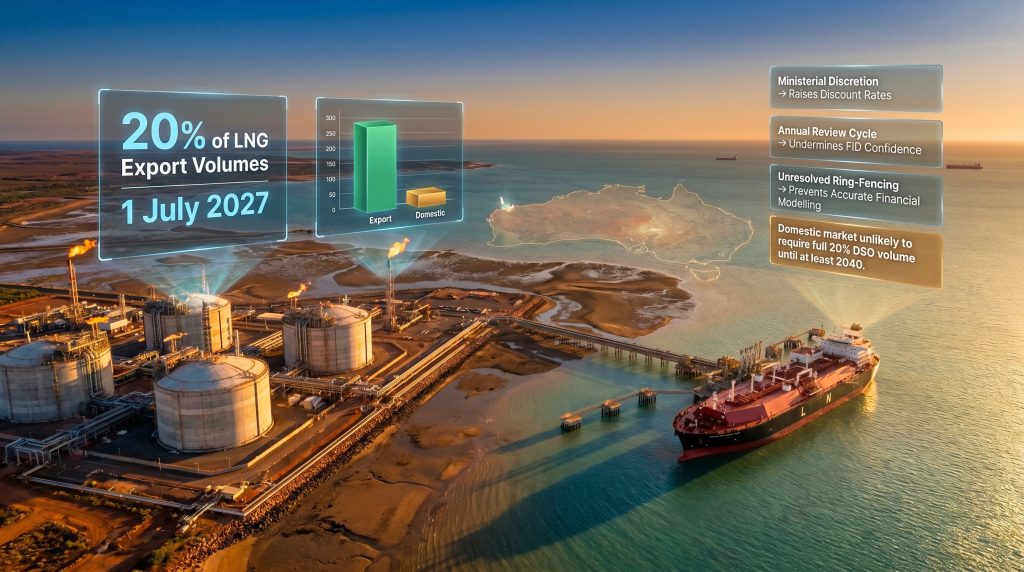
The Long-Cycle Trap: Why Regulatory Design Determines Whether Australia's Gas Future Gets Built
Energy policy rarely fails because of bad intentions. It fails because the architecture of regulation creates incentives that contradict the stated goal. Nowhere is this dynamic more consequential than in long-cycle resource investment, where the gap between a policy announcement and its real-world consequences can span a decade or more. The Wood Mackenzie domestic gas supply framework investor uncertainty debate presents precisely this kind of structural risk: a well-motivated intervention with commercial ambiguities that could undermine the upstream investment it ultimately depends upon.
Understanding why requires stepping back from the headline numbers and examining how capital actually flows into gas projects, how investors price regulatory uncertainty, and what happens when a 30-year infrastructure decision must be made against a policy framework that resets every 12 months.
When big ASX news breaks, our subscribers know first
What the DSO Actually Proposes and Where the Design Gaps Begin
The Federal Government's proposed Domestic Supply Obligation (DSO) would require LNG exporters to direct gas volumes equivalent to 20% of their total export output into the Australian domestic market. The obligation is scheduled to take effect from 1 July 2027, with an annual review cycle and ministerial discretion as the primary governance mechanism.
At face value, the policy has a coherent rationale. Australia's east coast gas market has experienced periods of domestic tightness, and concerns about export volumes crowding out local supply have intensified as legacy fields decline. A reservation-style mechanism is not without precedent: Western Australia has operated a domestic gas reservation policy for LNG projects since 2006, requiring that 15% of LNG project output be reserved for domestic supply.
The WA model, however, was built into project approvals at the outset, with clear and contractually embedded obligations. The proposed federal DSO differs in several important respects, and furthermore, it arrives at a time when Australia's resource energy exports are already navigating a complex set of market and regulatory pressures.
The key structural gaps identified in Wood Mackenzie's analysis include:
- Whether the 20% obligation applies at the individual project level or to each corporate participant across their entire portfolio
- Where the regulatory ring-fence is drawn, at the participant, project, or state jurisdiction level
- How the government would respond if domestic demand falls materially short of mandated supply volumes
- What commercial recourse exists for producers if ministerial decisions shift substantially between annual review periods
- How the framework interacts with existing long-term supply contracts and tolling arrangements
Each of these unresolved questions represents a discrete risk variable. In combination, they create a layered uncertainty that is disproportionately more damaging to investor confidence than any single ambiguity in isolation.
| DSO Feature | Current Status |
|---|---|
| Obligation threshold | 20% of LNG export volumes |
| Proposed start date | 1 July 2027 |
| Review mechanism | Annual cycle |
| Decision authority | Ministerial discretion |
| Application scope | Unresolved: project vs. participant level |
| Ring-fencing definition | Not yet established |
The Mismatch Between Annual Policy Cycles and Decadal Investment Horizons
One of the most technically important concerns raised in Wood Mackenzie's analysis is the fundamental incompatibility between how the DSO is governed and how upstream gas capital is deployed.
Offshore LNG development projects routinely require 10 to 30 years of capital commitment, with final investment decisions (FIDs) made on the basis of financial models that stress-test regulatory conditions across the full project lifecycle. The cost structures involved are extraordinary: a greenfield LNG facility in Australian waters can require $15 billion to $50 billion or more in upfront capital before a single cargo is shipped.
Against that investment backdrop, a regulatory obligation that resets annually under ministerial authority introduces a structural incompatibility. Project financiers, equity partners, and rating agencies cannot accurately model a compliance liability that is subject to political recalibration every 12 months. This is not theoretical risk aversion. It translates directly into:
- Higher discount rates applied to future project cash flows, reducing net present value
- Elevated hurdle rates required to justify new capital deployment
- Longer pre-FID due diligence cycles as legal and financial teams attempt to stress-test unresolvable variables
- Delayed or deferred investment decisions at precisely the moment Australia needs new upstream supply committed
The core problem is not the existence of a domestic supply obligation. It is that the framework's governance architecture, annual ministerial review with discretionary override, was designed for policy flexibility rather than capital attraction. These two objectives are fundamentally in tension when applied to infrastructure with a multi-decade investment horizon.
How Does This Affect Existing Infrastructure Projects?
Consider, for instance, how the uncertainty compounds for projects already in development. The North West Shelf extension represents exactly the kind of long-cycle commitment that requires stable, predictable regulatory conditions to proceed. When Wood Mackenzie domestic gas supply framework investor uncertainty is layered on top of already complex project economics, the consequences for FID timelines become very real.
Is the 20% Threshold Actually Calibrated to Market Need?
Beyond governance mechanics, Wood Mackenzie's research raises a more fundamental question about whether the 20% obligation is grounded in verifiable domestic demand forecasts. The firm's analysis of proposed windfall levy impacts indicates that the Australian domestic gas market is unlikely to require the full 20% DSO volume across all LNG projects until at least 2040, given current and projected demand trajectories.
This is a significant finding. It suggests that a broadly applied DSO commencing in 2027 could generate structural domestic oversupply for more than a decade before demand catches up to mandated volumes.
The implications of sustained oversupply are commercially serious:
| Scenario | Market Outcome |
|---|---|
| DSO applied broadly from 2027 | Potential domestic oversupply through 2030s |
| Gas priced below export netback | Producer revenue erosion, reduced reinvestment |
| Oversupply sustained through mid-2030s | Suppressed domestic prices, reduced exploration incentive |
| Investors reprice sovereign risk | Capital redirection to competing LNG jurisdictions |
The concept of netback pricing is relevant here. In export-oriented gas markets, the domestic price that producers require to sustain investment is typically benchmarked against the export netback, which is the LNG price minus shipping, liquefaction, and other costs. When mandated domestic supply volumes exceed demand, prices fall below the netback threshold, and the economic case for continued upstream investment deteriorates.
The very policy designed to secure domestic supply can, if poorly calibrated, suppress the exploration investment that future supply depends upon. This dynamic is further complicated by shifting commodity prices and project economics, which already place producers under considerable financial pressure.
A more demand-responsive framework design would likely incorporate:
- Demand-linked trigger thresholds rather than fixed percentage mandates applied uniformly
- Graduated implementation timelines aligned to independently verified domestic shortfall data
- Transparent, rules-based review criteria insulated from short-term political considerations
- Clear ring-fencing definitions established and consulted on prior to the obligation taking effect
Ministerial Discretion as a Sovereign Risk Amplifier
The Wood Mackenzie analysis places particular emphasis on the role of ministerial discretion as a compounding risk factor. To understand why, it is worth distinguishing between two fundamental regulatory design types in energy policy.
Rules-based frameworks establish fixed, predictable obligations and review criteria that producers can model with legal certainty. Discretion-based frameworks reserve decision-making authority for a minister, creating flexibility for government but uncertainty for investors.
| Framework Type | Investor Certainty | Policy Flexibility | Capital Attraction |
|---|---|---|---|
| Rules-based (fixed thresholds) | High | Low | Strong |
| Discretion-based (ministerial) | Low | High | Weak |
| Hybrid (demand trigger + rules review) | Moderate | Moderate | Conditional |
Australia has historical precedent for how discretionary energy policy affects project structuring. Consequently, broader concerns about government intervention in resources have become increasingly prominent among institutional investors assessing Australian exposure.
What makes the current DSO proposal potentially more disruptive is the simultaneous stacking of multiple unresolved variables. Individually, each gap, scope ambiguity, ring-fencing uncertainty, annual review exposure, and discretionary override, is a manageable concern. Together, they create a compounding uncertainty effect that institutional capital finds structurally difficult to underwrite.
Australia's LNG Competitive Position: The Stakes Behind the Policy Debate
The DSO debate does not occur in a vacuum. Australia competes for upstream LNG investment in a global market where capital allocation decisions are made comparatively, not in isolation. However, the geopolitical risk in resource investment adds another layer of complexity that investors must navigate alongside domestic regulatory concerns.
Australia consistently ranks among the world's top two LNG exporters, alongside Qatar, with annual export capacity of approximately 88 million tonnes per annum (mtpa) across its operating projects. That position is not guaranteed to persist without continued upstream reinvestment as legacy fields decline.
The competitive environment has intensified considerably:
- Qatar is expanding its North Field capacity to exceed 126 mtpa by the late 2020s, maintaining cost advantages through integrated project structures
- The United States has accelerated LNG export approvals, with multiple new projects under development across Louisiana and Texas, benefiting from lower production costs and a rules-based regulatory environment
- East Africa, particularly Mozambique and Tanzania, is advancing large-scale LNG projects that are attracting major international capital commitments
Any deterioration in Australia's sovereign risk profile relative to these competitors directly affects its ability to attract the upstream reinvestment needed to sustain and grow export capacity. Furthermore, Wood Mackenzie's broader assessment of Australia's energy competitiveness specifically flags that the current framework design risks deterring or deferring upstream capital commitments at a time when new project development is critical to replacing declining production from ageing fields such as those in the Bass Strait and Browse Basin.
The next major ASX story will hit our subscribers first
What Needs to Change Before 2027
The path to a functional DSO is not inherently blocked. The policy objective, securing sufficient domestic gas supply, is legitimate and achievable. The problem is architectural, not intentional. Resolving it requires targeted interventions before the framework takes effect.
- Define the ring-fence with legal precision before the obligation applies, establishing unambiguous boundaries at participant, project, and jurisdictional levels
- Replace annual ministerial discretion with rules-based triggers linked to independently verified domestic supply shortfall data, removing political discretion from routine compliance assessments
- Align review cycles to investment horizons by moving from annual political reviews to multi-year regulatory certainty windows that reflect the capital lifecycle of upstream projects
- Publish demand trajectory modelling transparently, with methodology open to industry review, justifying the 20% threshold against projected domestic requirements year by year through to 2040
- Establish commercial recourse mechanisms with clear remedies for producers if ministerial decisions shift materially between review periods, reducing open-ended liability exposure
- Consult on project-level vs. participant-level application with a binding legislative decision made well before 2027, so legal and financial teams can model obligations with certainty
If policymakers proceed with the current framework without resolving these design gaps, the DSO risks becoming a case study in regulatory own-goals: a mechanism intended to secure domestic gas supply that instead suppresses the upstream investment Australia needs to produce that supply in the first place.
Frequently Asked Questions: Australia's Domestic Supply Obligation
What is Australia's proposed Domestic Supply Obligation?
The DSO is a federal policy framework that would require LNG exporters to supply gas volumes equivalent to 20% of their export output into the Australian domestic market, proposed to commence on 1 July 2027.
Why has Wood Mackenzie raised concerns about the DSO?
Wood Mackenzie's analysis identifies that key commercial and legal details remain unresolved, including the scope of application, ring-fencing definitions, and the role of ministerial discretion, creating elevated uncertainty for the long-cycle investment decisions that underpin Australia's gas sector.
Could the DSO lead to domestic gas oversupply?
Energy research suggests the domestic market is unlikely to require the full 20% obligation volume across all LNG projects until at least 2040, meaning a broadly applied DSO from 2027 could generate structural oversupply for over a decade.
How does ministerial discretion increase investor risk?
When compliance obligations are subject to annual ministerial review rather than fixed rules-based criteria, producers cannot accurately model their regulatory liability across a project lifecycle. This raises discount rates, compresses valuations, and increases the hurdle rate required for new capital commitments.
What would a better-designed DSO look like?
A more investment-compatible framework would feature demand-linked trigger thresholds, clearly defined ring-fencing provisions established before the obligation takes effect, multi-year review cycles aligned to investment horizons, and transparent demand modelling that justifies the 20% threshold against verified domestic requirements.
Key Risk Summary: What the DSO Debate Reveals
| Risk Factor | Nature of Risk | Investor Impact |
|---|---|---|
| Ministerial discretion | Sovereign risk elevation | Raises project discount rates |
| Annual review cycle | Short-termism vs. long-cycle investment | Undermines FID confidence |
| Unresolved ring-fencing | Compliance liability ambiguity | Prevents accurate financial modelling |
| Potential domestic oversupply | Revenue and price erosion | Suppresses reinvestment capacity |
| Scope ambiguity (project vs. participant) | Legal and commercial uncertainty | Delays capital commitment |
The central lesson from Wood Mackenzie's analysis of the domestic gas supply framework is one that applies broadly to resource policy design: Wood Mackenzie domestic gas supply framework investor uncertainty is not merely a sentiment metric. It is a structural input into capital allocation decisions that shapes whether projects get built, when exploration commitments are made, and ultimately whether domestic supply objectives are achievable at all. Resolving the DSO's commercial architecture before 2027 is not an industry preference to be weighed against policy ambitions. It is the prerequisite for the policy to deliver what it promises.
This article presents analysis of publicly reported research and industry commentary. It does not constitute financial advice. Readers should seek independent professional guidance before making investment decisions related to the energy sector or resource markets.
Want To Stay Ahead of Major ASX Resource Discoveries Before the Broader Market Reacts?
While Australia's gas sector navigates complex regulatory headwinds, Discovery Alert's proprietary Discovery IQ model scans ASX announcements in real time, instantly alerting subscribers to significant mineral discoveries across more than 30 commodities — visit the Discovery Alert discoveries page to explore historic examples of exceptional returns, or start your 14-day free trial at Discovery Alert and position yourself ahead of the market.