July 3, 2026
The Hidden Complexity Behind Two of the ASX's Biggest Mining Names
Iron ore built two of Australia's most recognisable corporate empires, but the decade ahead will be defined by what lies beyond it. Investors who approach the Fortescue or Rio Tinto shares the better buy debate purely through the lens of yield are missing the deeper structural forces reshaping how global mining companies create and preserve long-term value. Commodity diversification, copper pipeline credibility, earnings quality, and capital discipline are increasingly the metrics that separate durable mining wealth from cyclical income that can evaporate when bulk commodity prices turn.
Understanding which of these two ASX mining giants offers the better buy requires moving past surface-level comparisons and examining the fundamental architecture of each business.
When big ASX news breaks, our subscribers know first
How Each Company Actually Generates Its Earnings
Fortescue: The Pilbara Powerhouse With a Single Engine
Fortescue built its fortune almost entirely on iron ore extracted from Western Australia's Pilbara region, and that remains the overwhelming driver of its revenue and profit today. This concentration is simultaneously the company's greatest strength and its most significant structural vulnerability.
When iron ore prices are elevated, Fortescue's cash generation is formidable, and dividend payments can be exceptionally large relative to its share price. However, when prices fall, the earnings impact flows through with minimal buffer. There are no aluminium smelters, copper mines, or lithium projects large enough to meaningfully offset a sustained iron ore price correction.
The key dynamics of Fortescue's earnings model include:
- Iron ore shipments from the Pilbara constitute nearly all of the company's revenue base
- Cost per tonne (C1 costs) is a critical profitability metric, and Fortescue has historically maintained competitive cash costs, typically in the range of US$17 to US$19 per wet metric tonne
- Fortescue's ore is lower grade than benchmark 62% Fe product, meaning it typically sells at a discount to the iron ore index price — a structural consideration often underappreciated by retail investors
- The company has been developing its copper strategy, but current copper contributions to group earnings remain negligible relative to iron ore
That last point deserves particular attention. Fortescue's ores average closer to 57% to 58% iron content, compared to the benchmark 62% Fe specification used in most price indices. Furthermore, this grade discount means Fortescue receives a lower realised price per tonne than headline iron ore price trends would suggest, and that discount can widen when Chinese steel mills have access to higher-grade alternatives. It is a nuance that significantly affects earnings sensitivity modelling.
Rio Tinto: Multi-Commodity Architecture With a Transition Metals Foundation
Rio Tinto operates across iron ore, copper, aluminium, lithium, titanium dioxide, borates, and diamonds. While iron ore remains its largest single profit contributor, the breadth of its commodity base provides meaningful earnings diversification that Fortescue simply cannot match today.
The company's Pilbara iron ore operations are world-class, and its cost position is among the lowest globally. But what differentiates Rio Tinto structurally is the presence of established, revenue-generating assets across multiple commodities at different points in their demand cycles.
Key characteristics of Rio Tinto's earnings architecture:
- The Pilbara iron ore system delivers high-margin tonnes but now represents a smaller proportional share of group earnings than it did a decade ago
- Copper operations span multiple jurisdictions, including Kennecott in the United States and Oyu Tolgoi in Mongolia — one of the world's largest undeveloped copper-gold resources now in production
- Aluminium, through Rio Tinto's ELYSIS partnership and its Canadian smelting operations, provides exposure to industrial and green aluminium demand
- The Rincon lithium project in Argentina adds a nascent but strategically important position in battery materials
- Titanium dioxide feedstocks and borates contribute steady, lower-volatility earnings streams
The breadth of Rio Tinto's commodity exposure means that when iron ore prices soften, the company does not face the same direct earnings cliff that a single-commodity producer confronts. This earnings buffering is a qualitative advantage that does not always show up clearly in point-in-time valuation multiples.
Fortescue or Rio Tinto Shares: Valuation and Earnings Compared
When evaluating whether Fortescue or Rio Tinto shares represent the better buy, raw valuation multiples tell only part of the story. The quality and predictability of earnings behind those multiples matters enormously. Consequently, monitoring the China steel demand outlook is essential for understanding how each company may perform in the period ahead.
| Metric | Fortescue (ASX: FMG) | Rio Tinto (ASX: RIO) |
|---|---|---|
| FY26 EPS (Consensus) | ~$1.73 | ~$11.88 |
| FY27 EPS (Consensus) | ~$1.42 | ~$12.38 |
| Reference Share Price | ~$20.47 | ~$185.59 |
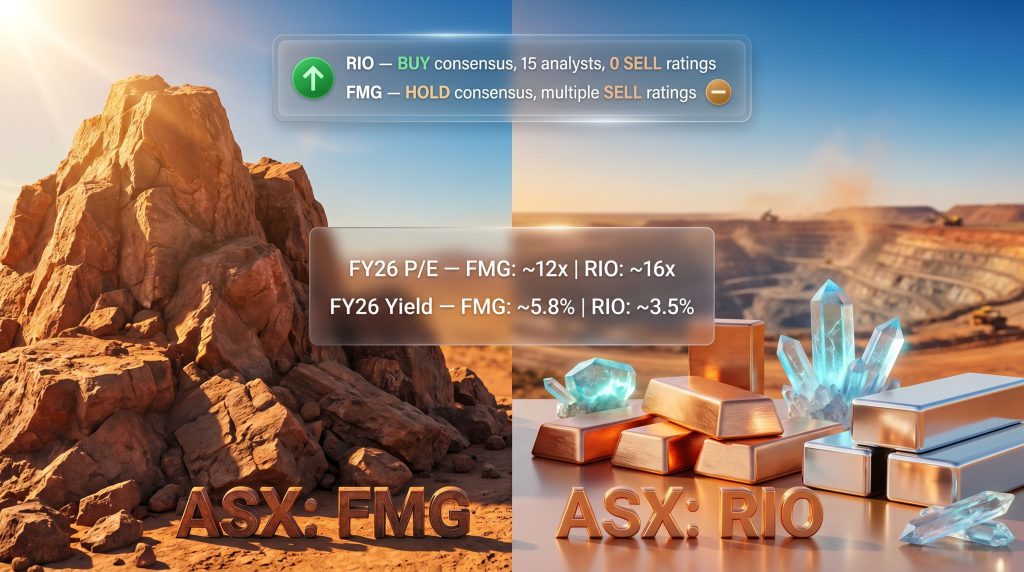
| FY26 P/E Multiple | ~12x | ~16x |
| FY27 P/E Multiple | ~14x | ~15x |
| FY26 Dividend Estimate | ~$1.19/share | ~$6.54/share |
| FY27 Dividend Estimate | ~$0.94/share | ~$6.81/share |
| FY26 Forward Yield | ~5.8% | ~3.5% |
| FY27 Forward Yield | ~4.6% | ~3.7% |
Source: CommSec consensus estimates. Reference prices as of early June 2026. Forward estimates are consensus projections and subject to revision.
Several observations stand out from this data:
- Fortescue's FY27 EPS is projected to decline from FY26 levels (~$1.42 vs ~$1.73), reflecting analyst caution around iron ore price assumptions and grade discount headwinds
- Rio Tinto's FY27 EPS is projected to grow modestly (~$12.38 vs ~$11.88), suggesting analysts see a more stable and incrementally expanding earnings base
- Fortescue's lower P/E multiple is not necessarily a value signal in isolation — in cyclical mining, a compressed multiple often reflects higher earnings uncertainty rather than genuine undervaluation
- Rio Tinto's P/E premium narrows from FY26 to FY27, implying converging multiples as its earnings growth trajectory becomes clearer
A lower earnings multiple in a commodity-dependent miner should be interrogated, not celebrated. If analysts are projecting earnings contraction, a 12x multiple on declining earnings can represent poorer value than a 16x multiple on expanding earnings.
Is Fortescue's Higher Dividend Yield Worth the Risk?
The Income Calculation Investors Often Get Wrong
Fortescue's ~5.8% forward yield for FY26 is genuinely attractive on paper, and it is easy to understand why income-focused ASX investors find it compelling. However, several structural factors complicate the income thesis for anyone holding it as a primary dividend stock.
First, Fortescue's dividend policy is tightly linked to its payout ratio against net profit after tax. When earnings fall, dividends follow. Historical data from iron ore price cycles confirms this pattern. During periods of iron ore price weakness, Fortescue's per-share dividends have contracted sharply, sometimes by more than 50% year-over-year, making it a volatile income stream for retirees or investors who depend on consistent cash flows.
Second, the grade discount issue described above means Fortescue's realised iron ore price is structurally lower than what investors see in headline spot price data. When Chinese steel producers are under margin pressure, they often preferentially reduce purchases of lower-grade fines. This can exacerbate Fortescue's volume and price realisations simultaneously, as detailed analysis of major ASX miners has highlighted.
Rio Tinto's Dividend: Calibrated for Consistency
Rio Tinto's estimated dividends of ~$6.54 per share in FY26 rising to ~$6.81 in FY27 represent a gradual, upward-trending income profile rather than a volatile yield story. The company's multi-commodity earnings base provides more consistent free cash flow generation, which underpins dividend reliability through commodity cycles.
Factors supporting Rio Tinto's dividend sustainability:
- A strong balance sheet with investment-grade credit ratings provides flexibility to maintain dividends through temporary earnings softness
- Diversified earnings reduce the probability of a simultaneous collapse in all revenue streams
- Capital allocation discipline, including a formal dividend policy framework, provides more structural predictability for income investors
- The FY26 to FY27 dividend growth trajectory (~4% increase) suggests a management team comfortable with incremental yield expansion
For ASX investors building a long-term income portfolio, a dividend that grows steadily by 3% to 5% per year across a cycle can compound into significantly greater wealth than a higher starting yield that halves every time the iron ore market corrects.
The Copper Decade: Why This Metal Defines the Long-Term Investment Case
Understanding Why Copper Has Become the Most Contested Commodity in Mining
Copper's role in the global economy is undergoing a structural transformation. Historically consumed primarily in construction, wiring, and industrial manufacturing, copper demand is now being augmented by electrification trends that were not part of the commodity's demand profile a decade ago. Indeed, the emerging copper supply crunch is becoming one of the most consequential dynamics in global commodity markets.
The key structural demand drivers for copper through the 2030s include:
- Grid modernisation: Upgrading and expanding electricity transmission infrastructure globally requires enormous quantities of copper conductors
- Renewable energy buildout: Solar panels, wind turbines, and their associated infrastructure use significantly more copper per megawatt than conventional power generation
- Electric vehicles: A battery electric vehicle contains approximately three to four times the copper of an internal combustion engine vehicle
- Data centre expansion: Hyperscale data centres supporting AI workloads require copper-intensive cooling and power delivery systems
- Industrial electrification: Factory automation and the shift away from gas-powered industrial processes requires additional copper-intensive electrical systems
The supply side of this equation is equally important, and less commonly understood. Building a new copper mine from discovery to first production typically takes 15 to 20 years, and the permitting and environmental assessment process has become progressively more complex in most major mining jurisdictions. Meanwhile, ore grades at existing mines are declining on a global average basis, meaning the same tonnage of rock must be processed to produce less copper than it did historically.
This structural supply tightness is one reason why copper is increasingly attracting a premium valuation from institutional investors who understand mining development timelines.
Rio Tinto's Copper Credentials vs Fortescue's Development Timeline
Rio Tinto copper expansion efforts are well advanced, with assets generating meaningful revenue today. Kennecott in Utah is one of North America's largest copper operations. Oyu Tolgoi in Mongolia, now in its underground expansion phase, is expected to become one of the top five copper mines in the world by production volume. These are not pipeline ambitions; they are operating businesses contributing to group earnings.
Fortescue's copper strategy is directionally sound, but execution timelines matter enormously in this sector. Exploration and early-stage development projects face years of drilling, feasibility studies, permitting processes, and capital commitment before they generate a single revenue dollar.
Hypothetical scenario: If copper sustains above US$4.50 per pound through the late 2020s driven by accelerating grid investment and EV penetration, Rio Tinto's existing copper operations would be generating materially higher earnings during that window. Fortescue's copper assets, at their current stage of development, would likely still be in ramp-up or pre-production phases. This timing asymmetry is a genuine differentiator when constructing a long-term investment thesis.
Strategic Positioning: Navigating the Energy Transition
Fortescue's Green Ambitions: Optionality With Execution Risk
Fortescue has pursued an ambitious strategy to integrate green hydrogen production and renewable energy into its operational and commercial model. The intellectual ambition of this pivot is not in question. The execution challenge, however, is significant.
Green hydrogen production at commercial scale remains expensive relative to conventional hydrogen, and the economics are sensitive to electricity cost and electrolyser efficiency improvements that have not yet fully materialised. The capital requirements are substantial, creating a tension between funding green energy ambitions and maintaining the dividend payments that income investors rely upon.
Investors evaluating this strategy should monitor:
- Progress on green hydrogen project milestones and any commercial offtake agreements
- Capital allocation between iron ore sustaining capital, copper development, and green energy investment
- Whether green energy investments are generating returns that justify their opportunity cost against traditional mining capital deployment
Rio Tinto's Approach: Expanding Across Existing Frameworks
Rather than pivoting to entirely new industries, Rio Tinto has pursued a strategy of deepening its position across commodities already within its operational expertise. The Rincon lithium project in Argentina, acquired for approximately US$825 million in 2022, represents an entry into battery materials without the operational risk of developing an entirely unfamiliar business model.
In addition, the green iron transition is reshaping how major miners think about their long-term positioning in decarbonisation-linked commodities. This measured, competency-aligned approach to the energy transition tends to attract less media attention than bold green hydrogen announcements, but it may ultimately deliver more reliable risk-adjusted returns for long-term shareholders.
The next major ASX story will hit our subscribers first
Analyst Sentiment and Institutional Positioning
Broker consensus data provides a useful signal about institutional assessment of each stock's risk-reward profile. Based on available consensus surveys, and as independent analysis of these miners has noted, Rio Tinto holds a notably stronger institutional endorsement:
| Sentiment Factor | Fortescue (ASX: FMG) | Rio Tinto (ASX: RIO) |
|---|---|---|
| Consensus Recommendation | HOLD | BUY |
| SELL Ratings | Multiple | None |
| Analyst Coverage | Broad | Broad (15+ analysts) |
| Earnings Trajectory (FY27) | Declining | Growing |
The presence of multiple SELL ratings on Fortescue is not a reason to avoid it categorically, but it does indicate that professional analysts with access to detailed financial modelling and industry contacts see meaningful downside risk in the stock at current pricing. The clean BUY consensus on Rio Tinto with no SELL ratings among 15 or more analysts surveyed is a notably strong institutional endorsement.
Structured Risk Assessment: Key Downside Factors for Each Stock
| Risk Factor | Fortescue (ASX: FMG) | Rio Tinto (ASX: RIO) |
|---|---|---|
| Iron Ore Price Sensitivity | Very High | High (partially offset) |
| Commodity Concentration Risk | Very High | Moderate |
| Ore Grade Discount Risk | High (57-58% Fe product) | Lower (higher-grade mix) |
| Dividend Sustainability | Cyclically Variable | More Stable |
| Green Energy Execution Risk | High | Low |
| Copper Growth Timeline | Long (development stage) | Near-to-medium term |
| Analyst Sentiment | HOLD with SELL ratings | BUY, no SELL ratings |
| Balance Sheet Flexibility | Moderate | Strong |
The ore grade discount risk for Fortescue deserves special emphasis because it is often overlooked in general commentary. Iron ore is not a homogeneous commodity. Steelmakers pay a premium for high-grade ore (65% Fe and above) and apply a discount to lower-grade material because lower-grade fines produce more slag, consume more coke, and reduce blast furnace efficiency.
Fortescue's product, sitting at approximately 57% to 58% Fe, consistently trades at a discount to the benchmark 62% Fe price. In a weak market, that discount can widen significantly, compressing Fortescue's realised revenue per tonne more severely than headline iron ore price movements alone would suggest.
Which Investor Profile Suits Each Stock?
Fortescue (ASX: FMG) May Be Suitable For Investors Who:
- Seek maximum near-term income and are comfortable accepting cyclical dividend variability
- Already hold diversified resources exposure through other positions (copper, aluminium, critical minerals)
- Have a higher risk tolerance and actively track iron ore price movements and Chinese steel demand data
- Accept that the green hydrogen strategy carries meaningful execution risk and may weigh on free cash flow in the medium term
Rio Tinto (ASX: RIO) May Be Suitable For Investors Who:
- Want a single ASX mining position delivering broad commodity exposure across multiple demand cycles
- Prefer a more predictable dividend growth trajectory supported by multi-commodity free cash flow
- Are positioning for long-term structural copper and critical minerals demand without accepting development-stage risk
- Value strong institutional support, a clean analyst consensus, and an established transition metals pipeline
Decision framework: If income maximisation in the near term is the primary objective and iron ore cycle risk is an acceptable trade-off, Fortescue's yield profile has genuine merit. For investors seeking durable long-term capital growth alongside dividend income, with credible exposure to the commodities most relevant to global decarbonisation infrastructure, Rio Tinto presents a more complete investment proposition at current pricing.
Frequently Asked Questions: Fortescue or Rio Tinto Shares the Better Buy
Is Rio Tinto or Fortescue the better long-term investment on the ASX?
Based on commodity diversification, copper exposure, analyst consensus, and earnings trajectory, Rio Tinto is generally considered the stronger long-term investment. Fortescue offers higher near-term income yield but carries greater iron ore concentration and grade discount risk.
What dividend yield does Fortescue offer compared to Rio Tinto?
Based on FY26 consensus estimates, Fortescue offers a forward dividend yield of approximately 5.8%, compared to Rio Tinto's approximately 3.5%. These figures are based on CommSec consensus data using reference prices around early June 2026 and are subject to revision.
How exposed is Fortescue to iron ore prices?
Fortescue is almost entirely dependent on iron ore for its earnings, with the additional complication that its lower-grade product (~57-58% Fe) trades at a discount to benchmark prices. This makes Fortescue more sensitive to iron ore market conditions than even its commodity concentration alone would suggest.
Does Rio Tinto have copper exposure?
Yes. Rio Tinto operates existing copper assets including Kennecott in the United States and the Oyu Tolgoi mine in Mongolia, which is scaling toward becoming one of the world's top five copper producers. These assets contribute to current earnings and are expected to grow in importance as global copper demand increases.
What is the P/E ratio of Fortescue vs Rio Tinto?
Based on FY26 consensus estimates, Fortescue trades at approximately 12x earnings and Rio Tinto at approximately 16x earnings. The discount on Fortescue's multiple reflects higher earnings uncertainty rather than a clear value opportunity, particularly given the projected FY27 earnings decline.
Which ASX mining stock has stronger broker support?
Rio Tinto holds an average BUY recommendation with no SELL ratings across 15 or more analysts surveyed. Fortescue holds a HOLD consensus with multiple SELL ratings, reflecting materially weaker institutional conviction at current pricing.
Key Takeaways at a Glance
- Commodity diversification remains Rio Tinto's most significant structural advantage, spanning iron ore, copper, aluminium, lithium, and industrial minerals
- Ore grade is an underappreciated differentiator: Fortescue's lower-grade product (~57-58% Fe) faces a structural price discount that amplifies earnings sensitivity beyond what headline iron ore prices suggest
- Fortescue's yield is higher in nominal terms but comes with meaningful cyclical variability tied to iron ore price movements and payout ratio mechanics
- Copper positioning strongly favours Rio Tinto, with operating assets at Kennecott and Oyu Tolgoi versus Fortescue's development-stage ambitions
- Analyst sentiment is substantially stronger for Rio Tinto, with a clean BUY consensus versus Fortescue's HOLD rating and multiple SELL recommendations
- Valuation appears cheaper for Fortescue on a P/E basis, but declining FY27 earnings estimates undermine the value argument
- Green energy execution at Fortescue represents both a long-term optionality story and a near-term capital allocation risk that investors must factor into their assessment
- Investor profile remains the ultimate filter: Fortescue suits short-to-medium-term income investors with higher risk tolerance; Rio Tinto suits those building long-term, resilient resources exposure
This article contains general financial information only and does not constitute personal financial advice. All earnings estimates and valuation multiples referenced are based on consensus data as of early June 2026 and are subject to change. Past performance is not indicative of future returns. Investors should consider their own circumstances and consult a licensed financial adviser before making investment decisions.
Want to Stay Ahead of the Next Major ASX Mining Discovery?
While weighing up the long-term merits of established giants like Rio Tinto and Fortescue, Discovery Alert's proprietary Discovery IQ model scans ASX announcements in real time, delivering instant alerts on significant mineral discoveries — including copper, the commodity most likely to define the decade ahead — so subscribers can identify actionable opportunities before the broader market reacts. Explore historic discoveries and their exceptional returns, then begin your 14-day free trial to position yourself at the forefront of the next major find.