June 8, 2026
Understanding Australia's Energy Storage Challenge
Australia's renewable energy transition faces a fundamental bottleneck that threatens grid stability across the continent. As wind and solar installations proliferate throughout the National Electricity Market, intermittency challenges create dangerous gaps in reliable power supply. The Australian Energy Market Operator projects critical storage deficits emerging by 2035 as aging coal-fired power stations reach retirement age, removing approximately 15-20 GW of dispatchable generation capacity from the eastern grid.
Traditional storage solutions encounter severe scalability constraints within Australia's unique geographic and economic landscape. Furthermore, battery metals investment considerations show that lithium battery installations, while suitable for short-duration applications, require extensive land parcels and enormous capital investment to achieve grid-scale capacity. Pumped hydro storage demands specific topographical conditions with substantial elevation changes and reliable water sources, resources unavailable across much of the continent's interior where renewable generation potential is highest.
The economic mathematics reveal why surface-based storage hits practical limits. Battery systems excel at rapid response but struggle with duration, typically providing 2-4 hours of discharge capacity at economically viable price points. Pumped hydro offers longer duration storage but requires geographic conditions found in limited locations, creating transmission constraints that reduce overall system efficiency.
Underground storage technologies present a transformative alternative that bypasses these fundamental limitations. By utilizing geological formations for energy containment, these systems achieve storage durations measured in weeks or months rather than hours, enabling seasonal energy shifting that matches Australia's variable renewable output patterns with consistent demand profiles.
When big ASX news breaks, our subscribers know first
What Makes Salt Caverns Ideal for Large-Scale Energy Storage?
Salt formations possess unique chemical and physical properties that create naturally secure underground storage environments. Unlike porous rock structures that allow gas migration, salt deposits form impermeable barriers that prevent hydrogen leakage over extended timeframes. The crystalline structure of halite (sodium chloride) demonstrates plasticity under pressure, allowing the formation to adapt to internal pressure variations without brittle fracturing that could compromise containment integrity.
Storage Technology Comparison Matrix:
| Technology | Capacity Potential (GWh) | Cost per MWh Stored | Discharge Duration | Geographic Constraints |
|---|---|---|---|---|
| Salt Cavern Storage | 100+ per cavern | Low operational costs | Weeks to months | Requires salt deposits |
| Lithium Batteries | 0.1-1 per installation | High per MWh | 2-4 hours | Minimal geographic limits |
| Pumped Hydro | 10-50 per facility | Medium per MWh | 6-20 hours | Requires elevation differential |
| Compressed Air | 2-8 per facility | Medium per MWh | 2-10 hours | Requires underground caverns |
Solution mining creates artificial underground reservoirs through controlled dissolution processes. Fresh water injection dissolves salt formations at predetermined depths, with the resulting brine extracted to surface facilities. This process generates caverns with precise geometric specifications optimized for hydrogen storage applications, achieving capacities that dwarf surface alternatives.
International precedent demonstrates proven reliability spanning over five decades. The Teesside facility in the United Kingdom has maintained continuous hydrogen storage operations since 1971, establishing safety protocols and operational procedures that inform modern deployment strategies. Multiple facilities across the United States, Germany, and France provide additional validation of long-term technical viability.
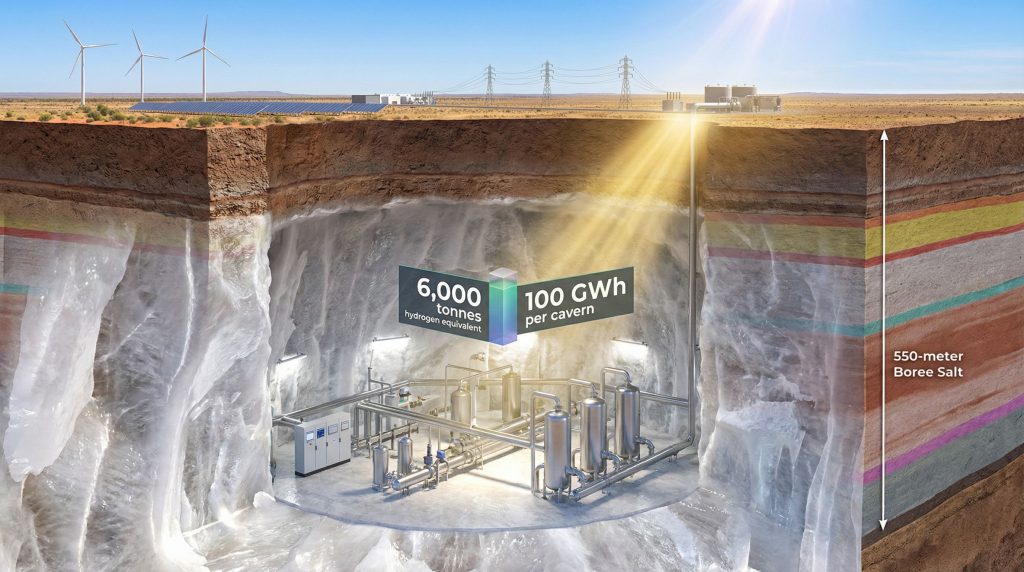
A single salt cavern in Australia's storing hydrogen gas in Adavale Basin salt caverns project could accommodate approximately 6,000 tonnes of hydrogen gas, equivalent to 100 gigawatt hours of energy storage capacity. This represents roughly 50 times the storage capacity of Australia's largest battery installations, demonstrating the transformative scale potential of underground storage infrastructure.
Where Are Australia's Prime Salt Cavern Locations?
The Adavale Basin: Eastern Australia's Hidden Energy Vault
The Adavale Basin represents Australia's most promising geological formation for large-scale underground energy storage, spanning 180,000 square kilometers beneath central Queensland. This ancient sedimentary basin, first identified in 1958, remains significantly under-explored due to its challenging accessibility, positioned beneath both the Galilee and Eromanga Basins at depths exceeding 2 kilometers from the surface.
The Boree Salt deposit within the Adavale Basin contains approximately 550 meters of salt thickness at optimal depths, representing the only formation in eastern Australia with sufficient salt reserves for commercial hydrogen storage applications. Recent geological assessment through a record-breaking 3-kilometer drilling operation has confirmed the deposit's technical specifications, with researchers extracting 976 meters of solid rock core samples alongside comprehensive groundwater data.
Strategic positioning relative to population centers provides significant transmission advantages:
- Quilpie, Blackall, and Charleville sit directly above the basin, offering existing infrastructure access points
- Proximity to Brisbane enables connection to Australia's third-largest metropolitan energy market
- Great Artesian Basin separation ensures 2-kilometer vertical distance from freshwater resources
- Transmission corridor alignment connects to existing high-voltage infrastructure serving eastern Australian grid
However, geological modelling insights reveal why the Adavale Basin sits below Australia's largest freshwater source. The Great Artesian Basin provides the only reliable water source for 180,000 outback residents, creating community concerns about underground storage development. Nevertheless, geological analysis confirms substantial vertical separation between the salt deposits and freshwater aquifers, with storage operations occurring approximately 2 kilometers below drinking water supplies.
The November 2025 drilling project, representing a $31 million research investment, collected over 500 rock chip samples and multiple groundwater specimens to establish baseline environmental conditions. This comprehensive data set enables detailed feasibility assessment for storing hydrogen gas in Adavale Basin salt caverns, with analysis results expected by mid-2026.
Alternative Australian Salt Formations for Energy Storage
Australia possesses additional salt basin formations, though none match the Adavale Basin's combination of thickness, depth, and geographic positioning for eastern market access. The Canning Basin in Western Australia contains substantial evaporitic deposits, but extreme remoteness and limited transmission infrastructure create significant development barriers.
Comparative Analysis of Australian Salt Basins:
| Basin | Depth Accessibility | Salt Purity | Renewable Energy Zone Proximity | Infrastructure Requirements |
|---|---|---|---|---|
| Adavale Basin | Challenging (3+ km) | High | Moderate | Moderate |
| Canning Basin | Moderate (1-2 km) | Variable | Low | High |
| Polda Basin | Unknown | Unknown | Low | High |
South Australia's Polda Basin represents a potential storage location, but comprehensive geological characterization remains incomplete. Unlike the Adavale Basin's recent intensive study, these alternative formations lack detailed technical assessment necessary for commercial development planning.
The geographic distribution of Australia's salt resources creates natural regional storage hubs. Western Australian formations could serve Perth and surrounding industrial facilities, while South Australian deposits might support Adelaide's energy requirements. However, the Adavale Basin's position beneath Queensland provides optimal access to the interconnected eastern grid serving 80% of Australia's population.
How Do Engineers Create Underground Hydrogen Storage Caverns?
Solution Mining Process Breakdown
Creating underground storage caverns requires precise engineering control over natural dissolution processes. The technique begins with directional drilling to access salt formations at optimal depths, typically 1-3 kilometers below surface level where geological pressure and temperature conditions favor stable cavern formation.
Step-by-Step Cavern Development Process:
- Initial drilling and casing installation establishes wellbore integrity through overlying rock formations
- Fresh water injection begins controlled salt dissolution at the target depth zone
- Brine extraction removes dissolved salt solution, creating initial cavity space
- Geometric shaping uses controlled injection patterns to achieve optimal storage geometry
- Cavity expansion continues dissolution until design specifications are achieved
- Final preparation installs hydrogen injection and extraction equipment
Water circulation patterns determine final cavern shape and storage efficiency. Engineers inject fresh water through central tubing while extracting saturated brine through annular space between tubing and wellbore casing. This creates predictable dissolution patterns that generate caverns with favorable height-to-width ratios for hydrogen storage applications.
The timeline from exploration to operational capacity typically spans 3-5 years for commercial-scale facilities. Initial geological assessment and regulatory approval processes consume 12-18 months, followed by 18-24 months for cavern creation and infrastructure installation. Advanced projects utilizing proven geological formations can compress development schedules through parallel processing of regulatory and construction activities.
Technical Specifications and Capacity Planning
Individual salt caverns achieve remarkable storage density compared to surface alternatives. A typical Adavale Basin cavern could accommodate 6,000 tonnes of hydrogen gas under optimal pressure conditions, equivalent to approximately 100 gigawatt hours of energy storage capacity. This single underground facility matches the output of roughly 50 of Australia's largest battery installations.
Pressure Management Systems ensure safe containment through multiple engineered controls:
- Primary pressure monitoring tracks internal cavern conditions continuously
- Secondary containment barriers prevent migration to surrounding rock formations
- Emergency pressure relief systems manage potential over-pressurization scenarios
- Automated injection controls maintain optimal storage conditions
Energy density calculations demonstrate significant advantages over alternative storage technologies. Underground hydrogen storage achieves approximately 33 kWh per cubic meter of storage volume, compared to 0.2-0.5 kWh per cubic meter for pumped hydro reservoirs. This 60-100x improvement in volumetric efficiency enables massive storage capacity within relatively compact underground footprints.
Salt's self-healing properties provide natural safety mechanisms absent from engineered storage systems. Under pressure variations, salt behaves like a plastic material that flows to fill voids and seal potential leak pathways. This characteristic creates inherently stable storage environments that improve safety margins over extended operational periods.
What Are the Economic Advantages of Underground Hydrogen Storage?
Underground storage systems eliminate many surface infrastructure costs that drive traditional storage expenses. Surface hydrogen storage requires extensive pressure vessel fabrication, specialized materials resistant to hydrogen embrittlement, and comprehensive safety systems to manage potential leakage scenarios. Underground caverns utilize natural geological containment that reduces both capital and operational expenditures.
Cost Structure Analysis reveals multiple economic advantages:
- Minimal land acquisition requirements reduce project development costs
- Natural pressure containment eliminates expensive pressure vessel fabrication
- Extended operational lifespan spreads capital costs over 30-50 year timeframes
- Reduced maintenance requirements compared to complex surface equipment
Scale economics become increasingly favorable as storage capacity increases. While individual caverns require substantial drilling investment, each additional cavern leverages existing surface infrastructure and operational expertise. Large-scale storing hydrogen gas in Adavale Basin salt caverns projects could achieve cost reductions of 40-60% compared to initial demonstration facilities.
20-Year Total Cost of Ownership Analysis:
| Cost Category | Underground Storage | Battery Storage | Pumped Hydro |
|---|---|---|---|
| Capital Cost ($/kWh) | $50-80 | $300-500 | $100-200 |
| Operating Cost ($/kWh/year) | $1-3 | $10-20 | $5-10 |
| Replacement Cycles | None (30+ years) | 2-3 replacements | Minimal |
| Total 20-year Cost | $70-140/kWh | $1000-1500/kWh | $200-400/kWh |
Land use efficiency creates additional economic value through minimal surface footprint requirements. Underground storage facilities typically require 1-5 hectares for surface infrastructure compared to 50-200 hectares for equivalent battery installations. This dramatic reduction in land requirements eliminates acquisition costs and ongoing land use restrictions that impact surface storage economics.
Scale Economics and Grid Integration
Underground hydrogen storage enables seasonal energy arbitrage that surface technologies cannot economically achieve. Australia's renewable energy generation follows predictable seasonal patterns with peak solar output during summer months and maximum wind generation during winter periods. Storage systems capable of shifting energy across 3-6 month timeframes capture significant value from these seasonal price differentials.
Revenue streams extend beyond simple energy arbitrage to include grid stability services and industrial supply applications. Underground storage facilities can provide rapid response capabilities for grid frequency regulation while maintaining substantial reserves for longer-duration backup power requirements. This dual-purpose capability increases revenue potential compared to single-function storage alternatives.
Integration with existing natural gas pipeline networks offers additional economic opportunities. Many underground storage facilities can accommodate compressed air energy storage alongside hydrogen applications, providing operational flexibility that adapts to changing market conditions over multi-decade operational lifespans.
Investment requirements for commercial-scale deployment remain substantial but achievable within Australia's energy infrastructure development programs. Individual cavern development typically requires $50-100 million investment, while comprehensive regional storage hubs demand $500 million to $2 billion in total capital deployment across multiple caverns and associated infrastructure.
How Safe Is Hydrogen Storage in Underground Salt Caverns?
Risk Assessment Framework
Underground salt formations provide inherently stable storage environments that surpass surface facility safety margins through multiple natural containment mechanisms. Salt's unique geological properties create self-sealing barriers that adapt to pressure variations without compromising structural integrity, unlike brittle rock formations that can fracture under stress.
Salt behaves fundamentally differently from other geological materials under pressure conditions:
- Plastic deformation allows salt to flow and seal potential leak pathways automatically
- Pressure equilibration distributes stress throughout the formation rather than creating failure points
- Chemical stability prevents hydrogen reactions that could compromise storage integrity
- Long-term creep behavior gradually improves containment effectiveness over time
"Under pressure variations that might fracture rigid rock types, salt demonstrates plastic behavior similar to thick paste or putty. This characteristic enables the formation to self-heal minor fractures and maintain containment integrity even under worst-case scenario conditions involving geological stress or pressure fluctuations."
Depth separation from groundwater systems provides additional safety margins unavailable to surface storage applications. Storing hydrogen gas in Adavale Basin salt caverns occurs approximately 2 kilometers below freshwater aquifers, creating multiple geological barrier layers that prevent any potential migration toward drinking water supplies.
Comparison with surface hydrogen storage reveals significant safety advantages. Surface facilities face risks including pressure vessel failure, external fire exposure, and potential sabotage or accidental damage from surface activities. Underground storage eliminates these exposure pathways while providing natural pressure management through geological containment.
Environmental Impact Considerations
Brine disposal management represents the primary environmental consideration for salt cavern development. Solution mining generates substantial volumes of saturated salt water that requires appropriate disposal or beneficial reuse applications. Modern projects typically inject brine into deep saline aquifers unsuitable for freshwater supply, or process the material for commercial salt production.
Fresh water requirements for cavern creation demand careful resource management, particularly in arid regions where water availability constrains other economic activities. However, water consumption occurs primarily during initial development phases, with minimal ongoing requirements once storage operations commence.
Monitoring systems ensure long-term geological stability through continuous assessment:
- Seismic monitoring detects any ground movement related to storage operations
- Groundwater quality surveillance confirms protection of freshwater resources
- Cavern integrity testing verifies containment effectiveness over operational lifespans
- Surface subsidence measurement tracks any ground-level elevation changes
Can hydrogen storage contaminate drinking water supplies?
Storage operations occur 2+ kilometers below groundwater sources with multiple geological barriers preventing upward migration.
What happens if storage pressure exceeds safe limits?
Salt formations naturally accommodate pressure variations through plastic deformation that maintains containment integrity.
How do operators monitor for potential leaks?
Continuous pressure monitoring, periodic well testing, and groundwater quality surveillance provide multiple detection methods.
Environmental benefits include reduced surface infrastructure requirements compared to alternative storage technologies. Underground facilities eliminate visual impacts, noise generation, and electromagnetic interference associated with large-scale battery installations or pumped hydro facilities.
The next major ASX story will hit our subscribers first
What Role Could Underground Storage Play in Australia's Energy Transition?
Strategic deployment scenarios through 2040 position underground storage as essential infrastructure for Australia's renewable energy transition. As coal-fired generation retires across eastern states, grid operators require flexible storage solutions capable of managing both daily cycling and extended backup power requirements during adverse weather conditions.
Scenario 1: Renewable Energy Firming Applications
Underground storage provides critical backup capacity during extended periods of low renewable generation. Multi-day weather systems that reduce both solar and wind output across large geographic areas require storage solutions with week-long discharge capabilities unavailable from battery technologies.
Scenario 2: Industrial Hydrogen Supply Chains
Large-scale manufacturing processes increasingly require reliable hydrogen supplies for steel production, chemical processing, and other industrial applications. Underground storage enables consistent supply availability regardless of renewable generation variability, supporting industrial decarbonization initiatives.
Scenario 3: Export Infrastructure for Green Hydrogen
Australia lithium innovations in renewable energy complement Australia's emerging hydrogen export industry, which requires substantial storage capacity to accumulate production from variable renewable sources into consistent export shipments. Underground facilities provide the scale necessary to support major international supply contracts.
Integration with existing natural gas pipeline networks offers additional deployment flexibility. Many underground storage facilities can accommodate multiple gas types, enabling operators to adapt to changing market conditions while maintaining infrastructure utilisation rates over extended operational periods.
Regional Development Opportunities
Storing hydrogen gas in Adavale Basin salt caverns development would create significant employment opportunities in regional Queensland communities currently experiencing economic challenges from mining industry transitions. Construction phases typically employ 200-500 workers per major facility, while ongoing operations require 50-100 permanent positions with specialised technical skills.
Skills transfer from oil and gas industry experience provides immediate workforce advantages:
- Drilling operations expertise directly applies to cavern development projects
- High-pressure systems management translates to hydrogen storage operations
- Geological assessment capabilities support site selection and development planning
- Safety protocols and procedures adapt readily to underground storage applications
Local economic benefits extend beyond direct employment to include supply chain opportunities, increased service sector demand, and enhanced regional infrastructure development. Major storage projects typically generate $500 million to $2 billion in regional economic activity across construction and initial operational phases.
Regional Economic Impact Projections:
| Impact Category | Construction Phase (5 years) | Operations Phase (30+ years) |
|---|---|---|
| Direct Employment | 250-500 positions | 75-150 positions |
| Indirect Employment | 400-800 positions | 150-300 positions |
| Annual Economic Impact | $150-300 million | $50-100 million |
| Total Regional Investment | $800 million – $1.5 billion | $1.5-3 billion |
Infrastructure development accompanies major storage projects through improved transportation networks, enhanced telecommunications capacity, and upgraded electrical transmission infrastructure. These improvements benefit broader regional development beyond energy storage applications.
When Might Commercial Salt Cavern Storage Become Reality?
Development timelines for storing hydrogen gas in Adavale Basin salt caverns depend on successful completion of current geological assessment phases and subsequent regulatory approval processes. Geoscience Australia's sample analysis results, expected by mid-2026, will provide critical data for detailed feasibility studies and environmental impact assessments.
Key Development Milestones Through 2035:
2026-2027: Feasibility Assessment Phase
- Geological data analysis completion
- Environmental baseline studies
- Preliminary engineering design
- Economic viability assessment
2028-2030: Regulatory Approval Phase
- Environmental impact statement preparation
- Community consultation processes
- Federal and state permitting procedures
- Indigenous land use negotiations
2031-2035: Construction and Commissioning Phase
- Detailed engineering design completion
- Cavern development and infrastructure construction
- Safety systems installation and testing
- Commercial operations commencement
Regulatory approval pathways involve multiple jurisdictions including federal environmental legislation, Queensland state mining and petroleum regulations, and local government planning approvals. Streamlined approval processes developed for other major infrastructure projects could reduce total approval timelines from 5-7 years to 3-5 years.
Commercial demonstration projects provide essential stepping stones toward full-scale deployment. Initial facilities typically operate at reduced capacity (1-2 caverns) to validate technical performance, environmental compliance, and economic assumptions before expanding to commercial scale operations.
Industry Investment and Policy Drivers
Government incentives for large-scale storage deployment include direct funding programs, tax credits for renewable energy infrastructure, and regulatory frameworks that monetise grid stability services. The Australian Government's renewable energy targets create policy pressure for storage solutions capable of supporting reliable grid operations as thermal generation retires.
Private sector interest spans energy companies, utilities, and industrial hydrogen consumers seeking supply security. Major utilities require storage solutions to manage renewable energy portfolio risks, while industrial users seek reliable hydrogen supplies for manufacturing processes. In addition, mining industry innovation creates opportunities for underground storage technologies to support decarbonisation efforts.
Investment Landscape Major Players and Funding Mechanisms:
Energy Companies:
- Origin Energy, AGL Energy seeking storage solutions for renewable portfolios
- International developers with salt cavern storage experience
- Hydrogen production companies requiring storage infrastructure
Financial Sector:
- Infrastructure investment funds targeting long-term energy assets
- Superannuation funds seeking stable, long-duration investment opportunities
- Green bonds and sustainable finance instruments
Government Programs:
- Australian Renewable Energy Agency (ARENA) demonstration funding
- Clean Energy Finance Corporation debt and equity investments
- State government regional development incentives
International collaboration opportunities exist with proven salt storage operators in the United States, United Kingdom, and European Union. Technology transfer partnerships can accelerate development timelines while reducing technical risks associated with first-of-kind Australian deployments.
Underground Storage as Australia's Energy Security Solution
Underground hydrogen storage in salt caverns represents a transformative technology that addresses fundamental limitations constraining Australia's renewable energy transition. The unique combination of massive storage capacity, extended discharge duration, and economic viability positions this technology as essential infrastructure for achieving reliable renewable electricity supply.
Technical feasibility has been demonstrated through decades of international operational experience, while Australia's substantial salt resources provide the geological foundation necessary for large-scale deployment. The Adavale Basin specifically offers optimal characteristics combining storage capacity, geographic positioning, and infrastructure access that support commercial viability.
Environmental safety considerations demonstrate significant advantages over surface storage alternatives through natural geological containment and substantial separation from groundwater resources. Modern monitoring and operational protocols ensure protection of critical freshwater supplies while enabling massive energy storage capacity development.
Economic analysis reveals compelling advantages across multiple cost categories, with underground storage achieving 50-70% cost reductions compared to equivalent battery capacity while providing 10-20 times longer discharge duration. These economic fundamentals support commercial deployment as renewable energy penetration increases across Australia's electricity networks.
Strategic importance extends beyond renewable energy reliability to encompass industrial competitiveness and export opportunity development. Reliable, large-scale storage enables manufacturing sector decarbonisation while supporting Australia's emerging position in global hydrogen export markets. Furthermore, renewable energy transformations in mining operations could benefit significantly from underground storage solutions.
Next steps for advancing storing hydrogen gas in Adavale Basin salt caverns from research to commercial reality require continued government support for demonstration projects, streamlined regulatory approval processes, and private sector investment in commercial-scale facilities. Success in these areas positions Australia as a global leader in underground energy storage technology deployment.
The information presented in this analysis reflects current technical understanding and market conditions as of early 2026. Actual project development timelines, costs, and performance may vary based on technological developments, regulatory changes, and market evolution. Potential investors should conduct independent due diligence before making investment decisions related to underground storage technologies.
Ready to Capitalise on Underground Energy Storage Opportunities?
Discovery Alert's proprietary Discovery IQ model delivers instant notifications on significant ASX mineral discoveries, including breakthrough developments in battery metals and energy storage technologies that could transform Australia's renewable energy landscape. Stay ahead of major mining discoveries with real-time alerts that turn complex geological data into actionable investment insights, and begin your 14-day free trial today to position yourself for the next wave of energy transition opportunities.