
June 25, 2026
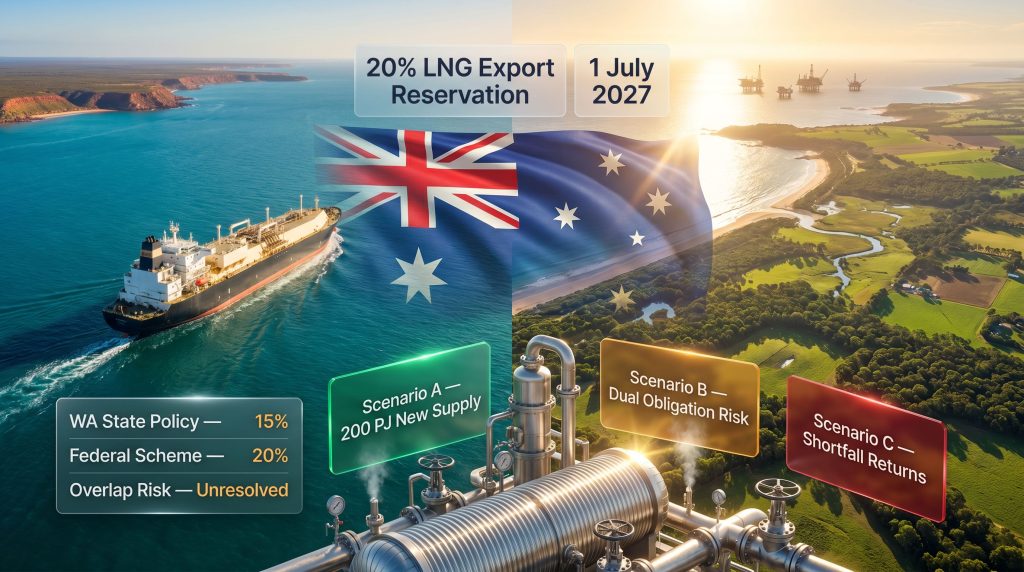
The Architecture of Obligation: How Australia's Gas Reservation Scheme Reshapes Domestic Energy Markets
Mandatory volume obligations are among the most consequential tools available to resource-rich governments seeking to balance export revenue with domestic energy security. Unlike price caps or subsidy mechanisms, reservation schemes embed supply requirements directly into the commercial operating conditions of producers, creating a fundamentally different incentive structure. The Australia gas reservation scheme follows this logic, and its design choices will reverberate across upstream investment decisions, international capital flows, and the long-term affordability of energy for Australian households and industry alike.
When big ASX news breaks, our subscribers know first
Understanding the Volume Obligation Model and Why It Differs from Price Intervention
The federal government's reservation framework is built around a single, non-negotiable premise: LNG exporters must redirect 20% of shipped export volumes to the Australian domestic market. This is a volume commitment, not a price control. The distinction matters enormously in practice.
Price control mechanisms regulate what producers can charge; they do not guarantee supply enters the domestic market at all. Volume obligations, by contrast, force physical redirection of gas, regardless of whether higher returns are achievable through export. This structural difference is why the scheme is generating such concentrated attention from producers, investors, and policy analysts.
Key design features of the proposed scheme include:
- Commencement date: 1 July 2027
- Obligation rate: 20% of shipped LNG export volumes diverted to domestic supply
- Grandfathering provision: Term supply contracts executed prior to 2026 will be honoured under existing arrangements
- Consultation window: Public submissions closed 30 June 2026, with policy refinement scheduled from July through December 2026
- Legislative pathway: Final scheme architecture expected to be formalised in early 2027
The grandfathering provision is a critical design feature that is often underappreciated. By protecting pre-existing long-term supply agreements, the federal government has attempted to limit retroactive commercial disruption while still imposing forward obligations on new or renegotiated contracts. Whether this creates a two-tier market, where old contract holders operate under materially different commercial conditions than new entrants, remains an unresolved tension in the scheme's design.
Woodside's Structural Position: East Coast vs. West Coast Exposure
Woodside Energy's relationship with the Australia gas reservation scheme is more nuanced than a simple producer-versus-regulator framing suggests. The company operates across fundamentally different gas market architectures on opposite sides of the continent, and the reservation scheme affects each in distinct ways.
On the east coast, Woodside does not export LNG. Its eastern assets supply the domestic market through Bass Strait infrastructure. The company is assuming operatorship of the Gippsland Basin Joint Venture (GBJV) from ExxonMobil in 2026, a 50:50 partnership that includes some of Australia's most strategically significant gas infrastructure:
- The Longford gas processing plants, operating at 700 terajoules per day (TJ/day) of processing capacity
- The Long Island Point gas liquids terminal in Victoria
- Offshore-to-onshore pipeline networks connecting Bass Strait fields to the mainland
Woodside will also assume operatorship of the Kipper unit joint venture, a three-party arrangement where Woodside holds 32.5%, ExxonMobil holds 32.5%, and Japan's Mitsui holds 35%. The Kipper field is a significant sub-sea gas and condensate discovery in the Gippsland Basin, notable for its relatively high CO2 content, which historically complicated its commercial development.
On the west coast, Woodside operates two major LNG export terminals:
| Facility | Capacity | Location |
|---|---|---|
| North West Shelf LNG | 14.3 million tonnes per annum (mtpa) | Pilbara, Western Australia |
| Pluto LNG | 4.9 mtpa | Pilbara, Western Australia |
This geographic split is central to the reservation debate. Woodside's west coast operations are already subject to Western Australia's state-level 15% domestic gas reservation requirement, which has been in operation for decades and is widely credited with keeping domestic gas prices in WA approximately 50% lower than equivalent east coast prices.
The Double Obligation Risk and the Western Australia Exemption Demand
The most commercially sensitive question Woodside faces under the federal scheme is whether its west coast LNG exporters will be subjected to both state and federal reservation obligations simultaneously. If the national framework does not include an explicit carve-out for producers already operating under the WA Domestic Gas Policy, Woodside could face cumulative reservation obligations that materially alter the economics of its west coast LNG business.
Furthermore, Woodside's formal submission to the Gas Market Review outlines the company's position on this overlap risk in considerable detail, providing one of the most comprehensive industry perspectives on the dual-obligation challenge.
The Western Australian state government has separately indicated that its existing 15% reservation requirement satisfies the federal government's stated policy objectives, though formal legislative exemption from the national scheme has not yet been confirmed.
| Policy Layer | Jurisdiction | Reservation Rate | Current Status |
|---|---|---|---|
| WA Domestic Gas Policy | State (Western Australia) | 15% of LNG-linked production | Active and enforced |
| Federal Reservation Scheme | National | 20% of LNG export volumes | Proposed, effective July 2027 |
| Overlap Risk for Woodside | West Coast Operations | Potentially cumulative | Unresolved pending final scheme design |
Woodside's position is clear: the company conditionally supports a market-oriented reservation framework for the east coast but insists the scheme must explicitly protect producers already meeting state-level obligations from additional federal requirements. Without this protection, the company faces a structurally uncompetitive position relative to producers operating exclusively under the federal framework.
What Does This Mean for Domestic Gas Supply?
The broader implications for Australia's resource and energy exports are substantial. A poorly calibrated double obligation could deter further upstream investment in WA, ultimately reducing the volume of gas available to both domestic users and export customers. This outcome would run directly counter to the scheme's stated policy objectives.
The Gippsland Basin: Where Regulatory Design Becomes a Capital Allocation Decision
The stakes of getting the scheme's design right are particularly acute in the Gippsland Basin. Woodside has identified four discrete development targets within its Gippsland portfolio, collectively capable of delivering up to 200 petajoules (PJ) of sales gas, equivalent to approximately 5.34 billion cubic metres, to the domestic market.
This represents a potentially significant addition to Australia's east coast gas supply, a market projected to face structural shortfalls later this decade. However, the decision to drill new domestic wells is explicitly linked to regulatory certainty.
Woodside's leadership has communicated publicly that new upstream investment in the Gippsland Basin will require both technical maturity and appropriate policy settings, meaning productive collaboration between industry, government, and community stakeholders. The implication is direct: capital will not be committed to east coast domestic supply expansion until the reservation scheme's final design provides a stable, predictable operating environment.
This creates an uncomfortable feedback loop for policymakers. The reservation scheme is intended to address domestic gas shortfalls, yet poorly designed or ambiguous scheme mechanics may delay exactly the upstream investment needed to solve that shortfall.
Comparative Governance: How Australia's Approach Stacks Up Globally
Australia's reservation model sits within a broader international tradition of domestic market obligations for hydrocarbon producers. Understanding how other jurisdictions have structured similar frameworks illuminates both the opportunities and risks inherent in the federal scheme's design. Indeed, the shifting geopolitical mining landscape has increasingly prompted resource-rich nations to reconsider how they balance sovereign resource interests against export commercialisation.
| Country/Region | Reservation Mechanism | Domestic Obligation Rate | Key Feature |
|---|---|---|---|
| Western Australia | State Domestic Gas Policy | 15% of LNG-linked volumes | Decades-long price stability record |
| Australia (Federal, Proposed) | National LNG Reservation Scheme | 20% of export volumes | Mandatory from July 2027 |
| Indonesia | Domestic Market Obligation (DMO) | 25% of production | Applied across coal and gas sectors |
| Norway | State equity model via Equinor | Indirect obligation | Security through state ownership rather than mandate |
| Qatar | Sovereign production management | N/A, fully state-managed | Domestic allocation determined by national production policy |
The WA model is the most instructive case study for Australian federal policymakers. Its effectiveness rests on a single structural feature: reservation obligations are embedded at the point of project approval, not imposed retrospectively. This creates certainty for both producers and domestic consumers from the outset of a project's life cycle.
Indonesia's DMO model offers a contrasting lesson. Applied more broadly across commodity types, it has sometimes generated compliance friction and periodic domestic supply disruptions, particularly when global commodity prices diverge significantly from domestic price benchmarks.
The next major ASX story will hit our subscribers first
Foreign Investment Uncertainty and the Broader Industry Response
The reservation scheme is generating measurable anxiety among international investors with exposure to Australian LNG assets. Mandatory volume diversion requirements fundamentally alter the commercial calculus of long-term supply contracts, which typically span 15 to 25 years and are priced against global LNG benchmarks. Inserting domestic diversion obligations into this framework introduces counterparty risk and pricing complexity that makes financial modelling more difficult and project financing more expensive.
Major industry participants including Santos and Shell have publicly engaged with the Gas Market Review process, supporting reservation in principle while simultaneously calling for investment incentive frameworks to offset compliance costs. This conditional support reflects a broader industry concern: that poorly calibrated obligations could curtail upstream development precisely when new domestic supply is most urgently needed.
In addition, resource permitting reforms in other major resource economies are creating a competitive dynamic that Australian policymakers cannot afford to ignore. If the federal scheme is perceived as overly burdensome, capital may redirect toward jurisdictions offering more favourable regulatory environments.
There is also a structural risk specific to smaller domestic producers. A reservation scheme that inadvertently favours large LNG exporters with the operational scale to absorb volume diversions may crowd out smaller, domestic-focused gas companies that compete on price rather than volume. If the scheme reduces competitive tension among domestic suppliers rather than increasing it, prices for industrial and residential users may not fall as anticipated.
The Climate Tension: Energy Security vs. Decarbonisation Commitments
Environmental advocacy groups, including the Climate Council, have advanced a fundamentally different critique of the reservation scheme. Their concern is not that the scheme will fail to deliver domestic gas supply, but that it will succeed too well — functioning as a structural incentive for expanded upstream drilling that undermines Australia's decarbonisation trajectory.
This tension represents one of the most difficult policy design challenges the federal government faces. A reservation mechanism that guarantees domestic gas volumes must, by definition, support continued gas production. Yet Australia's climate commitments require a managed transition away from fossil fuel dependence over the coming decades.
The growing role of renewable energy in mining and energy-intensive industries suggests that long-term gas demand may decline more rapidly than current projections assume. However, the federal government has not yet publicly resolved this contradiction. The risk is that the scheme becomes a political compromise that satisfies neither energy security advocates nor climate transition proponents.
Three Scenarios for Scheme Outcomes and Their Investment Implications
The scheme's ultimate design will likely resolve into one of three broad outcomes, each with distinct consequences for Australia's domestic gas market and upstream investment environment.
Scenario A: Well-designed scheme with explicit WA exemption
- Woodside commits to Gippsland Basin drilling programme; up to 200 PJ of new domestic supply progresses toward market
- Foreign investor confidence stabilises as regulatory certainty reduces project risk premiums
- WA Domestic Gas Policy remains operationally intact, avoiding dual obligation for west coast producers
- East coast shortfall risk is materially reduced through a combination of new supply and volume diversion
Scenario B: Overlapping obligations without WA carve-out
- Woodside faces cumulative state and federal reservation requirements on its west coast LNG business
- East coast upstream investment is deferred pending legal and commercial certainty
- Domestic supply outlook deteriorates as capital retreats from new development
- International LNG buyers face heightened uncertainty about Australia's reliability as a contract partner
Scenario C: Scheme diluted or abandoned
- East coast structural shortfall risk re-emerges as a market failure requiring more interventionist policy responses
- Political pressure intensifies for price controls or export licensing restrictions
- Domestic industrial users face sustained price volatility, undermining investment in energy-intensive manufacturing
Regulatory Timeline: Key Decision Points Through 2027
For investors and market participants tracking the Australia gas reservation scheme and Woodside's east coast development plans, the following milestones represent the critical decision sequence:
- 30 June 2026 — Public consultation period closes; industry submissions formally lodged
- July to December 2026 — Federal government refines scheme design based on submissions; WA exemption status expected to be clarified
- Early 2027 — Final scheme architecture legislated or formalised by the Commonwealth
- 1 July 2027 — Reservation obligations commence for qualifying LNG exporters
- Parallel track — Woodside's Gippsland Basin drilling investment decisions made in response to scheme design certainty
The timeline is compressed. From scheme finalisation in early 2027 to obligation commencement on 1 July 2027, producers will have limited time to restructure commercial arrangements, renegotiate supply contracts, and adjust operational planning. This compressed implementation window is itself a source of industry concern, particularly for mid-tier producers with less institutional capacity to absorb rapid regulatory change.
What the Scheme's Design Signals for Australia's Long-Term Gas Market Architecture
Beyond the immediate compliance questions, the federal reservation scheme represents a watershed moment in Australian energy governance. For decades, domestic gas markets on the east coast operated under a framework that prioritised export commercialisation, with domestic supply treated as a residual obligation rather than a primary policy objective.
The shift to mandatory volume obligations signals that this model is no longer politically or economically sustainable. Consequently, energy transition demand and broader decarbonisation pressures are adding further complexity to an already challenging policy environment. Australia's east coast gas market has faced growing structural dysfunction, characterised by price volatility, supply concentration, and insufficient upstream investment in domestic-focused development.
The Australia gas reservation scheme is the federal government's response to this dysfunction. However, analysis from the AFR suggests that the WA experience serves as both a model and a warning for national policymakers seeking to replicate its success at the federal level. Whether the scheme's design will ultimately be sophisticated enough to resolve these structural issues remains, as of mid-2026, an open question.
Disclaimer: This article contains forward-looking statements and scenario projections based on publicly available policy documents and industry commentary. These projections involve inherent uncertainty and should not be construed as financial advice or investment recommendations. Readers should conduct independent analysis and consult qualified advisers before making investment decisions related to Australian energy sector assets.
Want to Identify the Next Major ASX Resource Opportunity Before the Market Does?
Australia's evolving gas reservation scheme is reshaping upstream investment decisions and capital flows across the resource sector — and Discovery Alert's proprietary Discovery IQ model ensures subscribers receive real-time alerts the moment significant ASX mineral discoveries are announced, turning complex resource data into actionable investment insights. Explore historic examples of major discovery returns on Discovery Alert's dedicated discoveries page and begin your 14-day free trial to position yourself ahead of the broader market.