August 22, 2026
The Frontier Minerals Opportunity That Global Capital Is Finally Taking Seriously
Across the global mining investment landscape, a quiet but consequential reallocation of attention is underway. As established mining jurisdictions face deepening cost pressures, tightening environmental approvals, and intensifying community opposition, capital allocators are systematically reassessing frontier markets with large, underexplored geological endowments and improving institutional frameworks. Within this context, Egypt has emerged as one of the most closely tracked repositioning stories in the sector, and the Egypt mining forum investment attraction has become the principal mechanism through which that story is being told to international audiences.
Understanding why this matters requires looking beyond event announcements and into the structural geology, regulatory architecture, and economic incentives that are collectively reshaping Egypt's mining investment proposition.
When big ASX news breaks, our subscribers know first
Egypt's Geological Foundations: What the Arabian-Nubian Shield Actually Means for Investors
The starting point for any serious analysis of Egypt's mining sector is the Arabian-Nubian Shield, a Precambrian geological formation that underlies Egypt's Eastern Desert and Sinai Peninsula. Arabian-Nubian Shield geology represents one of the planet's most underexplored ancient crustal terrains, formed roughly 900 to 540 million years ago, geologically analogous to productive gold-bearing terrains in West Africa and Western Australia, yet having received a fraction of the modern systematic exploration investment directed at those regions.
What makes this formation particularly compelling from an investment standpoint is its polymetallic character. Unlike single-commodity geological provinces, the Arabian-Nubian Shield hosts mineralisation signatures that include:
- Primary gold in orogenic lode and epithermal systems, some with grades that rival established African gold belts
- VMS deposits containing copper, zinc, and associated by-products including silver and gold
- Rare earth element occurrences linked to alkaline and carbonatite intrusions, gaining importance in the context of global energy transition and rare earth supply chains
- Industrial minerals including phosphate, kaolin, silica sand, and iron ore with established commercial extraction histories
A critical but underappreciated fact is that Egypt's gold mining heritage stretches back more than three thousand years to the Pharaonic period, with ancient workings documented across hundreds of sites in the Eastern Desert. Modern geological surveys have used these ancient workings as exploration guides, recognising that pre-industrial miners, despite their rudimentary technology, were often highly effective at identifying surface-exposed mineralisation.
The challenge, and the opportunity, lies in applying modern geophysical and geochemical methods to identify the deeper extensions of these ancient mineralised systems.
The presence of active operations by globally recognised tier-one operators in Egypt signals that the country's mineralisation is not merely prospective on paper. AngloGold Ashanti's involvement at the Sukari Mine, reaffirmed through a 2024 investment commitment, and Barrick Gold's active interest in the region provide the kind of institutional validation that materially shifts risk perception for secondary and junior capital allocators.
What Is the Egypt Mining Forum and Why Is the 2026 Edition Significant?
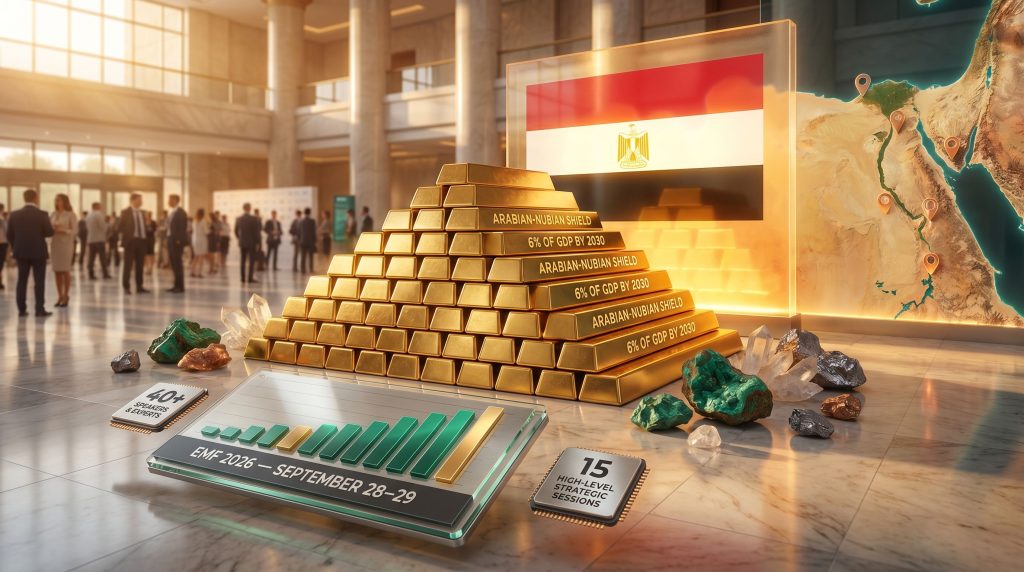
The Egypt Mining Forum was established in 2022 as a structured convening platform designed to close the gap between Egypt's geological inventory and the international capital needed to develop it. Each successive edition has expanded in scope, and the fifth edition, EMF 2026, scheduled for September 28 and 29 at the New Administrative Capital, represents a significant step-change in ambition.
Furthermore, several factors distinguish the 2026 forum from its predecessors:
- It will be held under the direct patronage of President Abdel Fattah al-Sisi, elevating the event's political visibility and signalling executive-level commitment to the sector
- It is projected to be the largest edition since inception, measured by international delegation volume, corporate participation, and sponsoring entities
- It will include government and investment delegations from countries attending the EMF for the first time, broadening the geographic diversity of engagement
- The programme architecture has been substantially expanded, incorporating both strategic and technical dimensions of the mining value chain
For more details on the event structure, the Egypt Mining Forum 2026 conference page outlines the full scope of strategic sessions and participation opportunities.
Programme Architecture: What Attendees Can Expect
| Programme Component | Format Details |
|---|---|
| High-Level Strategic Sessions | Approximately 15 sessions with international ministers, heads of delegation, major mining company CEOs, and global financial institutions |
| Technical Programme | Approximately 10 main sessions featuring 40+ speakers and experts from Egyptian and international mining communities |
| Thematic Coverage | Mineral exploration, value chain development, sustainability, digital transformation, and local manufacturing |
| Engagement Formats | Roundtables, bilateral investment meetings, and an exhibition of mining technologies and services |
| New Participant Nations | First-time government and investment delegations from multiple countries |
Egypt Mining Forum Investment Attraction: The Regulatory Reform Engine
For international capital allocators evaluating Egypt as a mining destination, the reform programme underway represents the most substantive change to the sector's governance architecture in a generation. The reforms address the three primary friction points that historically suppressed foreign direct investment in Egyptian mining: contractual uncertainty, institutional fragmentation, and information asymmetry.
Standardising the Investment Contract
The adoption of the Model Mining Exploitation Agreement (MMEA) is arguably the most impactful single reform from an investor perspective. Prior to the MMEA framework, fiscal terms were negotiated bilaterally on a project-by-project basis, creating significant uncertainty for financial modelling and extending pre-development timelines. The MMEA introduces:
- Transparent, standardised fiscal terms that reduce negotiation risk and compress deal timelines
- Royalty and revenue-sharing structures aligned with international mining industry norms
- Contractual clarity that improves bankability for project finance purposes, similar to the role that definitive feasibility studies play in reducing investor uncertainty
Institutional Independence and Operational Capacity
The conversion of Egypt's former Mineral Resources Authority into the Mineral Resources and Mining Industries Authority, restructured as an independent economic entity, addresses a long-standing institutional constraint. The previous authority operated primarily as a regulatory gatekeeper, with limited mandate or capacity to actively promote investment or structure complex agreements.
However, the new entity has substantially greater operational flexibility. It can now manage sector revenues and reinvest in promotional activities, possesses enhanced negotiating capacity for complex investment agreements, and operates with a genuine sector development mandate rather than a purely administrative function.
The Digital Gateway: Reducing Information Asymmetry
One of the most underappreciated barriers to exploration investment in frontier jurisdictions is geological data accessibility. When historical survey data is locked in analogue archives or accessible only through bureaucratic intermediaries, early-stage explorers face disproportionate costs and timelines. Egypt's digital mining investment portal directly addresses this constraint by:
- Providing accessible geological datasets to international investors at the pre-application stage
- Publishing bid round schedules and licensing opportunity calendars in advance
- Enabling streamlined investor registration and online application procedures
Egypt's 6% GDP Target: What It Signals to Long-Term Investors
Egypt has set an explicit policy benchmark of raising mining's contribution to 6% of GDP by 2030. At present, the sector contributes a fraction of that level, meaning the target implies a substantial multiplication of output, investment, and employment within the sector over a defined planning horizon.
For institutional investors, this type of quantified government commitment serves a specific analytical function. It establishes a planning horizon that extends beyond electoral cycles and provides a basis for evaluating regulatory consistency over time. Consequently, when a government publishes a numerical sector development target and convenes high-visibility international forums to demonstrate progress against it, the political cost of regulatory reversal increases commensurately.
Egypt's Minister of Petroleum and Mineral Resources, Karim Badawi, has emphasised that improving the country's standing in global mining investment indices is a stated government priority, recognising that index positioning directly influences investor confidence, corporate financing conditions, and the formation of international partnerships.
As Minister Badawi confirmed at the Egypt Mining Forum, Egypt is ready to expand exploration across all minerals, underscoring how seriously the government is treating this sector repositioning.
This acknowledgement matters because global mining investment indices are actively used by corporate finance teams and fund managers to screen and rank potential investment destinations. A government that actively manages its index positioning is demonstrating institutional sophistication that reduces perceived political risk.
The Integrated Mining Ecosystem: Beyond Extraction Economics
The conceptual framework driving EMF 2026 is the notion of an integrated mining ecosystem, a deliberate expansion of Egypt's sector ambitions beyond primary resource extraction. This framework signals Egypt's intention to capture downstream value rather than simply exporting raw mineral commodities.
The five-stage value chain framework encompasses:
- Geological exploration and research — systematic data generation to derisk early-stage investment decisions
- Development and feasibility — structured pathways from discovery through to bankable project status
- Production operations — internationally competitive extraction activities supported by reliable energy and logistics infrastructure
- Local manufacturing — downstream processing of mineral outputs to create domestic industrial linkages and export higher-value products
- Value maximisation — strategic positioning of Egyptian mineral outputs within global critical mineral supply chains
This approach has implications for how investors should model Egyptian mining projects. A jurisdiction that actively incentivises downstream processing creates additional investment opportunities beyond mine development, including processing facilities, logistics infrastructure, and ancillary industrial activities.
ESG, Technology, and Human Capital as Forum Pillars
The 2026 forum's agenda integrates themes that reflect the evolving requirements of internationally mobile mining capital, particularly from institutional investors with defined ESG mandates:
- Environmental sustainability frameworks aligned with international reporting standards
- Digital transformation in both mining operations and sector administration
- Human capacity development programmes to build local technical expertise
- Technology adoption across exploration, development, and production phases
The next major ASX story will hit our subscribers first
How Egypt Compares to Regional Peers
| Competitiveness Dimension | Egypt's Position | Reform Trajectory |
|---|---|---|
| Regulatory Transparency | Improving via MMEA adoption | Standardisation and simplification |
| Geological Data Access | Improving via digital portal | Full archive digitisation underway |
| Institutional Capacity | Strengthened via new authority structure | Operational autonomy expansion |
| Infrastructure Quality | Competitive across energy and logistics | Continued corridor investment |
| International Operator Presence | Tier-one operators confirmed | Expanding partnership pipeline |
| Global Index Ranking | Active improvement programme | Target: material advancement by 2027 |
Egypt's advantages over certain comparable North African and sub-Saharan African mining jurisdictions include its mature energy infrastructure, established port and logistics networks, proximity to European markets, and a large domestic labour pool with developing technical capacity. These structural factors reduce operating costs and de-risk project execution relative to more remote or infrastructure-constrained frontier jurisdictions.
Confirmed International Interest: Reading the Corporate Signals
The presence of AngloGold Ashanti and Barrick Gold, ranked respectively among the world's largest gold producers, in Egypt's mining sector is not merely symbolic. For smaller mining companies and financial sponsors evaluating Egypt, the participation of tier-one operators functions as a due diligence proxy. Their operational presence effectively reduces the information burden on secondary investors.
Beyond gold, bilateral mining cooperation discussions between Egypt and the United States, as well as frameworks being developed with Türkiye, and Japanese industrial interest signalled by Komatsu, indicate that the Egypt mining forum investment attraction strategy is resonating across multiple mineral categories and investor geographies. A Turkish company has also been confirmed as active in gold exploration within Egypt's Eastern Desert, further diversifying the international operator base.
Disclaimer: This article contains forward-looking statements and projections related to Egypt's mining sector development targets and investment frameworks. These statements involve inherent uncertainty and should not be construed as financial advice. Investors should conduct independent due diligence and seek professional guidance before making investment decisions in any mining jurisdiction.
Ready to Identify the Next Major Mineral Discovery Before the Market Does?
Discovery Alert's proprietary Discovery IQ model delivers real-time alerts on significant ASX mineral discoveries, transforming complex geological data into actionable investment insights for both short-term traders and long-term investors — explore Discovery Alert's dedicated discoveries page to see how historic discoveries have generated substantial returns, and begin your 14-day free trial today to position yourself ahead of the broader market.