July 24, 2026
The Industrial Crossroads: Why Decarbonising Aluminium Defines Australia's Climate Credibility
Few industrial challenges reveal the complexity of net-zero ambitions quite like primary aluminium production. Unlike sectors where electrification is straightforward, aluminium smelting and alumina refining demand continuous, high-volume electricity at a scale that tests even the most ambitious renewable energy grids. For Australia, a country that has built significant economic identity around its mineral processing capabilities, the question is not simply whether green aluminium is achievable, but whether the policy architecture, technology readiness, and market incentives can align fast enough to prevent permanent industrial contraction.
The Australia green aluminium roadmap that has taken shape between 2025 and mid-2026 represents the most comprehensive attempt yet to answer that question, combining production incentives, storage investment, technology development pathways, and international supply chain diplomacy into a single industrial transition strategy.
When big ASX news breaks, our subscribers know first
Why Australia's Aluminium Sector Sits at the Centre of the Clean Energy Debate
The Emissions Reality: Understanding the Carbon Footprint of Smelting
Aluminium manufacturing is estimated to account for roughly 3 to 4% of Australia's total greenhouse gas emissions, placing it firmly among the country's most carbon-intensive industrial activities. This is not a marginal problem. Australia operates four primary aluminium smelters, all of which remain connected to electricity grids that still carry meaningful fossil fuel exposure. The structural reason for this intensity lies in the electrochemical nature of primary aluminium production: the Hall-Heroult smelting process requires continuous direct current electricity at enormous volumes, and the alumina refining stage that precedes it relies heavily on high-temperature thermal energy historically supplied by natural gas and coal.
Decarbonising these processes is therefore among the highest-leverage interventions available within the Australian economy. According to the Australian Aluminium Council, transitioning to zero-emissions electricity represents the most powerful single action available to reduce the sector's carbon output, which makes energy system transformation the central challenge rather than a supporting consideration.
What Makes Australia Structurally Suited to Lead in Green Aluminium?
Australia's natural endowment creates an unusual combination of advantages rarely found in a single jurisdiction. Furthermore, these advantages place the country in a strong position to capitalise on growing global demand for low-carbon metals:
- Exceptional solar irradiance and wind resources capable of generating low-cost renewable electricity at industrial scale
- An existing vertically integrated value chain spanning bauxite mining in Western Australia and Queensland, alumina refining at world-scale facilities, and primary smelting across multiple states
- Growing buyer demand for certified low-carbon aluminium from automotive manufacturers, building and construction companies, and data centre operators managing embodied carbon in their supply chains
- Geographic proximity to high-growth Asian markets, including India, Japan, and South Korea, where green procurement standards are tightening
This convergence of natural advantage, industrial infrastructure, and market timing positions Australia to compete as a premium supplier of low-carbon aluminium if the domestic policy framework can bridge the transition cost gap effectively. Australia's green metals leadership in this space is increasingly recognised as a strategic national priority rather than simply an environmental obligation.
What the Green Aluminium Roadmap Actually Encompasses
A Multi-Layered Policy Architecture, Not a Single Programme
It is important to understand that the Australia green aluminium roadmap is not a single government document or funding scheme. It is a convergence of federal production incentives, renewable energy infrastructure investment, industrial technology development funding, and international supply chain partnerships that collectively form a transition architecture spanning the full aluminium value chain.
The roadmap is embedded within the broader Future Made in Australia policy agenda, which identifies green metals as a strategic national export priority. This framing matters because it positions aluminium decarbonisation not merely as a climate obligation but as an industrial competitiveness strategy, changing the economic logic of transition investment.
ARENA's Technology Development Mandate
The Australian Renewable Energy Agency has developed a dedicated alumina refining decarbonisation roadmap that identifies four core technology pathways. These pathways address the thermal energy challenge in refining, which is distinct from the electricity challenge in smelting:
| ARENA Priority Area | Technology Focus | Current Development Stage |
|---|---|---|
| Calcination decarbonisation | Electric and hydrogen calcination | Pre-commercial demonstration |
| Bayer process reform | Mechanical vapour recompression | Approaching commercial readiness |
| Steam generation replacement | Electric boilers powered by renewables | Early commercial deployment |
| Smelting electricity transition | Renewable power purchase agreements | Active negotiation phase |
ARENA's current priorities include commercialising low-emissions calcination technology, demonstrating decarbonised Bayer-process refining at scale, and accelerating renewable electricity integration into smelting operations across all four of Australia's primary facilities.
The AUD 2 Billion Production Credit: Structure, Mechanics, and Market Signal
How the Green Aluminium Production Credit Works
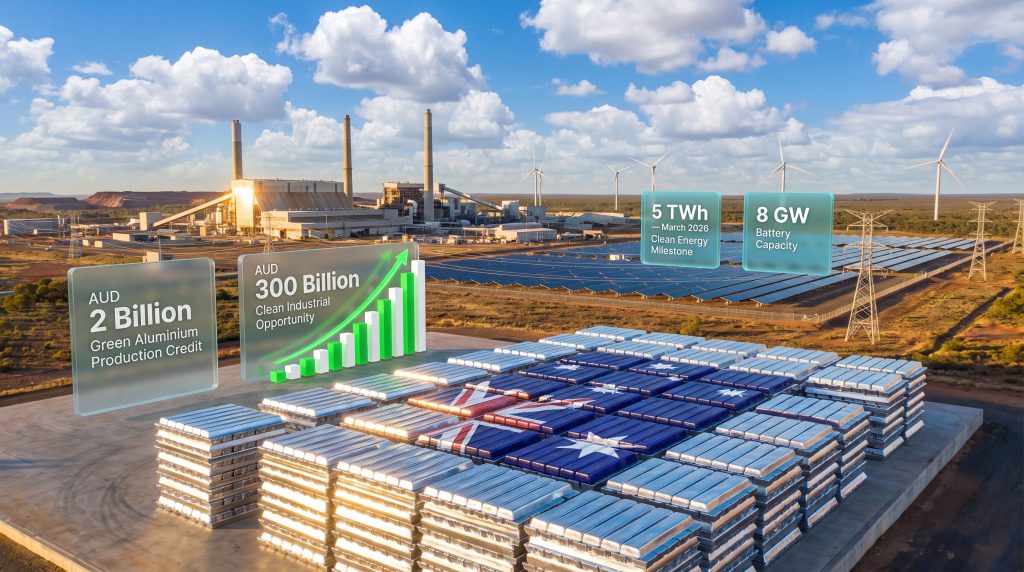
Announced in January 2025, the Green Aluminium Production Credit programme commits AUD 2 billion in direct financial support to smelters transitioning away from fossil fuel-based electricity. Unlike capital grants, which reward investment decisions at a single point in time, the production credit is structured on a per-tonne basis, meaning financial support is tied directly to the ongoing production of lower-carbon aluminium at qualifying Australian facilities.
The programme runs for up to ten years, with an outer boundary set at 2044, whichever milestone arrives first. This extended runway is significant because it aligns the incentive period with the realistic commercialisation timelines for renewable electricity contracts and grid-scale storage deployment. Major producers including Alcoa, Rio Tinto, and Tomago Aluminium are expected to enter contracts under the scheme. The consultation on this $2 billion credit opened to industry stakeholders as part of the programme's development process.
Why Output-Linked Credits Outperform Capital Grants for This Application
The decision to structure support as production credits rather than upfront grants reflects lessons learned from comparable programmes internationally. In addition, this approach creates more durable commercial outcomes:
- Output-linked credits create sustained incentives for continued low-carbon production rather than rewarding a one-time capital commitment
- The model mirrors mechanisms embedded in the United States Inflation Reduction Act's clean energy provisions and European green industry support frameworks
- Credits directly address the electricity cost disadvantage that Australian smelters face when competing against facilities in regions with access to cheaper legacy power, such as coal-heavy grids in parts of Asia
- The per-tonne structure also creates a clear carbon intensity metric that can be independently verified and used to certify product for premium green aluminium markets
"The production credit programme represents a deliberate shift away from the grant-based industrial support model, acknowledging that aluminium decarbonisation requires sustained commercial viability rather than a single investment trigger."
The Four Technologies Driving Alumina Refining Decarbonisation
Breaking Down the Refining Challenge
Alumina refining is frequently the less-discussed half of the aluminium decarbonisation challenge, with smelting receiving more policy attention due to its sheer electricity demand. However, the Bayer process used in refining generates substantial emissions from thermal energy consumption, particularly during the calcination stage where aluminium trihydrate is converted to alumina powder at temperatures exceeding 1,000 degrees Celsius.
ARENA's roadmap identifies four primary pathways for addressing this challenge:
- Mechanical Vapour Recompression (MVR): Captures waste steam energy within the refining circuit and recycles it back into the process, substantially reducing the volume of new thermal energy required. This technology is the closest to commercial readiness among the four pathways.
- Electric Boilers: Replace gas-fired steam generation with electrically driven systems powered by renewable energy, eliminating direct combustion emissions from steam supply. This pathway benefits most from falling renewable electricity costs.
- Electric Calcination: Substitutes fossil fuel combustion in the calcination kiln with resistance or induction electric heating, enabling zero-direct-emission calcination when powered by renewables. Currently at pre-commercial demonstration stage in global trials.
- Hydrogen Calcination: Uses green hydrogen as a combustion fuel within the calcination process, eliminating CO2 from the reaction chemistry. Dependent on the cost trajectory of green hydrogen production.
Deployment Pathways: Speed vs. Certainty
ARENA's roadmap models two distinct adoption trajectories:
| Pathway | Deployment Window Post-Technology Maturity | Net Zero Alignment |
|---|---|---|
| Innovator Abatement Pathway | Approximately 5 years | Ahead of 2050 national target |
| Gradual Abatement Pathway | Approximately 10 years | Aligned with 2050 national target |
The Innovator Pathway assumes accelerated commercialisation driven by strong policy signals, early mover investment confidence, and coordinated industry-government partnership. The Gradual Pathway reflects a more conservative adoption curve typical of capital-intensive industries operating with long asset lives and conservative investment committees. Both pathways remain consistent with Australia's 2050 net-zero commitments, but only the Innovator Pathway creates buffer time for unexpected delays.
Renewable Energy Infrastructure: The Grid Milestones That Make This Possible
March 2026: A Clean Energy Inflection Point
The operational credibility of Australia's green aluminium ambitions depends fundamentally on whether the national electricity grid can reliably supply renewable power at the scale and continuity that smelters require. The milestones reached in the first quarter of 2026 provide meaningful evidence that this threshold is approaching.
During March 2026, utility-scale solar and wind generation surpassed 5 TWh in a single month, a benchmark that demonstrates sustained industrial-scale renewable output rather than peak generation during ideal conditions. Battery discharge reached 245 GWh during the same period, while utility-scale battery capacity either operational or under active development crossed 8 GW nationally. The Australian Energy Market Operator confirmed that renewable generation and battery storage played an increasingly prominent role in the National Electricity Market throughout Q1 2026.
Consequently, these renewable mining solutions are becoming increasingly viable for energy-intensive industries like aluminium smelting.
January 2026: The Federal Battery Investment Commitment
These grid milestones were supported by a federal government commitment in January 2026 of AUD 500 million (approximately USD 349 million) directed toward battery manufacturing and storage deployment, alongside expanded auctions for dispatchable renewable power.
The strategic rationale for this investment is direct: aluminium smelters require continuous, high-volume electricity that cannot be interrupted by the natural intermittency of solar and wind generation. Grid-scale battery storage addresses precisely this reliability gap, providing the buffer capacity that allows smelters to commit to renewable power purchase agreements without accepting unacceptable operational risk.
"The relationship between grid storage capacity and smelter transition confidence is more direct than is commonly appreciated. Without reliable dispatchable renewable power, even the most generous production credit cannot unlock smelter decarbonisation commitments."
The next major ASX story will hit our subscribers first
The AUD 300 Billion Clean Industrial Opportunity
What the Mission Possible Partnership Roadmap Identified
Between October 2025 and March 2026, a joint roadmap released by Mission Possible Partnership and the Industrial Transition Accelerator mapped approximately AUD 300 billion in potential clean industrial investment for Australia, cataloguing around 70 large-scale projects across low-carbon manufacturing sectors including aluminium.
The roadmap's core finding challenges a common assumption: the availability of green industrial supply is not the binding constraint. Rather, the binding constraint is demand. Without mandated domestic markets or protected price signals, green aluminium commands a price premium that most buyers are not yet contractually required to absorb.
The recommended policy levers address this demand gap directly:
- Green procurement frameworks requiring government-funded infrastructure projects to source certified low-carbon aluminium, creating anchor demand that justifies production investment
- Carbon contracts for difference (CCfD) protecting producers from carbon price volatility by guaranteeing a floor price for avoided emissions, reducing the investment risk that currently deters long-term decarbonisation commitments
- Border carbon adjustment mechanisms that prevent carbon-intensive imported aluminium from undercutting domestically produced green product on price alone
Case Study: Tomago Aluminium and the Transition Cost Squeeze
Australia's Largest Smelter at a Critical Juncture
During March and April 2026, the Australian Government evaluated a proposed USD 470 million subsidy-backed electricity support package for Tomago Aluminium, Australia's largest primary aluminium smelter. The package was designed to reduce electricity costs during the facility's transition toward renewable power supply, preserving operational continuity during the period when renewable alternatives have not yet reached full cost parity with legacy power contracts.
Tomago represents a substantial share of Australia's primary aluminium output and employs thousands of workers in New South Wales' Hunter Valley region, giving its future significant economic weight beyond its direct production contribution.
The Structural Problem That Tomago Illustrates
Tomago's situation is not unique to that facility. It reveals a structural vulnerability in the transition architecture that affects every aluminium smelter operating in Australia. However, targeted bridging support can address this gap effectively:
- Legacy power contracts provide price certainty that renewable alternatives cannot yet match
- When those contracts expire, smelters face a cost gap before long-term renewable power purchase agreements reach competitive pricing
- Without bridging support during this window, economically viable facilities risk premature closure, destroying industrial capacity that would require decades and tens of billions in capital to rebuild
- The economic case for bridging support is therefore rational even at significant short-term fiscal cost, because the alternative is permanent capacity loss rather than temporary subsidy expenditure
Bell Bay: A Cautionary Lesson in Transition Sequencing
How a Smelter Was Lost Despite Bridging Support
The Bell Bay Aluminium experience in Tasmania provides the most sobering data point in the Australia green aluminium roadmap to date. Toward the end of 2025, Bell Bay secured a 14-month interim electricity supply agreement to maintain operations while longer-term renewable power negotiations continued. Despite this bridging arrangement, the smelter permanently ceased operations in July 2026 following the expiry of the interim period without a viable long-term power solution being finalised.
The Bell Bay outcome illustrates a sequencing failure that industrial policy designers must absorb:
- Interim supply agreements buy time but cannot substitute for durable long-term renewable energy contracts
- When interim periods expire without confirmed successors, closures can occur rapidly and permanently
- The narrow window of transition support effectiveness means that parallel rather than sequential deployment of policy tools is essential
- Bell Bay's closure strengthens the policy rationale for earlier and more comprehensive intervention at the three remaining smelters
Rio Tinto's Global Low-Carbon Strategy and Its Australian Implications
The CBA Acquisition: Building a Diversified Green Portfolio
Brazil's antitrust authority CADE approved Rio Tinto and Chinalco's acquisition of a controlling stake in Companhia Brasileira de Alumínio in March 2026, positioning Rio Tinto to expand its global portfolio of low-carbon aluminium assets. Brazil's hydropower-dominated electricity grid provides some of the lowest-carbon primary aluminium production in the world, making CBA strategically valuable in a market increasingly segmented by carbon intensity certification.
For Australia, this development signals Rio Tinto's commitment to building a geographically diversified low-carbon aluminium supply base. The Gladstone aluminium repowering initiative, for instance, demonstrates how this global strategy is being implemented at the facility level in Australia, which strengthens rather than undermines the case for continued domestic investment.
The Prysmian Partnership: Opening Premium Downstream Markets
In March 2026, Rio Tinto partnered with cable systems company Prysmian to trial low-carbon aluminium cables specifically designed for data centre infrastructure. This collaboration targets one of the fastest-growing sources of embodied carbon scrutiny in global supply chains, as hyperscale data centre operators face increasing pressure to account for carbon embedded in power transmission components, not just operational electricity consumption.
This downstream application development matters significantly for the economics of the entire Australia green aluminium roadmap. When premium commercial channels exist for certified low-carbon product, the price differential between green and conventional aluminium becomes a commercial opportunity rather than a cost burden. The aluminium industry leaders investing in these downstream partnerships are consequently positioning themselves advantageously for the next decade of premium market growth.
Australia-India Supply Chain Diplomacy: The Strategic Dimension
Critical Minerals Cooperation and Its Aluminium Sector Relevance
In February 2026, Australia reaffirmed its strategic partnership with India on critical minerals at the 4th Global Metals and Mining Meet in Kolkata. While this cooperation focuses primarily on minerals essential to clean energy technologies, it has direct relevance to the aluminium transition through two channels.
First, the battery storage systems that underpin renewable-powered smelting depend on critical mineral supply chains that Australia and India are working to jointly secure. Second, India represents one of the highest-growth potential markets for certified low-carbon aluminium in Asia, given its rapidly expanding manufacturing sector and emerging green procurement frameworks.
Australia's clean aluminium ambitions therefore intersect with a broader Indo-Pacific supply chain realignment that positions resource-rich, policy-aligned nations as preferred suppliers to markets seeking alternatives to carbon-intensive or geopolitically complex supply chains.
The Risk Landscape: What Could Derail the Roadmap?
Structural Barriers That Demand Policy Attention
Even with the most comprehensive policy architecture deployed to date, the Australia green aluminium roadmap faces material risks that investors and policymakers should evaluate clearly:
| Risk Category | Specific Challenge | Potential Mitigation |
|---|---|---|
| Energy cost gap | Renewable electricity more expensive than legacy coal power for industrial users | Production credits, CCfDs, long-term PPAs |
| Technology readiness | Electric and hydrogen calcination not yet at commercial scale | ARENA funding, staged deployment pathways |
| Transition timing | Smelters face closure risk before renewables reach cost parity | Bridging subsidies, interim supply agreements |
| Market premium absorption | Green aluminium commands prices many buyers are not mandated to pay | Green procurement mandates, carbon border mechanisms |
| Grid reliability | Intermittent renewables insufficient for continuous smelter operations without storage | Grid-scale battery investment, dispatchable renewable auctions |
| Sequencing failure | Policy tools deployed sequentially rather than simultaneously | Coordinated multi-mechanism deployment, as Bell Bay demonstrates |
Disclaimer: Projections, timelines, and investment estimates referenced throughout this article are based on publicly available policy announcements, industry roadmaps, and government statements as of mid-2026. They do not constitute financial advice. Technology commercialisation timelines and policy programme outcomes remain subject to material uncertainty and may differ significantly from current projections.
Frequently Asked Questions: Australia Green Aluminium Roadmap
What Is the Australia Green Aluminium Roadmap?
The Australia green aluminium roadmap is a coordinated framework of policy programmes, technology development pathways, infrastructure investment, and international partnerships designed to decarbonise the country's aluminium production sector from bauxite mining and alumina refining through to primary smelting, with the objective of achieving net-zero production aligned with Australia's 2050 climate commitments.
How Much Is the Australian Government Investing in Green Aluminium?
The federal government has committed AUD 2 billion through the Green Aluminium Production Credit programme and AUD 500 million for battery storage and renewable energy infrastructure. A proposed USD 470 million electricity support package for Tomago Aluminium was under government evaluation as of April 2026, bringing potential direct support into multi-billion dollar territory across the sector. Furthermore, analysts at the Climate Works Centre have examined whether these tax incentives are sufficient to drive meaningful smelter decarbonisation at scale.
Which Australian Aluminium Smelters Are Targeted by the Transition?
Australia's four primary smelters, including facilities operated by Alcoa, Rio Tinto, and Tomago Aluminium, are the primary targets of the Green Aluminium Production Credit. The Bell Bay smelter in Tasmania was also central to the transition narrative before permanently ceasing operations in July 2026. The Alcoa low-carbon partnership model, for instance, demonstrates how major producers are structuring commercial relationships to accelerate their transition commitments.
What Technologies Are Being Developed to Decarbonise Australian Aluminium?
ARENA's roadmap focuses on four pathways for alumina refining: mechanical vapour recompression, electric boilers, electric calcination, and hydrogen calcination. For smelting, the primary pathway is transitioning to renewable electricity delivered reliably through grid-scale battery storage and long-term power purchase agreements.
When Might Australia Produce Commercially Significant Volumes of Green Aluminium?
Under the Innovator Abatement Pathway, meaningful refining decarbonisation could be achieved within approximately five years of technology maturity reaching commercial scale. Smelter transition timelines are linked to the production credit programme running to 2036 under current parameters, with the outer programme boundary extending to 2044.
What Success Looks Like: Measuring Progress Against the Roadmap
Concrete Benchmarks for the Transition
Translating the Australia green aluminium roadmap from policy architecture into verified industrial outcome requires measurable benchmarks. The most meaningful indicators include:
- Retention and full renewable electricity transition of all remaining primary smelters by the mid-2030s
- Commercial deployment of at least two ARENA-identified refining decarbonisation technologies at industrial scale within the Innovator Pathway timeline
- Establishment of Australia as a recognised supplier of certified low-carbon aluminium to Asian and European premium markets, with product traceability documentation accepted by major buyers
- Sustained grid-scale battery capacity exceeding 8 GW, a threshold already reached or in active development as of Q1 2026
- Domestic green procurement frameworks mandating low-carbon aluminium content in publicly funded infrastructure projects
The Competitive Window and What It Means for Australia
Nations and industrial operators that establish credible green aluminium supply chains within the 2025 to 2035 decade will secure structural advantages in premium market segments that are increasingly governed by carbon intensity thresholds rather than price alone. Australia's combination of renewable energy abundance, vertically integrated production infrastructure, existing smelting expertise, and policy momentum creates a structurally advantaged starting position relative to most competing jurisdictions.
The convergence of production credits, storage investment, ARENA technology roadmaps, and international supply chain partnerships documented across 2025 and into 2026 represents the most ambitious and multi-layered green aluminium policy architecture Australia has deployed. Whether that architecture proves sufficient, and whether it is deployed fast enough to prevent the kind of sequencing failure witnessed at Bell Bay, will define the trajectory of Australian aluminium for the next generation.
For deeper coverage of global aluminium industry developments, sustainability transitions, and market intelligence across the full value chain, AL Circle at alcircle.com provides ongoing tracking of policy, technology, and commercial developments shaping the sector.
Want to Capitalise on the Next Major ASX Resources Discovery Before the Broader Market?
Discovery Alert's proprietary Discovery IQ model delivers real-time alerts on significant ASX mineral discoveries — including those driving the green metals transition reshaping industries like aluminium — turning complex data across more than 30 commodities into clear, actionable investment insights. Explore historic discoveries and their market returns, then begin your 14-day free trial at Discovery Alert to position yourself ahead of the market.