
July 24, 2026
How Export Credit Agencies Shape the Economics of Large-Scale Mining Finance
The architecture of project finance for large-scale mining developments is rarely built on a single pillar. Instead, it takes shape through a layered process of institutional engagement, feasibility validation, and multi-party debt assembly that can span years before a shovel ever enters the ground. Understanding how Export Development Canada Atlas Salt financing works, and where specific milestones sit within it, is essential for investors, analysts, and industry observers trying to interpret what a letter of interest from an export credit agency actually means in practice.
Export credit agencies occupy a distinctive position in the project finance ecosystem. Unlike commercial banks, which are primarily driven by risk-adjusted return targets, ECAs are mandated to support national economic objectives, including industrial development, export competitiveness, and supply chain resilience. This dual mandate allows ECAs to accept longer loan tenors, tolerate higher structural complexity, and engage at earlier stages of project development than most private lenders would consider appropriate.
For a pre-revenue mining project seeking to assemble hundreds of millions of dollars in senior debt, ECA participation is not merely a financing source. It functions as a credibility signal that can unlock engagement from other institutional lenders by demonstrating that a sophisticated, government-backed financial institution has conducted preliminary scrutiny and found the project worthy of further diligence.
When big ASX news breaks, our subscribers know first
The Great Atlantic Salt Project: A Long-Duration Industrial Asset in a Stable Jurisdiction
Located in Newfoundland and Labrador, Canada, the Great Atlantic Salt project is being developed by TSX-V-listed Atlas Salt as what the company envisions will become a four-million-tonne-per-year industrial salt operation. The project's design parameters place it firmly in the category of infrastructure-grade mining assets, characterised by long operational life, stable commodity demand, and a jurisdiction with well-established mining regulatory frameworks.
The September 2025 definitive feasibility study serves as the anchor document for the current financing process and presents a compelling financial profile across multiple metrics:
| Financial Metric | Value |
|---|---|
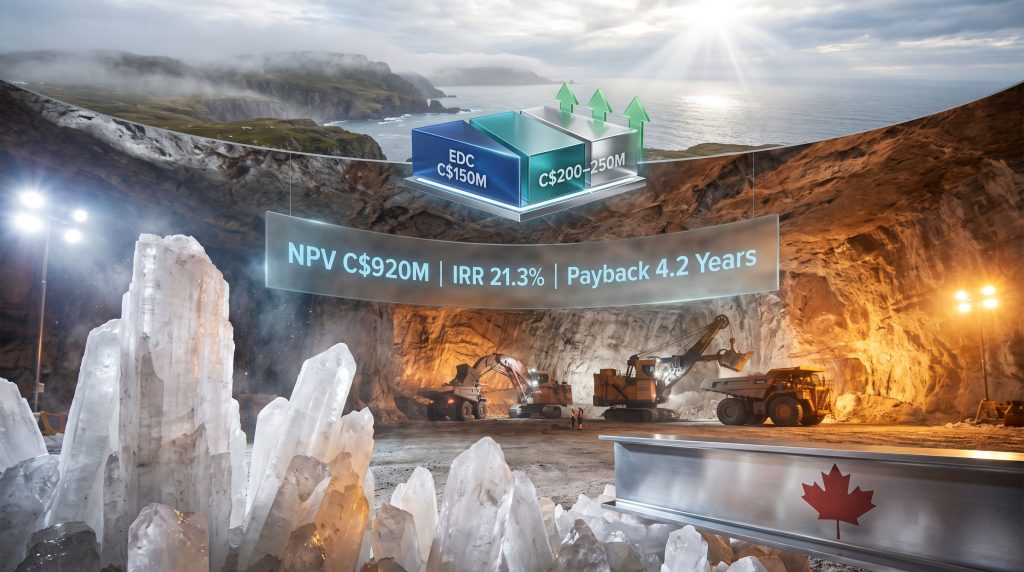
| After-Tax NPV | C$920 million |
| Internal Rate of Return (IRR) | 21.3% |
| Payback Period | 4.2 years |
| Annual After-Tax Free Cash Flow | C$188 million |
| Projected Mine Life | 25 years |
| Annual Production Capacity | 4 million tonnes |
A 4.2-year payback period is notably short for a capital-intensive operation with a 25-year mine life, and the C$920 million NPV provides substantial headroom above the total senior debt target of C$350 million to C$400 million. This ratio between project value and debt quantum is a key metric that lenders use to assess coverage and structural resilience in the event of operational or market stress.
Why Industrial Salt Appeals to Institutional Lenders
Industrial salt is not a glamorous commodity, but its demand characteristics are precisely the kind that long-tenor debt providers find attractive. Salt consumption spans road de-icing, chemical manufacturing feedstock, water treatment, and food processing, creating a diversified end-market profile that insulates revenues from single-sector downturns.
Unlike metals such as copper or nickel, which are subject to significant price volatility driven by global economic cycles and speculative positioning, industrial salt trades within relatively narrow price bands. This non-cyclical demand profile reduces the sensitivity of project cash flows to commodity market movements. Consequently, this reduces the modelling risk that lenders must account for when stress-testing debt service coverage ratios over multi-decade loan periods.
"Long-tenor project debt, particularly from export credit agencies, is typically sized against a project's ability to service debt under conservative commodity price assumptions. A commodity with low price volatility, like industrial salt, reduces the spread between base-case and downside scenarios, making debt structuring more straightforward."
Export Development Canada's Letter of Interest: What It Signals and What It Does Not
Export Development Canada has issued a letter of interest to provide up to C$150 million in long-term project debt financing for the Great Atlantic Salt project. Positioned against the total senior debt target of C$350 million to C$400 million, this single instrument represents approximately 37 to 43 percent of the total debt stack being assembled.
The significance of this milestone, however, must be understood in context. A letter of interest is a non-binding expression of institutional appetite. It confirms that EDC has reviewed the project at a preliminary level and has sufficient interest to proceed toward formal due diligence. It does not constitute a loan commitment, a term sheet, or any form of legally enforceable financial obligation.
Furthermore, the pathway from a letter of interest to actual debt drawdown involves several independent and sequential processes:
| Stage | Description | Binding? |
|---|---|---|
| Letter of Interest | Signals institutional appetite | No |
| Due Diligence | Technical, financial, environmental review | No |
| Credit Approval | Internal committee sign-off | No |
| Term Sheet | Indicative loan terms proposed | Partially |
| Definitive Agreement | Legally binding loan documentation | Yes |
| Financial Close | Funds committed and drawdown begins | Yes |
Each stage is independent, and progress through one does not guarantee advancement to the next. Investors monitoring the financing process should track milestone disclosures across all stages, not treat the letter of interest as a proxy for financing certainty.
What EDC's Engagement Process Looks Like in Practice
EDC's project finance division applies structured due diligence across technical, environmental, social, and financial dimensions before any credit committee considers a loan application. For a large-scale mining project, this typically involves independent technical reports, environmental and social impact assessments, market studies, and detailed financial modelling under multiple commodity price scenarios.
The rigour of this process is itself part of the derisking function. When EDC completes its diligence and advances to credit approval, that outcome carries informational value for other lenders who may be conducting parallel processes with less depth. ECA diligence reports, while typically not publicly shared, are understood within project finance circles to set a credibility threshold that commercial lenders often treat as a reference point.
Assembling the Full Debt Stack: Multi-Party, Multi-Jurisdictional Complexity
The C$150 million EDC letter of interest represents one component of a financing strategy that targets between C$350 million and C$400 million in total senior secured debt. The remaining C$200 million to C$250 million is expected to be sourced from a combination of:
- Export credit agencies in other jurisdictions, potentially aligned with countries that import Canadian industrial salt or supply capital equipment for the project
- Vendor financing counterparties, typically equipment manufacturers that provide structured credit as part of major supply contracts
- Strategic supply financing partners, which may include development finance institutions or specialised infrastructure debt funds
Endeavour Financial is serving as Atlas Salt's financial advisor, coordinating engagement across this multi-counterparty landscape. The role of a specialist mining finance advisor in this context is material. Accessing institutional debt markets for a pre-revenue mining project requires navigating complex intercreditor dynamics, aligning documentation standards across multiple jurisdictions, and managing information disclosure processes simultaneously.
"The involvement of vendor financing counterparties alongside ECAs reflects a sophisticated capital stack strategy. Equipment suppliers that provide vendor financing have an incentive to see the project advance, creating a partial alignment of interest that can support deal resilience during the assembly process."
In addition, the various capital raising methods employed across such complex financing structures often require the input of specialised mining private equity players to bridge gaps between institutional debt tranches.
Benchmarking the Project's Financial Returns Against Sector Norms
An IRR of 21.3% positions the Great Atlantic Salt project competitively within the broader industrial minerals development pipeline. For context, feasibility-stage industrial mineral projects in stable jurisdictions often target IRRs in the 15 to 20 percent range as a threshold for attracting institutional debt and equity. A project clearing that range with meaningful headroom, particularly one offering a sub-five-year payback on a 25-year asset life, presents a relatively favourable risk-return profile for lenders focused on long-duration infrastructure-style investments.
The C$920 million NPV figure is particularly relevant to debt structuring. Senior secured lenders typically size debt at a fraction of NPV, applying coverage ratios that ensure the project's economic value substantially exceeds the loan quantum even under stress scenarios. With total debt targeted at roughly 38 to 43 percent of NPV at feasibility, the structural coverage position appears conservative by typical project finance standards, though lenders will apply their own modelling assumptions during formal diligence.
Key Risk Factors That Investors Should Monitor
Despite the strength of the feasibility metrics and the significance of the Export Development Canada Atlas Salt letter of interest, several risk factors remain material to the financing outcome:
- Due diligence outcomes: Technical or environmental findings during EDC's formal review could alter loan terms, reduce the loan quantum, or affect eligibility entirely
- Full debt stack assembly: Reaching financial close requires multiple counterparties to independently complete diligence and reach binding commitments, a process that is inherently sequential and subject to extended timelines
- Credit market conditions: Shifts in benchmark interest rates or institutional risk appetite between now and financial close could affect the pricing and availability of senior debt
- Permitting challenges: Institutional lenders typically require key construction and operating permits to be in place or near completion before committing capital
- Commodity market dynamics: While industrial salt demand is relatively stable, any structural changes in end markets, particularly road de-icing volumes driven by climatic or policy shifts, could affect revenue projections
"The EDC letter of interest is a meaningful derisking event in the context of early-stage project finance, but it represents one node in a complex, multi-party process. Assessing financing probability requires tracking progress across all counterparty engagements, not any single instrument in isolation. This article does not constitute financial advice, and readers should conduct their own due diligence before making investment decisions."
For further context on how this financing milestone was announced, Atlas Salt's official release provides a detailed overview of the company's current financing update and strategic direction.
The next major ASX story will hit our subscribers first
Frequently Asked Questions
What is the difference between a letter of interest and a loan commitment?
A letter of interest confirms that an institution has reviewed a project at a preliminary level and has appetite to proceed toward formal engagement. It is non-binding and does not obligate the lender to provide financing. A loan commitment, by contrast, is a legally enforceable obligation to provide funds subject to specified conditions. These instruments sit at opposite ends of the project finance process, separated by months or years of diligence and negotiation.
Why does ECA participation matter for other lenders?
Export credit agencies apply institutional-grade diligence frameworks that are recognised across the project finance industry. When an ECA signals interest in a project, it provides an informational signal that other lenders, including commercial banks and development finance institutions, treat as a credibility reference. This can accelerate parallel diligence processes and reduce the friction involved in assembling a multi-party debt package.
What commodity markets does the Great Atlantic Salt project serve?
Industrial salt serves a broad range of end markets, including highway and municipal road de-icing across North America, chlor-alkali chemical manufacturing, water softening and treatment, and food-grade salt production. This diversified demand base is a structural feature that reduces revenue concentration risk and supports lender confidence in long-term cash flow projections.
Is the C$150 million EDC financing confirmed?
No. The letter of interest is a non-binding preliminary step. Furthermore, Export Development Canada Atlas Salt financing remains entirely subject to the satisfactory completion of technical and environmental due diligence, internal credit committee approval, and the execution of definitive financing agreements. None of these conditions have yet been met. However, the milestone does represent meaningful institutional validation of the project's potential at this stage of development.
Want to Track the Next Major Resource Discovery Before the Market Moves?
Discovery Alert's proprietary Discovery IQ model scans ASX announcements in real time, turning complex mineral and resource data into actionable investment insights — explore historic discoveries and their returns to understand the opportunity, then start your 14-day free trial at Discovery Alert to position yourself ahead of the broader market.