July 24, 2026
The Hidden Cost of Listing Everywhere: Why Exchange Rationalisation Is Reshaping Critical Minerals Companies
For publicly traded mining companies, the instinct to list on as many exchanges as possible once seemed like a logical path to broader capital access. More exchanges meant more investors, more liquidity pools, and theoretically a more diversified shareholder base. However, that calculus has shifted considerably over the past decade, particularly for companies whose trading activity has become concentrated on a single dominant venue. When one exchange captures the overwhelming majority of volume, the other listings stop functioning as liquidity sources and start functioning as cost centres.
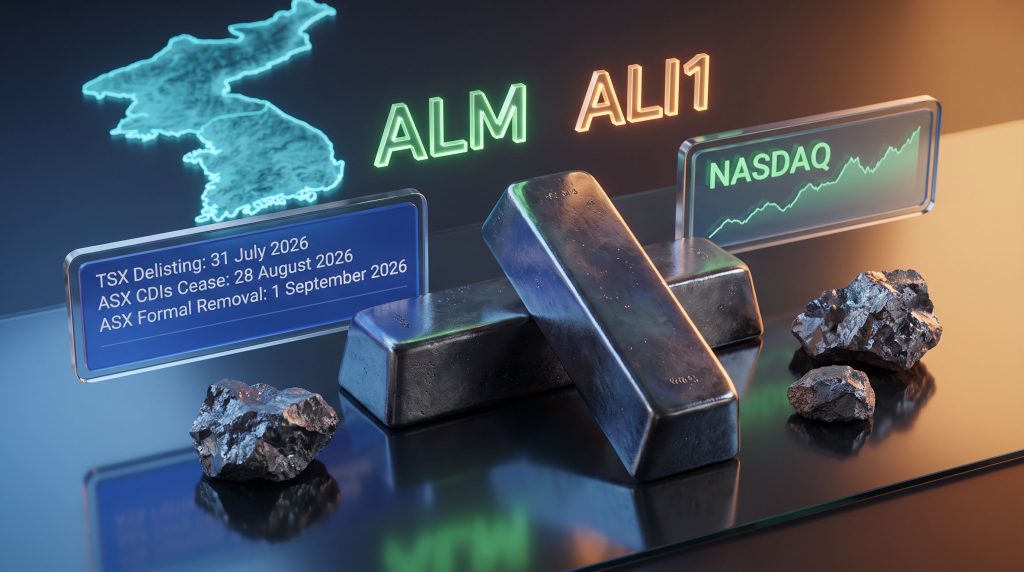
This structural reality sits at the heart of why Almonty delists from ASX and TSX, making it one of the few Western-focused tungsten producers with active mining operations to rationalise its exchange presence so decisively. The company will retain its listings on Nasdaq under the ticker ALM and on the Frankfurt Stock Exchange under ALI1, preserving institutional-grade market access while shedding the administrative weight of maintaining listings where trading activity had become negligible relative to Nasdaq volumes.
When big ASX news breaks, our subscribers know first
Understanding Almonty's Operational Footprint Before the Delisting Context
Before unpacking the exchange mechanics, it is worth understanding what kind of company Almonty Industries actually is, because the nature of its assets adds important context to why its investor base has gravitated toward Nasdaq rather than the ASX or TSX.
Almonty owns and operates the Sangdong tungsten mine in South Korea, which represents one of the most significant tungsten deposits outside of China. The company also holds operational assets and development-stage projects across Portugal, Spain, and the United States. Tungsten itself is classified as a critical mineral by governments across the Western world, primarily because global production is heavily concentrated in China, which accounts for roughly 80% of annual global tungsten supply according to the United States Geological Survey (USGS).
Tungsten's strategic importance makes it genuinely difficult to substitute in many applications. It carries the highest melting point of any known metal at approximately 3,422 degrees Celsius, and it is used extensively in:
- Hardened cutting tools and industrial drill bits
- Armour-piercing ammunition and defence-grade components
- Aerospace and high-temperature alloy manufacturing
- Semiconductor fabrication equipment
- Electrical contacts and filaments
This combination of strategic supply chain relevance and near-irreplaceable material properties means that Almonty's investor base skews toward US-based institutional funds focused on defence supply chains, critical minerals mandates, and industrial metals. That investor concentration on Nasdaq is not coincidental; it reflects the industrial and geopolitical thesis that underpins the entire investment case.
What Are the Exact Delisting Dates and Timelines Investors Need to Know?
The timeline for both delistings is clearly defined, giving investors on the affected exchanges a structured window to manage their positions.
| Exchange | Event | Date |
|---|---|---|
| TSX (Toronto) | Voluntary delisting effective | 31 July 2026 (close of trading) |
| ASX (Australia) | CDIs cease trading | 28 August 2026 |
| ASX (Australia) | Formal removal from official list | 1 September 2026 |
| Nasdaq (ALM) | Continues trading | Ongoing |
| Frankfurt (ALI1) | Continues trading | Ongoing |
Almonty's exit from the TSX and ASX does not represent a withdrawal from public markets. Two active trading venues remain operational, including a major global exchange. Investors retain full liquidity pathways, though the access mechanics differ by jurisdiction and broker capability.
What Is an ASX CDI and Why Does It Matter for Australian Investors?
Australian investors holding Almonty shares do so through Chess Depositary Interests (CDIs), not direct shareholdings. This distinction matters significantly during a delisting event.
A CDI is a financial instrument created specifically to allow foreign-incorporated companies to access the ASX's CHESS (Clearing House Electronic Subregister System) settlement infrastructure. Because Almonty is incorporated outside Australia, it cannot issue ordinary shares directly into CHESS. Instead, a depositary holds the underlying shares, and Australian investors hold CDIs that represent a beneficial interest in those underlying shares.
The practical implications of this structure during a delisting are:
- CDI holders can sell their interests on-market through the ASX before trading ceases on 28 August 2026.
- CDI holders can instruct their broker to convert CDIs into underlying Nasdaq-listed shares if they wish to maintain their investment position.
- CDI holders who take no action before the formal removal on 1 September 2026 face uncertainty about their position depending on their broker's default handling procedures.
- Tax residency, brokerage access to US markets, and currency conversion considerations all apply when converting CDIs to Nasdaq shares.
Australian investors should treat 28 August 2026 as their operative deadline, not 1 September, since that later date represents the administrative removal rather than the final trading opportunity. Furthermore, according to Almonty's official announcement, the process for managing secondary listings has been clearly communicated to assist investors through the transition.
Why Did Almonty Choose to Exit the ASX and TSX? The Business Case Unpacked
Trading Volume Concentration and the Nasdaq Dominance Factor
The core driver of this decision is straightforward: Almonty's trading volume had become so concentrated on Nasdaq that the ASX and TSX listings were generating minimal additional investor access while consuming disproportionate resources.
This phenomenon is more common than many retail investors realise. When a company lists on multiple exchanges, its total float is effectively divided across those venues. If institutional investors, algorithmic market makers, and active traders overwhelmingly prefer one exchange, the other venues suffer from what market structure specialists call liquidity fragmentation: a condition where thinly traded secondary listings produce wider bid-ask spreads, lower price discovery quality, and reduced execution efficiency.
In Almonty's case, the migration of volume toward Nasdaq likely accelerated as the company's critical minerals thesis gained traction among US-based defence and technology supply chain investors, a category of capital that predominantly operates through Nasdaq-listed securities. In addition, the critical minerals demand surge globally has further concentrated institutional attention on exchanges where these thematic mandates are most actively traded.
The True Cost Architecture of Multi-Exchange Listings
The financial burden of maintaining simultaneous listings across four exchanges is rarely appreciated by retail investors. The costs are not limited to listing fees; they cascade across multiple compliance functions.
| Cost Category | Impact on Small-to-Mid-Cap Miners |
|---|---|
| Regulatory filing duplication | Separate and often non-identical disclosure obligations per jurisdiction |
| Legal and audit fees | Multiplied across each exchange's distinct requirements |
| Investor relations overhead | Managing multiple shareholder registries and communication channels |
| Currency and settlement complexity | CHESS (Australia) vs. DTC (US) vs. CDS (Canada) settlement systems |
| Management time allocation | Board and executive bandwidth consumed by compliance activities |
| Corporate secretary resources | Coordinating multi-jurisdictional continuous disclosure obligations |
For a company of Almonty's size, this overhead is not trivial. Resources directed toward regulatory compliance at low-volume exchanges represent capital and management attention that could otherwise be directed toward mine development, feasibility work, or offtake negotiations for assets like Sangdong.
Is This a Sign of Financial Distress or Strategic Optimisation?
Voluntary delistings driven by volume consolidation are fundamentally different from delistings triggered by regulatory sanctions, financial failure, or investor relations crises. When a company retains active listings on Nasdaq and the Frankfurt Stock Exchange simultaneously, the decision is almost certainly one of operational efficiency rather than capital market retreat.
It is worth noting several precedents from across the critical minerals sector where companies have progressively streamlined their exchange presence as their primary listing venue matured. The pattern typically follows a predictable arc: early-stage companies list broadly to access capital pools in multiple geographies, then consolidate as one exchange captures the majority of institutional interest and the cost-benefit calculation shifts decisively.
Almonty's Nasdaq listing places it within a market structure that gives it direct visibility to US-based fund managers with critical minerals mandates, defence supply chain investment theses, and industrial metals coverage. Furthermore, the company's American defence deal has reinforced exactly why US institutional capital has become Almonty's dominant investor base. Frankfurt provides secondary access to European institutional capital, particularly relevant given that the European Union has also classified tungsten as a critical raw material under its own strategic minerals framework.
What Happens to Investors on the TSX and ASX After Delisting?
Practical Implications for Canadian TSX Shareholders
Canadian investors holding Almonty shares on the TSX face an effective date of 31 July 2026 at the close of trading. Key considerations include:
- Shares held through Canadian brokerages may or may not be automatically transferable to Nasdaq access depending on the brokerage's international market capabilities.
- Investors should contact their broker well in advance of 31 July 2026 to understand conversion or transfer procedures.
- Currency implications arise when converting between CAD-denominated holdings and USD-denominated Nasdaq shares.
- Capital gains events may or may not be triggered depending on the conversion mechanism and individual tax circumstances; independent tax advice is recommended.
Practical Implications for Australian ASX CDI Holders
For Australian investors, the action window is slightly longer but the structural complexity is greater due to the CDI mechanism. The recommended approach in priority order is:
- Contact your broker immediately to confirm whether they can facilitate CDI-to-Nasdaq share conversions.
- If conversion is possible and you wish to maintain your position, initiate the conversion process well before 28 August 2026 to allow for settlement timing.
- If you prefer to exit your position entirely, plan on-market sales for before 28 August 2026, as this is the last day ASX trading is available.
- If you are uncertain, seek independent financial advice before the trading halt date rather than after.
CDI holders who take no action risk ending up in a position where their depositary interest is administratively handled in ways that may not align with their investment intentions. Consequently, Kalkine's coverage of the announcement highlights that the voluntary nature of this delisting reflects trading volume realities rather than any underlying operational concern.
Where Does Almonty Go From Here? Strategic Outlook Post-Delisting
Sangdong and the Western Tungsten Supply Chain Argument
The Sangdong mine in South Korea's Gangwon Province is historically significant. The site was one of Asia's largest tungsten producers during the 20th century before being closed and later brought back into development by Almonty. The deposit's scale and grade profile are considered among the more meaningful tungsten resources available outside China's dominant production base.
Western governments, led by the United States and followed by the European Union, have progressively expanded their critical minerals classification lists to include tungsten. This is driven by concerns about supply chain vulnerability to export restrictions and geopolitical disruptions. China's history of applying export controls on critical materials, including rare earths in 2010 and more recently during trade tensions, has made Western tungsten supply a genuine industrial policy concern. Furthermore, Almonty's strategic tungsten partnership positions the company well to capitalise on this growing demand from defence and aerospace sectors.
Could Nasdaq Consolidation Improve Almonty's Investor Profile?
Consolidating trading onto Nasdaq creates a more concentrated and visible order book, which can attract algorithmic market makers, improve price discovery, and reduce bid-ask spread width over time. For a company whose investment thesis is centred on critical minerals supply security, being a pure Nasdaq-primary company also aligns the stock more cleanly with US-based thematic ETFs and defence-adjacent fund mandates that screen for exchange eligibility.
Frankfurt remains an important secondary venue for European institutional access, particularly given the EU's own critical raw materials framework and its interest in securing tungsten supply for industrial manufacturing, automotive components, and defence procurement.
Disclaimer: This article is intended for informational purposes only and does not constitute financial or investment advice. Past performance is not indicative of future results. Investors should seek independent professional advice before making any investment decisions. Exchange delisting timelines and procedures are subject to change; investors should verify current information directly with Almonty Industries and their respective brokers.
The next major ASX story will hit our subscribers first
Frequently Asked Questions: Almonty Delisting from ASX and TSX
Is Almonty going private after delisting from the ASX and TSX?
No. Almonty Industries will continue trading publicly on Nasdaq under the ticker ALM and on the Frankfurt Stock Exchange under ALI1.
When is the last day to sell Almonty CDIs on the ASX?
The final day for ASX trading is 28 August 2026, ahead of the formal removal from the official list on 1 September 2026.
When does the TSX delisting take effect?
The Toronto Stock Exchange delisting becomes effective at the close of trading on 31 July 2026.
Does this affect Almonty's mining operations?
No. The Sangdong mine in South Korea and development projects in Portugal, Spain, and the United States are entirely unaffected by the exchange restructuring.
What is a CDI and why do Australian investors hold them instead of ordinary shares?
A Chess Depositary Interest (CDI) allows foreign-incorporated companies to access the ASX's CHESS settlement system. Australian investors hold beneficial interests through a depositary rather than holding underlying shares directly.
Key Takeaways: Almonty Delists from ASX and TSX
- Almonty Industries is voluntarily exiting the TSX effective 31 July 2026 and the ASX effective 1 September 2026, with ASX trading ceasing 28 August 2026
- Nasdaq (ALM) and Frankfurt (ALI1) listings remain fully active
- The decision reflects trading volume concentration on Nasdaq and the disproportionate compliance cost of maintaining low-volume secondary listings
- Australian CDI holders face a defined action window ending 28 August 2026 and should contact their broker promptly
- The move reflects a broader exchange rationalisation trend among critical minerals companies maturing onto primary institutional venues
- Almonty's operational assets, anchored by the strategically significant Sangdong tungsten mine, are entirely unaffected by the exchange restructuring
Want to Catch the Next Major Critical Minerals Discovery Before the Market Does?
Discovery Alert's proprietary Discovery IQ model scans ASX announcements in real time, instantly identifying significant mineral discoveries across tungsten, rare earths, and more than 30 other commodities — translating complex data into clear, actionable insights for investors at every level. Explore how historic ASX mineral discoveries have generated substantial returns and begin your 14-day free trial today to position yourself ahead of the broader market.