July 24, 2026
The Invisible Wall: Why Capital Has Walked Away From South African Coal
Across global commodity markets, a quiet but consequential restructuring of capital allocation has been underway for nearly a decade. Environmental, Social, and Governance (ESG) mandates have fundamentally redrawn the boundaries of what institutional lenders and investors consider financeable. In few places is this tension more visible than South Africa, where South Africa coal mining funding options continue to narrow as coal underpins both economic output and electricity generation, yet finds itself increasingly shut out from the mainstream financial system.
This is not simply an ideological shift. It reflects a systematic repricing of risk, a reorientation of fiduciary frameworks, and the emergence of entirely new gatekeeping mechanisms within capital markets. For South African coal operators, the consequence is a funding landscape that bears little resemblance to conditions even ten years ago.
Understanding what still exists, what has retreated, and what conditions now govern access to finance is essential knowledge for any operator, investor, or policymaker with exposure to this sector. Furthermore, this ongoing coal market transformation is reshaping how project viability is assessed at every level.
When big ASX news breaks, our subscribers know first
How the Capital Stack Has Fractured
Commercial Banks: Managed Retreat, Not Immediate Exit
The most widely discussed dimension of the South Africa coal mining funding crisis involves commercial banks. According to insights shared at the Coal and Energy Transition Day held in Johannesburg on July 22, 2026, major banking institutions are maintaining support for existing coal sector clients while simultaneously executing structured reductions in their overall exposure to carbon-intensive lending. This distinction matters enormously in practice.
The operational reality is that banks are not slamming doors on longstanding clients overnight. Rather, they are managing a gradual portfolio rotation that systematically excludes new coal mine development from their lending mandates. Willie Hattingh, head of mining and resources advisory at Rand Merchant Bank, confirmed at the event that the appetite to finance new, large-scale coal mining complexes through conventional bank balance sheets is no longer present in either the local or international market.
This has a compounding effect. As existing coal operations mature or require expansion capital, the pathway to traditional debt refinancing narrows. Operators who have historically relied on banking relationships now face a structural wall rather than a negotiation.
The Private Equity Absence and Its Cascading Consequences
Beyond commercial banking, the private equity dimension of South Africa coal mining funding options is equally constrained, and arguably less discussed. General private equity has maintained a limited presence in the global mining sector for an extended period, driven by the asset-intensive nature of resource extraction, long capital cycles, and difficulty in achieving the return profiles that buyout-focused funds typically require.
Within South Africa's coal market specifically, this absence is acute. Specialist mining private equity, the category of capital that understands reserve economics, production scheduling, and commodity cycle risk in sufficient depth to underwrite greenfield or expansion-stage coal assets, has largely been absent. This contrasts with other resource jurisdictions, particularly in North America and Australia, where dedicated mining-focused private equity vehicles have remained more active.
The practical consequence in South Africa is that the gap historically bridged by specialist mining PE has not been filled by an alternative institutional source. Instead, commodity traders have stepped into a portion of this space, providing structured financing for new plant construction and project development. However, as Hattingh noted, trader-backed capital operates at a fundamentally smaller scale than the balance sheets of major banks. The result is a ceiling on the size and complexity of projects that can realistically be funded through this channel alone.
South Africa Coal Mining Funding Options: A Practical Map
The IDC as the Primary Structured Finance Pathway
For most coal operators navigating the current environment, the Industrial Development Corporation (IDC) represents the most accessible and institutionally structured source of project finance in South Africa. The IDC's mining and metals division mandate explicitly includes supporting coal operations that contribute to energy security and industrialisation, and this includes supply chains connected to existing coal-fired power infrastructure.
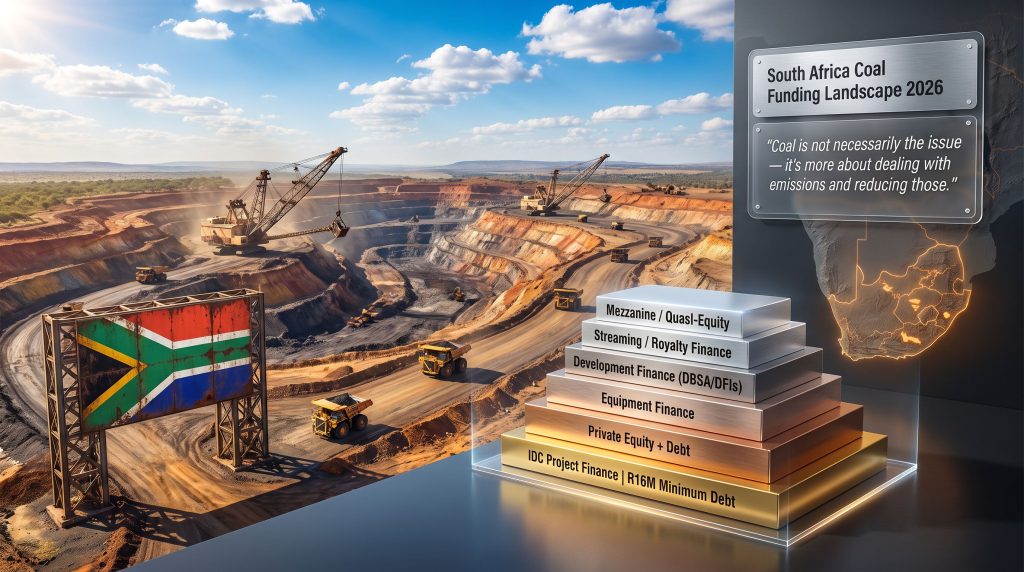
Ali Mnisi, the IDC's Business Development Manager for the Energy and Power Strategic Business Unit, confirmed at the July 2026 event that the IDC's position is not that coal itself is the problem. The focus, rather, is on addressing emissions and reducing them over time. This framing is significant: it opens space for coal operations to remain within the IDC's investment universe provided they can demonstrate credible emissions management trajectories.
Key parameters of the IDC's coal finance offering include:
- Minimum debt funding threshold of R16 million, creating a floor that effectively excludes very small operations from direct access.
- A requirement for a bankable feasibility study supported by an independent technical review and a compliant mineral resource and reserve statement (SAMREC or JORC standard).
- A meaningful sponsor equity contribution, typically falling in the 20% to 40% range of total project cost, depending on risk profile.
- Environmental permitting documentation, including an approved Environmental Impact Assessment and relevant water use authorisations.
- A demonstrated off-take agreement or verified market demand to validate revenue assumptions.
- An increasingly expected emissions management or decarbonisation pathway plan, particularly for projects seeking alignment with development finance criteria.
Critically, the IDC does not prioritise funding for new coal-fired power stations. Its support is oriented toward existing operational supply chains and toward coal projects that integrate cleaner technologies or emissions reduction commitments.
Private Equity, Strategic Partnerships, and Hybrid Structures
For operators who cannot meet IDC criteria or who require capital beyond what a single institution can provide, equity-plus-debt hybrid structures have emerged as the de facto architecture for brownfield restarts and junior project development.
These arrangements typically pair a strategic equity investor, often one with direct operational expertise or an existing off-take relationship, with a debt component sourced from development lenders or equipment financiers. The logic is one of risk distribution: no single capital provider carries the full project risk, and the presence of an operational partner with skin in the game signals credibility to other funders.
This model is best suited to:
- Startup or early-stage operations where the full documentation stack is available but institutional debt alone is insufficient.
- Brownfield restarts where proven historical production data reduces geological uncertainty but operational capital is required.
- Junior-to-mid-tier operations where management expertise and market relationships can attract a strategic co-investor.
Equipment Finance: Lower Barrier, Asset-Specific Capital
One of the least discussed but practically important South Africa coal mining funding options is equipment finance. This mechanism operates differently from project finance in that capital is secured against specific machinery rather than the project as a whole. Lease-to-own structures and equipment loans are available for major mining assets including draglines, continuous miners, haul trucks, and processing plant components.
The advantages are meaningful for capital-constrained operators:
- Documentation requirements are substantially lower than IDC or bank project finance.
- Equipment finance can be layered on top of other funding instruments to reduce total upfront capital demands.
- Repayment schedules can be structured to align with production ramp-up timelines.
The trade-off is that equipment finance addresses a specific capital need rather than providing development capital for a project in its entirety. It functions best as a component of a broader, multi-source funding strategy.
Alternative Structures: Streaming, Royalties, and Mezzanine Debt
For operations that cannot meet conventional lending criteria, several alternative financing instruments exist that are less commonly understood within the South African coal context. Furthermore, innovative structures are increasingly being explored as the mainstream funding gap widens, with appetite for innovative funding in the mining industry growing across African markets.
Royalty and streaming finance allows capital providers to receive a portion of future production revenue or physical output in exchange for upfront funding. This is non-dilutive from an equity perspective and does not require the operator to service traditional debt. The key requirement is a credible reserve estimate and production forecast that gives the capital provider confidence in future cash flows.
Mezzanine debt sits between senior debt and equity in the capital stack, typically carrying a higher interest rate to compensate for its subordinated position. For projects that have partially secured senior debt but face a capital stack gap, mezzanine instruments provide a mechanism to close the funding shortfall without further diluting equity holders.
Vendor financing, where equipment or service suppliers extend credit against future revenue, represents another avenue that can reduce the initial capital burden on operators, though it requires established commercial relationships and supplier confidence in project viability.
The Decision Framework: Matching Funding to Project Stage
The following table maps each major funding route to the most appropriate project stage and key requirements:
| Funding Route | Best Suited For | Key Requirements | Typical Scale |
|---|---|---|---|
| IDC Project Finance | Development and expansion | Feasibility study, sponsor equity, permitting, off-take | R16M minimum debt |
| Private Equity and Strategic Partner | Startups and brownfield restarts | Off-take agreement, operational plan | Variable |
| Equipment Finance | Machinery acquisition | Deposit, asset security | Asset-specific |
| DBSA and DFI Concessional Finance | Transition-linked projects | Decarbonisation plan, emissions pathway | Project-dependent |
| Streaming and Royalty Finance | Junior and higher-risk operations | Proven reserves, production forecast | Variable |
| Mezzanine Debt | Capital stack gap-filling | Demonstrated cash flow potential | Project-dependent |
| Trader-Structured Finance | Smaller-scale new plant development | Off-take relationship, operational track record | Smaller scale |
Decarbonisation as a Funding Gateway, Not Just a Policy Constraint
The Presidential Climate Commission's Transitional Framework
A dimension of the South Africa coal funding debate that often goes underappreciated is the distinction between outright prohibition and conditional investability. South Africa's Presidential Climate Commission (PCC) has defined decarbonisation as a gradual process of emissions reduction leading toward net-zero by 2050, not an abrupt coal phase-out.
PCC executive director Dorah Modise articulated at the July 2026 event that coal projects incorporating clean coal technologies or emissions reduction strategies retain credibility as investable assets within this transitional framework, provided the investment case is clearly articulated and accompanied by structured proposals. This is a nuanced position that creates a navigable pathway for coal operators willing to engage seriously with emissions management.
Projects moving in the direction of emissions reduction retain investability within a decarbonisation framework, but the quality and credibility of the proposal itself is the determining factor.
Technologies such as coal beneficiation, carbon capture systems, and cleaner combustion approaches are among the mining decarbonisation pathways that can reframe a project's risk classification from stranded asset to transition-compatible investment.
Energy Security as a Countervailing Policy Argument
South Africa's domestic energy realities create a policy tension that is unlike any other major economy. Coal currently accounts for a dominant share of electricity generation, and Eskom's generation fleet remains heavily dependent on coal supply from mines in Mpumalanga and the Waterberg. This creates an energy security argument for continued coal investment that sits in direct tension with international ESG capital market requirements.
The energy transition demand narrative, however, does not automatically exclude coal in South Africa's specific policy context. For development finance institutions and domestic lenders operating within South Africa's policy framework, this tension creates space for continued coal financing that would not exist in, for example, a European financing context.
The key is that operators who can situate their projects within the energy security narrative, while simultaneously articulating a credible path toward emissions reduction, access a broader pool of available capital than those pursuing conventional coal expansion without any transition credentials.
The next major ASX story will hit our subscribers first
What Capital Readiness Actually Looks Like in 2026
Building a viable funding package for a South African coal project in the current environment requires assembling a documentation stack that satisfies multiple capital providers simultaneously. Operators who approach this process sequentially, seeking one funder before engaging others, are likely to find the process slower and more uncertain than those who develop a comprehensive project investment case from the outset.
A capital-ready South African coal project typically requires:
- A bankable feasibility study with independent technical review.
- A SAMREC or JORC-compliant mineral resource and reserve statement.
- An approved Environmental Impact Assessment and water use licence.
- A detailed mine plan with production schedule and integrated cost model.
- A signed off-take agreement or verifiable evidence of market demand.
- A sponsor equity commitment in the 20% to 40% range.
- An emissions management plan or decarbonisation pathway document.
- A structured investment case that frames the project within energy security and transition narratives.
Strategic Takeaway: In 2026, the distinction between funded and unfunded coal projects in South Africa is increasingly less about coal itself and more about the quality, completeness, and narrative framing of the investment case presented to potential funders.
Operators who treat documentation as a compliance exercise rather than a strategic communication tool are likely to find the funding landscape more hostile than it actually needs to be. Those who invest in the quality of their investment case, align themselves with institutional mandate requirements, and demonstrate genuine engagement with emissions management are materially better positioned to assemble a viable capital stack across multiple funding sources.
Disclaimer: This article is intended for informational purposes only and does not constitute financial, investment, or legal advice. Forward-looking statements regarding funding availability, policy frameworks, and project viability involve inherent uncertainty. Readers should conduct independent due diligence and seek professional advice before making any investment decisions.
Want to Stay Ahead of the Next Major ASX Mineral Discovery?
While capital continues to reshape itself around ESG mandates and transitional frameworks, Discovery Alert's proprietary Discovery IQ model cuts through the complexity by delivering real-time alerts on significant ASX mineral discoveries — turning vast amounts of market data into clear, actionable investment insights for both short-term traders and long-term investors. Start your 14-day free trial today, or explore Discovery Alert's dedicated discoveries page to see how historic mineral discoveries have generated substantial returns for those positioned ahead of the market.