July 24, 2026
Why Iron Ore Grade Has Become the New Competitive Frontier
The seaborne iron ore trade has historically rewarded volume above almost everything else. For decades, the dominant logic was simple: more tonnes shipped meant more revenue, and the benchmark 62% Fe price was the universal yardstick against which producers measured themselves. That logic is fracturing. The global steel industry is now navigating a structural reconfiguration driven by decarbonisation targets, carbon pricing legislation, and the economics of emissions-efficient blast furnace operation. In this new environment, ore grade is no longer just a quality metric — it is a direct financial lever for steelmakers trying to manage their carbon costs.
This shift is creating a two-tier iron ore market. Producers supplying standard-grade material face growing pricing headwinds as their product offers steelmakers little relief from rising carbon compliance costs. Producers capable of consistently delivering ore above 63% Fe, with a high proportion of lump product, are finding that their material commands structurally supported premiums that go well beyond simple quality differentials. The Kumba premium iron ore strategy is built precisely around this dynamic — and the company's first-half 2026 results provide a detailed window into how that strategy is performing under real-world conditions. Furthermore, understanding iron ore price trends helps contextualise why this premium positioning is gaining commercial momentum.
When big ASX news breaks, our subscribers know first
Where Kumba Sits in the Global Iron Ore Quality Spectrum
Understanding the commercial logic of the Kumba premium iron ore strategy requires appreciating what distinguishes its product from the global benchmark. The Fastmarkets 62% Fe free-on-board price serves as the industry's reference point, but Kumba's ore consistently exceeds that grade threshold by a meaningful margin.
| Metric | Kumba Performance | Industry Benchmark |
|---|---|---|
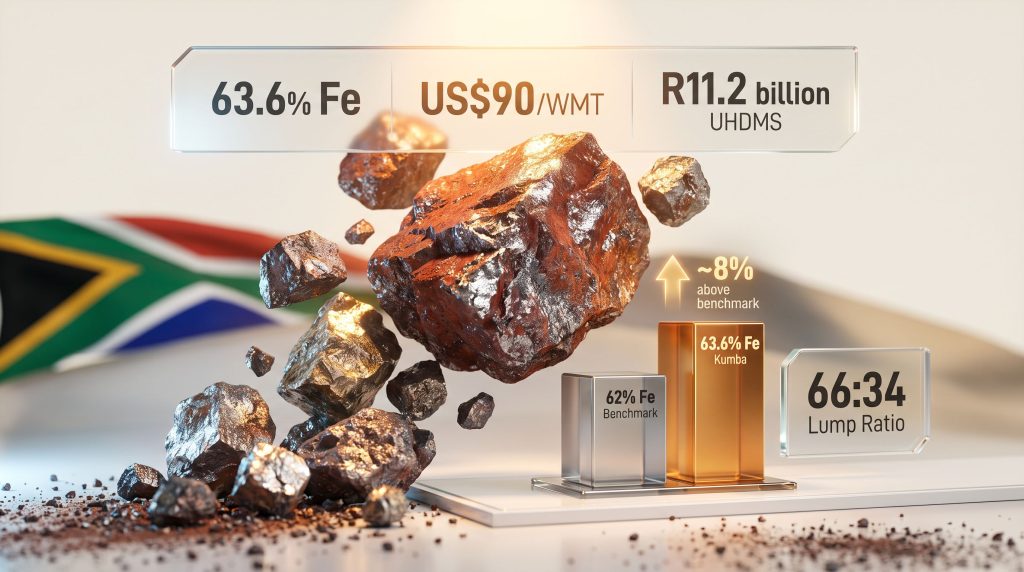
| Average Iron Content | 63.6% Fe | 62% Fe (Fastmarkets benchmark) |
| Lump-to-Fine Ratio | 66:34 | ~30–40% lump typical for major exporters |
| Realised Export Price Premium | ~8% above benchmark | 0% (benchmark = par) |
| H1 2026 Realised Export Price | US$90/WMT | ~US$83/WMT (62% Fe equivalent) |
Two figures in that table deserve particular attention. First, the 63.6% Fe average grade places Kumba's product in a category that enables measurable reductions in coke consumption during blast furnace operation — a commercially significant advantage for steelmakers facing tightening emissions requirements. Second, the 66:34 lump-to-fine ratio is exceptional by global standards. Most major iron ore exporters, including large Australian producers, typically achieve lump ratios in the 30–40% range. Lump ore is charged directly into blast furnaces without sintering, eliminating an entire energy-intensive processing step and reducing both operating costs and carbon emissions for the steelmaker.
Key Insight: Kumba's 66% lump composition is not a geological accident — it reflects the physical characteristics of the Sishen and Kolomela ore bodies combined with deliberate processing choices designed to maximise the proportion of high-value lump product in the final export mix.
What the Kumba Premium Iron Ore Strategy Actually Involves
The Quality-Over-Volume Framework
The Kumba premium iron ore strategy is frequently described in terms of product quality, but it is more precisely understood as a commercial positioning decision that flows through every aspect of the business — from how ore is mined and processed to how logistics are managed and how capital is allocated.
Rather than competing on volume with high-tonnage, lower-grade producers, Kumba targets a differentiated customer segment: steelmakers who are willing and able to pay above-benchmark prices for ore that reduces their operational costs and emissions exposure. This positioning is structurally coherent in a world where carbon pricing mechanisms are tightening, but it demands consistent execution across four interlocking pillars:
- Premium product mix — maintaining an average iron content of 63.6% Fe and a lump ratio of 66:34, which consistently outperforms competing exporters on both dimensions
- UHDMS technology deployment — a R11.2 billion investment in ultra-high dense media separation technology at Sishen to convert previously sub-economic ore into premium saleable product
- Renewable energy integration — incorporating wheeled renewable electricity at Kolomela to reduce emissions intensity and operating costs simultaneously
- Logistics partnership with Transnet — collaborative infrastructure restoration along the Ore Export Corridor to ensure that product quality translates into reliable export throughput
Each pillar reinforces the others. Premium product mix generates pricing power. UHDMS technology expands the volume of ore that qualifies for premium classification. Renewable energy reduces the carbon footprint of production, enhancing the product's appeal to emissions-conscious steelmakers. And logistics reliability ensures the premium product actually reaches international customers on schedule. In addition, green iron production is becoming an increasingly relevant consideration as steelmakers seek to align their supply chains with decarbonisation commitments.
How UHDMS Technology Transforms Sishen's Asset Economics
Ultra-high dense media separation is arguably the most technically significant component of the Kumba premium iron ore strategy, and it is worth understanding precisely how it works and why it matters.
Conventional dense media separation uses a liquid medium of controlled density to separate ore particles: material denser than the medium sinks (reporting as higher-grade product), while lighter material floats (reporting as waste or lower-grade feed). UHDMS operates on the same fundamental principle but achieves separation at significantly higher density thresholds with greater precision, using advanced cyclone technology and more tightly controlled media conditions. This precision allows the recovery of premium-grade product from ore that conventional processing would classify as marginal or non-saleable.
At Sishen, the practical consequence is transformative. The mine contains a substantial volume of ore that currently falls below the threshold for premium product classification under conventional processing. UHDMS unlocks the commercial value of this material without requiring new mining areas, expanding the mine footprint, or significantly increasing waste generation.
| UHDMS Project Metric | Value |
|---|---|
| Total Capital Investment | R11.2 billion |
| Premium Product Share (Pre-UHDMS) | ~18% of Sishen output |
| Premium Product Share (Post-UHDMS) | ~55% of Sishen output |
| Expected Payback Period | By 2029 |
| Internal Rate of Return | >30% |
| Main Plant Tie-In | August 2026 |
The shift from approximately 18% to 55% premium product share is not an incremental improvement — it is a fundamental reconfiguration of Sishen's revenue profile. A mine that previously generated the majority of its tonnage at benchmark-adjacent pricing will progressively transition to one where the majority of output qualifies for premium pricing mechanisms. Beyond near-term margin improvement, UHDMS is expected to extend Sishen's operational mine life by unlocking ore zones that were previously sub-economic under conventional processing assumptions. You can read more about Kumba's production framework and how Sishen and Kolomela fit into the broader operational strategy.
Featured Snippet: What is UHDMS technology in iron ore mining? Ultra-high dense media separation (UHDMS) is an advanced ore processing method that uses precisely controlled high-density separation media and cyclone technology to recover premium-grade iron ore from lower-grade feed material. It significantly increases the proportion of high-value product from existing ore bodies without requiring mine footprint expansion.
H1 2026 Operational Performance: Reading the Numbers Correctly
Production and Sales Snapshot
Kumba's first-half 2026 results require careful interpretation. Headline production declined 3% to 17.7 Mt, and sales fell 1% to 18.6 Mt — figures that could be read as operational underperformance without broader context. The reality is more nuanced.
| Metric | H1 2026 Result | Change vs. Prior Period |
|---|---|---|
| Total Production | 17.7 Mt | -3% |
| Total Sales | 18.6 Mt | -1% |
| Sishen Production | 12.7 Mt | +3% |
| Kolomela Production | 4.9 Mt | -16% |
| Total Waste Mining | 83.5 Mt | +4% |
| Realised Export Price | US$90/WMT | +8% vs. 62% Fe benchmark |
| Total Recordable Injury Frequency Rate | 0.80 | Improved from 1.18 |
The production decline was driven almost entirely by Kolomela, where a 16% reduction to 4.9 Mt reflected planned stockpile drawdowns, scheduled maintenance, and the impact of Transnet's first planned 10-day maintenance shutdown on the Ore Export Corridor. Importantly, waste mining at Kolomela increased sharply during the period as stripping activities accelerated, building access to future ore zones. This is a standard mine sequencing decision — sacrificing near-term production volume to secure long-term ore access — rather than evidence of operational deterioration.
Meanwhile, Sishen delivered a 3% production increase to 12.7 Mt, supported by improved plant stability and a strong second-quarter recovery after weather disruptions earlier in the year. The safety performance improvement, with the Total Recordable Injury Frequency Rate falling from 1.18 to 0.80, is also a material development given the direct relationship between safety performance and operational continuity at large open-pit mines.
Full-year guidance of 31–33 Mt production and 35–37 Mt sales was maintained, reflecting confidence in improving operational momentum through the second half of 2026.
The Transnet Partnership: Infrastructure as Competitive Moat
Why Logistics Reliability Is as Strategically Important as Ore Quality
A producer can engineer exceptional ore quality but still fail to realise premium pricing if it cannot reliably deliver product to international customers. This is the fundamental tension that has constrained Kumba's commercial performance in recent years. The Ore Export Corridor linking Northern Cape mines to Saldanha Bay Port has faced significant performance challenges, and every tonne of premium iron ore that cannot be exported on schedule represents a direct erosion of the quality premium Kumba has worked to build.
The H1 2026 period marked a notable step forward in the restoration of this infrastructure. Key milestones in the first planned 10-day maintenance shutdown included:
- Replacement of 101 km of rail along the export corridor
- Lifting of speed restrictions on key corridor sections
- Cold commissioning of Tippler 3 at Saldanha Bay Port, increasing export handling capacity
- Planning for a second scheduled maintenance shutdown in the second half of 2026
While rail volumes declined during the shutdown itself, this maintenance represents a deliberate investment in long-term export reliability rather than a logistical failure. Each kilometre of rail replaced and each speed restriction lifted directly increases the corridor's capacity to export Kumba's premium product efficiently and on schedule.
Partnership in Practice: The Kumba-Transnet collaboration on Ore Export Corridor restoration represents one of South Africa's most consequential mining infrastructure programmes. Logistics reliability functions as a force multiplier for product quality — without it, even the highest-grade iron ore cannot consistently command the premium pricing it deserves in international markets.
Cost Pressures, Currency Dynamics, and Guidance Adjustments
The Operating Cost Environment
Kumba's cost environment in H1 2026 reflected two converging pressures that affected many commodity producers globally.
The first was above-inflation increases in key mining inputs — diesel, explosives, and steel consumables — partially attributable to supply chain disruptions linked to ongoing geopolitical instability in the Middle East. These are US dollar-denominated input costs that move with global commodity and logistics markets.
The second was rand strength relative to the US dollar, which created a dual compression effect: increasing the rand-equivalent cost of US dollar-denominated inputs while simultaneously reducing the rand value of US dollar export revenues.
| Operation | Cost Guidance Status | Revised USD Exchange Rate Assumption |
|---|---|---|
| Sishen | Maintained | R16.50/USD (revised from R16.00) |
| Kolomela | Maintained | R16.50/USD (revised from R16.00) |
Critically, Kumba maintained its underlying rand-denominated cost guidance for both operations, revising only the exchange rate assumption used to translate US dollar cost guidance. This distinction matters for investors: the operational cost base remains within guided parameters, and the exchange rate adjustment reflects currency market movements rather than operational cost blowouts.
The next major ASX story will hit our subscribers first
Green Steel, CBAM, and the Structural Demand Thesis for Premium Ore
Why Decarbonisation Is a Multi-Decade Tailwind
Steel production is responsible for approximately 7–9% of global CO₂ emissions, making it one of the most scrutinised sectors under international climate frameworks. Blast furnace operators have limited short-term options for dramatically reducing their emissions intensity — the physics of ironmaking impose constraints on how quickly the industry can transition to hydrogen-based or electric arc furnace routes. Within those constraints, however, ore grade is one of the most accessible levers available to steelmakers seeking to reduce their carbon footprint incrementally.
Higher-grade ore produces more iron per tonne charged into the furnace, which means less coke is required per tonne of hot metal produced. Less coke means lower CO₂ emissions per heat. The relationship is not linear across all grade increments, but the directional effect is consistent and commercially meaningful at current carbon pricing levels. Furthermore, advances in hydrogen iron ore reduction are reshaping what steelmakers expect from their ore inputs over the medium term.
| Iron Ore Grade | CO₂ Reduction Potential vs. 58% Fe | Typical Price Premium vs. 62% Fe Benchmark |
|---|---|---|
| 58% Fe | Baseline | Discount |
| 62% Fe | Moderate improvement | Par (benchmark) |
| 63–64% Fe | Meaningful reduction | 5–10% premium |
| 65%+ Fe (DR-grade) | Significant reduction | 15–25%+ premium |
The CBAM Effect on Iron Ore Demand Hierarchies
The EU's Carbon Border Adjustment Mechanism represents a particularly important demand-side catalyst for premium iron ore producers. CBAM imposes a carbon cost on steel imports that do not meet EU emissions standards, effectively penalising steelmakers who supply European markets using carbon-intensive production methods. Since ore grade directly influences blast furnace carbon intensity, steelmakers in CBAM-affected trade flows have a growing financial incentive to source higher-grade ore inputs — and to pay the associated premium — because doing so reduces their CBAM liability.
Goldman Sachs has previously noted that high-grade iron ore premiums are likely to remain structurally supported by steelmakers' emissions reduction requirements. Wood Mackenzie has similarly identified premium iron ore products as critical inputs for lowering blast furnace emissions during the global transition toward greener steel production. Kumba's average grade of 63.6% Fe and its 66% lump ratio position it squarely within the product categories that benefit from these structural demand dynamics. However, the broader China steel and iron ore market remains a critical variable, given China's dominant role in seaborne iron ore consumption.
Key Risks to the Premium Strategy
Scenario Analysis: Where the Model Could Face Stress
No commodity strategy is without execution and market risk. Four scenarios warrant consideration:
Scenario 1 — Logistics Deterioration
If Transnet's Ore Export Corridor restoration programme stalls or experiences setbacks, Kumba's ability to export premium product reliably is directly impaired. Product quality that cannot reach customers on schedule loses much of its commercial value.
Scenario 2 — Global Steel Demand Contraction
Prolonged weakness in global steel demand, particularly in China which dominates seaborne iron ore consumption, could compress even premium pricing. Weak mill margins reduce steelmakers' capacity to pay quality premiums, narrowing the spread between benchmark and premium pricing.
Scenario 3 — UHDMS Commissioning and Execution Risk
The R11.2 billion UHDMS programme at Sishen is a large-scale capital deployment with a main plant tie-in scheduled for August 2026. Commissioning delays, cost overruns, or underperformance relative to projected premium product ratios would delay the expected payback by 2029 and reduce the greater than 30% IRR target. Capital projects of this complexity and scale carry inherent execution risk.
Scenario 4 — Rand Appreciation
A significant and sustained rand appreciation would compress the rand value of US dollar export revenues while cost structures remain largely rand-denominated. This currency mismatch is an inherent feature of South African mining economics and a risk that cannot be fully hedged through operational decisions alone. Consequently, the impact of tariffs on iron ore markets also represents an evolving external risk factor that producers must monitor closely.
Disclaimer: The scenario analysis above is presented for informational and analytical purposes only and does not constitute financial advice. Commodity markets are subject to significant uncertainty, and actual outcomes may differ materially from those described.
Frequently Asked Questions: Kumba Premium Iron Ore Strategy
What is Kumba Iron Ore's average iron ore grade?
Kumba produces iron ore with an average iron content of approximately 63.6% Fe, above the standard 62% Fe Fastmarkets benchmark used for global iron ore pricing. This higher grade enables Kumba to command a consistent price premium in international markets.
How much of a price premium does Kumba achieve over the benchmark?
In the first half of 2026, Kumba achieved a realised export price of US$90 per wet metric tonne, representing approximately 8% above the Fastmarkets 62% Fe free-on-board equivalent price.
What is UHDMS technology and why is Kumba investing in it?
Ultra-high dense media separation (UHDMS) is an advanced ore processing technology that recovers premium-grade iron ore from lower-grade feed material using precisely controlled high-density separation media. Kumba is investing R11.2 billion in UHDMS at Sishen to increase premium product share from approximately 18% to 55% of output, extend mine life, and improve margins. Payback is expected by 2029 with an internal rate of return exceeding 30%. For further detail, Mining Weekly's coverage provides a thorough overview of the project's scope and rationale.
What is Kumba's full-year 2026 production guidance?
Kumba maintained full-year 2026 guidance of 31–33 Mt of production and 35–37 Mt of sales, supported by improving operational momentum at Sishen and progressive restoration of Transnet's Ore Export Corridor.
How does the EU Carbon Border Adjustment Mechanism affect iron ore demand?
CBAM imposes a carbon cost on imported steel that does not meet EU emissions thresholds. Steelmakers supplying European markets are therefore financially incentivised to use higher-grade iron ore inputs, which reduce blast furnace carbon intensity and lower their CBAM liability. This mechanism is expected to increase structural demand for premium-grade iron ore over the medium term.
What is Kumba's lump-to-fine ratio and why does it matter?
Kumba's lump-to-fine ratio is approximately 66:34, meaning roughly two-thirds of its product is lump ore. Lump ore commands a price premium over fine ore because it can be charged directly into blast furnaces without sintering, reducing steelmakers' energy consumption, processing costs, and carbon emissions per tonne of steel produced. Anglo American's premium iron ore portfolio outlines how this product quality fits within the group's broader strategy.
Key Takeaways: The Strategic Logic Behind Kumba's Premium Positioning
The Kumba premium iron ore strategy is best understood not as a defensive response to volume competition from larger producers, but as a deliberate offensive positioning in a market segment that is structurally growing in value. The following points capture the essential logic:
- Kumba's 63.6% Fe average grade and 66% lump ratio represent an engineered commercial advantage, not simply a geological fortunate circumstance
- The R11.2 billion UHDMS investment at Sishen has the potential to triple the premium product share of that mine's output, fundamentally reconfiguring its revenue profile by 2029
- Logistics reliability via the Ore Export Corridor is the operational dependency that determines whether product quality actually translates into commercial outperformance — making the Transnet partnership strategically critical
- CBAM and broader carbon pricing mechanisms are functioning as demand-side catalysts, increasing the financial value of high-grade iron ore inputs to steelmakers in regulated markets
- With a greater than 30% IRR target on UHDMS and payback expected within this decade, the financial case for the strategy is grounded in quantifiable return metrics rather than speculative positioning
- The H1 2026 safety improvement, with the TRIFR falling from 1.18 to 0.80, reflects an operational discipline that directly supports the consistency of production required to sustain premium product delivery commitments
For investors and industry observers seeking broader context on African mining investment trends, strategic partnerships, and the evolving role of commodity producers in global decarbonisation supply chains, the Mining Indaba conference series provides a platform where these themes are examined at depth. Further information is available at miningindaba.com.
Want to Spot the Next Major Mineral Discovery Before the Market Does?
Discovery Alert's proprietary Discovery IQ model delivers real-time alerts on significant ASX mineral discoveries — instantly translating complex data across more than 30 commodities into clear, actionable insights for both short-term traders and long-term investors. Explore how historic mineral discoveries have generated substantial returns and begin your 14-day free trial today to position yourself ahead of the broader market.