July 24, 2026
The Invisible Ceiling Above Critical Minerals Supply Diversification
The history of commodity markets is littered with policy intentions that collided with capital market realities. Governments have long believed that declaring a strategic priority is functionally equivalent to solving it. In the critical minerals space, this assumption is now being stress-tested at an unprecedented scale. The forces reshaping global supply chains for platinum group metals, rare earth elements, titanium, and graphite are not primarily geological or technological in nature. They are financial, structural, and deeply rooted in how the world's largest mining companies allocate capital.
Understanding why critical minerals supply diversification keeps falling short of its policy ambitions requires looking beyond the headlines and into the mechanics of mine financing, corporate portfolio strategy, and the uncomfortable economics of building supply chains in jurisdictions that have never hosted them before. The critical minerals demand surge makes this challenge all the more urgent.
When big ASX news breaks, our subscribers know first
Why Policy Frameworks Keep Running Into Capital Market Walls
In July 2026, two significant policy developments converged within days of each other. The IEA published its Global Critical Minerals Outlook 2026 on July 15, introducing a formal risk classification system that elevated titanium, magnet rare earth elements, graphite, tungsten, tellurium, cobalt, and germanium to the highest supply-security concern tier based on concentrated sourcing and limited substitutability. Six days later, a White House executive order tightened the conditions under which the Department of Defense can grant sourcing waivers for critical materials from restricted nations, effectively improving the procurement position of qualifying non-Chinese supply chains.
Together, these measures represent meaningful forward movement on the policy architecture of supply diversification. However, what they cannot do is write project finance term sheets, replace the operational expertise of a tier-one mining company, or compress the multi-year permitting timelines that govern new mine development in most Western jurisdictions.
The Resiliency Premium: Who Actually Pays for Safer Supply Chains?
One of the least-discussed structural problems in the critical minerals diversification debate is the cost differential between politically aligned and politically concentrated supply chains. Mining and processing in jurisdictions with robust environmental standards, higher labour costs, and longer regulatory timelines is fundamentally more expensive than production in regions that have spent decades optimising for cost efficiency above all else.
This cost gap is what analysts refer to as the resiliency premium, and it sits at the heart of every financing conversation involving non-Chinese rare earth, titanium, or graphite projects. Unless that premium is absorbed through one of several mechanisms, diversification projects struggle to reach bankability:
- Concessional finance from government development banks that lowers the effective cost of capital
- Long-term offtake agreements that guarantee revenue certainty, reducing lender risk perception
- Contracts-for-difference that establish price floors, protecting project economics from commodity price volatility
- Defence procurement mandates that create captive demand for qualifying supply chains
Each of these tools is being deployed to varying degrees across the G7 and allied-nation frameworks. None has yet been deployed at a scale sufficient to fundamentally reorder where major mining companies choose to invest.
The $60 Billion Question: What Full Supply Chain Diversification Actually Costs
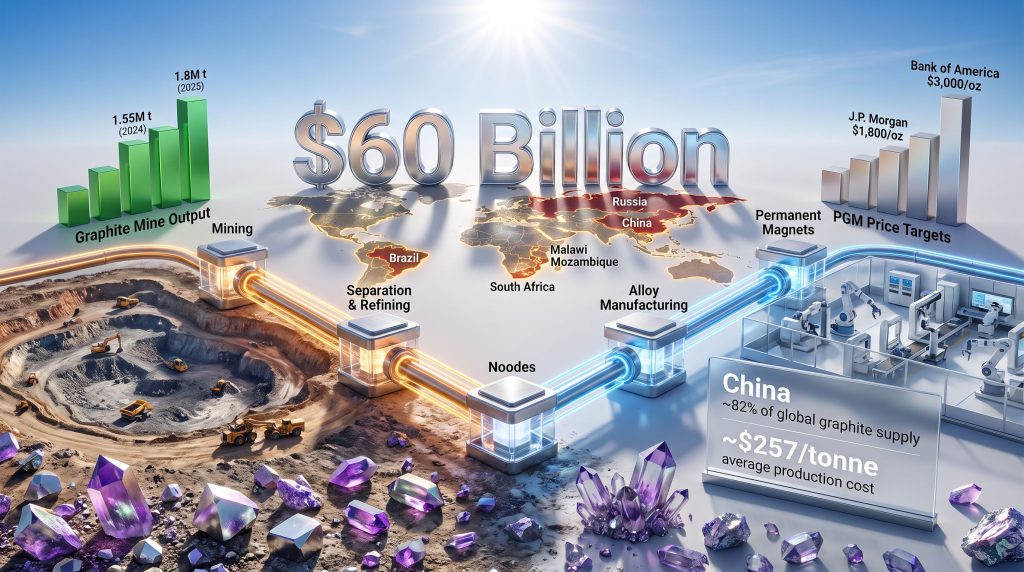
The IEA's estimate that Western rare earth mining, refining, and magnet manufacturing capacity must reach between two and six times current levels by 2035 carries a price tag of approximately $60 billion across the full supply chain. This figure is frequently cited but rarely unpacked, and the distinction matters enormously for investors trying to understand where capital is most urgently needed.
The $60 billion does not refer to building more mines. It refers to constructing an entirely parallel industrial ecosystem, from geological extraction through chemical separation, oxide production, alloy manufacturing, and permanent magnet fabrication. Each stage is technically distinct, capital-intensive, and requires regulatory compliance in multiple jurisdictions simultaneously. Furthermore, the complexity of rare earth supply chains means that gaps at any single stage can undermine the entire effort.
The Three Stages Where the Capital Gap Is Most Acute
-
Mining and concentration focuses on identifying, permitting, and constructing new rare earth mines outside China, with particular emphasis on magnet rare earth elements including neodymium, praseodymium, dysprosium, and terbium. These four elements form the foundation of neodymium-iron-boron permanent magnets used in electric vehicle motors, wind turbines, and defence systems.
-
Separation and refining involves building chemical processing plants capable of producing separated rare earth oxides at commercial purity standards. This is the stage where China's competitive advantage is most deeply entrenched, with decades of accumulated process engineering, infrastructure investment, and environmental cost externalisation creating a structural moat that cannot be overcome through policy declarations alone.
-
Alloy and magnet manufacturing converts separated oxides into finished permanent magnets. This stage carries the highest value-add in the entire chain and the greatest strategic sensitivity, as finished magnets are direct inputs into defence hardware, aerospace systems, and clean energy technology.
The uncomfortable reality is that a mine in Canada or Australia that produces rare earth concentrate still contributes almost nothing to supply security if that concentrate travels to China for separation and returns as processed oxide. Geographic diversification of extraction without equivalent diversification of processing solves perhaps half the supply risk problem.
China's export restrictions on rare earth materials affecting Japan and the United States through mid-2026 illustrated this vulnerability in real time. The restrictions did not simply raise prices. They demonstrated that access to Chinese rare earth processing infrastructure cannot be contractually assumed, a risk that much of Western manufacturing had treated as hypothetical.
Building Integration as a Competitive Necessity
The Energy Fuels critical minerals strategy is currently constructing what may become one of the most significant non-Chinese rare earth supply platforms in the Western Hemisphere, advancing through its White Mesa Mill in Utah. The facility, the only operating conventional uranium mill in the United States, is already producing neodymium-praseodymium oxide at initial scale through an early processing phase. The company's pending acquisitions of Australian Strategic Materials and Vacuumschmelze are designed to extend this capability across the full supply chain, from rare earth ore processing through to finished neodymium-iron-boron permanent magnets. Vacuumschmelze's South Carolina facility already produces these magnets for defence applications, though both acquisitions remain subject to closing conditions.
The logic underlying this integration strategy is well-established in competitive terms. A single-stage rare earth producer operating anywhere in the chain faces margin compression at every adjacent step controlled by Chinese competitors. A vertically integrated platform can, consequently, capture value across the entire sequence while offering downstream customers something increasingly valuable: a single-source, traceable, allied-nation supply solution with full chain-of-custody documentation.
Mark Chalmers, President and Chief Executive Officer of Energy Fuels, has articulated this integration imperative publicly, noting that genuine competitiveness with Chinese rare earth producers requires capability across every stage from mining through to alloy production. Missing a single step in the middle creates a dependency that undermines the strategic rationale for the entire platform.
PGM Supply Concentration: A Case Study in Structural Fragility
The platinum group metals market offers perhaps the clearest existing example of what extreme supply concentration looks like in practice, and why the diversification pipeline has so far failed to scale.
South Africa accounted for approximately 70% of mined platinum in 2025 according to IEA estimates, with Russia contributing roughly 12%. Russia's share of mined palladium supply reached approximately 45%. Output from both jurisdictions declined through 2025:
- South Africa faced rising operating costs and persistent electricity supply constraints that reduced production volumes across multiple operations
- Russia experienced declining ore grades combined with equipment maintenance challenges that cumulatively lowered palladium output
Against this backdrop of tightening supply, major investment banks have published notably divergent but uniformly constructive price forecasts:
| Institution | Platinum Target | Palladium Target | Target Period |
|---|---|---|---|
| J.P. Morgan | $1,800/oz | $1,350/oz | Year-end 2026 |
| Bank of America | $3,000/oz | $2,200/oz | Q4 2026 |
The spread between these two institutional forecasts is itself informative. It reflects genuine uncertainty about the pace of electric vehicle adoption's impact on palladium demand from catalytic converters, the duration of South African power supply challenges, and the degree to which geopolitical risk to Russian supply is priced in versus discounted.
Why Approximately 90% of PGE Reserves Sit in One Country
A less commonly appreciated geological fact underpins the PGM concentration problem: roughly 90% of global PGE reserves are concentrated in South Africa, specifically within the Bushveld Igneous Complex. This is not an accident of exploration effort. It reflects a genuinely unusual geological event in which a massive layered mafic intrusion created an extraordinarily concentrated endowment of platinum, palladium, rhodium, iridium, osmium, and ruthenium in a single region.
This geological reality means that diversifying PGM supply is not primarily a matter of insufficient exploration elsewhere. It is a structural constraint that limits the size and grade of deposits available outside South Africa. Only two major greenfield PGE mines are expected to enter production in the near term globally, leaving the diversification pipeline critically thin relative to demonstrated demand.
ValOre Metals holds 100% of the Pedra Branca PGE project in Ceará State, Brazil, which carries an NI 43-101 Inferred Resource of 2.2 million ounces of platinum, palladium, and gold across 63.3 million tonnes grading 1.08 grams per tonne (effective March 8, 2022). A Preliminary Economic Assessment is targeted for the fourth quarter of 2026, representing the primary near-term de-risking milestone. The Ceará State location places the project outside the two dominant PGM producing regions, which is precisely what makes it strategically relevant despite its early development stage.
Nick Smart, Chief Executive Officer of ValOre Metals, has described the platinum market dynamic as one where meaningful supply constraints are occurring simultaneously with continued and in some cases expanding demand, with primary mine production declining over the previous five years even as prices approximately doubled. This combination of price signal and supply inelasticity is characteristic of a commodity whose production cannot be quickly scaled regardless of economic incentive.
The Titanium Case: When Major Miners Choose Familiar Over Strategic
The Kasiya rutile-graphite project in Malawi represents a rare convergence of strategic characteristics that policy frameworks were specifically designed to encourage. The deposit hosts three US-designated critical minerals within a single ore body: natural rutile as a titanium feedstock, natural graphite, and heavy rare earth elements accessible through a by-product concentrate. A Definitive Feasibility Study has been completed, advancing the project far beyond most of its peers in the non-Chinese titanium pipeline.
Despite this combination, Rio Tinto confirmed in early July 2026 that it would not exercise its option to become operator of the project. The company attributed the decision explicitly to its capital allocation framework, directing resources toward iron ore, copper, aluminium, and lithium rather than reflecting any deterioration in Kasiya's technical or economic merits. Rio Tinto retains an approximate 18.2% shareholding, signalling continued strategic interest while declining operational commitment.
The implications of this decision extend beyond one project:
- Execution risk transfers from a major miner with established project delivery capability to a smaller developer with more constrained balance sheet resources
- Financing complexity increases materially because major-miner participation typically anchors project finance conversations with lenders and provides offtake credibility
- The policy-capital disconnect becomes concrete and measurable rather than theoretical
- The timing, occurring against a backdrop of expanding government support for exactly the type of supply chain Kasiya would serve, makes the signal particularly significant
The Graphite Cost Problem That No Policy Can Legislate Away
China produces approximately 1.2 million tonnes of natural graphite annually, representing around 75 to 82% of global mine output, at an average production cost of approximately $257 per tonne. Non-Chinese graphite producers face a structural cost disadvantage rooted in decades of infrastructure investment, processing efficiency, and environmental cost structures that are not replicated in Western or African mining jurisdictions. The global graphite shortage is, in part, a direct consequence of this entrenched concentration.
Ben Stoikovich, Chairman of Sovereign Metals, has noted publicly that this cost reality means many non-Chinese graphite projects sit too high on the effective cost curve to compete without premium pricing from buyers willing to pay explicitly for supply diversification.
World graphite mine production did increase from approximately 1.55 million tonnes in 2024 to an estimated 1.8 million tonnes in 2025, reflecting genuine diversification progress:
| Country | 2024 Output (est.) | 2025 Output (est.) | Key Development |
|---|---|---|---|
| Mozambique | ~39,000 t | ~60,000 t | Balama Mine restart, June 2025 |
| Tanzania | ~35,000 t | ~75,000 t | Output more than doubled |
| Brazil | Increasing | Increasing | Boa Sorte and Santa Cruz mines commenced 2024 |
| China | ~1.27M t | ~1.48M t | Still approximately 82% of global supply |
The data shows non-Chinese graphite production growing, but China's absolute output is also expanding, meaning the concentration ratio is shifting slowly rather than fundamentally.
The Friendshoring Framework: Allied Sourcing as Geopolitical Architecture
The concept of preferentially sourcing critical minerals from geopolitically aligned nations has moved from theoretical policy discussion into active procurement architecture. Several distinct national approaches have emerged:
- United States prioritises domestic production capability, allied-nation sourcing agreements, and downstream processing investment, reinforced by the July 2026 executive order tightening DoD sourcing waiver conditions
- Australia focuses on building processing capacity to move beyond raw material export, maintaining strong alignment with US and Japanese end-user demand
- India has developed strategic sourcing recommendations targeting partnerships with Australia, Canada, Finland, Brazil, the Philippines, and Chile
- European Union is pursuing the European critical raw materials facility framework with domestic production targets and formal allied-nation sourcing preferences
- Japan has the most mature diversification track record, having restructured its rare earth supply chains significantly following the 2010 Chinese export restriction episode affecting rare earths
The Minerals Security Partnership operates as the primary multilateral coordination mechanism, attempting to pool allied-nation demand signals to make individual projects more bankable. Volume guarantees and long-term offtake commitments under this framework can materially reduce commercial risk for project developers, but the gap between policy coordination and commercial financing remains significant.
The next major ASX story will hit our subscribers first
What Investors Should Actually Be Watching
For investors tracking critical minerals supply diversification as an investment theme, the distinction between policy milestones and commercial milestones is critical. Government announcements, risk classification updates, and procurement framework changes are necessary context but insufficient investment signals on their own.
Pre-production milestones that indicate genuine commercial progress:
- Preliminary Economic Assessment completion for advanced exploration projects, particularly in PGMs
- Definitive Feasibility Study outcomes with updated capital cost estimates reflecting current input costs
- Offtake agreement execution with creditworthy counterparties willing to pay a resiliency premium
- Investment-grade project financing closed for a non-Chinese rare earth separation or processing facility
- Government loan commitments or equity co-investment that demonstrates public-sector risk sharing at project level
The single most meaningful signal the market is waiting for:
A major diversified mining company moving capital into an advanced platinum, rare earth, or titanium project through acquisition or funding commitment, rather than exiting one, would represent the strongest available evidence that government incentives have crossed the threshold required to redirect major-miner capital allocation toward supply diversification at scale.
Until that signal appears, the critical minerals supply diversification landscape will remain dominated by smaller developers and mid-cap producers advancing projects that carry genuine strategic value but face material financing and execution constraints relative to the scale of what is required.
Recycling's Role: Necessary Contributor, Insufficient Solution
The IEA has consistently identified recycling as a meaningful secondary supply contributor for copper, cobalt, lithium, and nickel. For rare earth elements specifically, however, the contribution of recycling to near-term supply security is structurally limited by several factors that are rarely discussed in mainstream coverage:
- Permanent magnet designs in many EV motors and electronics are not optimised for end-of-life rare earth recovery, making disassembly and separation technically challenging
- Collection infrastructure for end-of-life batteries and electronics remains underdeveloped in most jurisdictions outside Japan and parts of Europe
- The installed base of products reaching retirement age is constrained by the relatively recent mass deployment of rare earth-intensive technologies
- Magnet recycling rates remain very low globally, with most separated rare earth content currently lost to landfill or downcycled into lower-value applications
Recycling is a necessary component of any long-term resilient supply system but cannot materially reduce primary supply requirements within the 2026 to 2035 planning horizon that governs current policy discussions. The $60 billion investment requirement the IEA has identified assumes recycling contributes at rates consistent with current technology and infrastructure trajectories.
Frequently Asked Questions: Critical Minerals Supply Diversification
What does the IEA's new risk classification system actually change?
The IEA's July 2026 framework formally elevates titanium, magnet rare earths, graphite, tungsten, tellurium, cobalt, and germanium to the highest supply-security concern tier. Practically, this strengthens the policy rationale for government financing instruments, procurement preferences, and allied-nation coordination mechanisms. It does not independently fund or advance any specific project.
Why is refining more strategically sensitive than mining?
Refining requires specialised chemical processing infrastructure and technical expertise that took decades to develop in China. A country that mines rare earth ore but lacks separation capacity remains dependent on Chinese processing, meaning supply-chain resilience requires equivalent investment across the full value chain from extraction through to finished materials.
What is the resiliency premium and who absorbs it?
The resiliency premium is the cost differential between producing critical minerals in politically aligned, higher-regulatory-standard jurisdictions versus concentrated, lower-cost producing regions. Without mechanisms such as price guarantees, concessional finance, or premium offtake agreements, this premium makes diversification projects commercially unviable relative to incumbent producers. Resolving who absorbs this cost, governments, end-users, or taxpayers, is the central unresolved question in critical minerals supply policy.
Why are major miners not committing capital despite stronger policy support?
Major diversified miners operate under capital allocation frameworks that prioritise risk-adjusted returns across established commodity categories. Iron ore, copper, aluminium, and lithium offer deeper development pipelines, more predictable demand curves, and lower execution risk than early-stage platinum, rare earth, or titanium projects in frontier jurisdictions. Until policy incentives demonstrably improve the risk-return profile of these projects to compete with established alternatives, capital allocation patterns are unlikely to shift materially.
Disclaimer: This article is intended for informational purposes only and does not constitute financial or investment advice. References to price forecasts, production estimates, and capital requirements are based on publicly available research and analyst projections as of the time of writing. All forecasts involve uncertainty and actual outcomes may differ materially. Investors should conduct their own due diligence before making investment decisions.
Want to Identify the Next Major Critical Minerals Discovery Before the Market Does?
Discovery Alert's proprietary Discovery IQ model scans ASX announcements in real time, instantly identifying significant mineral discoveries across rare earths, platinum group metals, titanium, and graphite — turning complex geological data into actionable investment insights for both short-term traders and long-term investors. Explore historic discoveries and their exceptional returns, then start your 14-day free trial to position yourself ahead of the market.