June 30, 2026
The Architecture of Mineral Sovereignty: Why Indo-Pacific Alliances Are Being Rebuilt From the Ground Up
Across the global economy, a quiet but consequential restructuring is underway. The systems that deliver the raw materials powering electric vehicles, defence systems, semiconductors, and renewable energy infrastructure were built for efficiency, not resilience. For decades, the logic of comparative advantage encouraged concentration. Today, that concentration has become a liability, and the nations most exposed are moving with urgency to architect alternatives.
The Australia and Japan critical minerals partnership, formalised during a three-day state visit to Australia by Japanese Prime Minister Sanae Takaichi in May 2026, represents one of the most significant bilateral responses to this structural problem in the Indo-Pacific region. However, to understand why this agreement carries genuine strategic weight, it is necessary to examine the deeper mechanics of mineral supply chain vulnerability before arriving at the partnership itself.
When big ASX news breaks, our subscribers know first
The Concentration Problem: Understanding Systemic Mineral Risk
Critical minerals are not simply industrial commodities. They are foundational inputs across four converging demand vectors that define the modern economy: energy transition infrastructure, defence technology, artificial intelligence hardware, and advanced manufacturing. What makes them strategically distinct from other commodities is the degree to which their processing and refining capacity has become concentrated within a single national jurisdiction.
China currently controls approximately 70% of global refining capacity across 19 out of 20 minerals tracked as strategically critical by major economies. This is not primarily a matter of geological endowment. Many of these minerals exist in substantial quantities across Australia, Africa, South America, and North America. The concentration operates at the processing layer, where the capital-intensive, environmentally complex work of converting raw ore into refined metals and compounds takes place.
This distinction between extraction capacity and processing capacity is one of the most underappreciated dynamics in critical minerals analysis. A nation can possess world-class mineral reserves while remaining entirely dependent on foreign refining infrastructure to convert those reserves into usable industrial inputs. It is at the refining stage where strategic leverage is actually exercised.
| Metric | Scale |
|---|---|
| China's share of global rare earth refining | ~70% across key minerals |
| Critical minerals where this concentration applies | 19 out of 20 tracked globally |
| Australia's share of Japan's total energy supply | ~33% |
| Australia's LNG market position for Japan | Largest single supplier |
The geopolitical implications of this structure are severe. Any supply disruption at the refining stage cascades simultaneously across defence procurement, semiconductor manufacturing, battery production, and clean energy infrastructure. Furthermore, unlike oil supply disruptions, which primarily affect energy and transport, critical mineral refining disruptions affect the physical production capacity of multiple technology sectors at once.
This has led policymakers to develop a concept increasingly described as mineral sovereignty: the strategic imperative for nations to secure reliable, independent access to the full critical minerals value chain, from extraction through to refined product. The conceptual parallel to critical minerals and energy security frameworks developed in the wake of the 1970s OPEC oil crises is deliberate and instructive.
What the Australia-Japan Critical Minerals Partnership Actually Involves
The bilateral agreement between Australia and Japan elevates critical minerals from a trade consideration to a core pillar of economic and national security for both nations. This elevation is not merely rhetorical. It is supported by a substantial capital commitment and an institutional framework designed to translate diplomatic alignment into industrial outcomes.
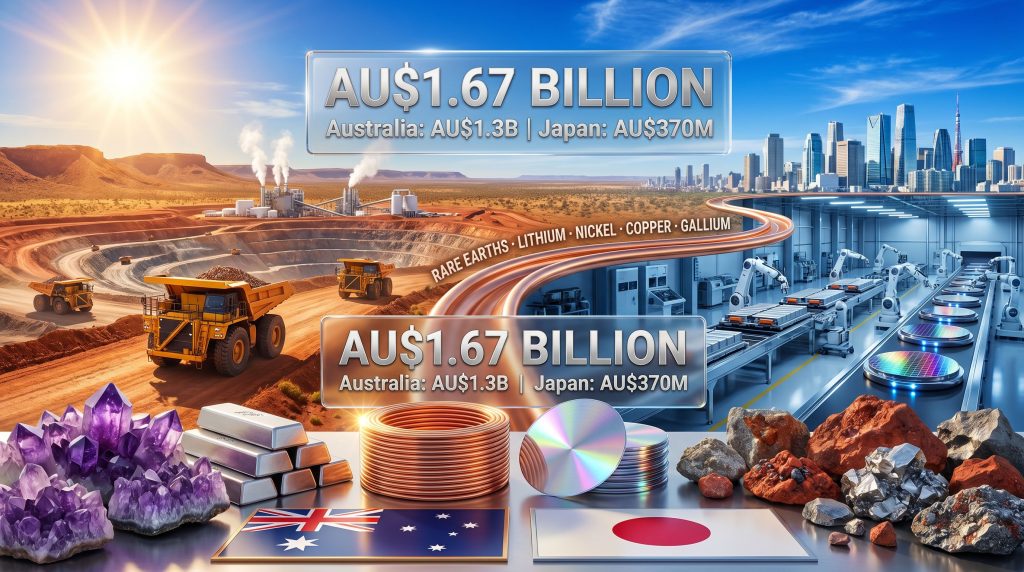
Australia has committed up to AU$1.3 billion (approximately US$943 million) to the partnership, while Japan has contributed AU$370 million (approximately US$268.5 million) in grants and direct investments, with provisions for scaling this contribution as projects mature. The combined commitment of approximately AU$1.67 billion (around US$1.1 billion) represents a meaningful deployment of blended public capital designed to de-risk co-investment from private sector participants in both countries.
| Contributor | Committed Capital | Instrument Type |
|---|---|---|
| Australia | Up to AU$1.3 billion (~US$943M) | Joint project funding |
| Japan | AU$370 million (~US$268.5M) | Grants and direct investments |
| Combined | Blended public capital |
Japan's performance-linked deployment structure is notable. Rather than a fixed allocation released regardless of project outcomes, the Japanese contribution is structured to scale as projects demonstrate progress. This reflects a disciplined approach to public capital deployment: using initial tranches to validate project viability before committing larger sums, while also signalling to private sector investors that due diligence has been conducted at the governmental level.
The partnership is built across three interconnected pillars:
- Critical minerals supply chain co-investment, targeting extraction, processing, and domestic refining capacity across a prioritised list of minerals
- Energy security and LNG continuity, reaffirming Australia's role as Japan's primary energy supplier while establishing a transition pathway toward renewable energy trade
- Defence and regional security cooperation, pairing the economic architecture with strategic alignment on Indo-Pacific stability
The minerals prioritised under the agreement reflect both current industrial demand and emerging technological requirements:
- Rare earth elements (light and heavy) for defence-grade magnets and EV motor systems
- Lithium and nickel for battery supply chains serving both consumer and grid-scale applications
- Gallium for semiconductors, LED systems, and solar photovoltaic cells
- Copper for electrification infrastructure across transport, grid, and industrial systems
- Minerals with emerging applications in quantum computing and biotechnology
Critically, the partnership's scope explicitly includes domestic smelting and metal processing capacity. This is the strategic differentiator. Raw mineral extraction, while valuable, does not resolve the concentration problem if ore continues to be shipped to Chinese refineries for processing. Building Australian refining capability closes the value-add gap and creates the alternative supply pathway that both nations require.
The Geopolitical Pressure Points Behind the Timeline
The urgency embedded in this agreement reflects three compounding systemic pressures that have accelerated the timeline for bilateral mineral security frameworks.
First, China has demonstrated a clear willingness to employ mineral supply chain access as a geopolitical instrument. Export restrictions on rare earths, gallium, and germanium have signalled to import-dependent economies that commercial supply agreements offer insufficient protection against politically motivated disruption. The lesson absorbed by Japanese and Australian policymakers is that supply chain resilience requires structural alternatives, not merely contractual protections.
Second, instability in the Middle East, including risks to critical energy shipping lanes through the Strait of Hormuz, has exposed the fragility of energy supply chains that both Japan and Australia depend upon. For Japan, a nation with extremely limited domestic hydrocarbon production, this vulnerability is existential in economic terms. The diversification toward trusted, geographically stable partners is a direct response to this exposure.
Third, technology sector demand has accelerated sharply. AI infrastructure buildout requires enormous quantities of the same minerals that underpin clean energy and defence technology. The critical minerals demand surge from converging demand curves has compressed the timeline within which alternative supply chains must become operational to remain strategically relevant.
These are not isolated geopolitical events. They represent compounding systemic pressures that transform bilateral mineral security frameworks from a diplomatic preference into an economic necessity.
Industrial Foundations: Why This Partnership Is Not Starting From Zero
The Lynas Rare Earths Financing Model
One of the most important and least-discussed aspects of the Australia-Japan critical minerals relationship is that it already has a validated operational precedent spanning more than fourteen years. In 2011, Sojitz Corporation and the Japan Organisation for Metals and Energy Security (JOGMEC) provided financing to Lynas Rare Earths, an ASX-listed company operating what became the world's largest rare earth mining and processing operation outside China.
That initial financing enabled Lynas to commence light rare earth production. By 2025, the investment had matured to encompass heavy rare earth output as well, demonstrating the long-compounding value of patient capital in critical minerals development. The timeline from initial financing to diversified rare earth production was approximately fourteen years, a figure that carries significant implications for how the current partnership's outcomes should be assessed.
Patient capital in critical minerals operates on a fundamentally different timeline than venture or growth equity. The Lynas model suggests that meaningful supply chain outcomes require a decade-plus commitment from both the financing and operational sides of the relationship.
This is not simply a historical footnote. It is an operationally validated template for the current AU$1.67 billion framework. Furthermore, the rare earth supply chain importance demonstrated through this model shows that Japanese institutional capital combined with Australian resource assets and processing infrastructure can produce globally significant supply chain outcomes, but only when the capital is structured to withstand the extended development timelines inherent to mining and refining projects.
The Gallium Recovery Precedent at Western Australia's Alumina Refineries
A less widely known element of the existing Australia-Japan industrial relationship involves gallium recovery operations developed through collaboration between Sojitz, JOGMEC, and Alcoa's alumina refining operations in Western Australia.
Gallium is a byproduct of bauxite processing. It occurs in trace concentrations within the alumina production process and can be recovered through specialised extraction techniques applied to the refining stream. The strategic importance of gallium has intensified dramatically as it is a critical input for compound semiconductors used in high-frequency electronics, LED lighting systems, solar photovoltaic cells, and military radar and communications equipment.
China controls a dominant share of global gallium production, a position it has demonstrated willingness to leverage through export controls. The work already completed between Sojitz, JOGMEC, and Alcoa's Western Australian operations to develop gallium recovery capability represents an early-stage but industrially validated alternative to Chinese supply. This is precisely the kind of incremental capability building that the broader partnership agreement is designed to accelerate.
Australia's Strategic Position as an Anchor Supplier
Australia's competitive position within Western-aligned critical minerals frameworks rests on a combination of geological endowment, political stability, and established trade infrastructure that is difficult to replicate quickly in other jurisdictions. Indeed, Australia's critical minerals strategy reflects years of deliberate policy positioning to capitalise on exactly this competitive advantage.
Australia's reserve positions across partnership-priority minerals are substantial:
- Lithium: Among the world's largest known reserves, with significant hard-rock spodumene deposits in Western Australia
- Nickel: Major sulphide and laterite deposits with existing processing infrastructure
- Rare earth elements: Large-scale deposits across multiple states including Western Australia and Queensland
- Copper: Significant porphyry and iron oxide copper-gold (IOCG) deposits with long operational histories
- Gallium: Recovery potential embedded within existing alumina refining operations
What differentiates Australia's position from other resource-rich nations is not merely the size of its reserves but the maturity of its regulatory frameworks, the quality of its existing infrastructure, and its established relationships with Japanese industrial and financial institutions built across decades of LNG and iron ore trade.
The partnership's joint commitment to emissions targets and recycling frameworks within Australian critical minerals supply chains adds an important commercial dimension. ESG-credentialed mineral supply is increasingly a purchasing requirement for Japanese manufacturers subject to their own sustainability reporting obligations. Australian production, developed under stringent environmental standards, consequently positions itself as a premium supply option for this segment of Japanese industrial demand.
The next major ASX story will hit our subscribers first
Energy Security: The Hydrocarbon Foundation of the Relationship
Understanding the critical minerals partnership requires understanding the energy relationship that precedes and underpins it. Australia currently supplies approximately one-third of Japan's total energy requirements and is Japan's single largest supplier of liquefied natural gas. This relationship is not incidental to the critical minerals partnership; it is the commercial and institutional foundation upon which the new agreement is constructed.
The joint statement on energy security reaffirms a mutual commitment to maintaining open trade flows of liquid fuels and gas, with particular focus on continuity in the context of disruption risks from Middle East instability. For Japan, which imports virtually all of its hydrocarbon requirements, Australian LNG represents a geographically stable, politically reliable alternative to Middle Eastern supply routes that pass through contested maritime chokepoints. The Australia-Japan joint statement on critical minerals cooperation makes this energy-minerals interdependence explicit at the highest levels of both governments.
The energy dimension of the partnership is explicitly designed to evolve:
- Near-term: LNG supply security and continuity of hydrocarbon trade
- Medium-term: Co-investment in renewable energy infrastructure and clean technology supply chains
- Long-term: Positioning Australian green hydrogen and ammonia exports as eventual successors to LNG within the bilateral energy relationship
This transition pathway is strategically coherent because the minerals required for Japan's domestic energy transition, including lithium for battery storage, rare earths for wind turbines, and gallium for solar cells, are precisely the minerals Australia is committing to supply under the critical minerals pillar. The two components of the partnership are structurally interlocked.
Defence Integration: Transforming Commerce Into Strategic Alliance
The defence and security cooperation component of the Australia-Japan agreement, which includes a reported commitment to Japanese-designed warship procurement valued at approximately AU$10 billion, transforms the nature of the relationship. What would otherwise be a sophisticated commercial arrangement becomes a strategic alliance with integrated economic architecture.
This integration matters because defence supply chains and critical minerals supply chains share the same underlying mineral inputs. The rare earth magnets used in naval propulsion systems, the gallium-based semiconductors in military communications equipment, and the advanced battery systems in modern defence platforms are sourced from the same geological assets and processed through the same industrial infrastructure as civilian technology applications.
Building a robust bilateral critical minerals supply chain therefore serves both economic and security functions simultaneously. This dual-use characteristic is one of the primary reasons both governments have chosen to elevate critical minerals to a core pillar of the relationship. In addition, Australia's defence critical materials strategy aligns directly with the security architecture being constructed through this bilateral agreement.
Prime Minister Takaichi affirmed during the visit that both nations are committed to maintaining close and urgent communication with each other in responding to shared challenges, a signal that the governance structure supporting the partnership is intended to operate with the responsiveness of a security alliance rather than the slower tempo of conventional trade diplomacy.
Where This Partnership Sits in the Broader Western-Aligned Minerals Architecture
The Australia and Japan critical minerals partnership does not exist in isolation. It is one node within a wider network of bilateral and multilateral agreements that Western-aligned economies are constructing to reduce systemic dependence on single-nation refining concentration.
Related frameworks include the UK-US-Australia supply chain resilience agreement, EU-Australia trade and minerals cooperation discussions, the UK-India mineral supply chain collaboration, and the Quad's broader Indo-Pacific supply chain initiatives spanning Australia, India, Japan, and the United States. Each of these frameworks targets different segments of the critical minerals value chain, and Australia appears in multiple of them simultaneously.
Australia's position as an anchor supplier across several overlapping frameworks is a strategic asset that compounds in value as global demand for critical minerals accelerates. However, the risk is coordination complexity: managing multiple bilateral commitments requires institutional capacity and clear prioritisation of which projects receive capital and offtake commitments first. A detailed breakdown of the six critical minerals projects driving this cooperation illustrates precisely how these prioritisation decisions are being made in practice.
Strategic Outlook: Three Scenarios for Partnership Outcomes
The partnership's ultimate impact will be determined by factors operating across geological, financial, geopolitical, and regulatory dimensions. Three plausible scenarios frame the range of outcomes over the next decade.
Scenario 1: Accelerated Build-Out (Optimistic)
Japanese private capital scales rapidly behind the public investment anchor. Australian processing capacity reaches export-grade refining capability within five years. The bilateral model becomes a replicable template across additional Indo-Pacific partnerships, with the combined AU$1.67 billion public capital leveraging several times that figure in private co-investment.
Scenario 2: Steady-State Progression (Base Case)
Projects advance on a seven-to-twelve-year development timeline consistent with historical precedent established by the Lynas model. LNG revenues continue to fund the energy transition bridge. Incremental processing capability reduces but does not eliminate third-party refining dependency within the decade.
Scenario 3: Structural Headwinds (Stress Case)
Commodity price volatility, permitting complexity, or geopolitical escalation in the Indo-Pacific slows project development. Capital deployment becomes contingent on resolution of external risk factors. Consequently, the partnership maintains its institutional architecture but delivers reduced physical supply chain outcomes against its initial timeline.
Investors and industry participants should treat this partnership as a long-duration strategic commitment rather than a near-term catalyst. The Lynas financing precedent demonstrates that meaningful critical minerals supply chain outcomes compound over a decade-plus timeframe, not quarters.
What to Monitor as the Partnership Develops
- Bilateral working group activity: The formation of an official-level, corporate, and research working group is where project pipelines will be identified first
- Domestic processing announcements: Australian smelting and refining investments will be the leading indicator of how quickly the partnership is closing the value-add gap
- Japanese industrial offtake agreements: Binding long-term purchase commitments from Japanese manufacturers will validate commercial viability
- Minerals scope expansion: Watch for inclusion of additional minerals such as cobalt and manganese as the framework matures beyond its initial priority list
- Private capital leverage ratios: The degree to which AU$1.67 billion in public capital crowds in private co-investment will determine the partnership's ultimate economic scale
Frequently Asked Questions: Australia-Japan Critical Minerals Partnership
What is the total value of the Australia-Japan critical minerals partnership?
The combined capital commitment totals approximately AU$1.67 billion (around US$1.1 billion). Australia is contributing up to AU$1.3 billion, while Japan has committed AU$370 million in grants and investments, with scope to increase this figure as projects demonstrate progress.
Which minerals are the focus of the agreement?
The primary focus minerals are rare earth elements (both light and heavy varieties), lithium, nickel, copper, and gallium. These were selected for their centrality to EV manufacturing, defence technology, semiconductor production, and renewable energy infrastructure.
How does this partnership reduce Chinese mineral supply chain exposure?
By co-investing in Australian extraction, processing, and domestic refining capacity, both nations are developing alternative, trusted supply pathways that bypass the concentration risk embedded in China-dominated processing infrastructure. The explicit inclusion of domestic smelting capability within the partnership's scope is the mechanism through which this bypass is being constructed.
What role does LNG play in the agreement?
LNG supply security functions as a parallel and foundational pillar. Australia is Japan's largest LNG supplier, and the energy security component of the agreement ensures continuity of hydrocarbon flows while the longer-term transition to renewable energy trade is progressively developed. The energy and minerals dimensions of the partnership are structurally connected rather than separate.
Is this part of a broader international minerals strategy?
The Australia and Japan critical minerals partnership is one component of a wider network of Western-aligned critical minerals partnerships spanning the EU, US, UK, and India, all structured to build resilient supply chains that reduce dependence on concentrated global refining infrastructure. Australia's position across multiple overlapping frameworks simultaneously is one of its most distinctive strategic assets.
Key Dimensions at a Glance
| Dimension | Summary |
|---|---|
| Total Capital Commitment | ~AU$1.67B (AU$1.3B Australia + AU$370M Japan) |
| Partnership Elevation | Critical minerals designated a core pillar of economic and security relations |
| Industrial Precedent | Builds on 14+ years of Sojitz and JOGMEC investment in Australian mineral assets |
| Minerals Focus | Rare earths, lithium, nickel, copper, gallium |
| Energy Dimension | LNG continuity plus renewable energy transition pathway |
| Strategic Objective | Reduce dependence on concentrated global refining infrastructure |
| Governance Structure | Bilateral working group spanning officials, companies, and researchers |
| Defence Integration | Paired with warship procurement and enhanced security cooperation |
Disclaimer: This article contains forward-looking statements, scenario projections, and analysis based on publicly available information as of the date of publication. It does not constitute financial or investment advice. Readers should conduct their own due diligence before making investment decisions. Projections and scenarios involve inherent uncertainty and actual outcomes may differ materially from those described.
Want to Invest in the ASX Companies Driving the Next Wave of Critical Mineral Discoveries?
Discovery Alert's proprietary Discovery IQ model delivers real-time alerts the moment significant ASX mineral discoveries are announced — from rare earths and lithium to gallium and copper — instantly translating complex geological data into actionable investment insights for both short-term traders and long-term investors. Explore historic examples of major discovery returns and begin your 14-day free trial at Discovery Alert to position yourself ahead of the market.