May 15, 2026
The Australian retail landscape operates within a complex regulatory framework where traditional promotional strategies face unprecedented scrutiny from consumer protection authorities. This regulatory environment has fundamentally transformed how major retailers approach pricing decisions, creating ripple effects throughout supply chains and competitive positioning strategies. The intersection of consumer psychology, legal compliance, and market dynamics has never been more critical for retail operators seeking sustainable growth while maintaining regulatory compliance.
Recent developments in Federal Court proceedings have highlighted the sophisticated enforcement mechanisms available to Australian consumer protection regulators. These legal frameworks represent decades of legislative evolution designed to protect consumers from misleading commercial practices while maintaining competitive market conditions. The financial implications for non-compliance have reached levels that can materially impact shareholder value and operational strategies for major retail corporations. Furthermore, companies must consider the broader tariffs impact on investment markets when assessing regulatory compliance costs.
Understanding Australian Consumer Law's Pricing Provisions
Australia's consumer protection framework operates through a comprehensive legislative structure centered on the Australian Consumer Law (ACL), which forms Schedule 2 of the Competition and Consumer Act 2010. This framework establishes strict prohibitions against misleading and deceptive conduct in commercial dealings, with particular emphasis on pricing representations that could mislead reasonable consumers about value propositions.
The Australian Competition and Consumer Commission (ACCC) serves as the primary enforcement authority, wielding extensive investigative powers and penalty mechanisms. These powers include the ability to issue infringement notices, seek civil penalty orders through Federal Court proceedings, and coordinate with private class action proceedings initiated by affected consumer groups.
Key enforcement statistics demonstrate the ACCC's active approach:
- Investigation timelines typically span 6-18 months for complex pricing cases
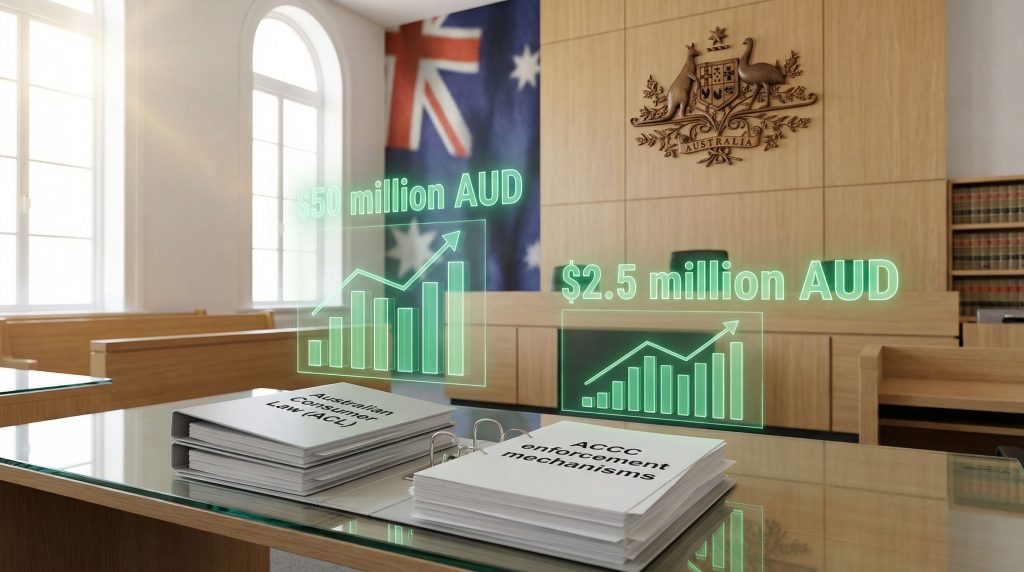
- Civil penalty proceedings can result in maximum fines of $50 million AUD for corporations
- Individual director liability can reach $2.5 million AUD under accessory liability provisions
- Consumer compensation claims often exceed regulatory penalties in aggregate value
The regulatory framework distinguishes between inadvertent pricing errors and systematic misleading conduct. Systematic patterns of price manipulation, particularly those involving temporal manipulation of reference prices, attract the highest penalty considerations. This distinction has become increasingly important as digital pricing systems enable rapid price adjustments across product categories.
Federal Court jurisdiction over consumer protection matters ensures consistent interpretation of misleading conduct standards across Australian jurisdictions. The court's approach emphasizes the perspective of reasonable consumers in their assessment of whether pricing representations create false impressions about value or savings opportunities.
The 'Down, Down' deals Coles ACCC case represents a significant development in this regulatory landscape, commencing with Federal Court proceedings in February 2026. This case has been characterized as potentially precedent-setting for how promotional pricing claims are evaluated under Australian consumer protection standards. In addition, businesses must remain vigilant about identifying regulatory risks that could impact their operations.
When big ASX news breaks, our subscribers know first
What Constitutes Misleading Pricing Under Australian Law?
Australian consumer protection law establishes specific criteria for determining when pricing representations cross the threshold from legitimate promotional activity to misleading conduct. The legal framework focuses on whether representations create false or misleading impressions about price reductions, value comparisons, or savings opportunities available to consumers.
Primary categories of misleading pricing conduct include:
- Temporal price manipulation: Artificially inflating regular prices for brief periods to create inflated reference points for subsequent discount claims
- False reference pricing: Using recommended retail prices or competitor comparisons that do not reflect genuine market conditions
- Inadequate disclosure: Failing to provide sufficient information about pricing methodologies, discount durations, or qualification requirements
- Volume-based deception: Presenting bulk pricing in ways that obscure actual per-unit costs or savings calculations
The evidentiary standards for establishing misleading conduct require demonstration that representations were likely to mislead reasonable consumers in the relevant market segment. Courts consider factors including consumer demographics, product categories, and the specific context in which pricing claims are presented.
Consumer reliance requirements have evolved through case law to include:
| Reliance Factor | Legal Standard | Practical Application |
|---|---|---|
| Reasonable consumer test | Would typical consumers be misled? | Assessed through consumer behavior evidence |
| Materiality threshold | Did pricing claims influence purchasing decisions? | Demonstrated through sales data analysis |
| Causation linkage | Direct connection between claims and consumer harm | Established through expert economic analysis |
| Foreseeability standard | Should retailers have anticipated consumer confusion? | Evaluated based on industry best practices |
The 'Down, Down' deals Coles ACCC case appears to center on allegations that promotional pricing claims may have created misleading impressions about genuine price reductions. While specific details of the allegations remain subject to court proceedings, the case highlights the ACCC's focus on promotional campaigns that use consistent branding messages across extended periods.
Documentation requirements for pricing compliance have intensified significantly. Retailers must maintain comprehensive records demonstrating the genuine nature of regular pricing, the duration of promotional periods, and the methodologies used to calculate discount percentages. These records become critical evidence in any subsequent enforcement proceedings.
Consumer psychology research has increasingly informed legal assessments of misleading conduct. Courts now consider academic studies on how consumers interpret pricing signals, the cognitive shortcuts used in value assessment, and the impact of brand messaging on purchasing decisions.
How Major Retailers Navigate Promotional Pricing Compliance
Australian retail corporations have developed sophisticated internal compliance frameworks responding to the heightened regulatory environment surrounding promotional pricing practices. These systems integrate legal review processes, technology solutions, and staff training programs designed to prevent misleading pricing representations while maintaining competitive promotional strategies.
Internal compliance infrastructure typically includes:
- Pricing governance committees with legal, marketing, and operations representation
- Technology audit trails tracking price changes and promotional campaign parameters
- Legal review protocols for advertising materials and promotional campaign structures
- Consumer communication standards ensuring clear disclosure of pricing methodologies
Risk management approaches have evolved beyond simple legal compliance to encompass reputational risk assessment and stakeholder communication strategies. Major retailers now engage external legal advisors specialising in consumer protection law to review complex promotional structures before market launch. However, companies must also consider broader regulatory changes, such as the executive order on permits affecting various business sectors.
Industry best practices for promotional pricing compliance:
- Reference price validation: Maintaining evidence that regular prices represent genuine market pricing over adequate time periods
- Disclosure standardisation: Implementing consistent formats for communicating pricing methodologies to consumers
- Campaign documentation: Creating comprehensive records of promotional decision-making processes and approval workflows
- Consumer feedback monitoring: Establishing systems to identify and respond to consumer confusion about pricing claims
The grocery retail sector faces particular challenges due to the frequency of promotional activities and the complexity of multi-product pricing strategies. Product categories with volatile supplier costs require enhanced documentation to justify pricing fluctuations and discount calculations.
Proactive engagement with the ACCC has become a strategic priority for major retailers. This includes voluntary consultation on complex promotional structures and participation in industry guidance development initiatives. Some retailers have implemented 'regulatory liaison officer' positions to manage ongoing relationships with consumer protection authorities.
Staff training programmes now extend beyond traditional marketing teams to include merchandising, category management, and store operations personnel. These programmes emphasise the legal implications of pricing decisions and the importance of accurate record-keeping for promotional activities. Consequently, retailers must also understand how broader market forces, including US tariffs and industry effect, can impact their compliance strategies.
The 'Down, Down' deals Coles ACCC case has intensified industry focus on long-running promotional campaigns that use consistent messaging themes. Retailers are reassessing campaigns that span extended periods to ensure pricing claims remain accurate throughout the promotional duration.
What Are the Financial Implications of Consumer Law Breaches?
The financial consequences of consumer protection law violations extend far beyond direct penalty assessments, encompassing class action exposure, operational disruption costs, and long-term reputational damage that can impact customer loyalty and shareholder value. Australian retail corporations face increasingly sophisticated penalty calculation methodologies that consider company size, market position, and the scope of consumer impact.
Maximum penalty structures under current Australian Consumer Law provisions:
| Violation Category | Corporate Maximum | Individual Maximum | Calculation Basis |
|---|---|---|---|
| Misleading conduct (per violation) | $50 million AUD | $2.5 million AUD | Turnover-based assessment |
| Systematic pricing violations | Multiple penalty multiplier | Director accessory liability | Consumer impact scaling |
| Ongoing promotional breaches | Penalty per promotional period | Personal accountability measures | Duration-based calculations |
Penalty calculation methodologies consider multiple factors:
- Corporate turnover analysis: Penalties scaled to company revenue and market capitalisation
- Consumer impact assessment: Number of affected customers and average financial harm per consumer
- Deterrent effect requirements: Ensuring penalties discourage future violations across the retail sector
- Cooperation credit: Reduced penalties for companies demonstrating proactive compliance efforts
Class action proceedings represent potentially larger financial exposure than regulatory penalties. Consumer class actions for misleading pricing typically seek compensation for the difference between advertised savings and actual savings available to consumers. These calculations can involve millions of transactions across extended time periods.
Historical class action settlement ranges for Australian retail pricing violations:
- Small-scale regional cases: $2-5 million AUD in consumer compensation
- National promotional campaigns: $15-50 million AUD settlement ranges
- Multi-year systematic violations: Potential exposure exceeding $100 million AUD
- Legal cost allocation: Additional $5-15 million AUD in professional fees
Reputational damage quantification has become increasingly sophisticated, with economic analysis firms specialising in brand value impact assessment. Studies indicate that high-profile consumer protection violations can reduce customer loyalty metrics by 15-25% over 12-month periods, with corresponding impacts on revenue and profit margins.
Insurance coverage for consumer protection violations varies significantly across retail corporations. Directors and officers insurance policies often exclude intentional misleading conduct but may provide coverage for inadvertent violations or defence costs during investigations.
The 'Down, Down' deals Coles ACCC case has generated significant market speculation about potential penalty ranges, with retail industry analysts suggesting the case could establish new benchmark penalty levels for promotional pricing violations. The case's characterisation as potentially precedent-setting suggests financial implications could extend beyond immediate penalty assessments. Moreover, companies must consider the global market tariff impact when evaluating overall financial risks.
Operational compliance costs have escalated substantially:
- Technology infrastructure upgrades: $2-10 million AUD for pricing audit systems
- Legal advisory services: $500,000-2 million AUD annually for ongoing compliance review
- Staff training programmes: $200,000-1 million AUD for comprehensive retail team education
- Audit and monitoring systems: $300,000-1.5 million AUD for internal compliance infrastructure
How Do Consumer Protection Cases Progress Through Federal Courts?
Federal Court proceedings for consumer protection violations follow established procedural frameworks designed to balance regulatory enforcement efficiency with defendant due process rights. The Australian court system has developed specialised approaches for managing complex commercial litigation involving multiple parties, extensive documentary evidence, and sophisticated economic analysis requirements.
Typical litigation timeline progression:
Investigation and Pre-Filing Phase (6-18 months)
- ACCC evidence gathering: Document production requests, witness interviews, expert analysis commissioning
- Corporate response protocols: Legal representation engagement, internal investigation processes, stakeholder communication
- Settlement negotiation opportunities: Early resolution discussions before formal court proceedings
- Parallel class action coordination: Managing simultaneous regulatory and private litigation risks
Federal Court Filing and Case Management (3-6 months)
- Pleadings exchange: Statement of claim, defence filing, and any cross-claims between parties
- Case management conferences: Court-directed scheduling for discovery, expert evidence, and trial preparation
- Interlocutory applications: Preliminary applications for protective orders, evidence preservation, or procedural determinations
- Public disclosure requirements: ASX continuous disclosure obligations for listed corporations
Discovery and Evidence Exchange (6-12 months)
- Document production: Comprehensive disclosure of pricing records, marketing materials, and internal communications
- Expert witness preparation: Economic analysis, consumer behaviour studies, and industry practice assessments
- Witness statement preparation: Key personnel interviews and statement verification processes
- Technical evidence compilation: Pricing system data extraction and analysis verification
Parallel proceeding management has become increasingly complex:
| Proceeding Type | Primary Objectives | Coordination Requirements |
|---|---|---|
| ACCC penalty proceedings | Regulatory compliance and deterrence | Evidence sharing protocols |
| Consumer class actions | Individual consumer compensation | Joint liability assessments |
| Shareholder litigation | Corporate governance accountability | Discovery coordination agreements |
| Insurance coverage disputes | Policy interpretation and coverage | Parallel litigation management |
The 'Down, Down' deals Coles ACCC case commenced in Federal Court in February 2026, with proceedings expected to span 12-18 months based on similar complex promotional pricing cases. The case management approach will likely involve extensive document discovery given the multi-year promotional campaign allegations.
Evidence preservation requirements have become increasingly stringent:
- Electronic data retention: Comprehensive preservation of pricing systems, marketing databases, and consumer communication records
- Chain of custody protocols: Formal procedures for maintaining evidence integrity throughout litigation
- Expert access provisions: Technical access for economic and consumer behaviour analysis
- Confidentiality protections: Court orders protecting commercially sensitive pricing strategies and competitive information
Settlement negotiations can occur throughout litigation proceedings, with Federal Court judges actively encouraging commercial resolution where appropriate. Settlement discussions often intensify following completion of expert evidence exchange, when parties have clearer assessments of litigation risks and potential outcomes.
What Lessons Can Other Retailers Learn From High-Profile Cases?
The evolving landscape of consumer protection enforcement provides critical insights for retail corporations seeking to maintain competitive promotional strategies while ensuring regulatory compliance. High-profile enforcement actions demonstrate the ACCC's sophisticated approach to investigating promotional pricing practices and the Federal Court's willingness to impose significant penalties for systematic misleading conduct.
Strategic compliance lessons from recent enforcement trends:
Proactive Legal Review Integration
- Marketing campaign approval workflows: Mandatory legal review before promotional campaign launch
- Pricing methodology documentation: Comprehensive records supporting discount calculations and reference price justifications
- Consumer communication auditing: Regular review of promotional materials for potential misleading representations
- Cross-functional compliance teams: Integration of legal, marketing, and operations perspectives in promotional planning
Technology-Enabled Compliance Monitoring
- Automated pricing audit systems: Real-time monitoring of price changes and promotional campaign parameters
- Consumer feedback analysis: Systematic review of customer complaints and inquiries related to promotional pricing
- Competitive pricing intelligence: Market analysis to ensure promotional claims reflect genuine competitive positioning
- Documentation automation: Technology solutions for maintaining comprehensive promotional campaign records
Industry-wide compliance evolution patterns:
- Enhanced disclosure practices: More comprehensive communication about pricing methodologies and promotional terms
- Shortened promotional periods: Reduced duration campaigns to minimise temporal manipulation risks
- Reference price standardisation: Industry adoption of consistent approaches to regular price establishment
- Consumer education initiatives: Proactive communication about promotional pricing practices and consumer rights
The 'Down, Down' deals Coles ACCC case has prompted retail industry associations to develop enhanced guidance materials for promotional pricing compliance. These resources emphasise the importance of genuine regular pricing periods and clear consumer communication about promotional terms.
Crisis management protocols have become essential:
- Early regulatory engagement: Proactive communication with ACCC when potential issues are identified
- Media relations coordination: Professional communication strategies for managing public relations during investigations
- Stakeholder communication plans: Coordinated messaging for investors, suppliers, and consumer groups
- Operational continuity planning: Maintaining business operations during extended litigation proceedings
Supply chain implications of consumer protection compliance extend beyond immediate retail operations. Supplier relationships must now accommodate enhanced documentation requirements, pricing transparency provisions, and potential testimony obligations in enforcement proceedings.
Consumer trust research indicates that transparency in promotional pricing practices has become a competitive advantage factor. Retailers demonstrating clear, consistent promotional practices report higher customer loyalty metrics and reduced customer service complaints related to pricing confusion. Furthermore, retailers must stay informed about broader economic developments, such as how the ACCC's case against Coles might influence their own compliance strategies.
The next major ASX story will hit our subscribers first
How Does This Case Influence Future Retail Industry Practices?
The 'Down, Down' deals Coles ACCC case represents a potential watershed moment for Australian retail promotional practices, with implications extending across grocery, general merchandise, and specialty retail sectors. Industry analysis suggests the case outcome could establish new precedents for promotional campaign duration limits, reference price validation requirements, and consumer communication standards.
Anticipated regulatory developments include:
Enhanced ACCC Enforcement Guidelines
- Promotional campaign duration limits: Potential guidance on maximum timeframes for consistent promotional messaging
- Reference price validation standards: Specific requirements for establishing genuine regular pricing baselines
- Consumer communication protocols: Standardised disclosure requirements for promotional pricing methodologies
- Industry consultation processes: Enhanced engagement between regulators and retail industry associations
Competitive Landscape Transformation
- Promotional strategy differentiation: Retailers developing unique approaches to avoid industry-wide promotional patterns
- Pricing transparency initiatives: Voluntary adoption of enhanced consumer communication about pricing practices
- Technology investment acceleration: Industry-wide adoption of advanced pricing compliance monitoring systems
- Professional services expansion: Growth in legal and compliance advisory services specialising in promotional pricing
Market competition effects are already emerging:
| Impact Category | Short-term Effects (6-12 months) | Long-term Implications (2-5 years) |
|---|---|---|
| Promotional frequency | Reduced campaign duration and frequency | Industry standardisation of promotional cycles |
| Consumer communication | Enhanced disclosure in marketing materials | Technology-enabled real-time pricing transparency |
| Compliance investment | Immediate system upgrades and staff training | Integrated compliance management platforms |
| Competitive positioning | Differentiation through compliance leadership | Trust-based competitive advantages |
Investment community analysis suggests that consumer protection compliance capabilities may become key valuation factors for retail corporations. ESG (Environmental, Social, and Governance) investment criteria increasingly incorporate consumer protection track records in retail sector assessment methodologies.
Consumer behaviour adaptation patterns:
- Promotional scepticism increase: Enhanced consumer scrutiny of discount claims and promotional messaging
- Price comparison sophistication: Greater use of technology tools for independent price verification
- Brand trust prioritisation: Consumer preference for retailers with transparent pricing practices
- Regulatory awareness growth: Increased consumer knowledge of rights and complaint mechanisms
Legislative reform discussions within Australian government circles focus on potential amendments to strengthen consumer protection frameworks. Proposed changes include mandatory pricing history disclosure requirements, standardised promotional pricing terminology, and enhanced penalty calculation methodologies.
The 'Down, Down' deals Coles ACCC case has generated international attention from consumer protection regulators in comparable jurisdictions. Regulatory authorities in the United Kingdom, Canada, and New Zealand are monitoring case developments for potential application in their respective enforcement frameworks. As reported by The Guardian, consumer watchdogs are arguing that the promotional practices may have been utterly misleading to customers.
Industry association response initiatives:
- Best practice development: Collaborative creation of industry standards for promotional pricing compliance
- Training programme expansion: Enhanced professional development opportunities for retail compliance personnel
- Regulatory liaison committees: Formal consultation structures between industry groups and consumer protection authorities
- Research and development coordination: Joint investment in technology solutions for promotional pricing compliance
What Should Consumers Know About Their Rights in Pricing Disputes?
Australian consumers possess comprehensive legal protections against misleading promotional pricing practices, with multiple avenues available for seeking compensation and resolution of pricing disputes. Understanding these rights enables consumers to make informed decisions about participation in enforcement actions and class action proceedings.
Individual consumer remedy options:
Direct Compensation Claims
- Statutory guarantees: Right to refund or exchange for goods not matching promotional representations
- Misleading conduct damages: Compensation for financial losses resulting from misleading pricing claims
- Consequential loss recovery: Additional costs incurred due to reliance on false promotional information
- Interest and legal cost recovery: Potential reimbursement for costs associated with successful claims
Dispute Resolution Mechanisms
- Consumer affairs agencies: State-based consumer protection departments offering mediation services
- Industry ombudsman schemes: Sector-specific dispute resolution for retail and telecommunications industries
- Small claims courts: Accessible court proceedings for individual claims under statutory thresholds
- Alternative dispute resolution: Professional mediation and arbitration services for complex pricing disputes
Class action participation guidelines provide consumers with important choices:
| Class Action Stage | Consumer Rights | Decision Requirements |
|---|---|---|
| Case commencement | Automatic inclusion unless opt-out | No immediate action required |
| Settlement negotiations | Right to object to proposed settlements | Active participation in approval processes |
| Distribution phase | Entitlement to share of settlement funds | Evidence submission for compensation calculation |
| Appeals process | Right to be represented in higher court proceedings | Potential additional waiting periods |
Evidence preservation recommendations for consumers include:
- Purchase documentation: Receipts, credit card statements, and promotional materials from disputed transactions
- Communication records: Correspondence with retailers about pricing issues or complaint resolution attempts
- Advertising materials: Screenshots, printouts, or recordings of promotional claims that influenced purchasing decisions
- Financial impact documentation: Records demonstrating additional costs or lost savings from misleading pricing
The 'Down, Down' deals Coles ACCC case may result in consumer compensation opportunities separate from ACCC penalty proceedings. Consumers who believe they were misled by promotional pricing claims during relevant periods should preserve transaction records for potential future claims.
Consumer advocacy organisations play crucial roles in monitoring retail pricing practices and supporting individual consumer rights. These organisations often coordinate group complaints to regulators and provide resources for understanding complex class action proceedings.
Legal representation options for consumer pricing disputes vary based on claim complexity and potential recovery amounts. No-win, no-fee arrangements are commonly available for class action participation, while individual claims may qualify for legal aid assistance in appropriate circumstances.
Consumer education initiatives have expanded significantly following high-profile enforcement actions. These programmes focus on recognising misleading promotional practices, understanding legal rights, and accessing appropriate dispute resolution mechanisms.
Consumer protection in promotional pricing represents a fundamental market fairness principle where sophisticated legal frameworks must balance commercial innovation with transparent communication standards that enable informed consumer decision-making.
Digital technology has enhanced consumer ability to verify pricing claims through price comparison applications and historical pricing databases. These tools provide consumers with independent verification capabilities that complement legal protection frameworks.
Frequently Asked Questions About Retail Pricing Law Compliance
What evidence do consumers need to prove misleading pricing claims?
Consumers must demonstrate that promotional pricing representations created false impressions about savings or value. Required evidence typically includes purchase receipts, promotional materials, and documentation of the actual pricing history for disputed products. Consumer protection authorities can access retailer pricing systems to verify genuine regular pricing patterns.
How long do retailers need to sell products at regular prices before promotional claims become valid?
Australian consumer law does not specify exact timeframes, but courts generally require that regular prices represent genuine market pricing over reasonable periods. Industry practice suggests minimum 4-6 week regular pricing periods before promotional discount claims, though this varies based on product categories and seasonal factors.
Can consumers pursue individual compensation while class action proceedings are ongoing?
Individual consumer rights are generally preserved during class action proceedings, but consumers must choose between participating in class actions or pursuing separate individual claims. Legal advice is recommended to assess which option provides better compensation prospects for specific circumstances.
What penalties can retail executives face for misleading pricing violations?
Individual directors and executives can face personal liability up to $2.5 million AUD under accessory liability provisions if they are knowingly involved in misleading conduct. Corporate executives may also face professional sanctions and reputational consequences affecting future employment opportunities.
How do promotional pricing violations affect consumer guarantee protections?
Misleading pricing violations do not eliminate consumer guarantee rights for product quality and fitness for purpose. Consumers retain statutory guarantee protections regardless of whether promotional pricing claims are subsequently found to be misleading or deceptive.
What role do consumer complaints play in ACCC investigation decisions?
Consumer complaints provide crucial intelligence for ACCC enforcement priorities and investigation initiation. The volume and consistency of complaints about specific promotional practices often trigger formal investigations, particularly when complaints demonstrate systematic patterns across multiple consumers and time periods.
This analysis is provided for informational purposes and does not constitute legal advice. Consumers and businesses should consult qualified legal professionals for specific guidance on consumer protection law compliance and enforcement matters.
Ready to Navigate Complex Market Regulations and Opportunities?
With regulatory landscapes constantly evolving across sectors like retail, mining, and investments, Discovery Alert's proprietary Discovery IQ model cuts through market complexity to deliver real-time alerts on significant ASX mineral discoveries. Stay ahead of regulatory changes and market shifts with immediate insights that transform complex data into actionable investment opportunities, ensuring you're positioned for success when major discoveries create substantial market movements. Begin your 14-day free trial today and secure your competitive advantage in an increasingly regulated investment environment.