
June 15, 2026
Understanding the Structural Challenges Behind Australia's Gold Production Setbacks
Australia's mining sector faces unprecedented infrastructure challenges as aging processing facilities struggle to meet modern production demands. The convergence of decades-old equipment with contemporary extraction targets creates systematic vulnerabilities that extend far beyond individual operators, revealing deeper structural issues within the Northern Star gold production guidance downgrade and broader industry evolution trends. Furthermore, these infrastructure limitations affect operational forecasting accuracy across multiple operators in the sector.
When big ASX news breaks, our subscribers know first
Understanding the Structural Challenges Behind Australia's Gold Production Setbacks
Gold mining operations across Australia confront a critical infrastructure crisis as processing facilities installed during previous commodity cycles reach the end of their operational effectiveness. The technical degradation of milling equipment creates cascading production disruptions that compound quarterly guidance uncertainties across multiple operators.
Mill Infrastructure Degradation at Kalgoorlie Operations
Processing facility constraints represent the most significant bottleneck affecting Australian gold production, with throughput limitations directly correlating to reduced annual output capacity. Northern Star Resources exemplifies this challenge through its Kalgoorlie operations, where aging mill infrastructure has created systematic production shortfalls.
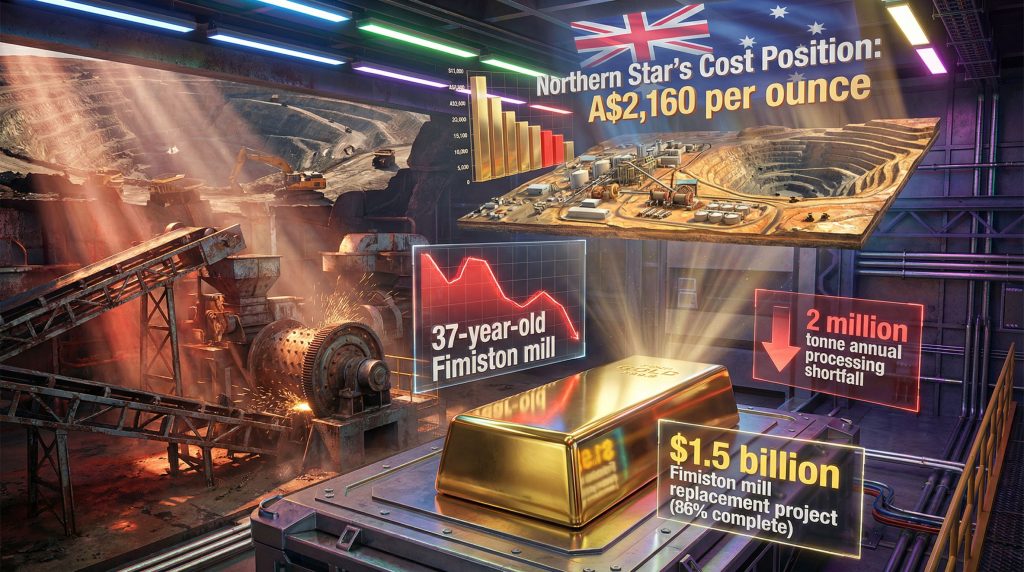
The company's current milling capacity struggles to process ore at rates necessary to meet annual production targets, resulting in a 2 million tonne processing deficit that cascades into guidance revisions. Equipment reliability issues compound these throughput constraints, as aging components require more frequent maintenance cycles that interrupt continuous production flows.
Key Infrastructure Metrics:
- 37-year operational history of primary milling equipment
- Processing throughput gaps creating annual production shortfalls
- Maintenance frequency increases reducing operational uptime
Labour Productivity Pressures at Jundee Operations
Mining efficiency metrics across Australian gold operations indicate declining productivity relative to global industry benchmarks. Workforce deployment optimisation challenges affect operational continuity, particularly when combined with infrastructure constraints that limit processing capacity regardless of mining output levels.
Cost-reduction initiatives under review create additional operational uncertainty, as management teams balance workforce optimisation against production consistency requirements. These labour productivity pressures extend beyond individual sites, reflecting broader industry challenges in maintaining skilled mining personnel across remote operational locations.
The integration of mining efficiency improvements with processing capacity expansion requires coordinated workforce planning that accounts for both current operational needs and future infrastructure capabilities. Additionally, CEO production insights reveal similar challenges across the sector.
How Do Production Downgrades Impact Gold Mining Valuations?
Market reactions to production guidance revisions demonstrate heightened sensitivity within the Australian gold sector, particularly when downgrades occur during elevated commodity price environments. Valuation frameworks employed by institutional investors incorporate guidance reliability as a key factor in determining premium multiples for mining equity investments.
Market Reaction Analysis Framework
Northern Star Resources experienced approximately 20% share price decline following its production guidance revision, significantly exceeding typical market responses to similar announcements across the sector. The magnitude of this reaction reflects accumulated credibility concerns regarding management's ability to forecast production accurately.
| Impact Category | Northern Star Example | Industry Benchmark |
|---|---|---|
| Share Price Volatility | -20% single-day decline | -8% to -12% typical range |
| Market Cap Erosion | Billions in value lost | Varies by company size |
| Guidance Reliability | Repeated downgrades | Single revision tolerance |
| Premium Valuation Loss | Material discount applied | Temporary adjustment |
The company's $15 fair value estimate maintained by analysts suggests the market reaction exceeded fundamental valuation impacts, indicating investor sentiment deterioration beyond operational challenges alone.
Investor Confidence Metrics
Guidance reliability concerns directly affect premium valuations commanded by gold mining equities, as institutional investors apply discount factors to companies demonstrating forecast volatility. The repeated nature of Northern Star's guidance revisions compounds credibility challenges, with market participants questioning management's operational visibility.
Cash flow projection uncertainty impacts dividend sustainability assessments, as reduced production volumes directly correlate to lower cash generation capacity. This creates secondary valuation pressure as income-focused investors reassess dividend coverage ratios under revised production scenarios.
Operational credibility challenges extend beyond financial metrics to encompass management team effectiveness in executing operational improvements. The market's reaction magnitude suggests accumulated scepticism regarding infrastructure upgrade timelines and productivity enhancement initiatives.
Moreover, recent production insights Q4 data indicates that Northern Star's challenges reflect broader sectoral trends affecting production forecasting accuracy.
What Are the Long-Term Production Recovery Strategies?
Infrastructure replacement strategies represent the primary pathway for production recovery, with capital-intensive mill replacement projects offering the most direct solution to throughput constraints. Northern Star's approach demonstrates the scale of investment required to address aging processing infrastructure across Australian gold operations.
Capital Investment Solutions
The $1.5 billion Fimiston mill replacement project represents one of Australia's largest gold processing infrastructure investments, designed to double current throughput capacity. Project completion status at 86% indicates near-term resolution of current production constraints, with commissioning scheduled for July 2026.
Enhanced throughput capacity targeting 27 million tonnes annually represents a fundamental transformation of processing capabilities, with full capacity achievement projected for fiscal year 2029. This timeline accommodates ramp-up periods necessary for complex processing equipment optimisation and workforce training requirements.
Investment Parameters:
- Total project cost: $1.5 billion infrastructure replacement
- Capacity enhancement: Processing throughput doubling capability
- Implementation timeline: July 2026 commissioning with FY29 full capacity
- Production impact: Resolution of current 2 million tonne processing deficit
Asset Optimisation Approaches
Equipment redeployment strategies enable mining operators to optimise resource allocation across multiple operational sites, improving overall fleet utilisation while addressing specific capacity constraints. Northern Star's multi-site portfolio provides flexibility for equipment redistribution based on production priorities and infrastructure capabilities.
Staff rationalisation initiatives across underperforming sites create cost optimisation opportunities while maintaining operational capacity at higher-productivity locations. This approach requires careful coordination to avoid disrupting critical operational knowledge and maintaining regulatory compliance across all sites.
Processing facility consolidation strategies concentrate production through higher-efficiency facilities, reducing operational complexity while improving overall throughput capacity. The integration of acquired assets through consolidation creates synergy opportunities that extend beyond simple cost reduction.
However, investors should remain vigilant about management red flags that could indicate deeper operational challenges beyond infrastructure constraints.
How Does Northern Star's Position Compare on the Global Cost Curve?
Cost curve positioning within the global gold industry determines operational sustainability across commodity price cycles, with Australian producers facing unique cost pressures related to labour expenses and regulatory compliance requirements. Northern Star's cost structure places it within competitive ranges while maintaining exposure to commodity price volatility.
All-In Sustaining Cost Analysis
Northern Star's all-in sustaining cost of approximately AUD 2,160 per ounce (equivalent to USD 1,400 per ounce) positions the company within the middle of the second quartile on the global gold industry cost curve. This cost position provides operational flexibility across moderate commodity price environments while maintaining profitability during price downturns.
Guidance maintenance of AUD 875-975 per ounce reflects operational optimisation initiatives designed to improve cost positioning relative to global peers. The significant gap between current costs and guidance targets indicates substantial operational improvement potential through infrastructure upgrades and efficiency enhancements.
Cost Structure Components:
- Current AISC: AUD 2,160 per ounce (USD 1,400)
- Industry positioning: Second quartile middle range
- Target cost range: AUD 875-975 per ounce maintained
- Improvement potential: Significant operational optimisation opportunity
Competitive Positioning Factors
Geographic concentration risk in Western Australia creates operational vulnerability through weather-related disruptions and regulatory changes affecting the regional mining sector. However, this concentration also provides logistical advantages through established infrastructure and skilled labour availability.
Processing facility efficiency gaps relative to global peers reflect the aging infrastructure challenges affecting Australian gold operations broadly. The upcoming mill replacement project addresses this competitive disadvantage while positioning Northern Star for improved cost curve placement.
Reserve quality versus extraction complexity trade-offs require ongoing evaluation as mining operations extend deeper into existing ore bodies. Higher-grade reserves justify increased extraction costs, while lower-grade zones require processing efficiency improvements to maintain profitability.
Furthermore, understanding these competitive dynamics becomes crucial when developing comprehensive investment strategy insights for the gold sector.
What Role Does Gold Price Volatility Play in Production Planning?
Commodity price cycles create complex strategic planning challenges for gold mining companies, requiring production optimisation decisions that balance short-term cash generation against long-term operational sustainability. Price volatility affects capacity utilisation strategies and capital allocation priorities across multi-year investment horizons.
Price Sensitivity Modelling
Gold mining operations demonstrate significant sensitivity to commodity price fluctuations, with production planning strategies requiring scenario-based modelling across multiple price environments. Current gold prices at approximately USD 5,100 per ounce create exceptional cash generation opportunities while masking operational efficiency challenges.
| Gold Price Scenario | Production Impact | Cash Flow Effect |
|---|---|---|
| USD 2,050 (midcycle) | Optimal capacity utilisation | Sustainable dividend policy |
| USD 5,100 (current) | Maximum production push | Enhanced cash generation |
| Below USD 1,800 | Selective mining approach | Dividend review likely |
Midcycle price assumptions of USD 2,050 per ounce represent long-term marginal cost estimates for global gold production, providing baseline scenarios for infrastructure investment decisions. Current elevated prices create opportunities for accelerated capital investment in processing capacity upgrades.
Hedging Strategy Implications
Spot price exposure strategies maximise cash flow generation during elevated commodity price environments while accepting downside risk during price corrections. Forward sales contracts provide price certainty for capital project financing but limit upside participation during price appreciation periods.
Currency hedging requirements for Australian dollar-denominated operations create additional complexity when gold sales occur in USD markets. Exchange rate volatility affects realised gold prices and cash flow projections independently of commodity price movements.
Production flexibility enables mining operators to optimise extraction rates based on prevailing commodity prices, with higher prices justifying increased operational intensity and lower prices supporting conservation strategies for higher-grade reserves.
According to recent analysis from The Australian Financial Review, the Northern Star gold production guidance downgrade reflects these broader price volatility challenges facing the sector.
The next major ASX story will hit our subscribers first
How Do Acquisition Strategies Affect Operational Integration?
Growth through acquisition creates operational complexity that compounds during periods of infrastructure stress, requiring management attention allocation across multiple sites with varying operational characteristics. Northern Star's 14 acquisitions since 2010 demonstrate the integration challenges facing diversified gold mining portfolios.
Portfolio Complexity Management
Multi-site coordination difficulties emerge when aging infrastructure affects different operations simultaneously, requiring prioritisation decisions regarding capital allocation and operational support resources. The integration of Pogo operations in Alaska and Kalgoorlie Super Pit consolidation created geographic diversification while increasing management complexity.
Standardisation challenges across acquired assets reflect varying operational practices and equipment specifications inherited through acquisition activity. The 2021 Saracen merger added additional processing facilities with different throughput capacities and maintenance requirements.
Management attention allocation between operations becomes critical during operational stress periods, with infrastructure challenges at major facilities potentially affecting oversight of smaller operations. Resource allocation decisions require balancing immediate operational needs against long-term strategic priorities.
Synergy Realisation Timelines
De Grey Mining integration through the May 2025 acquisition adds development-stage assets requiring different management approaches compared to operating mines. The Hemi project development targets 500,000 ounces annually by 2030, representing approximately 25% of current total company production.
Kalgoorlie operations consolidation benefits include processing facility optimisation and reduced operational complexity through unified management approaches. The consolidation of 100% ownership in the Kalgoorlie Super Pit enables integrated planning for infrastructure upgrades and production optimisation.
Processing facility optimisation across the portfolio creates opportunities for load balancing during maintenance periods and capacity utilisation improvements during normal operations. Cross-facility coordination becomes increasingly important as processing constraints affect overall production capacity.
What Are the Implications for Australian Gold Sector Investment?
The Northern Star gold production guidance downgrade reflects broader investment themes affecting Australian gold mining sector attractiveness, particularly regarding infrastructure age and capital intensity requirements. Mid-tier producers face distinctive pressures compared to major mining companies with greater capital allocation flexibility.
Sector-Wide Risk Factors
Infrastructure age across Australian gold operations creates systematic vulnerabilities as processing facilities installed during previous commodity cycles reach replacement requirements simultaneously. The capital intensity of mill replacement projects affects sector-wide cash flow allocation and dividend sustainability.
Labour cost inflation pressures in Australian mining regions create ongoing operational expense increases that affect cost curve positioning relative to global peers. Skilled labour shortages in remote mining locations compound these cost pressures while creating operational continuity risks.
Regulatory compliance complexity increases operational overhead costs while creating project approval delays for infrastructure upgrade initiatives. Environmental assessment requirements for major processing facility modifications extend project timelines and increase capital costs.
Investment Thesis Considerations
Production growth potential through infrastructure investment offers compelling value creation opportunities for investors willing to accept execution risk during construction and commissioning phases. The scale of throughput improvements available through mill replacement creates significant production capacity expansion.
Dividend sustainability during operational transitions requires careful evaluation of cash flow generation capacity under various commodity price scenarios. Companies undertaking major capital projects may reduce dividend distributions temporarily to fund infrastructure investments.
Takeover premium opportunities emerge when operational challenges create temporary valuation discounts relative to underlying asset value. Infrastructure constraints that reduce current production capacity may not reflect long-term production potential following capital investment completion.
As highlighted in recent Stockhead analysis, the market's reaction to production challenges creates both risks and opportunities for astute investors.
How Should Investors Evaluate Gold Mining Production Guidance?
Sophisticated investment analysis of gold mining operations requires multi-factor evaluation frameworks that incorporate infrastructure age, management execution history, and reserve quality assessments beyond simple production volume projections. Guidance reliability represents a critical factor in determining appropriate valuation multiples.
Due Diligence Framework
Infrastructure age assessment requires detailed evaluation of processing equipment installation dates, maintenance history, and replacement capital requirements over investment horizons. Equipment approaching end-of-life creates predictable production disruption risks that affect cash flow projections.
Management track record evaluation on guidance accuracy provides insight into operational visibility and execution capabilities during challenging operational periods. Repeated guidance revisions indicate systematic forecasting challenges that may persist until underlying operational issues receive resolution.
Reserve quality analysis encompasses ore grade distribution, mining complexity, and processing requirements that affect extraction costs and production scheduling flexibility. Higher-grade reserves provide operational flexibility during commodity price volatility while lower-grade zones require processing efficiency optimisation.
Cost curve positioning relative to global peers determines operational sustainability across commodity price cycles, with lower-cost producers maintaining profitability during price downturns while higher-cost operations face margin pressure.
Risk-Adjusted Return Calculations
Production variability impact on cash flow modelling requires scenario analysis incorporating infrastructure constraint effects on output consistency. Base case, upside, and downside production scenarios enable probability-weighted return calculations that account for operational uncertainty.
Capital allocation efficiency assessment examines management's historical success in improving operational performance through infrastructure investment and acquisition integration. Successful capital deployment history suggests higher probability of achieving projected production improvements.
Dividend policy sustainability under various commodity price and production scenarios requires cash flow sensitivity analysis incorporating debt service requirements and capital expenditure commitments. Sustainable dividend policies provide income certainty during operational transition periods.
The evaluation of gold mining investments during periods of operational transition requires balancing current production challenges against long-term capacity improvement potential. Infrastructure replacement projects create near-term execution risk while offering substantial production enhancement opportunities for successful implementation.
Consequently, the Northern Star gold production guidance downgrade serves as a critical case study for investors evaluating similar operational transitions across the Australian gold mining sector. Understanding these dynamics becomes essential for making informed investment decisions in this capital-intensive industry.
Investment in mining securities involves significant risk including commodity price volatility, operational execution challenges, and regulatory changes. Past performance does not guarantee future results. Investors should conduct thorough due diligence and consider their risk tolerance before making investment decisions.
Want to Stay Ahead of Major Mining Discoveries?
Discovery Alert's proprietary Discovery IQ model delivers instant notifications on significant ASX mineral discoveries, transforming complex mining data into actionable investment insights ahead of the broader market. Experience how historic discoveries have generated substantial returns by exploring Discovery Alert's dedicated discoveries page and begin your 14-day free trial today to position yourself advantageously in Australia's dynamic mining sector.