July 23, 2026
Australia's Petroleum Infrastructure Concentration Creates Systemic Risk
The fire at Geelong oil refinery in April 2026 exposed a critical vulnerability in Australia's energy infrastructure that has been developing for decades. This incident highlighted how the nation's petroleum processing capability has become dangerously concentrated, creating systemic risks that extend far beyond the immediate vicinity of any single facility.
Critical Processing Capacity Limitations
Australia operates with an exceptionally narrow petroleum refining infrastructure consisting of only two active facilities as of April 2026. This concentration creates unprecedented vulnerability when operational disruptions occur at either location, as demonstrated by the recent oil price crash insights affecting global markets.
The current operational refineries include:
- Viva Energy's Geelong Refinery (Victoria) – subject to the April 15-16, 2026 fire incident
- Ampol's Lytton Refinery (Brisbane, Queensland)
This duopoly structure emerged following decades of industry consolidation that systematically reduced operational redundancy across the continent. Energy Minister Chris Bowen's acknowledgement during the Geelong incident that Australia faces impact when "one of Australia's two oil refineries" experiences disruption highlights the precarious nature of this concentrated system.
Import Dependency and Strategic Vulnerabilities
The limited domestic processing infrastructure creates significant strategic exposure through several mechanisms. Furthermore, this situation becomes particularly concerning when considering global energy exports challenges facing resource-dependent nations.
Supply Chain Dependencies:
- International shipping lane concentration through Southeast Asian maritime corridors
- Foreign exchange currency exposure on petroleum product purchases
- Price volatility exposure from global spot market fluctuations
- Emergency allocation protocols during international crisis scenarios
Processing Capacity Shortfalls:
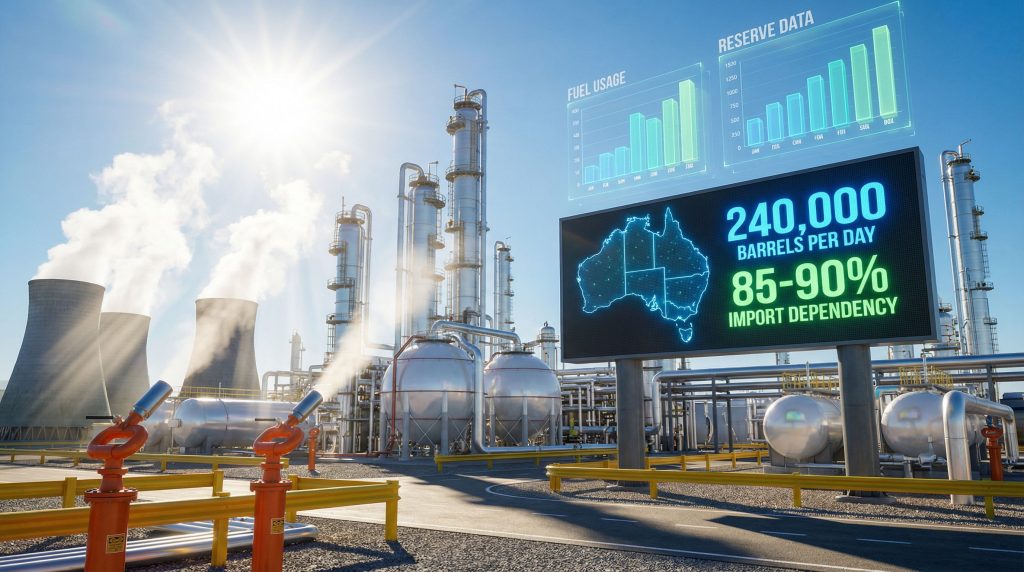
- Domestic refining capability covers approximately 10-15% of national consumption requirements
- Import requirements for 85-90% of refined petroleum products
- Strategic reserve coverage maintaining 28-35 days under International Energy Agency standards
- Limited surge capacity during emergency situations
The geographic separation between Australia's two refineries provides minimal risk mitigation, as both facilities serve distinct regional markets with limited cross-supply capabilities during emergency situations.
When big ASX news breaks, our subscribers know first
Economic Cascade Effects From Infrastructure Disruption
Immediate Market Response Mechanisms
The April 16, 2026 trading session demonstrated how energy infrastructure incidents trigger immediate market adjustments. Despite the ASX 200 maintaining modest gains at 8,978.7 points following risk-on momentum from US markets, analysts recognised the potential for delayed reaction as news spread throughout trading hours.
Market Sentiment Indicators on April 16, 2026:
- ASX 200: +0.2% modest advance despite infrastructure concerns
- Brent Crude: -0.1% to $94.69/barrel
- Australian Dollar: 71.7 US cents
- Iron Ore: +0.8% to $104.30/tonne (Singapore)
- Gold: Steady at $4,811/ounce
Market analysts noted that whilst initial trading followed international momentum, the Viva Energy incident "could be a bigger story locally as the morning gets on," indicating sophisticated market recognition of potential economic implications. In addition, global oil price movements analysis suggests that such incidents can have far-reaching consequences for international energy markets.
Sectoral Impact Distribution
Petroleum refining disruptions create immediate effects across multiple economic sectors through interconnected supply dependencies:
| Affected Sector | Primary Impact | Secondary Effects |
|---|---|---|
| Transportation | Fuel allocation priorities | Logistics cost increases |
| Aviation | Jet fuel supply constraints | Route optimisation requirements |
| Agriculture | Diesel availability concerns | Equipment operation limitations |
| Emergency Services | Strategic fuel reserves | Response capability planning |
| Manufacturing | Process energy costs | Production scheduling adjustments |
These cascading effects demonstrate why government officials immediately acknowledge systemic impact when critical infrastructure experiences operational disruption.
Emergency Response Effectiveness and Safety Protocol Performance
Demonstrated Containment Capabilities
The April 2026 Geelong incident provided a real-world validation of modern petroleum facility emergency response systems. Despite the fire being characterised as "massive" and reaching significant scale overnight, safety protocols functioned effectively.
According to The Guardian's coverage, the incident raised immediate concerns about fuel price impacts across Victoria and beyond.
Successful Emergency Response Outcomes:
- Fire contained to 30m × 30m perimeter by first light
- Zero reported injuries or fatalities among facility personnel
- Storage tank integrity maintained – no ruptures or explosions of refined or crude fuel containers
- Isolation procedures prevented cascade failures to adjacent processing units
Fire Rescue Victoria's incident commander confirmed the containment achievement, demonstrating that automated suppression systems and emergency shutdown procedures operated as designed during the crisis.
Safety System Architecture Validation
The incident revealed effective implementation of multi-layered protection protocols:
Primary Protection Systems:
- Automated fire suppression engagement
- Emergency isolation valve activation
- Personnel evacuation procedures without reported incidents
- Perimeter security establishment
Secondary Containment Measures:
- Process unit separation preventing spread
- Storage tank protection systems
- Emergency services coordination protocols
- Communication systems maintaining operational status
Viva Energy CEO Scott Wyatt's characterisation of the event as "a challenging incident" whilst noting that "units impacted are in the petrol complex" indicates that damage remained confined to specific processing areas rather than spreading throughout the facility.
National Energy Security Framework Implications
Strategic Asset Protection Requirements
Australia's limited domestic refining capacity elevates each operational facility to strategic national importance. However, the concentration of processing capability within two facilities creates unique policy challenges for energy security planning, particularly as the industry faces pressure from renewable energy transformations occurring globally.
Critical Infrastructure Designation Factors:
- Essential service provision to national economy
- Limited alternative supply arrangements during disruption
- Geographic concentration creating regional supply dependencies
- Military and emergency services fuel allocation requirements
Government Intervention Thresholds
Energy Minister Chris Bowen's immediate acknowledgement that "there will be an impact" from the Geelong incident demonstrates established government recognition protocols for critical infrastructure disruption. This rapid official response indicates pre-existing frameworks for:
- Strategic petroleum reserve activation consideration
- Emergency fuel allocation prioritisation
- Interstate supply coordination mechanisms
- Industry coordination for alternative sourcing arrangements
The government's immediate acknowledgement of systemic impact demonstrates the strategic importance of maintaining operational redundancy within critical energy infrastructure networks.
Investment Risk Assessment and Market Valuation Impact
Infrastructure Concentration Premium
Energy infrastructure companies with strategic national importance trade at valuations reflecting their essential service provision and limited competitive alternatives. Furthermore, global factors such as OPEC production impact continue to influence market dynamics and investment decisions.
Risk Assessment Metrics:
- Facility replacement costs and comprehensive insurance coverage
- Alternative supply arrangement capabilities during operational disruption
- Regulatory compliance track records and safety performance history
- Strategic asset concentration risks versus operational efficiency benefits
Market Psychology Factors:
- Government support likelihood during crisis scenarios
- Essential service designation providing regulatory protection
- Limited new entrant probability due to capital requirements and regulatory barriers
- Strategic importance creating implicit government partnership
Sector Investment Opportunities
Infrastructure vulnerabilities create investment opportunities across multiple related sectors:
Technology Enhancement Sectors:
- Advanced monitoring and predictive maintenance systems
- Fire suppression and safety technology improvements
- Process automation and remote operation capabilities
- Emergency response coordination platforms
Alternative Infrastructure Development:
- Renewable fuel processing facility development
- Strategic storage and distribution network expansion
- Modular processing technology implementation
- International supply chain diversification projects
Regional Economic Multiplier Effects
Employment and Community Impact
Major petroleum processing facilities serve as regional economic anchors with significant direct and indirect employment effects. Consequently, incidents like the fire at Geelong oil refinery have implications extending well beyond immediate operational concerns.
Direct Economic Contributions:
- 500-800 permanent positions in refinery operations
- 1,200-1,500 contractor services for maintenance and specialised support
- 300-400 logistics operations roles in transportation and materials handling
- 2,000-3,000 indirect employment opportunities throughout regional supply chains
Community Investment Effects:
- $150-200 million annually in local procurement spending
- $25-35 million in combined local and state tax revenue generation
- Infrastructure utilisation optimisation across port, rail, and pipeline networks
- Education, healthcare, and social infrastructure support investments
Regional Resilience Planning
The geographic concentration of refining capacity creates regional economic dependencies that extend beyond direct facility employment:
- Supply chain integration: Local businesses adapted to support petroleum processing operations
- Skills development: Specialised workforce training aligned with facility requirements
- Infrastructure investment: Transportation and utilities optimised for energy sector needs
- Economic diversification: Regional development strategies incorporating energy infrastructure advantages
The next major ASX story will hit our subscribers first
Technology Integration and Future Infrastructure Resilience
Advanced Process Control Implementation
Modern petroleum processing facilities increasingly integrate sophisticated monitoring and control systems to enhance operational safety and efficiency. The Age reported that the Geelong facility's emergency systems performed effectively during the crisis.
Digital Infrastructure Components:
- Predictive maintenance systems utilising sensor networks and machine learning algorithms
- Real-time safety monitoring with automated emergency response activation
- Process optimisation platforms maximising efficiency whilst maintaining safety protocols
- Remote operation capabilities enabling expert intervention during emergency situations
Alternative Feedstock Processing Capabilities
Infrastructure modernisation opportunities include adaptation for renewable and alternative fuel production:
Technology Enhancement Pathways:
- Renewable fuel processing integration within existing facility footprints
- Modular facility design enabling distributed processing networks
- Advanced feedstock flexibility accommodating multiple input types
- Carbon capture and utilisation systems for environmental compliance
These technological advancement opportunities provide pathways for enhancing infrastructure resilience whilst maintaining essential fuel production capabilities.
Policy Framework Development for Infrastructure Protection
Investment Incentive Structures
Strategic energy infrastructure requires comprehensive policy support frameworks addressing both operational security and long-term sustainability. However, current frameworks must adapt to evolving global energy markets and geopolitical pressures.
Financial Support Mechanisms:
- Tax incentive structures for facility safety and efficiency upgrades
- Regulatory frameworks supporting strategic infrastructure investment
- Research and development funding for advanced processing technologies
- Workforce development programmes for specialised technical skills
Strategic Partnership Development:
- International cooperation agreements for emergency supply arrangements
- Public-private coordination for infrastructure resilience planning
- Industry collaboration frameworks for best practice implementation
- Academic research partnerships for technology advancement
Emergency Preparedness Enhancement
The April 2026 Geelong incident demonstrates the effectiveness of existing emergency protocols whilst highlighting opportunities for system enhancement:
Preparedness Framework Components:
- Multi-facility coordination protocols for capacity sharing during disruption
- Strategic reserve management with rapid deployment capabilities
- Alternative supply activation through international partnership arrangements
- Communication systems ensuring coordinated response across government and industry
Australia's energy infrastructure resilience depends on maintaining both operational excellence at existing facilities and strategic planning for future capacity enhancement. The successful containment of the fire at Geelong oil refinery whilst maintaining zero casualties demonstrates effective safety system implementation, whilst the immediate government acknowledgement of systemic impact confirms the strategic importance of protecting these critical national assets.
Disclaimer: This analysis is based on publicly available information and market observations. Readers should conduct independent research and consult financial advisors before making investment decisions related to energy infrastructure or associated companies. Market conditions, commodity prices, and regulatory frameworks may change significantly over time.
Ready to Capitalise on Australia's Next Major Energy Discovery?
Discovery Alert's proprietary Discovery IQ model delivers instant notifications on significant ASX mineral and energy discoveries, empowering subscribers to identify actionable opportunities ahead of the broader market. Begin your 14-day free trial today at discoveryalert.com.au and position yourself to benefit from Australia's evolving energy landscape.