August 13, 2026
The Monetary Architecture That Made One Coin Inevitable
Every major shift in investor behaviour toward physical gold can be traced back to a single structural reality: paper currencies lose purchasing power over time, and the pace of that loss has accelerated since the international monetary system severed its connection to gold in 1971. The end of the gold standard reshaped how savers approached long-term wealth preservation. In the five decades that followed, central banks expanded money supplies at rates that would have been considered extraordinary by any prior historical standard.
The result is a world where savers instinctively reach for assets that cannot be printed, diluted, or legislated away. Understanding the role of gold in the monetary system helps explain why demand for sovereign bullion coins has grown so consistently over time.
Within that framework, sovereign gold coins occupy a specific and irreplaceable role. They are not speculative instruments. They are not yield-generating assets. They are precisely measured, institutionally guaranteed units of the world's oldest monetary metal, available in a form that any dealer, central bank, or exchange on earth will recognise and price without hesitation. And within that category, the Austrian Gold Philharmonic coin has earned a position that no other European sovereign bullion program has come close to challenging.
When big ASX news breaks, our subscribers know first
What the Austrian Gold Philharmonic Actually Is
The Austrian Gold Philharmonic, formally known in German as the Wiener Philharmoniker, is a sovereign gold bullion coin struck annually by the Münze Österreich in Vienna. Its inaugural strike took place on October 10, 1989, following authorisation by the Austrian National Council. Every standard bullion-issue Philharmonic is priced purely on its metal content, with no numismatic or collector premium attached to the standard series.
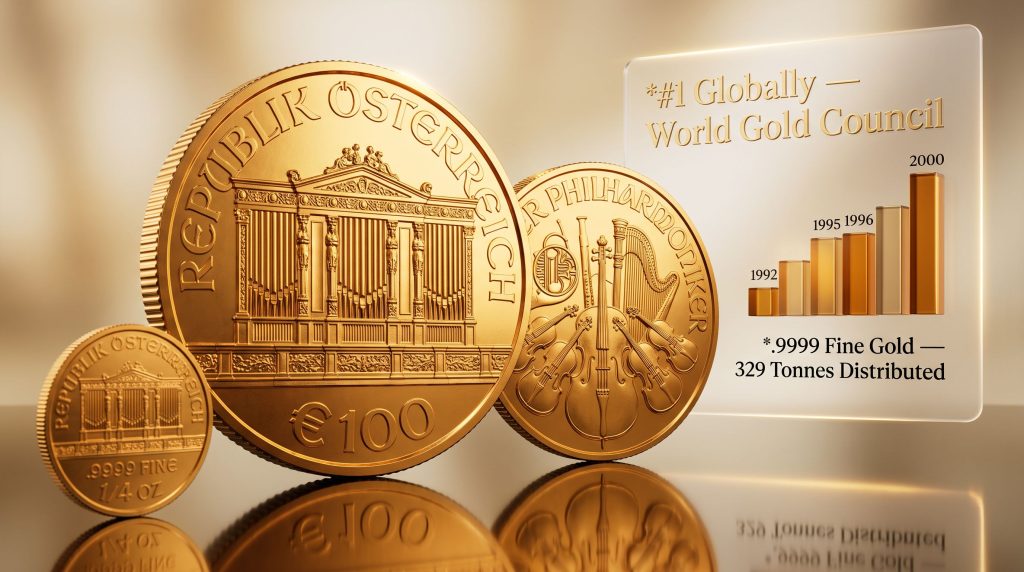
The coin is struck at .9999 fine gold, placing it in the highest purity tier available among major sovereign bullion programs globally. Its 1 oz version carries a nominal face value of €100 and holds legal tender status in Austria, backed by the Austrian government as official currency. Crucially, it is the only major gold bullion coin in the world denominated in euros, which provides a structural recognition advantage across all 20-plus eurozone nations that no competing program can replicate.
Why .9999 Fine Gold Changed European Investor Preferences
To understand why the Philharmonic captured its market so rapidly, it helps to understand what existed before it. In 1989, the two most widely traded sovereign gold coins globally were the South African Krugerrand and the American Gold Eagle, both struck at .9167 fine gold. This means both coins contain alloy additions, specifically silver and copper, to improve physical durability.
European buyers had long displayed a pronounced preference for pure gold compositions with no alloy blending. The Philharmonic launched directly into that unmet demand, delivering .9999 fine purity at scale from a central bank-owned mint with an eight-century operating history. The market's response was immediate and decisive: within 12 months of its first strike, the Philharmonic was the best-selling gold bullion coin on the European continent.
Furthermore, the debate around physical gold vs ETFs becomes particularly relevant here, as many European investors specifically sought coins that could be held directly, without custodial or counterparty risk.
The purity threshold effect is more than a technical distinction. In continental European and Asian secondary markets, coins with alloy additions can face additional scrutiny and modest recognition discounts, while .9999 fine sovereign coins trade with essentially zero authenticity friction.
The Institution Behind the Coin: Eight Centuries of Sovereign Minting
The Münze Österreich is not a recently established commercial operation. Its origins trace to 1194, when Duke Leopold V of Austria directed coin production using silver obtained from the ransom payment of King Richard I of England. The mint has operated continuously through the Habsburg Empire, the First and Second Austrian Republics, and into the modern eurozone era.
Today, the Münze Österreich functions as a wholly owned subsidiary of the Oesterreichische Nationalbank (OeNB), Austria's central bank. This ownership structure carries meaningful implications for investors:
- The Philharmonic's weight and purity guarantees are backed by a central bank-owned entity, not a private commercial refiner
- There is no counterparty risk from private ownership restructuring or commercial insolvency
- Institutional continuity spans more than 800 years, predating most of the world's central banks by centuries
- Total production capacity across all mint programs runs to approximately 450 million coins annually
- Estimated annual 1 oz Philharmonic production ranges from 300,000 to 800,000 coins, scaling with demand cycles, with notably elevated output during 2008–2009 and 2011–2012
Full Technical Specifications
The Five Denominations: Size, Weight, and Face Value
All five Philharmonic denominations are struck at identical .9999 fine purity and share the same obverse and reverse design with no variation between sizes.
| Size | Fine Weight | Face Value | Diameter |
|---|---|---|---|
| 1 oz | 31.10 g | €100 | 37 mm |
| 1/2 oz | 15.55 g | €50 | 28 mm |
| 1/4 oz | 7.78 g | €25 | 22 mm |
| 1/10 oz | 3.12 g | €10 | 16 mm |
| 1/25 oz | 1.24 g | €4 | 13 mm |
The 1 oz format generates the highest global trading volume and commands the tightest premiums relative to spot gold. Fractional denominations carry progressively higher per-ounce premiums, which is standard across all bullion programs globally. However, they allow investors to build positions incrementally or execute smaller secondary market sales without liquidating a full ounce. You can, for instance, purchase a 1/4 oz Austrian Philharmonic as a lower-cost entry point into the program.
The Design: Cultural Identity as a Market Signal
Both sides of the Philharmonic were designed by Thomas Pesendorfer, Chief Engraver of the Austrian Mint. In a detail that distinguishes this coin from virtually every other bullion program, the design has remained completely unchanged since the 1989 inaugural strike, a deliberate policy choice that communicates stability rather than novelty.
Obverse: The Great Pipe Organ of the Musikverein's Golden Hall in Vienna, the permanent concert home of the Vienna Philharmonic Orchestra. The organ's original installation by Friedrich Ladegast dates to 1872, though the instrument underwent full rebuilds in 1907 and again in 2011. The obverse carries the year of issue, the €100 face value, and the inscription REPUBLIK ÖSTERREICH.
Reverse: A central cello flanked by four violins, with a Vienna horn, harp, and bassoon arranged in the background. The WIENER PHILHARMONIKER inscription arcs across the top of the reverse. The Vienna horn depicted is a naturally valved instrument with a characteristically darker tonal profile, unique to Viennese orchestral tradition and appearing on no other major bullion coin in the world.
Annual design changes, common across commemorative coin programs, introduce collector-market pricing noise that undermines a coin's utility as a pure metal-content vehicle. The Philharmonic's unchanged design for over 35 years removes that ambiguity entirely.
Global Sales History and Market Dominance
The scale of the Philharmonic's commercial success across its first two decades provides important context for understanding its current liquidity profile.
| Year | World Gold Council Ranking |
|---|---|
| 1990 | No. 1 in Europe, No. 2 globally |
| 1992 | No. 1 globally |
| 1995 | No. 1 globally |
| 1996 | No. 1 globally |
| 2000 | No. 1 globally |
| 2008 | Outsold American Eagles and Krugerrands worldwide |
From launch through 2012, the program distributed more than 14 million coins, representing approximately 329 tonnes of gold placed into investor hands across five continents. To frame that figure: 329 tonnes represents one of the largest concentrated sovereign bullion distribution events in modern monetary history through a single coin program.
The 2008 financial crisis produced a particularly revealing data point. During the peak stress period of the global financial system, the Philharmonic achieved global sales leadership over both the American Eagle and the Krugerrand for the full calendar year. This reinforces the broader case for gold as a safe haven during periods of acute financial stress. Demand surges of this kind are not driven by marketing — they reflect the behaviour of investors who already understand the product and reach for the most familiar, most liquid, highest-purity instrument available when uncertainty is at its peak.
The next major ASX story will hit our subscribers first
Austrian Gold Philharmonic vs. Major Competing Coins
| Feature | Austrian Philharmonic | American Gold Eagle | Canadian Maple Leaf | South African Krugerrand |
|---|---|---|---|---|
| Gold Purity | .9999 fine | .9167 fine | .9999 fine | .9167 fine |
| Alloy Additions | None | Silver + Copper | None | Copper |
| 1 oz Gross Weight | 31.10 g | 33.93 g | 31.10 g | 33.93 g |
| 1 oz Diameter | 37 mm | 32.7 mm | 30 mm | 32.7 mm |
| Denomination Currency | Euro | USD | CAD | No face value |
| Legal Tender | Austria | United States | Canada | N/A |
| IRA Eligible (U.S.) | Yes | Yes | Yes | No |
| Primary Market Strength | Europe, Asia | United States | Global | Global |
The Canadian Maple Leaf is the Philharmonic's closest direct competitor on purity, as both are struck at .9999 fine with no alloy additions. The key distinction in continental European markets is denomination: the Philharmonic's euro face value creates immediate recognition and legal tender familiarity that the Maple Leaf cannot offer. The American Eagle, while dominant within the United States, carries alloy additions and typically trades at higher premiums than the Philharmonic for buyers prioritising maximum gold content per dollar spent.
IRA Eligibility: What U.S. Tax Law Requires and Why the Philharmonic Qualifies
Under Section 408(m)(3) of the U.S. Internal Revenue Code, gold held inside a self-directed precious metals IRA must meet a minimum fineness of .995. The Philharmonic's .9999 fine purity exceeds that threshold by a meaningful margin. Combined with its sovereign legal tender status, a requirement that many IRA custodians impose independently, the Philharmonic satisfies all standard eligibility criteria in its standard bullion-issue form.
Operational requirements for IRA inclusion include the following:
- Coins must remain in the physical custody of an IRS-approved trustee at an approved depository
- The account holder does not take personal possession of IRA-held coins at any point
- Only standard bullion-issue Philharmonics qualify — proof, graded, or numismatically priced versions are typically excluded
- All five denominations from the 1/25 oz through the 1 oz meet the purity standard
IRA Eligibility Checklist for the Austrian Gold Philharmonic:
- Purity meets or exceeds .995 fine: confirmed (.9999 actual)
- Sovereign legal tender status: confirmed
- Government-issued coin from a central bank-owned mint: confirmed
- All standard bullion-issue denominations qualify: confirmed
- Proof or numismatic versions: verify eligibility with your custodian before inclusion
Understanding Premium Dynamics and the True Cost of Ownership
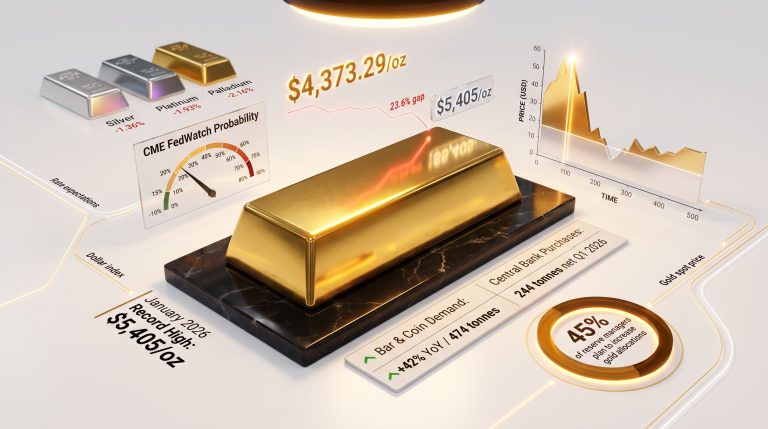
The Philharmonic's retail price equals the prevailing gold spot price plus a dealer premium. At a gold spot price of approximately $4,368 per troy ounce as of August 2026, a standard 1 oz Philharmonic typically retails between roughly $4,455 and $4,585, depending on order volume and dealer. The €100 face value is purely nominal; at current gold prices the metal content is worth approximately 43 times the face denomination.
Several factors govern premium economics for this coin:
- The 1 oz Philharmonic typically trades at dealer premiums of 2% to 5% over spot, among the tightest available in the sovereign coin market
- Fractional sizes carry progressively higher per-ounce premiums as size decreases, standard across all global bullion programs
- Tighter round-trip spreads at the 1 oz level improve the economics for investors who may eventually sell into the secondary market
- Purchasing through authorised dealer networks minimises counterparty risk and ensures competitive premium pricing
Authenticity Verification: How to Confirm a Genuine Coin
Given the global liquidity of the Philharmonic, counterfeit detection is a practical concern for buyers purchasing outside established dealer channels. Key verification steps include:
- Weight check: A genuine 1 oz Philharmonic measures exactly 31.10 grams on a precision scale
- Diameter check: The 1 oz version measures exactly 37 mm
- Magnetic test: Gold is non-magnetic; any attraction to a magnet indicates base metal contamination
- Acoustic test: A genuine gold coin produces a sustained, clear ring when lightly struck, commonly called the ping test
- Source verification: Purchasing from authorised dealer networks or directly through the Austrian Mint's official channels eliminates the vast majority of counterparty risk
The Philharmonic as a Monetary Framework, Not a Speculative Instrument
A useful way to understand the role of the Austrian Gold Philharmonic coin in a portfolio is to separate it from the category of speculative assets entirely. Gold does not generate income, pay dividends, or compound returns. What it does is maintain purchasing power across long time horizons in a monetary environment where the alternative — paper currency savings — has a structural tendency to lose real value.
The post-1971 monetary architecture creates a persistent, compounding case for hard asset allocation. When central banks expand money supplies to service sovereign debt obligations, the real return on cash savings is compressed below the actual inflation rate. Consequently, central bank gold demand has risen consistently as institutions themselves recognise this dynamic. Gold does not solve that problem directly; rather, it operates outside the system that creates it. An ounce of gold remains an ounce of gold regardless of monetary policy decisions in any jurisdiction.
The Philharmonic's specific contribution within this framework is to deliver that monetary function in the most institutionally credible, universally liquid, and purity-maximised form available to European and international investors. A coin struck by a central bank-owned mint with 800 years of continuous operation, at the highest purity tier available in the sovereign bullion market, with unchanged design across 35 years of annual production, is not an accident of marketing. It is the product of deliberate, sustained institutional commitment to a single proposition: that metal content, not aesthetics, is the foundation of value.
Key Facts at a Glance
| Data Point | Detail |
|---|---|
| First Issued | October 10, 1989 |
| Issuing Mint | Münze Österreich, Vienna (est. ~1194) |
| Gold Purity | .9999 fine (24-karat) |
| Sizes Available | 1/25 oz, 1/10 oz, 1/4 oz, 1/2 oz, 1 oz |
| 1 oz Face Value | €100 (nominal legal tender) |
| Total Distributed (through 2012) | 14+ million coins / ~329 tonnes |
| World Gold Council No. 1 Rankings | 1992, 1995, 1996, 2000 |
| IRA Eligible (U.S.) | Yes, all standard bullion issues |
| Design Changes Since 1989 | Zero |
| Mint Ownership | Oesterreichische Nationalbank (central bank) |
| Approx. Spot Price (August 2026) | $4,368 per troy ounce |
This article is for informational and educational purposes only and does not constitute investment advice. Precious metals prices fluctuate and past performance is not indicative of future results. Consult a qualified financial adviser before making investment decisions. IRA eligibility rules are subject to change; verify current requirements with your custodian and tax adviser.
Want to Know Which ASX Mining Stocks Could Be the Next Major Discovery?
While physical gold offers timeless wealth preservation, investors seeking dynamic exposure to the commodities sector may find significant opportunity in early-stage mineral discoveries — and Discovery Alert's proprietary Discovery IQ model delivers real-time alerts the moment significant ASX mineral announcements are made, turning complex data across 30-plus commodities into clear, actionable insights. Explore historic discoveries and their exceptional market returns, then begin a 14-day free trial to position yourself ahead of the broader market.