June 20, 2026
The Productivity Problem That Legacy Automation Can No Longer Solve
Underground mining has always been a discipline defined by constraint. The deeper a mine pushes into the earth, the more hostile, complex, and unpredictable its operating environment becomes. Tunnel geometries shift after every blast. Ventilation infrastructure crowds passageways. Temporary equipment, muck piles, and personnel create a constantly evolving spatial puzzle that machines must navigate in near-total darkness, saturated air, and choking dust.
For more than two decades, the automation in mining systems tasked with managing this environment have operated on a fundamental architectural assumption: that a pre-mapped, two-dimensional representation of the mine was sufficient for guiding autonomous equipment. That assumption is now breaking down under the weight of operational reality. As ore bodies push deeper, high-grade reserves become more geometrically irregular, and the cost pressure on underground operators intensifies, the gap between what first-generation automation can perceive and what modern mines actually demand has grown too wide to ignore.
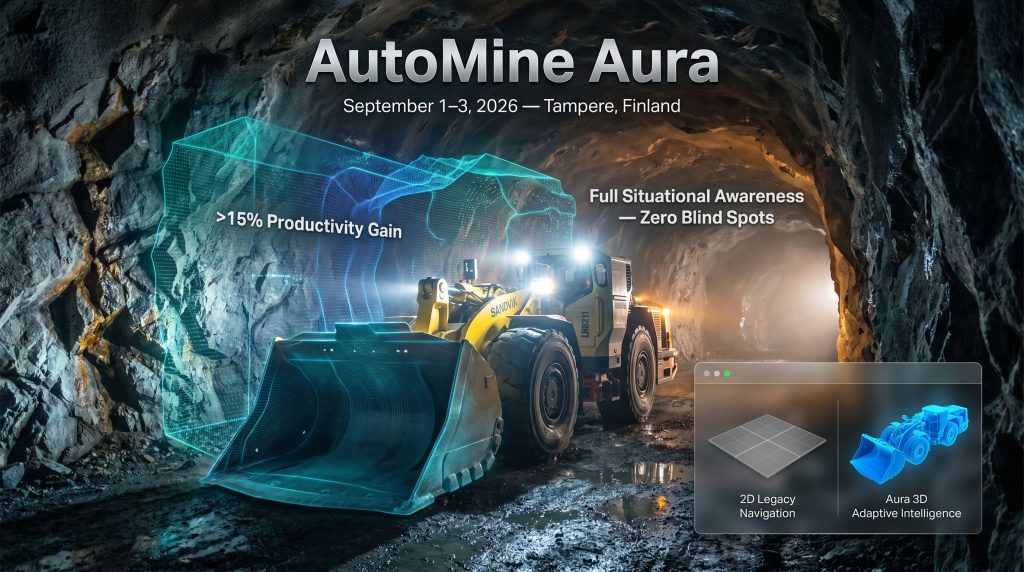
The launch of Sandvik AutoMine Aura with 3D perception system in May 2026 is the most substantive engineering response to that gap yet seen from any major equipment manufacturer. However, understanding why this platform represents a genuine architectural departure, rather than a marketing reframe of incremental improvements, requires examining both the technical limitations it addresses and the operational pressures that made those limitations unsustainable.
When big ASX news breaks, our subscribers know first
Two Decades of Navigation Architecture Left Largely Unchanged
Sandvik's original AutoMine platform was a landmark achievement when it was introduced, establishing a credible commercial framework for autonomous underground equipment at a time when the concept was largely theoretical. The system worked, and for many operations it worked well. However, its core navigation logic was built around a 2D model of the mine environment, using pre-surveyed route maps and fixed-path programming to guide equipment between loading and dumping points.
The problem with this architecture is not that it was poorly designed. It is that the underground environment it was designed for has changed faster than the system's ability to adapt. Modern deep underground operations present conditions that expose the limits of flat-map navigation with uncomfortable regularity:
- Blast-driven geometry changes alter tunnel profiles between shifts, rendering pre-mapped routes partially or entirely invalid.
- Debris accumulation, fallen ground, and temporary infrastructure installations create obstacles that 2D sensors struggle to detect and characterise.
- As mines develop new headings and working areas, the frequency of environmental updates required to keep navigation maps current exceeds what survey teams can practically deliver.
- Deeper orebodies introduce more complex access geometries, including ramps with tighter radii, tighter vertical clearances, and more irregular wall profiles.
Against this backdrop, the May 2026 launch of AutoMine Aura represents the most significant structural overhaul of the AutoMine platform in more than 20 years. According to Sandvik's Vice-President of Automation, David Hallett, the company deliberately chose not to build an updated version of the existing system. Instead, Aura was constructed as an entirely new platform from the ground up, a distinction that carries real operational weight rather than serving merely as a product positioning statement.
What the Sandvik AutoMine Aura 3D Perception System Actually Does
The defining technical innovation within Sandvik AutoMine Aura with 3D perception system is the shift from flat, map-dependent spatial awareness to real-time volumetric environmental modelling. This is not simply a sensor upgrade. It represents a fundamental change in how the machine understands and relates to the space it operates within.
Where legacy AutoMine systems interpret the mine as a network of known routes, Aura constructs a continuously updated three-dimensional model of the surrounding environment. The system uses sensor fusion techniques that combine multiple data streams into a coherent spatial picture, allowing it to detect, classify, and respond to objects and conditions in all three spatial dimensions simultaneously.
The practical implications of this capability are significant:
| Capability | Legacy AutoMine | AutoMine Aura |
|---|---|---|
| Environmental model | 2D static pre-survey map | 3D real-time volumetric model |
| Obstacle detection range | Limited by flat-plane sensing | Multi-layer, volumetric detection |
| Route adaptation | Requires operator intervention | Autonomous rerouting without supervision |
| Map currency | Dependent on survey update frequency | Continuously self-updating |
| Blind spot exposure | Present in vertical and lateral axes | Eliminated by full 3D spatial coverage |
| Productivity improvement | Baseline reference | Greater than 15% in field deployments |
The shift to online mapping is arguably the most operationally transformative element of the new platform. Rather than relying on a static spatial reference that becomes progressively less accurate as mining activity reshapes the environment, Aura continuously revises its understanding of the mine in real time. This means navigation decisions are always based on current conditions rather than conditions that existed at the time of the last survey.
Sensor Fusion in Extreme Underground Conditions
Underground mining environments present sensory challenges that have no direct parallel in other autonomous vehicle applications. There is no GPS signal. Dust concentrations frequently exceed visibility thresholds. Wall surfaces are irregular and acoustically complex. Humidity and temperature fluctuations affect sensor performance. Furthermore, any perception system that cannot maintain reliable operation under all of these conditions simultaneously is not commercially viable in this context.
Aura's sensor fusion architecture is specifically engineered for these conditions, combining complementary sensor modalities to maintain spatial awareness even when individual sensor streams are partially degraded. This multi-source approach provides resilience that single-sensor systems fundamentally cannot match, and it is one of the reasons Sandvik has been able to validate the platform's performance in what it describes as one of the world's most demanding underground operating environments.
The shift from static map-dependent navigation to continuous online mapping changes the fundamental relationship between an autonomous machine and the dynamic environment it operates within. It is the difference between a system that knows where it is and a system that understands where it is.
Performance Validation: What the 15% Productivity Gain Represents
Sandvik has reported that Aura deployments have delivered productivity improvements exceeding 15% in real underground mining conditions. For those unfamiliar with automation performance benchmarking in this sector, that figure warrants some context to appreciate its significance.
Underground mining productivity improvements in mature automation deployments typically plateau as systems approach the limits of their underlying architecture. Extracting an additional percentage point or two from a well-optimised legacy system often requires substantial capital investment in infrastructure, fleet expansion, or operational restructuring. A greater than 15% improvement attributed directly to platform capability represents a meaningful step-change, not a marginal refinement.
The sources of this gain are identifiable and operationally logical:
- Reduced obstacle-related stoppages. Legacy systems halt and wait for operator intervention when unexpected obstacles are detected. Aura's autonomous rerouting capability eliminates the majority of these intervention events, maintaining operational continuity through conditions that would previously have caused productivity-damaging delays.
- Higher average operating speeds. With superior spatial awareness, machines can operate at higher average speeds through complex tunnel sections without sacrificing safety margins, because the system has greater confidence in its understanding of the surrounding geometry.
- More efficient route execution. Adaptive path planning allows the system to select optimised routes in real time rather than following fixed paths that may not reflect current conditions, reducing unnecessary travel distance and time.
- Improved fleet utilisation. The redesigned operator interface enables single supervisors to manage multiple machines simultaneously at a higher level of efficiency, meaning fleet utilisation improves without requiring proportional increases in supervision headcount.
For large-scale underground operations processing tens of thousands of tonnes per day, the cost-per-tonne implications of a sustained 15%+ productivity improvement are substantial. Furthermore, data-driven mining operations demonstrate that across a full annual production cycle, the cumulative effect of reduced downtime, higher machine utilisation, and more efficient route execution compounds into a material economic advantage.
Safety Architecture: More Than Remote Operation
The safety case for underground mining automation is well established, but AutoMine Aura introduces dimensions of safety improvement that go beyond simply removing operators from hazardous environments. The platform's remote multi-machine supervisory model does eliminate direct operator exposure to dust, noise, and whole-body vibration, which are three of the most consequential occupational health hazards in underground mining. However, the safety architecture runs deeper than that.
Occupational diseases linked to underground mining remain a persistent global challenge. Silicosis and other dust-related lung conditions continue to affect mining workforces despite decades of engineering controls. Noise-induced hearing loss affects a disproportionately high share of underground equipment operators. Whole-body vibration from heavy underground machines is a recognised cause of musculoskeletal damage, particularly spinal injury, in long-tenure operators.
By enabling operators to manage multiple machines from a surface or refuge-level control environment, Aura removes these exposure risks from the supervisory role entirely. The redesigned operator interface compounds this safety benefit by reducing cognitive load, making it genuinely practical for one operator to maintain meaningful situational awareness across a multi-machine fleet without being overwhelmed by data complexity.
Full Compatibility with Existing Safety Infrastructure
A frequently underappreciated challenge in underground automation deployment is the integration requirement. Mines operate complex safety management ecosystems that include personnel tracking systems, blast clearance protocols, zone-access controls, and emergency communication networks. Any autonomous system that requires these ecosystems to be substantially rebuilt creates both cost barriers and transition-period safety risks.
Sandvik has designed Aura with a legacy compatibility layer that allows the platform to operate within existing mine network and access-control infrastructure. In addition, predictive maintenance in mining systems already in place at operating mines are not disrupted by an Aura deployment, meaning the automation upgrade does not create a window of reduced safety system capability during transition.
Comparing AutoMine Aura to AutoMine Concept: Understanding the Product Architecture
Sandvik's AutoMine product family spans multiple platforms serving different operational contexts and automation maturity levels. The distinction between AutoMine Concept and AutoMine Aura is worth understanding clearly, because the two are sometimes conflated in industry discussion.
AutoMine Concept has historically served as Sandvik's forward-looking technology demonstration vehicle, a platform for showcasing what fully autonomous underground mining could eventually achieve, typically in controlled or demonstration environments. It has been valuable for driving industry dialogue and establishing a vision for the future of the sector.
AutoMine Aura, however, is not a demonstration. It is a commercially deployable platform that has already been validated in operational underground mining conditions. The greater than 15% productivity gain cited by Sandvik was not achieved in a test environment. It was measured in an active mine operating under real-world conditions.
| Dimension | AutoMine Concept | AutoMine Aura |
|---|---|---|
| Deployment status | Technology demonstration | Commercial deployment platform |
| Validation environment | Controlled / demonstration | Active underground mine operations |
| Navigation approach | Advanced autonomous concepts | 3D perception with adaptive intelligence |
| Legacy compatibility | Not a primary design focus | Full compatibility with existing mine networks |
| Operator interface | Conceptual supervisory model | Redesigned intuitive multi-machine interface |
The next major ASX story will hit our subscribers first
Rollout Sequencing and the Strategic Logic of Starting with Loaders
Sandvik has confirmed that AutoMine Aura will be deployed first on underground loaders, specifically LHDs (Load Haul Dump machines). This sequencing is strategically coherent for several reasons that are worth unpacking.
LHDs are the highest-frequency autonomous machines in most underground operations. They perform the repetitive cycle of loading blasted material, tramming to the ore pass or surface portal, dumping, and returning to the loading point, often hundreds of times per shift across a multi-machine fleet. This operational pattern generates more autonomous navigation events per shift than virtually any other underground equipment category, meaning LHD deployments will produce the broadest and most statistically robust performance dataset for the Aura platform in the shortest timeframe.
That data richness matters, because machine learning systems improve with operational exposure. The more diverse underground conditions the Aura adaptive intelligence engine encounters and processes, the more refined its decision-making becomes. Starting the commercial rollout with the highest-cycle equipment category accelerates this learning curve in a way that starting with lower-frequency machines simply could not.
Following the initial loader rollout, Sandvik has indicated plans to extend Aura capabilities across additional underground equipment categories. The modular architecture of the platform, with its 3D perception and adaptive intelligence components designed for broad applicability, supports this expansion without requiring fundamental re-engineering for each new equipment type.
The platform's public debut is scheduled for Sandvik's Future of Mining event running from September 1 to 3, 2026, in Tampere, Finland. The event is expected to provide the global mining industry its first detailed hands-on exposure to the full Aura capability set, as announced by Sandvik earlier this year.
The Technology Convergence That Made Aura Possible
AutoMine Aura does not emerge from a vacuum. Its development reflects the maturation of several converging technology streams that have only recently reached the reliability and performance thresholds required for commercial underground mining application:
- Miniaturised sensor hardware capable of delivering robust 3D spatial data in confined, dust-laden, high-humidity environments without the size and fragility constraints that previously limited underground deployment.
- Edge computing capacity sufficient to process volumetric spatial data in real time without dependence on continuous high-bandwidth network connectivity, a critical requirement given the variable network conditions inside operating mines.
- Machine learning frameworks that can be trained on domain-specific underground operational data, allowing the adaptive intelligence engine to improve its decision-making quality with accumulated experience rather than remaining static after initial deployment.
- Human-machine interface design advances that allow operators without deep technical backgrounds to maintain effective supervisory awareness of complex multi-machine autonomous systems.
The combination of these factors has created a platform capability that was not technically achievable even five years ago. Consequently, AI in mining operations and this convergence dynamic suggest that the pace of platform-level capability advancement is likely to accelerate rather than plateau in the coming years.
What AutoMine Aura Means for Workforce Transition in Automated Mines
The operational model that Sandvik AutoMine Aura with 3D perception system enables, with single supervisors managing multiple autonomous machines from remote control environments, has implications for underground mining workforce structure that are both complex and worth examining carefully.
The dominant narrative around mining automation tends to frame workforce change in terms of job elimination. The operational reality, however, is more nuanced. The supervisory model that Aura enables does not remove the human element from underground operations. It fundamentally changes the skill profile that human operators need to bring to their roles.
The transition is from physical machine operation, which demands manual skill, tolerance for hazardous environments, and comfort with repetitive physical tasks, to automation supervision, which demands systems literacy, multi-machine situational awareness, and the judgment to intervene appropriately when autonomous systems encounter conditions outside their operational envelope.
This transition creates genuine workforce development challenges for mining companies investing in Aura-class automation. Furthermore, AI-powered mining efficiency platforms create corresponding opportunities for workers who develop the technical skill sets that the new operational model demands. Neither the challenge nor the opportunity should be minimised. Both require deliberate investment in training, role redesign, and change management to realise the full productivity and safety potential that platforms like AutoMine Aura are engineered to deliver.
This article is intended for informational purposes only and does not constitute financial or investment advice. Productivity figures and technical specifications referenced in this article are based on information provided by Sandvik as of May 2026. Readers should conduct their own research and due diligence before making any business or investment decisions related to mining automation technologies.
Want to Invest in the Companies Driving Mining's Next Major Discoveries?
As automation reshapes underground mining productivity, the real wealth-creation events in this sector continue to be driven by significant mineral discoveries — and Discovery Alert's proprietary Discovery IQ model delivers real-time ASX alerts the moment those discoveries are announced, turning complex geological data into actionable opportunities for investors at every experience level. Explore Discovery Alert's discoveries page to see the historic returns major mineral discoveries have generated, and begin your 14-day free trial to position yourself ahead of the broader market.