June 20, 2026
The Invisible Energy Drain: Why Pumping Systems Have Become Mining's Most Strategic Upgrade
Every major mining operation runs on two invisible currencies: ore and water. While the industry has poured billions into autonomous haulage, AI-driven blast optimisation, and robotic drilling, the systems responsible for moving billions of litres of water, slurry, and process fluid have largely operated on autopilot. That asymmetry is now closing fast.
Pumping infrastructure consistently ranks among the top three energy consumers on active mine sites, yet for decades it attracted the least investment in intelligent controls. In deep and ultra-deep underground operations, dewatering circuits alone can consume between 20% and 30% of total site electricity. When layered against rising energy costs, increasingly stringent decarbonisation mandates, and the relentless push toward deeper, more complex orebodies, the case for upgrading passive pump networks into smart mining pumping systems has shifted from optional to operationally necessary.
The transformation underway is not incremental. It represents a fundamental repositioning of pumping infrastructure from mechanical utility to strategic mine asset.
When big ASX news breaks, our subscribers know first
From Fixed-Speed Hardware to Fluid Intelligence: What Smart Mining Pumping Systems Actually Are
A precise definition matters here, particularly as the term "smart" gets applied loosely across mining technology marketing. A smart mining pumping system is a pump network equipped with integrated sensor arrays, real-time IIoT connectivity, edge computing capability, and analytics software that enables continuous performance monitoring, pre-failure fault detection, energy demand optimisation, and autonomous fluid management decisions across dewatering, slurry transport, and process water circuits.
The distinction from traditional systems is architectural, not cosmetic. Legacy pump infrastructure operated in complete isolation: fixed-speed motors drawing constant power regardless of actual demand, manual inspection cycles that could miss developing faults for weeks, and reactive repair schedules that responded to failures after production had already been disrupted. Smart systems invert every one of those operating assumptions.
The Core Technology Stack
The intelligence of a modern pump system emerges from several interlocking technology layers working in concert:
| Technology Layer | Primary Function | Operational Benefit |
|---|---|---|
| IIoT Sensor Arrays | Measure pressure, flow, temperature, vibration, acoustics | Continuous real-time condition awareness |
| Edge Computing Processors | On-skid data processing before cloud transmission | Reduced latency in fault detection and response |
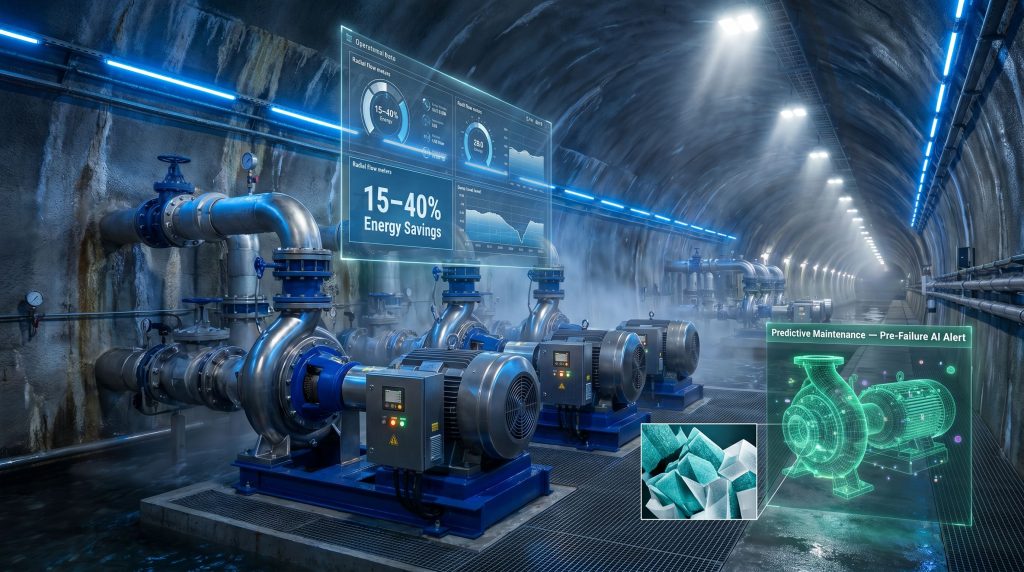
| Variable Frequency Drives (VFDs) | Dynamically adjust motor speed to match demand | 15-40% energy savings vs. fixed-speed operation |
| Digital Twin Platforms | Physics-based virtual replicas of physical pump systems | Scenario modelling and predictive optimisation |
| Cloud-Based Dashboards | Centralised monitoring across multiple pump circuits | Remote fleet oversight and performance benchmarking |
| AI/ML Fault Detection | Pattern recognition across multi-variable sensor streams | Prescriptive maintenance alerts before breakdown occurs |
Critically, the value of each layer compounds when integrated. Sensor data fed to edge processors enables real-time fault flags. Those flags, interpreted through AI-trained pattern recognition models, generate prescriptive recommendations rather than simple alarms. The result is a system capable of detecting early-stage bearing wear, adjusting pump speeds autonomously to extend component life, and scheduling maintenance intervention at the optimal window before failure occurs.
The Four High-Impact Use Cases Driving Smart Pump Adoption
Predictive Maintenance and Condition Monitoring
Unplanned pump failure in a dewatering circuit can halt underground production within hours. In many cases, the combined cost of emergency repair, replacement parts, and lost production significantly exceeds the original purchase price of the pump. This asymmetry makes predictive maintenance the highest-return entry point for mines beginning the smart pump transition.
Smart condition monitoring systems deploy acoustic emission sensors and multi-axis vibration analysis nodes to detect developing faults at the earliest mechanical stage. Bearing wear, seal degradation, and impeller imbalance each produce characteristic acoustic and vibration signatures that AI algorithms can identify weeks before physical failure. The system does not simply flag that something is wrong; it identifies the specific failure mode, recommends the corrective action, and calculates the optimal timing for intervention based on remaining component life estimates.
Furthermore, AI-powered mining efficiency platforms are increasingly being integrated with pump condition monitoring tools, allowing mines to coordinate predictive maintenance across multiple asset classes simultaneously. The operational outcomes are measurable:
- Extended mean time between failures (MTBF) across the pump fleet
- Reduced emergency spare parts inventory held on site
- Elimination of costly unplanned production shutdowns
- Shift from calendar-based to condition-based maintenance scheduling
Mine Dewatering and Flood Risk Management
Dewatering remains the most operationally critical pump application in underground mining. Water inrush events, triggered by unexpected groundwater influx or extreme rainfall, represent one of the most severe safety hazards an underground operation can face. Smart dewatering systems address both the efficiency and safety dimensions of this challenge simultaneously.
By integrating pump networks with site-wide water balance models and real-time meteorological data feeds, autonomous dewatering systems adjust pump output continuously in response to changing inflow rates. Sump level monitoring, inflow rate telemetry, and pump performance data combine to enable proactive management rather than emergency reaction.
Intelligent dewatering systems reduce inrush risk by ensuring that water removal capacity is continuously calibrated to actual water influx conditions rather than relying on static design parameters that may no longer reflect current mine geometry or groundwater behaviour.
Slurry and Paste Tailings Transport
Slurry pumping presents arguably the harshest operating environment in industrial fluid management: abrasive solids, variable density, corrosive chemistry, extreme wear rates, and rheological complexity that changes continuously as ore type and processing chemistry shift. Conventional pump materials and fixed operating parameters are structurally inadequate for this environment.
The industry's progressive transition toward paste tailings with solids content of 70% or greater amplifies both the challenge and the stakes. At these concentrations, precise real-time pump control is not a performance optimisation tool; it is a pipeline integrity requirement. Smart slurry systems monitor solids concentration, viscosity proxies, and flow velocity simultaneously, dynamically adjusting pump speed and discharge pressure to maintain safe transport conditions across changing slurry characteristics.
Pumping paste tailings at 70%+ solids content enables mines to recover and recycle substantial volumes of process water that would otherwise be permanently lost to evaporation in conventional tailings storage facilities, directly supporting water circularity targets.
Process Water Circulation and Site-Wide Water Balance
Process water circuits connect every major operational system on a mine site: dewatering, ore processing, dust suppression, and tailings management. Coordinating fluid movement across these interconnected circuits manually creates perpetual inefficiencies and periodic crises. Smart pump networks communicate across circuits autonomously, balancing inflow and outflow to maintain system equilibrium without human intervention.
Integration with Manufacturing Execution Systems (MES) enables fluid management to synchronise directly with extraction schedules and processing plant throughput in real time. This connects directly to the broader shift toward data-driven mining operations, where every operational variable is optimised through real-time analytics rather than static planning assumptions.
Digital Twins: The Physics-Based Revolution in Pump Performance Management
Digital twins represent one of the most significant conceptual advances in pump system management. A digital twin is not a monitoring dashboard or a data visualisation tool. It is a high-fidelity, physics-based simulation of a physical pump or pump circuit that runs continuously in parallel with its real-world counterpart, comparing actual operational data against theoretical performance benchmarks.
Industry projections indicate that by 2030, the majority of critical dewatering and slurry pumps at major mining operations will have cloud-hosted digital counterparts providing continuous performance intelligence.
How a Digital Twin Optimises a Dewatering Pump Circuit
The operational workflow of a digital twin system unfolds in five distinct stages:
- Baseline calibration – Physical pump performance data is used to construct the initial digital model, incorporating hydraulic geometry, motor specifications, and full pipeline configuration.
- Continuous data ingestion – Live sensor feeds covering pressure, flow, vibration, and temperature update the twin in real time throughout every operating shift.
- Deviation detection – The twin identifies when actual performance diverges from the modelled optimum and triggers investigation alerts before divergence becomes dysfunction.
- Scenario simulation – Engineers model planned operational changes such as increased mine depth or ore type transitions to determine optimal pump configurations before physical implementation.
- Prescriptive output – The system generates specific parameter adjustment recommendations, maintenance windows, or equipment replacement schedules based on modelled outcomes rather than elapsed time.
The compounding benefit of this approach is that digital twins reduce the energy waste embedded in conventional safety margins. Traditional pump systems are deliberately over-specified to buffer against uncertainty. With a digital twin providing precise, continuously updated operating parameters, those conservative energy buffers become unnecessary.
Electrification and VFDs: The Fastest Path to Energy Reduction
Fluid transport systems represent one of the largest controllable energy loads on mine sites, making pump electrification a high-priority lever in net-zero roadmaps. The progressive retirement of diesel-driven standalone pump units in favour of fully electrified infrastructure is already accelerating across major mining regions. In addition, the broader mining electrification trends reshaping haulage and drilling are now converging with pump infrastructure upgrades to create integrated zero-emission operational models.
IE4 and IE5 ultra-premium efficiency motor standards are becoming the baseline specification for new pump installations. When paired with advanced VFDs operating as continuous energy management systems rather than simple soft-start devices, these motor configurations deliver energy savings of 15-40% compared to fixed-speed equivalents.
Microgrid Integration: Aligning Pump Operations with Renewable Generation
The intersection of electrified pump infrastructure and on-site renewable energy generation creates a genuinely powerful operational synergy. Consequently, the uptake of renewable energy in mining is increasingly being designed around the load profiles of electrified pump circuits, with solar and wind generation sized to match peak dewatering and slurry transport demand windows.
| Capability | Operational Application |
|---|---|
| Microgrid-ready pump stations | Direct integration with on-site solar and wind generation assets |
| Intelligent load shifting | Schedule high-volume water transfer during peak renewable generation windows |
| Demand response capability | Reduce pump activity during low-generation periods to stabilise site electrical grid |
| Battery-electric submersible pumps | Replace diesel units in remote underground settings without surface reticulation |
Beyond motor and drive technology, Computational Fluid Dynamics (CFD) modelling is being applied at the hydraulic geometry level to minimise turbulence and internal friction losses within pump casings themselves. Optimised impeller and volute designs improve the fundamental conversion efficiency of electrical energy into hydraulic work, reducing the energy required to move a given fluid volume regardless of the control system above it.
Advanced Materials Science: Extending Pump Life in Extreme Environments
The wear challenge in slurry and paste tailings pumping is a materials science problem as much as an engineering one. Abrasion from high-solids slurries, corrosive process chemistry, and thermal cycling create degradation conditions that conventional pump metallurgy cannot sustain economically across an acceptable service interval.
Frequent component replacement drives high maintenance costs, extended production downtime, and a significant carbon footprint from manufacturing and transporting replacement parts — an often-overlooked lifecycle emissions factor in ESG reporting for mining operations.
Next-generation pump manufacturers are introducing two categories of advanced material to address this challenge:
- High-chrome alloys with self-healing microstructures engineered to resist the severe abrasion of super-thickened paste slurries at solids concentrations that would rapidly destroy conventional wear materials
- Nano-structured ceramic composites offering superior hardness and chemical resistance characteristics that extend component service life significantly beyond what traditional wear-resistant materials can achieve
The convergence of advanced materials science with smart condition monitoring creates a compounding reliability benefit: wear-resistant components last longer, while predictive analytics ensure that remaining service life is fully utilised before replacement, eliminating both premature and overdue maintenance interventions simultaneously.
The next major ASX story will hit our subscribers first
Circular Water Stewardship: Smart Pumps as the Engine of Zero-Discharge Operations
Water scarcity across major mining regions including arid zones in Australia, Chile, South Africa, and Central Asia is driving a structural shift from linear water consumption to closed-loop circularity. The traditional operational model of extracting, using, and discharging water is no longer economically or socially viable in these environments. This shift is integral to the wider mining sustainability transformation underway across the global industry.
Smart pumping systems are the primary technological enablers of zero-extraction, zero-discharge water management architectures. Their role extends beyond moving fluid efficiently; they are becoming active water quality management tools.
Future-generation pump systems will integrate spectral analysers within pump volutes to monitor water chemistry continuously during transit. Parameters tracked in real time will include pH levels, turbidity, heavy-metal concentrations, and electrical conductivity. The pumping network will then automatically route water flows to appropriate treatment circuits or recycling loops based on quality classification, preventing cross-contamination between clean and process-affected water streams.
This capability is particularly critical in mines operating within sensitive hydrological catchments where regulatory requirements demand precise accounting of water quality across every circuit boundary.
Traditional vs. Smart Mining Pump Systems: A Performance Comparison
| Performance Dimension | Traditional System | Smart Pumping System |
|---|---|---|
| Maintenance Approach | Reactive – fix after failure | Predictive – intervene before failure |
| Energy Management | Fixed-speed, constant power draw | VFD-controlled, demand-matched output |
| Monitoring Capability | Manual inspection, periodic checks | Continuous real-time sensor telemetry |
| Fault Detection | Post-failure diagnosis | Pre-failure AI-driven prescriptive alerts |
| Water Management | Single-circuit, manually balanced | Multi-circuit autonomous coordination |
| Tailings Handling | Conventional slurry transport | Dense-phase paste capability at 70%+ solids |
| System Integration | Isolated, standalone hardware | MES-integrated, mine-wide network participant |
| Environmental Reporting | Manual data collection and entry | Automated compliance data streams |
Barriers to Adoption: What Is Slowing the Smart Pump Transition?
Despite the compelling performance case, adoption barriers remain real and should be understood clearly by operations and capital allocation teams evaluating smart pump investments.
Technical constraints include connectivity limitations in deep underground environments where real-time data transmission from sensor arrays to surface systems is technically challenging and infrastructure-intensive. Legacy pump fleets at operating mines often require significant retrofitting to support IIoT integration, and the high-frequency sensor streams generated by connected pump systems demand robust edge computing and cloud storage architecture that many operations have not yet built.
Economic and organisational barriers centre on the high upfront capital cost of smart pump installations relative to conventional replacement units, a skills gap in mine site workforces where operating and interpreting predictive analytics platforms requires competencies not traditionally present in pump maintenance teams, and the challenge of demonstrating clear ROI to capital committees in terms of quantified reductions in downtime, energy cost, and maintenance expenditure.
Cultural and cybersecurity dimensions also apply. Operational conservatism in mining — where system reliability is genuinely paramount rather than a management cliché — creates legitimate caution around unproven sensor and software configurations. IIoT-connected pump systems integrated into mine-wide operational technology networks also introduce cybersecurity exposure that requires active management.
The 2030 Horizon: Autonomous, Integrated, and Self-Optimising Fluid Management
By 2030, the operational boundary between physical pump hardware and digital control intelligence is projected to become functionally indistinguishable at leading mine operations. Smart mining pumping systems will operate as autonomous agents within mine-wide operational networks, making real-time fluid management decisions without human intervention across dewatering, processing, and tailings circuits simultaneously.
Integration with autonomous haulage fleets, robotic drilling systems, and AI-driven processing plants through unified MES platforms will make fluid management a dynamic variable within production optimisation models, adjusted continuously as extraction rates, ore grades, and processing demands fluctuate across the operating shift.
Emerging capabilities on the near-term horizon include:
- Autonomous chemical dosing integrated directly into pump circuits for real-time water treatment optimisation without manual reagent management
- Swarm pump intelligence, where coordinated multi-pump networks redistribute hydraulic load dynamically based on collective system state and individual pump health data
- Blockchain-verified water reporting for regulatory compliance and ESG disclosure, with pump sensor data feeding directly into tamper-evident environmental records
- Subsurface pump robotics, comprising self-navigating submersible units capable of repositioning within underground workings in response to changing water ingress patterns
The trajectory is clear. By 2035, effective fluid management in competitive mining operations will require the coordinated control of data, energy, and water simultaneously through systems that are as much software platforms as they are mechanical infrastructure. Mining pump systems are not an upgrade pathway; they are the emerging operational standard that will define which mining enterprises remain cost-competitive, environmentally compliant, and safety-certified in the decade ahead.
Readers seeking broader context on the digitisation of mining infrastructure and next-generation fluid management technologies may find additional industry coverage at Metals Mining Review Europe, which tracks emerging trends across mining equipment and technology sectors.
Ready to Capitalise on the Mining Companies Leading This Technological Shift?
Discovery Alert's proprietary Discovery IQ model scans ASX announcements in real time, instantly identifying significant mineral discoveries across the mining sector — including the companies driving next-generation operational innovation — and delivers actionable alerts directly to subscribers. Explore historic discoveries and their market returns, then begin your 14-day free trial at Discovery Alert to position yourself ahead of the market.