June 20, 2026
The Engineering Reality Behind Helium-3: Why Earth Holds the Only Viable Near-Term Supply
Fusion energy has captivated scientists and investors for decades, not merely because of its theoretical promise, but because of the extraordinary scarcity of the fuels required to make it work at the highest efficiency. Among the most coveted of these fuels is helium-3, an isotope so rare on Earth that its value is measured in tens of thousands of dollars per gram. The tension between lunar helium-3 mining vs Earth extraction defines one of the most analytically interesting supply chain problems in the entire energy technology sector. Understanding why that gap exists requires moving past headline figures and into the engineering, thermodynamics, and orbital logistics that determine what is commercially possible versus what remains speculative.
When big ASX news breaks, our subscribers know first
What Makes Helium-3 Different From Every Other Energy Material
Most discussions of helium conflate two isotopes that behave very differently. The helium filling party balloons and MRI cooling systems is overwhelmingly helium-4 (He-4), a stable isotope with two protons and two neutrons. Helium-3 (He-3) carries only one neutron, and that seemingly minor difference produces dramatic consequences for nuclear physics. In a fusion reaction between deuterium and He-3, the process yields a proton and helium-4 rather than a neutron.
This matters enormously because neutron-free fusion reactions do not irradiate surrounding reactor structures, dramatically reducing material degradation, radioactive waste concerns, and shielding requirements. The theoretical energy yield from deuterium-He-3 fusion is comparable to conventional deuterium-tritium (D-T) fusion, which currently leads experimental programs including those at the National Ignition Facility and ITER.
However, the engineering advantages of a neutron-sparse reaction pathway have made He-3 the preferred long-term fuel target for advanced fusion concepts. The problem, as physicists and energy economists have long acknowledged, is not the physics of He-3 fusion. The physics works. The challenge is that He-3 barely exists in accessible form anywhere on or near Earth.
The Three Supply Pathways: A Structured Comparison
Every serious analysis of He-3 supply converges on three primary extraction pathways, each with fundamentally different cost structures, scalability ceilings, and accessibility profiles.
| Supply Pathway | Extraction Method | Cost Basis | Scalability | Government Dependency |
|---|---|---|---|---|
| Tritium Decay | Cryogenic distillation of decay gas | Market-priced tritium + separation costs | Very Low | Very High |
| Terrestrial Helium Wells | Directional drilling + cryogenic separation | Thermodynamic floor + capital and operating costs | Moderate | Low |
| Lunar Regolith | Excavation + thermal processing + orbital return | Transport-cost dominated; highly speculative | High in theory; near-zero in practice | Moderate to High |
The question facing energy strategists and technology investors is not which source contains the most He-3 in absolute terms. It is, however, which source can deliver usable quantities at defensible economics within a commercially relevant timeframe.
How Tritium Decay Produces Helium-3, and Why It Cannot Scale
The most immediate source of He-3 on Earth is a byproduct of radioactive decay within nuclear weapons programmes. Tritium, a radioactive hydrogen isotope, decays at approximately 5.5% per year, converting spontaneously into He-3 through beta decay. Weapons programmes must periodically replenish tritium in warheads as it decays, and the recovered He-3 is then separated and made available, primarily to government research programmes.
Step-by-Step: How He-3 Is Recovered From Tritium Decay
- Tritium is produced in nuclear reactors, historically including CANDU-type heavy water reactors, or extracted during routine warhead maintenance cycles.
- As tritium decays at the rate of roughly 5.5% annually, He-3 accumulates within sealed storage reservoirs.
- He-3 is separated from residual tritium using cryogenic distillation, exploiting the slight difference in boiling points between the two isotopes.
- Purified He-3 is then compressed and stored for distribution to research institutions or specialist commercial buyers.
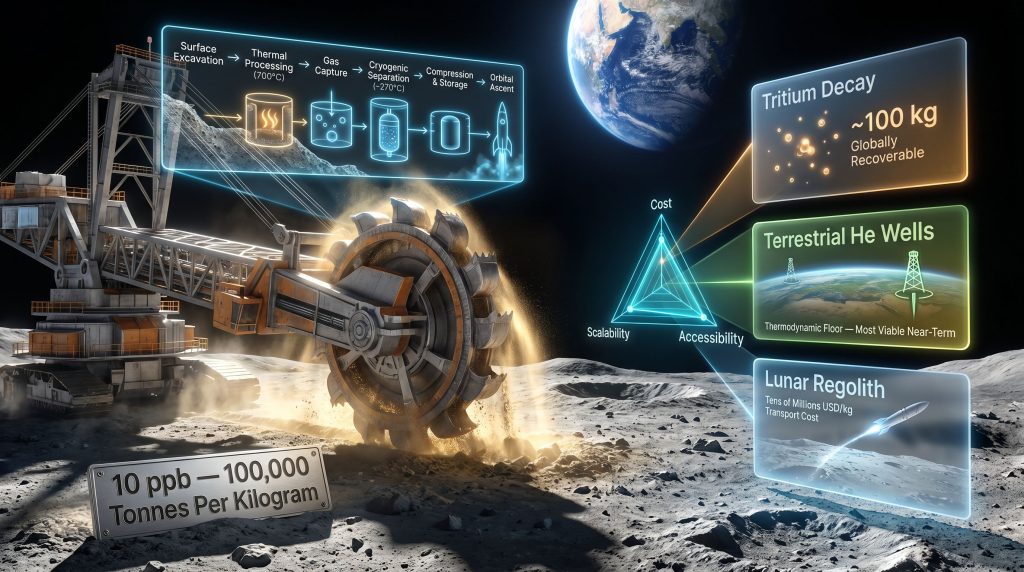
The structural ceiling on this pathway is severe. According to NASA's 2021 technical review, total recoverable He-3 from Earth-based tritium sources is estimated at approximately 100 kilograms globally. That figure is not a production rate — it is the aggregate maximum recoverable across all existing sources. No commercial actor can independently expand this supply channel. Tritium production volumes are constrained by nuclear treaty obligations and sovereign stockpile management decisions, meaning the He-3 output from this pathway is structurally fixed regardless of how much fusion demand grows.
Even if the entire globally recoverable supply of tritium-decay He-3 were directed exclusively toward fusion energy research, the total quantity would be insufficient to sustain a single commercial-scale demonstration reactor for any meaningful operational period. This is not a cost problem. It is a physics-constrained volume problem with no commercial solution.
Terrestrial Helium Wells: The Middle Ground With Genuine Near-Term Potential
Certain natural gas formations contain anomalously elevated concentrations of helium, and within those helium streams, trace quantities of He-3 can be identified and separated. This pathway uses technology that is largely continuous with existing natural gas extraction and cryogenic processing industries, which is its primary commercial advantage. Furthermore, the ongoing helium supply crisis makes terrestrial He-3 well development an increasingly urgent strategic priority.
The Thermodynamic Separation Floor Explained
Separating He-3 from a mixed gas stream requires cryogenic distillation operating at temperatures approaching absolute zero, approximately -270°C, to exploit the narrow difference in vapour pressures between He-3 and He-4. The thermodynamic separation floor represents the theoretical minimum energy input required to achieve this separation, serving as the baseline cost benchmark for any terrestrial well-based extraction operation.
Critically, this floor excludes capital expenditure on drilling infrastructure, cryogenic plant construction, compression systems, labour, transport, and ongoing operating costs. Real-world economics are materially higher than thermodynamic minimums, but this pathway still sits comfortably below lunar extraction economics by orders of magnitude. Understanding cut-off grade economics is essential when evaluating which terrestrial formations are worth pursuing.
Key operational variables that determine the economics of any given terrestrial He-3 well include:
- Well depth and subsurface geology determining drilling cost per metre
- Helium concentration in the raw gas stream, expressed as a percentage of total gas volume
- The He-3 to He-4 ratio within the helium fraction, which governs the separation throughput required per unit of He-3 recovered
- Proximity to existing cryogenic separation and gas processing infrastructure
- Regulatory environment and permitting timelines in the host jurisdiction
The rarity of anomalously He-3-enriched geological formations means scalability is real but bounded. Unlike conventional helium-4 production, which can draw on a relatively broad set of natural gas fields globally, high-grade He-3 terrestrial sources represent a narrow subset of an already specialist resource category.
Lunar Helium-3 Mining: Engineering the Impossible at Scale
The Moon's surface has been continuously bombarded by solar wind particles for approximately four billion years. Because the Moon lacks both a magnetic field and an atmosphere, solar wind ions, including He-3, implant directly into the uppermost metres of regolith. Scientific literature documents average He-3 concentrations of approximately 10 parts per billion (ppb) by mass in lunar surface material, with some estimates suggesting enriched polar regions may carry modestly higher concentrations.
The Grade Problem: 10 ppb Is Not a Mining-Grade Resource
To contextualise how extraordinarily dilute this concentration is, consider that commercial lithium brine operations typically process grades ranging from 200 to 2,000 parts per million (ppm) — between 20,000 and 200,000 times higher than lunar He-3 concentrations by mass ratio. At 10 ppb, extracting a single kilogram of He-3 requires processing approximately 100,000 tonnes of regolith. A NASA engineering concept estimated that a large bucket-wheel excavator mining roughly 1 to 3 square kilometres of surface to a depth of 3 metres per year could yield approximately 33 kilograms of He-3 annually, illustrating the sheer physical throughput that any viable lunar mining operation would require.
In addition, this challenge is compounded when one considers that space resource extraction of any kind remains in its earliest developmental phase, with no operational precedent for processing regolith at this scale in a vacuum environment.
Step-by-Step: The Lunar He-3 Extraction Process Chain
- Surface Excavation: Large-scale mechanical mining of regolith across wide surface areas to depths of 2 to 3 metres, using autonomous robotic equipment operating in the lunar vacuum environment.
- Thermal Processing: Heating excavated material to temperatures exceeding 700°C to volatilise solar wind gases embedded within the regolith, including He-3, He-4, hydrogen, and nitrogen compounds.
- Gas Capture: Collection of the released gas mixture in sealed processing vessels maintained under low-pressure or vacuum conditions to prevent loss of the volatilised stream.
- Cryogenic Isotope Separation: Separation of He-3 from He-4 and co-extracted volatiles using cryogenic distillation at temperatures approaching -270°C, performed in a low-gravity, high-radiation environment with no terrestrial maintenance analogue.
- Compression and Storage: Pressurised storage of purified He-3 in cryogenic containers engineered to withstand deep-space thermal cycling between approximately -173°C and +127°C.
- Orbital Ascent and Earth Return: Launch of He-3 payload from the lunar surface, transfer to an Earth-return vehicle in lunar orbit, atmospheric re-entry, and ground recovery.
Each individual step in this extraction chain introduces compounding technical risk, energy demand, and cost accumulation. The lunar surface environment degrades mechanical systems at rates that have no terrestrial operational equivalent, and no lunar mining infrastructure of any kind currently exists.
Why Transport Economics Dominate the Lunar He-3 Cost Structure
Current commercial payload delivery cost estimates to the lunar surface, derived from NASA's Commercial Lunar Payload Services (CLPS) contract data, indicate costs in the range of tens of millions of dollars per kilogram. Return transport from the lunar surface to Earth introduces additional propellant mass requirements, mission architecture complexity, and delta-V budget challenges that further compound total delivered cost.
These transport costs exist before a single gram of mining infrastructure has been installed, powered, operated, or maintained. Any breakeven analysis for lunar He-3 must therefore incorporate either a dramatic collapse in launch economics driven by fully reusable heavy-lift vehicles, or a fusion energy market valuing He-3 far above current or projected pricing benchmarks. The ESA's assessment of He-3 mining on the lunar surface similarly underscores how formidable these logistical hurdles remain.
A Full Comparative Framework: Lunar vs. Earth He-3
| Evaluation Axis | Tritium Decay | Terrestrial He Wells | Lunar Regolith |
|---|---|---|---|
| Extraction Cost | Moderate | Moderate to Low | Very High |
| Scalability | Very Low | Moderate | High in theory; near-zero in practice |
| Accessibility | Moderate, government-controlled | Moderate, conventional technology | Very Low, no infrastructure exists |
| Time to Commercial Scale | Near-term, constrained volume | Near to medium term | Decade-plus minimum |
| Geopolitical Risk | High, nuclear treaty dependent | Low to Moderate | High, space law uncertainty |
| Environmental Footprint | Low | Low to Moderate | Unknown, no operational precedent |
Is the 1 Million Tonne Lunar He-3 Estimate Credible?
Figures citing approximately 1 million tonnes of He-3 contained within the lunar regolith circulate widely in commercial and media contexts. This estimate is derived from theoretical solar wind implantation models applied across the entire lunar surface area over geological timescales. Consequently, it represents an in-situ resource hypothesis, not an engineering reserve estimate in any sense that would satisfy standard mining resource classification methodology.
In terrestrial mining, a resource estimate requires defined cut-off grades, processing assumptions, geotechnical data, and infrastructure feasibility. No lunar He-3 deposit has been assessed to this standard. The distinction between a theoretical resource that exists in parts-per-billion concentrations and an economically recoverable reserve is not semantic — it is the difference between a geological curiosity and a commercial supply pathway.
Claims of million-tonne lunar He-3 resources should be evaluated with the same rigorous scrutiny applied to any pre-feasibility stage resource assertion in a jurisdiction with no infrastructure, no established processing technology, and no legal framework for ownership of extracted material.
The next major ASX story will hit our subscribers first
What Would Actually Enable Lunar He-3 Mining to Become Viable?
Genuine lunar helium-3 mining vs Earth extraction comparisons must account for the fact that lunar commercialisation is contingent on at least four enabling conditions, none of which currently exist:
- Dramatically lower launch and return costs: Fully reusable heavy-lift vehicles achieving cost-per-kilogram-to-lunar-surface reductions of 90 to 95% relative to current CLPS benchmarks would be a necessary but not sufficient precondition.
- Autonomous lunar mining infrastructure: Robotic excavation, thermal processing, and cryogenic isotope separation systems capable of operating continuously in the lunar environment without human maintenance represent an engineering challenge across multiple simultaneous domains.
- Demonstrated commercial fusion demand using He-3 fuel: At least one operational He-3-fuelled fusion reactor creating a verified, sustained demand signal would be required to justify multi-decade capital commitment to lunar supply chain development.
- International space resource law clarity: Legally enforceable frameworks governing lunar resource ownership, extraction rights, and return logistics remain unresolved under current interpretations of the Outer Space Treaty framework.
Scenario Modelling: Three Futures for Lunar He-3
Scenario A: Optimistic (2045 to 2060)
Reusable launch costs fall below $1,000 per kilogram to lunar surface. Commercial fusion achieves a net-energy milestone using He-3 fuel. International lunar resource frameworks are ratified. Lunar He-3 becomes cost-competitive with terrestrial sources for high-value fusion applications.
Scenario B: Base Case (2060 to 2080 and beyond)
Launch costs decline incrementally through government-led programmes. Terrestrial He-3 supply remains the dominant commercial source through mid-century. Lunar He-3 emerges as a strategic supplementary supply rather than a primary market source.
Scenario C: Pessimistic (Indefinite deferral)
D-T fusion or alternative clean energy technologies achieve commercial scale before He-3 fusion creates sufficient demand. Lunar He-3 extraction infrastructure investment never achieves a defensible business case. Earth-based He-3 supply, though limited, remains adequate for research and niche applications indefinitely.
Why Earth-Based He-3 Extraction Is the Only Commercially Rational Near-Term Strategy
The operational readiness gap between terrestrial and lunar He-3 extraction is not measured in years. It is measured in decades of compounding engineering development across domains that do not yet have mature technology bases. Terrestrial extraction leverages existing directional drilling technology, established cryogenic processing infrastructure, functional supply chains, and regulatory frameworks that are understood even if not yet fully optimised for He-3 specifically.
Lunar extraction requires simultaneous breakthroughs across at least six distinct engineering domains: launch economics, autonomous robotics for vacuum environments, thermal processing of regolith at scale, cryogenic separation in low-gravity conditions, orbital logistics for return missions, and Earth re-entry systems for cryogenic payloads. For instance, unconventional resource extraction from deep-sea environments offers a useful parallel — demonstrating how technically demanding and capital-intensive non-standard extraction can be, even with gravity and atmospheric pressure on your side.
Current He-3 demand is concentrated in quantum computing, neutron detection systems, medical imaging particularly MRI lung ventilation studies, and cryogenic research. These are niche, relatively low-volume applications that are fully serviceable by terrestrial supply pathways at existing cost structures. The only demand driver that could justify lunar-scale He-3 supply infrastructure is fusion energy, which remains in the experimental phase with no confirmed commercial deployment timeline. Furthermore, asteroid mining advances are revealing just how vast the gap remains between theoretical space resource abundance and commercially viable extraction.
The investment case for lunar He-3 is therefore a long-duration, high-uncertainty bet on the convergence of fusion commercialisation and space infrastructure development. For near-to-medium-term investors evaluating the He-3 supply landscape, terrestrial well-based extraction occupies the most defensible position: existing technology, moderate cost structure, and no dependency on unproven engineering systems.
Frequently Asked Questions: Lunar Helium-3 Mining vs Earth Extraction
How much helium-3 is currently recoverable on Earth?
Approximately 100 kilograms of recoverable He-3 exists within Earth-based sources, primarily from tritium decay associated with nuclear weapons programmes, according to NASA's 2021 technical review. This is sufficient for ongoing research but inadequate for large-scale fusion energy deployment.
What concentration of He-3 exists in lunar regolith?
Scientific literature documents concentrations of approximately 10 parts per billion by mass in lunar surface material, meaning roughly 100,000 tonnes of regolith must be processed to yield a single kilogram of He-3.
What is the biggest cost driver for lunar He-3?
Transport logistics dominate lunar He-3 economics. Current estimates based on NASA CLPS contract data suggest payload delivery to the lunar surface costs tens of millions of dollars per kilogram, before any mining, processing, or return transport costs are factored in.
Is the claim of 1 million tonnes of He-3 on the Moon accurate?
This figure represents a theoretical extrapolation across the entire lunar surface over geological timescales. It is not a verified engineering reserve estimate and has not been assessed using standard mining resource classification methodologies.
When could lunar He-3 mining become economically viable?
Under optimistic assumptions — including dramatic reductions in launch costs, successful He-3 fusion demonstration, and space resource law clarity — commercial viability could emerge in the 2045 to 2060 timeframe. Under base-case assumptions, viability extends well beyond 2060.
Disclaimer: This article is intended for informational and educational purposes only and does not constitute financial or investment advice. All forecasts, scenario projections, and cost estimates referenced herein involve inherent uncertainty and should not be relied upon as predictions of future outcomes. Readers should conduct independent research and consult qualified advisers before making any investment decisions related to the helium-3 sector or adjacent industries.
Want to Stay Ahead of the Next Major Mineral Discovery on the ASX?
While helium-3 supply chains remain decades from commercial viability, significant mineral discoveries are being made right now on the ASX — and Discovery Alert's proprietary Discovery IQ model delivers real-time alerts the moment they are announced, turning complex data across more than 30 commodities into clear, actionable insights for both traders and long-term investors. Explore Discovery Alert's dedicated discoveries page to see how historic finds have generated extraordinary returns, and begin your 14-day free trial today to position yourself ahead of the broader market.