
June 19, 2026
The Hidden Bottleneck Inside Every Electric Vehicle Battery
Most conversations about battery supply chain security focus on lithium, cobalt, or nickel. Yet the single largest component by weight inside a standard lithium-ion battery cell is not a cathode material at all. It is graphite, and more specifically, the processed form used to construct the anode: Active Anode Material (AAM). This structural reality has been quietly overlooked in the broader policy debate around battery manufacturing, even as the vulnerability it represents has grown more pronounced.
Understanding why the Graphite One Ohio anode materials plant carries strategic weight requires starting with the chemistry, then working outward to the geopolitics, the industrial economics, and finally the engineering milestones now being executed in Ohio.
When big ASX news breaks, our subscribers know first
What Active Anode Materials Actually Do Inside a Battery
The Electrochemical Role of Graphite in Lithium-Ion Cells
During the charge cycle of a lithium-ion battery, lithium ions travel from the cathode through the electrolyte and intercalate into the layered crystalline structure of the graphite anode. This intercalation process, where lithium ions slot between graphene layers in a highly ordered carbon lattice, is what stores energy. During discharge, those ions migrate back toward the cathode, releasing electrical current in the process.
The quality of the graphite anode directly influences several critical performance parameters:
- Energy density: Higher-purity graphite with well-ordered crystallinity enables greater lithium intercalation capacity
- Cycle life: Structural consistency in the anode material reduces degradation over repeated charge-discharge cycles
- First-cycle efficiency: The proportion of lithium that becomes permanently embedded in the anode on the first charge, known as irreversible capacity loss, is highly sensitive to surface chemistry and particle morphology
- Fast-charging capability: Anode microstructure governs how quickly lithium ions can intercalate without causing metallic lithium plating, a significant safety risk
Battery-grade AAM is not simply mined graphite. It undergoes extensive processing, including purification to 99.95% carbon purity or higher, spheronisation to create consistent particle geometries, and surface coating, typically with a thin carbon layer, to optimise the electrochemical interface. This processing is as technically demanding as cathode material production, yet it has historically received less attention in domestic manufacturing strategies. Furthermore, growing critical minerals demand for battery-grade materials is placing additional pressure on supply chains that were already stretched.
Natural Versus Synthetic Graphite: Two Parallel Pathways
There are two distinct routes to producing battery-grade graphite AAM, each with different cost structures, supply chain dependencies, and performance profiles:
| Attribute | Natural Graphite AAM | Synthetic Graphite AAM |
|---|---|---|
| Feedstock Source | Mined flake graphite | Petroleum coke or coal tar pitch |
| Processing Energy | Lower (primary processing) | Very high (graphitisation at ~3,000°C) |
| Carbon Purity Achievable | Up to 99.95%+ with purification | Typically 99.9%+ |
| Crystal Structure | Natural layered structure | Engineered via heat treatment |
| Cost Profile | Lower raw material cost | Higher energy cost |
| Current Supply Concentration | Heavily China-dependent | Also China-dominant |
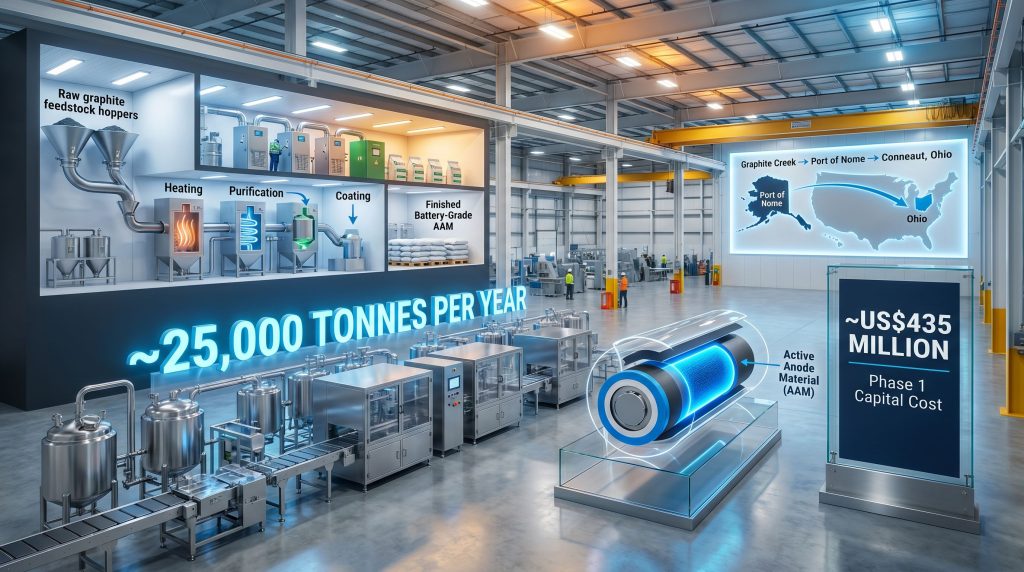
The Graphite One Ohio anode materials plant is designed to eventually process both types, beginning with synthetic graphite AAM during its initial operating phase, before incorporating natural graphite feedstock from the company's Alaskan deposit as that upstream project reaches production readiness.
The Supply Chain Architecture: Alaska to Ohio
Three Nodes, One Integrated System
The structure Graphite One is building is not simply a processing plant. It is a vertically integrated supply chain designed to eliminate the foreign processing dependency that currently characterises virtually all graphite anode supply reaching U.S. battery manufacturers. The architecture spans three geographically distinct operational nodes:
- Node 1, Extraction: The Graphite Creek deposit in western Alaska, described as one of the largest known graphite occurrences in North America, serves as the upstream mineral foundation
- Node 2, Logistics: The Port of Nome functions as the maritime corridor connecting Alaskan production to the continental processing network
- Node 3, Manufacturing: The Ohio facility transforms graphite feedstock into battery-grade AAM ready for cell manufacturing customers
What makes this architecture strategically significant is not any single node in isolation, but the end-to-end control it provides over a supply chain that currently runs almost entirely through China. Approximately 90% or more of the world's graphite anode materials are processed in China, a concentration level that exceeds even the well-publicised Chinese dominance in cobalt refining and rare earth separation. Indeed, the global graphite shortage driven by this dependency has become one of the most pressing vulnerabilities in the EV transition.
The Phased Feedstock Strategy: Why Start With Synthetic?
One of the more nuanced aspects of the Ohio plant's design is its deliberate sequencing of feedstock types. Beginning production with synthetic graphite AAM, which can be sourced from petroleum-derived precursors available through existing supply chains, allows the Ohio facility to commence operations and establish manufacturing credentials independently of the Graphite Creek development timeline.
This phased approach carries important de-risking logic. Mining and concentrating natural graphite in remote Arctic Alaska, then shipping it to Ohio for processing, involves a complex multi-year permitting, construction, and commissioning sequence. By structuring the Ohio plant to operate on synthetic feedstock first, the project can generate operational history, refine its manufacturing processes, and begin serving customers before the upstream mine is in production.
"The ability to decouple manufacturing ramp from mine development is a structural advantage that purely natural-graphite-dependent processing facilities do not have. It compresses the timeline to first commercial revenue while preserving the long-term competitive advantage of domestic mineral supply."
The Ohio Facility: Location, Specifications, and Engineering Progress
Conneaut, Ohio: Industrial Heritage as a Strategic Asset
The Graphite One Ohio anode materials plant is located in Conneaut, Ohio, representing the company's current operational focus following an earlier evaluation of a site in Niles, Ohio within the region known as "Voltage Valley." The Niles site had historical significance as a former national defence critical-minerals stockpile location, a legacy that reflects the broader strategic framing of the Ohio battery materials corridor.
Ohio's position as a manufacturing hub for the U.S. automotive sector makes it a logical geography for AAM production. Proximity to legacy automotive supply chain infrastructure, access to industrial-grade power and water, and an existing skilled manufacturing workforce all contribute to site economics that are difficult to replicate in less industrially developed states.
Phase 1 Production Parameters
| Parameter | Specification |
|---|---|
| Phase 1 Annual Capacity | ~25,000 tonnes of AAM |
| Estimated Phase 1 Capital Cost | ~US$435 million |
| Land Arrangement | 50-year lease with purchase option |
| Primary Outputs | Battery-grade graphite active anode materials |
| Initial Feedstock | Synthetic graphite |
| Subsequent Feedstock | Natural graphite from Graphite Creek, Alaska |
| Target End Markets | EVs, grid-scale energy storage, defence |
| Financing Status | Subject to project financing |
What the Production Line Integration Contract Involves
The engagement of a production line integration provider marks a concrete transition from strategic planning into detailed engineering execution. This type of contract covers the technical coordination between individual pieces of processing equipment, ensuring that material flows, thermal profiles, atmospheric controls, and mechanical interfaces across the entire production line function as an integrated system rather than a collection of isolated units.
The four core service areas being executed include:
- Equipment interface design: Specifying how individual processing units connect, including material handling conveyors, gas management systems, and thermal transfer interfaces
- Process integration: Aligning the upstream graphite input specifications, particle size distribution, purity, and morphology with the downstream AAM output requirements for battery cell manufacturers
- Production flow optimisation: Sequencing manufacturing steps to maximise throughput, minimise energy consumption per tonne of output, and reduce bottlenecks in the most energy-intensive processing stages, particularly high-temperature graphitisation and purification
- Operational readiness planning: Developing the commissioning frameworks, workforce training protocols, quality management systems, and safety procedures required to bring the facility into commercial operation
The progression of milestones that typically follow a production line integration contract in advanced materials manufacturing includes equipment procurement and vendor qualification, civil and structural engineering for facility fit-out, process simulation and pilot-scale validation, commissioning and operational testing, and ultimately commercial production ramp.
Regulatory Landscape and Market Demand Signals
How the IRA's FEOC Provisions Create Structural Demand for U.S. AAM
The Inflation Reduction Act introduced "foreign entity of concern" restrictions that progressively tighten the eligibility of batteries containing components or materials sourced from designated foreign entities, including Chinese companies, for the full EV tax credit. Because virtually all graphite anode supply currently flowing into U.S. battery manufacturing originates from China, either as processed AAM or as the natural flake graphite that is then processed in China, these restrictions create a structural demand signal for credibly domestic alternative supply.
For U.S. automakers seeking to maintain consumer eligibility for EV tax credits, securing non-FEOC graphite anode supply is not optional. It is a commercial necessity that becomes more pressing with each compliance year. This dynamic positions the Graphite One Ohio anode materials plant as a direct commercial response to a regulatory-driven supply gap that is already affecting purchasing decisions at the cell and vehicle manufacturer level. Consequently, advances in battery-grade processing technologies are increasingly seen as essential infrastructure investments across the industry.
Defence Industrial Base Considerations
Beyond the commercial EV market, military battery applications represent a demand category with characteristics that differ meaningfully from consumer markets. Defence procurement prioritises supply chain sovereignty and reliability over unit cost, which makes domestically produced, non-foreign-dependent AAM particularly attractive for military battery systems.
The historical use of the Niles, Ohio area as a critical-minerals stockpile location reflects a long-standing recognition within U.S. defence planning that graphite is a strategic material requiring domestic security of supply. In addition, broader efforts around US critical minerals production through defence-linked legislation have reinforced the case for facilities precisely like this one.
Financing Pathways Still to Be Secured
Both the Ohio manufacturing facility and the potential co-located recycling operation remain subject to project financing. Several federal financing instruments are potentially applicable to a project of this strategic profile:
- DOE Loan Programs Office (LPO): Provides debt financing for commercial-scale energy technology projects including battery materials manufacturing
- EXIM Bank critical minerals programs: Offers export-linked financing structures relevant to projects serving U.S. industrial supply chains
- Department of Defense Title III authorities: Enables direct industrial base investment in facilities producing materials deemed critical to national security
- Strategic partner equity and offtake-linked financing: Structures in which anchor customers or industrial partners provide capital in exchange for long-term supply agreements
Competitive Positioning and the Recycling Opportunity
Why Vertical Integration Is the Most Durable Business Model
| Business Model | Feedstock Control | Geopolitical Risk | Capital Intensity | Competitive Durability |
|---|---|---|---|---|
| Vertically Integrated (mine-to-anode) | High | Low | Very High | Maximum |
| Processing-Only (imported feedstock) | None | High | Moderate | Limited |
| Recycling-Supplemented Hybrid | Partial | Medium | High | High |
Processing-only facilities that depend on imported graphite feedstock, even if that processing occurs on U.S. soil, remain exposed to the same geopolitical concentration risks that motivate the broader onshoring agenda. A Chinese export restriction on raw or intermediate graphite would strand a processing-only operation just as effectively as it would an end user relying on finished Chinese AAM.
The Strategic Logic of Co-Located Recycling
A potential co-located battery recycling facility at the Ohio site would allow the plant to recover battery-grade graphite from end-of-life lithium-ion cells, providing a secondary feedstock stream that supplements and partially offsets dependence on either virgin mined graphite or synthetic graphite precursors. The battery recycling process for graphite recovery, however, remains technically complex and commercially nascent compared to cathode material recycling pathways.
As the U.S. EV fleet ages and first-generation battery packs reach end of life, the volume of recoverable graphite from domestic recycling streams is projected to grow substantially through the 2030s. This recycling component remains contingent on project financing and has not been confirmed as part of the initial construction scope. However, co-location with the primary AAM manufacturing facility would reduce the incremental capital cost of the recycling operation and create feedstock flexibility that stand-alone recycling facilities cannot replicate.
Furthermore, Graphite One's bankable feasibility study underscores the commercial rigour behind the broader supply chain vision, lending credibility to both the Ohio processing facility and the upstream Alaskan development timeline.
The next major ASX story will hit our subscribers first
Frequently Asked Questions
What will the Graphite One Ohio plant produce?
The facility is designed to produce battery-grade Active Anode Materials (AAM) for use in lithium-ion batteries across electric vehicle manufacturing, grid-scale energy storage, and defence applications.
Where is the Ohio plant located?
The current operational focus is Conneaut, Ohio. An earlier site evaluation examined Niles, Ohio within the Voltage Valley region, a location with historical ties to U.S. defence critical-minerals stockpiling.
What is the estimated Phase 1 capital cost?
Phase 1 capital expenditure is estimated at approximately US$435 million, a figure subject to revision as detailed engineering progresses.
How does the Ohio plant connect to the Alaska mining operation?
The supply chain flows from the Graphite Creek deposit in Alaska through the Port of Nome to the Ohio processing facility. The Ohio plant will initially operate on synthetic graphite feedstock, with Alaskan natural graphite incorporated as the upstream project advances toward production.
What phase is the project currently in?
As of mid-2026, the project is in the production line integration engineering phase, having engaged a specialist engineering provider to execute detailed design and equipment integration work.
Disclaimer: This article is intended for informational purposes only and does not constitute financial or investment advice. Project timelines, capital cost estimates, and production parameters referenced in this article are subject to change as engineering progresses and financing arrangements are finalised. The Graphite One Ohio anode materials plant remains subject to project financing. Readers should conduct their own due diligence before making any investment decisions.
Want To Get Ahead of the Next Major Critical Minerals Discovery on the ASX?
Discovery Alert's proprietary Discovery IQ model delivers real-time alerts on significant ASX mineral discoveries across battery materials, graphite, and over 30 other commodities, instantly translating complex data into actionable investment insights. Explore historic discoveries and their substantial market returns, then begin your 14-day free trial at Discovery Alert to position yourself ahead of the broader market.