June 19, 2026
India's Coal Reserves Are Worth More Unburnt Than Burnt
For most of its modern industrial history, India has treated coal as something to set on fire. The logic was straightforward: abundant reserves, established infrastructure, and a grid hungry for baseload power. But a fundamental recalculation is now underway, one that repositions coal not as a combustion fuel but as a chemical raw material. This distinction, seemingly technical, carries enormous economic and strategic consequences for the world's most populous nation.
The shift is not driven by environmental idealism. It is driven by hard arithmetic. India spends billions of dollars annually importing urea, ammonia, methanol, and liquefied natural gas — products that can, in principle, be manufactured domestically from the same coal already being extracted from Indian mines. Coal gasification in India is the industrial mechanism through which that substitution becomes possible, and the policy architecture now taking shape around it represents one of the most consequential industrial bets of the current decade.
When big ASX news breaks, our subscribers know first
The Structural Economics of Import Dependence
India's vulnerability to commodity import cycles is not incidental. It is structural. The country relies on India's LNG import structure to feed power plants and city gas networks, on imported ammonia and urea to sustain agricultural productivity, and on imported methanol and petrochemical feedstocks to supply its chemical manufacturing base. Each of these supply chains is priced in US dollars, subject to geopolitical disruption, and sensitive to shipping route volatility.
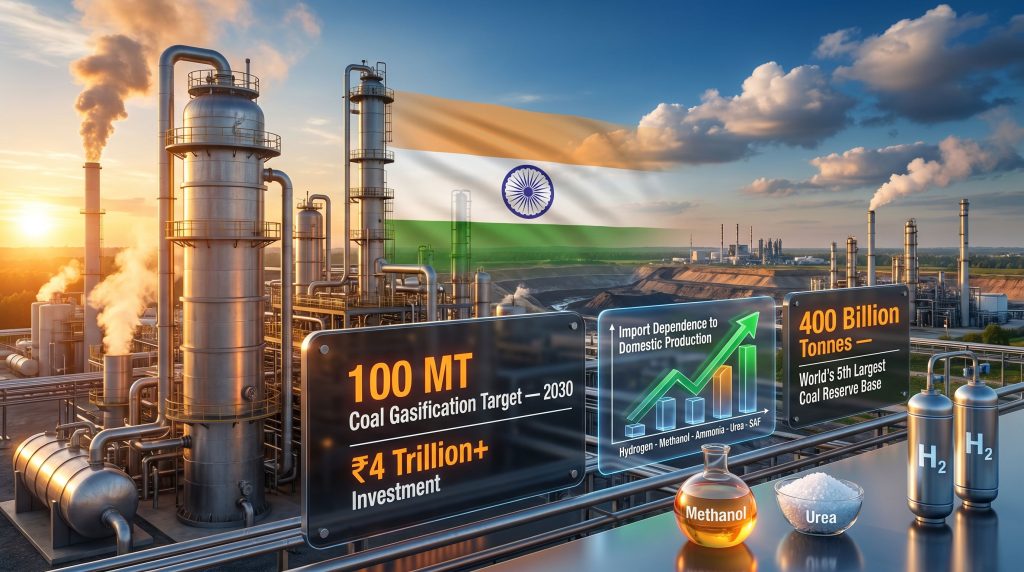
Against this backdrop, the scale of India's domestic coal endowment takes on a different meaning. The country holds over 400 billion tonnes of coal reserves, placing it among the five largest global coal reserves holders globally. Coal already underpins roughly 55% of the national energy mix and satisfies approximately 70% of electricity demand. India is the world's second-largest coal producer and consumer, and Coal India Limited holds the distinction of being the largest coal-producing company on the planet. The Gevra mine in Chhattisgarh alone ranks among the world's largest operating coal mines by output.
The strategic question, therefore, is not whether India can access coal. It is whether India can extract more value from it than simple combustion allows.
What Coal Gasification Actually Does: The Technical Case
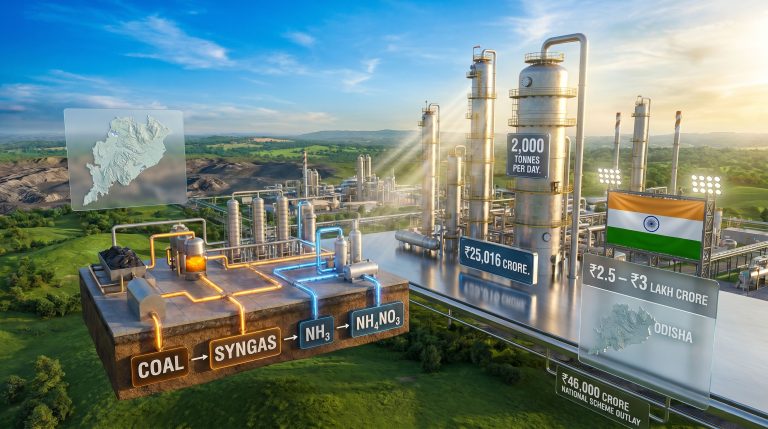
Understanding why coal gasification in India is attracting policy and investment attention requires grasping what the process does at a fundamental level. Gasification is a thermochemical reaction, not combustion. Coal is exposed to controlled quantities of oxygen, steam, or carbon dioxide at high temperatures, producing synthesis gas, or syngas — a mixture dominated by hydrogen (H₂) and carbon monoxide (CO).
This syngas intermediate is exceptionally versatile. Depending on downstream processing configuration, it can be refined into a wide array of industrial products:
- Hydrogen for clean fuel applications and industrial processes including steel and refining
- Methanol for fuel blending, chemical manufacturing, and maritime applications
- Ammonia as the primary precursor to fertiliser production
- Urea for direct agricultural use, currently a major import commodity
- Synthetic Natural Gas (SNG) compatible with existing pipeline infrastructure
- Sustainable Aviation Fuel (SAF) via Fischer-Tropsch synthesis
- Ethanol to complement India's domestic blending programme
Each of these products is currently imported in material volumes. The import substitution logic is therefore not abstract. It is product-by-product and sector-by-sector.
Surface Gasification vs. Underground Coal Gasification: What Does the Distinction Mean for India?
Two distinct technical pathways exist within the broader gasification framework, and India's policy emphasis currently sits firmly on surface gasification, where the conversion occurs in engineered above-ground reactor vessels using mined coal as feedstock.
| Feature | Surface Coal Gasification | Underground Coal Gasification (UCG) |
|---|---|---|
| Conversion location | Above-ground reactor vessels | Within the coal seam, in-situ |
| Mining requirement | Yes, coal must be extracted first | No surface mining required |
| Technology maturity | Commercially proven at scale | Emerging, limited commercial deployments |
| Environmental management | Managed above ground | Subsurface risk management required |
| India's policy focus | Primary emphasis | Exploratory and early-stage |
UCG has attracted interest globally because it theoretically unlocks coal deposits that are too deep or structurally unsuitable for conventional mining. However, subsurface water contamination risks and the absence of mature commercial-scale deployments mean India is concentrating near-term investment on surface gasification while UCG remains in an exploratory phase.
The High-Ash Coal Problem: A Technical Constraint With Strategic Implications
One of the less publicly discussed challenges in coal gasification in India is the quality profile of the domestic coal reserve base. A substantial proportion of India's coal carries high ash content, which creates specific engineering complications that directly affect project viability. Furthermore, this challenge has been well-documented, with detailed technical analysis from India's policy institutions outlining the specific reactor design and feedstock preparation requirements that high-ash conditions demand.
Technical Note: High-ash coal reduces the effective calorific value per tonne of feedstock and generates disproportionate volumes of slag and residue within gasifier systems. This places higher demands on reactor design, feedstock preparation, and waste management infrastructure.
The three principal gasifier technology categories each respond differently to this challenge:
- Entrained-flow gasifiers operate at very high temperatures and pressures, handling a wide range of coal qualities but requiring fine coal particle preparation and significant capital investment.
- Fluidised-bed gasifiers are better suited to lower-rank, high-ash coals and operate at moderate temperatures, offering flexibility but with efficiency trade-offs.
- Fixed-bed gasifiers are among the oldest and most proven configurations, suited to coarser coal, but less efficient with very high-ash feedstocks.
Technology selection is therefore not generic. Each project must be engineered around the specific ash content, moisture, and calorific profile of its designated coal supply. This creates a meaningful differentiation opportunity for international technology licensors and engineering firms with high-ash coal experience, particularly those from China, where similar feedstock challenges have been encountered at commercial scale.
India vs. China: The Scale Gap That Defines the Opportunity
China's coal-to-chemicals sector provides both a benchmark and a competitive reference point for India's ambitions. Chinese operators have deployed coal gasification at large-scale commercial capacity across fertiliser, methanol, and synthetic natural gas production, operating some of the most extensive coal chemical complexes in the world.
India's position, by contrast, is one of structured early acceleration. The technology is not unavailable. The coal resource is not insufficient. The gap is primarily one of investment mobilisation, project financing architecture, and technology localisation for high-ash feedstock conditions. Closing that gap is precisely what the National Coal Gasification Mission is designed to do.
The National Coal Gasification Mission: Architecture and Ambition
India's formal policy framework for scaling coal gasification is the National Coal Gasification Mission, which has set a production target of gasifying 100 million tonnes of coal annually by 2030. Supporting this target is a dedicated promotion scheme carrying a financial commitment of ₹37,500 crore, with broader capital mobilisation ambitions associated with the programme exceeding ₹4 trillion by 2030.
The incentive structure includes several distinct mechanisms designed to improve the economics of early-mover projects:
- Revenue-share concessions on coal supply, reducing the feedstock cost burden for gasification developers
- Separate auction windows for coal blocks designated specifically for gasification end-use
- Financial support structures aimed at de-risking project investment during early construction phases
- A draft Request for Proposal (RFP) framework placed in the public domain for stakeholder consultation, signalling the transition from policy design to active project tendering
Public sector entities anchoring the programme include Coal India Limited as the coal supply backbone, GAIL for gas infrastructure and downstream processing expertise, and BHEL for domestic engineering and reactor technology capability. State-level engagement is also active, with Maharashtra having positioned itself as an investment destination, with the state's leadership present at a recent industry roadshow where the mission's ambitions were articulated to investors and technology providers.
The next major ASX story will hit our subscribers first
Sector-by-Sector: Where Gasification Creates the Most Value
Fertilisers: The Highest-Priority Import Substitution Target
India's fertiliser sector carries one of the clearest economic cases for coal gasification. The country is among the world's largest importers of urea and ammonia, both synthesisable from coal-derived syngas. Reducing this fertiliser import reliance would generate direct foreign exchange savings while also insulating domestic food production economics from international commodity cycles. Agricultural policy alignment makes this application a strategic priority, not merely a commercial opportunity.
Steel: Coal Gasification as a Hydrogen Bridge
The Indian steel sector is actively evaluating hydrogen-based iron reduction as a route to lower carbon intensity. Coal gasification provides a near-term, domestically sourced hydrogen supply pathway while dedicated green hydrogen infrastructure remains years from commercial scale. This positions coal gasification as a pragmatic transitional decarbonisation enabler for one of India's most carbon-intensive industries.
Chemicals and Transport: Methanol and SAF Pathways
India's methanol economy programme targets fuel blending and chemical feedstock applications. Coal-to-methanol is among the most commercially mature gasification pathways globally, offering a direct displacement of imported methanol and natural gas-based chemical feedstocks. Simultaneously, SAF production via Fischer-Tropsch synthesis from syngas represents an emerging but technically viable pathway for progressively decarbonising aviation fuel supply in support of India's net-zero 2070 commitment.
Coal Gasification and India's Net-Zero 2070 Pathway
India's commitment to net-zero emissions by 2070 is frequently cited alongside coal gasification discussions, and the relationship between the two deserves careful analysis rather than simplistic framing. In addition, India's coal market reforms are evolving in parallel, with market liberalisation creating new pricing signals that will shape the commercial viability of gasification projects over the coming years.
| Utilisation Pathway | Approximate CO₂ Intensity | Carbon Capture Potential |
|---|---|---|
| Direct coal combustion (power) | High, approximately 900-1,000g CO₂/kWh | Limited without CCS retrofit |
| Coal gasification (without CCUS) | Moderate, varies by product pathway | Moderate |
| Coal gasification (with CCUS) | Substantially reduced | High, point-source capture is technically feasible |
| Green hydrogen (renewables-based) | Near-zero | Not applicable |
When integrated with carbon capture, utilisation, and storage (CCUS) technologies, coal gasification can produce blue hydrogen — a lower-carbon industrial fuel that fills the supply gap during the transition period before renewable-based green hydrogen achieves cost parity and scale.
The honest policy framing is that coal gasification occupies a defined but time-limited transitional role. It enables cleaner coal utilisation compared to direct combustion, supports import substitution across critical sectors, and funds the industrial base that will eventually transition to cleaner feedstocks. Critics correctly note that without robust CCUS deployment, the carbon abatement case weakens considerably. Proponents counter that the energy security and foreign exchange benefits independently justify the investment on development economics grounds alone. The broader global case for gasification further reinforces that this transitional logic is not unique to India but reflects a pattern emerging across multiple high-coal-endowment economies.
Investment Risk Framework: What Developers and Capital Allocators Must Evaluate
For investors and developers evaluating exposure to coal gasification in India, the opportunity is real but the risk profile is multi-dimensional:
- Technology risk involves selecting gasifier configurations appropriately matched to specific coal quality profiles, particularly high-ash Indian coal, where inappropriate technology choices can significantly impair project economics.
- Regulatory risk reflects evolving environmental compliance requirements, including emissions standards for gasification plant operations and potential future carbon pricing mechanisms.
- Commodity price risk arises because syngas derivative products including methanol, ammonia, and hydrogen are subject to global price cycles that can compress project margins during downturns.
- Execution risk acknowledges the historical track record of large-scale industrial project delivery timelines in India, where permitting, land acquisition, and infrastructure coordination have periodically extended construction schedules.
- Financing risk relates to the capital intensity of gasification facilities, which typically require multi-billion rupee investments per plant, demanding long-tenor debt facilities and patient equity capital.
Investor Note: The government's draft RFP framework and stakeholder consultation process represents a genuine entry point for technology licensors, EPC contractors, and financial investors to shape project structures before tendering closes. Early engagement in these consultation processes is likely to confer structural advantages in subsequent competitive bidding.
Key Metrics at a Glance
| Metric | Detail |
|---|---|
| India's coal reserve base | Over 400 billion tonnes (5th largest globally) |
| Coal's share of energy mix | Approximately 55% of total energy |
| Coal's share of electricity demand | Approximately 70% |
| 2030 gasification target | 100 million tonnes per annum |
| Government scheme financial commitment | ₹37,500 crore |
| Broader investment mobilisation target | ₹4 trillion+ by 2030 |
| Primary downstream products | Hydrogen, methanol, ammonia, urea, SNG, SAF, ethanol |
| Net-zero commitment timeline | 2070 |
| Key public sector participants | Coal India Limited, GAIL, BHEL |
The Reframing That Changes Everything
The conceptual shift at the heart of coal gasification in India is deceptively simple but industrially profound. Coal stops being a fuel to combust and becomes a chemical feedstock to refine. That reframing changes the economics of the entire reserve base, transforms the competitive position of domestic coal relative to imported LNG and chemical commodities, and opens an industrial development pathway that bypasses the import dependency that has made India vulnerable to external price shocks for decades.
The 100 million tonne per year target by 2030 is ambitious relative to current project pipelines, and achieving it will require significant acceleration across investment mobilisation, technology deployment, and regulatory execution. The high-ash coal challenge must be addressed at the project design level, not deferred. Environmental safeguards, including credible CCUS integration pathways, must keep pace with industrial expansion to protect the long-term legitimacy of the transition narrative.
But the structural logic is sound. India has the coal, the industrial demand, the policy architecture, and the economic incentive. What coal gasification now requires is execution at the scale the ambition demands.
This article is intended for informational purposes only and does not constitute financial or investment advice. Forecasts, targets, and projections referenced herein involve inherent uncertainty and may not be achieved. Readers should conduct independent research before making any investment decisions.
Want To Know Which ASX Commodity Discoveries Could Benefit From India's Industrial Shift?
Discovery Alert's proprietary Discovery IQ model scans ASX announcements in real time, instantly identifying significant mineral discoveries across the commodities underpinning global industrial transitions — from metallurgical coal to fertiliser feedstocks. Explore historic examples of major discovery returns and begin your 14-day free trial to position yourself ahead of the broader market.