June 19, 2026
Why Integrated Industrial Insolvencies Are Among the Most Complex Asset Dispositions in Emerging Markets
When courts in emerging economies are tasked with unwinding a vertically integrated industrial giant, the process rarely follows a clean, linear path. Mexico extends AHMSA and Minosa auction preparation by 10 days, and this latest development reveals just how much legal, operational, environmental, and political complexity can interact within even well-structured auction frameworks. Mexico's ongoing insolvency proceedings involving Altos Hornos de México (AHMSA) and its iron ore mining subsidiary Minosa offer a revealing window into how these processes actually function beneath the surface.
When big ASX news breaks, our subscribers know first
The Industrial Scale Behind the AHMSA and Minosa Insolvency
AHMSA, headquartered in Monclova, Coahuila, was long regarded as the backbone of Mexico's domestic steel industry. At its peak, the company operated as one of Latin America's largest fully integrated steel producers, encompassing blast furnaces, rolling mills, and coke production, all fed upstream by Minosa's iron ore extraction operations in the same northern Mexico region.
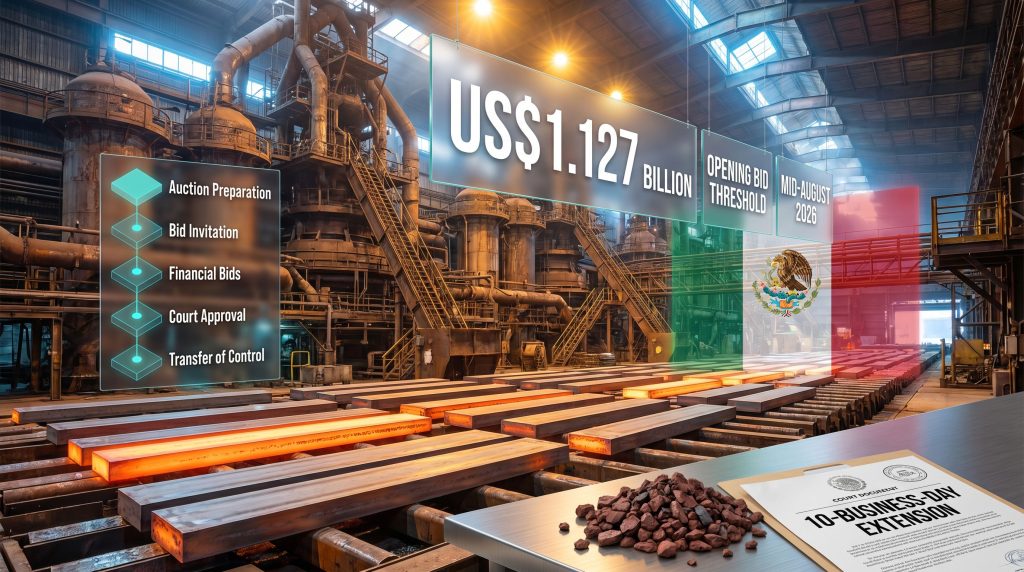
The combined scale of these two entities explains why the court-approved opening bid threshold has been set at approximately US$1.127 billion. This figure reflects not just asset replacement value but the embedded operational infrastructure of a going-concern industrial system that would cost multiples of that figure to replicate from scratch.
Key dimensions of the case's economic significance include:
- AHMSA's steel production capacity historically exceeded 4 million tonnes per annum, placing it among Mexico's dominant domestic suppliers
- Minosa's iron ore operations provided captive raw material supply, a strategic vertical integration that drives the going-concern premium in any acquisition scenario
- The Monclova, Coahuila region is economically reliant on these operations, with the combined workforce representing one of Mexico's largest single-site industrial employment concentrations
- Mexico currently imports a substantial share of its flat steel requirements, meaning that restoring AHMSA's capacity has genuine implications for the country's trade balance in manufactured goods
This is not simply a corporate restructuring. It is a case where industrial policy, regional employment, creditor recovery, and national supply chain resilience all converge inside a single court-supervised auction.
What Mexico Extends AHMSA and Minosa Auction Preparation by 10 Days Actually Signals
The decision by Mexican federal courts to authorise a 10-business-day extension to the auction preparation phase has been interpreted by some observers as another sign of process dysfunction. A more technically grounded reading, however, suggests the opposite.
In court-supervised industrial asset auctions, preparation phase extensions serve a specific administrative function. They are granted when auction administrators require additional time to complete pre-bid compliance work that falls within the approved sale framework. This typically involves:
- Finalising data room documentation for qualified bidder access
- Completing regulatory notification obligations to creditor classes
- Ensuring that environmental and operational disclosure materials meet due diligence standards
- Coordinating with court-appointed administrators on bid qualification criteria
A court-authorised preparation extension of this nature is categorically different from a structural revision to the auction terms. The bid floor, the joint sale framework, and the going-concern disposition approach all remain intact. What changes is the administrative calendar, not the commercial architecture of the sale.
The distinction matters because it affects how bidders, creditors, and market observers should interpret the signal. The table below frames the three categories of delay that can occur in complex industrial insolvency auctions and their respective implications:
| Delay Type | Implication for Bidders | Implication for Creditors |
|---|---|---|
| Administrative/Procedural | Minor calendar shift; no structural change | Marginal extension of recovery timeline |
| Structural Revision | Potential rebidding or requalification requirements | Risk of altered recovery terms |
| Court-Ordered Suspension | Process halt; likely legal challenge | Significant uncertainty around recovery value |
The 10-business-day extension authorised in this instance falls squarely within the administrative/procedural category.
Furthermore, Steel Market Update's coverage of the AHMSA bankruptcy auction confirms that the broader sale framework continues to move forward, reinforcing the administrative rather than structural reading of this extension.
The Going-Concern Sale Structure and Its Strategic Logic
One of the less-discussed but critically important decisions in this case was the court's approval of a joint sale framework for AHMSA and Minosa as unified operating units. In most large industrial insolvencies, courts face pressure from certain creditor classes to pursue piecemeal liquidation, which can theoretically maximise recovery on individual asset lines such as real estate, equipment, and intellectual property.
Mexican courts rejected this approach in favour of a going-concern auction for several reasons:
- Vertical integration premium: Separating Minosa from AHMSA would destroy the captive iron ore supply relationship that underpins the steel operation's cost competitiveness. A buyer acquiring AHMSA without Minosa would face immediate raw material sourcing risk at market prices, materially reducing their willingness to pay.
- Operational continuity: A going-concern sale preserves the workforce, permits, and operational licences that would otherwise require costly and time-consuming reacquisition by any new owner attempting to restart a liquidated facility.
- Creditor recovery maximisation: Despite appearing counterintuitive, the going-concern premium in large industrial cases typically yields higher aggregate creditor recovery than piecemeal liquidation, particularly when environmental remediation liabilities are factored into a liquidation scenario.
- Political feasibility: A unified sale that preserves employment is substantially easier to advance through Mexico's regulatory environment than a liquidation that could trigger mass unemployment in a politically sensitive region.
Projected Timeline: From Preparation Extension to Financial Close
Prior to the latest extension, the auction preparation phase was tracking toward financial bid submissions within approximately 60 days of the court's acceptance of the sale framework. If that trajectory holds following the current 10-business-day adjustment, the process could move toward a financial close window around mid-August 2026, though further procedural steps remain before any buyer is formally confirmed.
The key milestones separating the current preparation phase from a completed transaction are:
- Conclusion of the extended preparation documentation phase
- Formal publication of the bid invitation and opening of data room access to qualified parties
- Submission of qualified financial bids by registered participants
- Court review, evaluation, and approval of the winning bid
- Regulatory clearances where applicable (competition law, foreign investment review)
- Transfer of operational control and initiation of creditor settlement processes
Each of these milestones carries its own latent complexity. Court approval of a winning bid, for instance, can be subject to challenge by creditors who dispute the adequacy of recovery terms, which has historically introduced additional timeline risk in Latin American industrial insolvency cases.
Regulatory and Labour Dimensions That Shape the Auction's Real Constraints
Labour Obligations Under Mexican Insolvency Law
Under Mexico's Ley de Concursos Mercantiles (commercial insolvency law), labour obligations carry a privileged creditor status, meaning they rank ahead of most financial creditors in recovery hierarchy. For any buyer in this auction, this creates a meaningful due diligence obligation around understanding the full scope of AHMSA's employment contracts, pension liabilities, and union agreements before submitting a financial bid.
The Sindicato Nacional de Trabajadores Mineros, Metalúrgicos, Siderúrgicos y Similares de la República Mexicana (the national mining and steel workers union) has historically been a significant stakeholder in AHMSA's industrial relations landscape. Union stakeholder positioning can influence not just the auction timeline but the conditions attached to any sale approval, including employment preservation commitments that a buyer must absorb as a cost of acquisition.
Environmental Liability as a Hidden Acquisition Cost
Integrated steel and iron ore operations of AHMSA's vintage carry substantial environmental legacy obligations. Decades of blast furnace operation, coking processes, and mining extraction create remediation liabilities that are difficult to quantify without comprehensive site assessment. For prospective acquirers, this represents one of the most significant due diligence risks.
Buyers in distressed industrial asset auctions who underestimate environmental liability transfer risk have historically faced post-acquisition capital calls that materially erode the financial thesis underpinning their original bid. The 10-day extension likely benefits sophisticated bidders who need additional time to complete parallel environmental due diligence.
Foreign Investment and Competition Law Considerations
Mexico's foreign investment regulatory framework, overseen by the Comisión Nacional de Inversiones Extranjeras, requires review of acquisitions in sectors deemed strategically sensitive. While steel production and iron ore mining do not automatically trigger mandatory screening under current regulations, the scale of the AHMSA-Minosa transaction means that any international bidder should anticipate a regulatory engagement process running parallel to the auction timeline itself.
The next major ASX story will hit our subscribers first
Who Might Bid and What the Acquisition Mathematics Look Like
The US$1.127 billion opening bid floor immediately filters the universe of realistic acquirers to a small set of well-capitalised industrial players. Credible bidder categories include:
- Domestic Mexican industrial groups with existing interests in steel distribution, construction materials, or energy, who would benefit from backward integration into steel production
- Latin American regional steel producers seeking to expand capacity in Mexico's growing infrastructure market, particularly given the country's nearshoring-driven industrial investment cycle
- International strategic investors from steel-producing regions with established track records of acquiring distressed integrated assets, including players from Asia, Europe, and the Middle East who have participated in similar transactions globally
- Private equity or special situations funds with deep industrial expertise, though the operational complexity and labour obligations make purely financial buyer participation less likely without an industrial co-investor
The vertical integration of AHMSA and Minosa is a genuine acquisition premium driver. A buyer inheriting both the steel production platform and the captive iron ore supply chain acquires not just capacity but feedstock cost certainty in a commodity environment where iron ore price trends can be the single largest driver of integrated steel margin compression.
Benchmarking AHMSA Against Regional Insolvency Precedents
Large-scale industrial insolvency auctions in Latin America have a documented history of iterative delay. The AHMSA process is consistent with this regional pattern, though its going-concern joint sale structure distinguishes it from many precedent cases where piecemeal liquidation was the default outcome. Consequently, the global crude steel outlook provides useful context for understanding the strategic value at stake in this transaction.
| Case Characteristic | AHMSA / Minosa | Typical LatAm Industrial Insolvency |
|---|---|---|
| Asset Structure | Integrated steel + iron ore | Often single-sector |
| Sale Approach | Going-concern joint auction | Mixed (liquidation is common) |
| Opening Bid Threshold | ~US$1.127 billion | Varies widely |
| Court Jurisdiction | Federal (Mexico) | Federal or state-level |
| Timeline Pattern | Multiple extensions through 2026 | Frequently subject to delays |
| Labour Sensitivity | Very high (Coahuila employment hub) | Sector-dependent |
| Environmental Legacy Risk | Significant (decades of operations) | Present in most heavy industry cases |
The outcome of this process carries precedent value beyond the immediate transaction. How Mexican federal courts manage the balance between creditor recovery, employment preservation, and operational continuity will inform how future large industrial insolvencies in Mexico are structured, particularly as the country's nearshoring boom generates new industrial investment cycles in coming decades.
In addition, broader market forces are relevant here. The China steel and iron ore market continues to shape global steel economics, whilst developments around steel and aluminium tariffs and the wider global iron ore tariff impact add further complexity to the investment calculus for any prospective AHMSA-Minosa acquirer.
Frequently Asked Questions: AHMSA and Minosa Auction Process
What is the current status of the AHMSA and Minosa auction?
Mexican courts have authorised a 10-business-day extension to the auction preparation phase. This is an administrative adjustment within the existing approved framework. The joint sale structure and the US$1.127 billion opening bid threshold remain unchanged. According to BNamericas reporting on the new auction, the focus remains firmly on preserving operational continuity throughout this process.
Why are AHMSA and Minosa being sold as a single unit?
Courts approved a joint sale approach to preserve the vertical integration between AHMSA's steel production and Minosa's iron ore supply operations. Separating the entities would eliminate the captive feedstock relationship and reduce the going-concern value available to creditors.
When could the sale be completed?
Subject to the latest extension, financial bid submissions were projected within roughly 60 days of the sale framework acceptance, with potential completion around mid-August 2026. Court review, regulatory processes, and creditor approval steps mean the final closing timeline carries inherent uncertainty.
What are the biggest risks to the auction process?
The primary risks include creditor challenges to any winning bid, labour obligation disputes that complicate buyer due diligence, environmental liability quantification issues, and the possibility of regulatory review requirements for international bidders.
How does this case fit into Mexico's broader industrial policy context?
Mexico extends AHMSA and Minosa auction preparation by 10 days in a case that represents one of the largest industrial dispositions in Mexico's recent history. Its resolution, and particularly the preservation or otherwise of operational capacity and employment, carries political significance that extends well beyond the legal mechanics of the bankruptcy process itself.
What to Watch as the Process Moves Forward
For those tracking this case, the following developments will serve as the most meaningful indicators of process momentum:
- Court announcements confirming the conclusion of the extended preparation phase and the formal opening of bid submissions
- Regulatory filings or competition authority notifications that may signal international bidder participation
- Union communications from AHMSA's workforce representatives, which often provide early signals about labour condition negotiations attached to any prospective sale
- Named bidder disclosures, which in Mexican court-supervised processes are typically made public at the bid submission stage rather than during preparation
- Any further extension requests, which would begin to shift the pattern from routine administrative adjustment toward structurally significant delay
Disclaimer: This article is intended for informational purposes only and does not constitute financial, legal, or investment advice. Timelines, bid thresholds, and process details are based on publicly available reporting as of the date of publication and are subject to change as the court-supervised auction process evolves. Readers should conduct independent due diligence before drawing conclusions for investment or commercial decision-making purposes.
Want to Capitalise on the Next Major Mineral Discovery Before the Broader Market?
Discovery Alert's proprietary Discovery IQ model delivers real-time alerts on significant ASX mineral discoveries, transforming complex mineral data into actionable investment insights for both short-term traders and long-term investors — explore historic discoveries and their exceptional returns to understand the opportunity, then begin your 14-day free trial at Discovery Alert to position yourself ahead of the market.