July 29, 2026
The Hidden Complexity Behind Remote Dozer Operations in Sub-Arctic Gold Mining
Ground instability is one of the most underappreciated hazards in surface mining. Unlike equipment failures or chemical exposures, ground-related risk is dynamic, geographically variable, and notoriously difficult to predict with precision. In sub-arctic environments across Northern Canada, where freeze-thaw cycles can transform stable ground into compromised terrain within days, the challenge is compounded by remoteness, extreme temperatures, and the operational urgency that often accompanies remediation work. It is in this context that the role of semi-autonomous remote dozer technology becomes not just relevant, but strategically critical.
Understanding how AutoNav Lite technology in Northern Canada gold mining is reshaping ground management operations requires unpacking the full engineering logic behind semi-autonomous systems, the unique geological pressures of sub-arctic mining zones, and the practical reality of deploying advanced technology across vast distances under time pressure.
When big ASX news breaks, our subscribers know first
What Semi-Autonomous Operation Actually Means in a Mining Context
The term "automation" is frequently applied to mining technology in ways that obscure meaningful distinctions. In practice, automation in mining exists on a maturity spectrum with several clearly defined tiers:
-
Manual operation: A human operator physically occupies the cab and makes all decisions in real time.
-
Assisted operation: Onboard systems provide blade control feedback, load monitoring, or terrain alerts, but the operator remains in the cab.
-
Tele-remote (semi-autonomous) operation: The operator controls the machine from a remote workstation, using camera feeds and sensor data, with no physical presence near the equipment.
-
Full autonomy: The machine operates without real-time human input, using pre-mapped environments, GPS guidance, and onboard decision logic.
AutoNav Lite, developed by RCT (powered by Epiroc), sits firmly in the tele-remote category. This distinction matters enormously in practical deployment terms. Full autonomous systems require extensive pre-mapping of the operating environment, substantial infrastructure investment, and commissioning timelines that can stretch across many months. Tele-remote platforms like AutoNav Lite are engineered specifically for environments where those prerequisites cannot be met, whether due to unstable or constantly changing terrain, operational urgency, or the scale of the operation itself.
Semi-autonomous tele-remote systems are not a stepping stone toward full autonomy that operators settle for. In high-risk remediation environments, they are frequently the technically superior choice, because full autonomy cannot yet reliably account for unpredictable ground behaviour in real time.
For mid-tier and junior gold operators in Northern Canada, this distinction also carries a significant financial dimension. Furthermore, autonomous haulage technology platforms are typically built around proprietary OEM equipment ecosystems, requiring capital-intensive fleet standardisation. Agnostic platforms like AutoNav Lite can be retrofitted to existing mixed-fleet equipment, reducing both capital commitment and transition risk.
Why Northern Canada's Geology Creates a Distinct Risk Profile for Ground Operations
Sub-arctic mining environments impose a set of geological and environmental pressures that have no direct equivalent in temperate or tropical mining jurisdictions. Several factors combine to create an unusually demanding operational context:
Permafrost Dynamics and Active Layer Behaviour
In Northern Canada, permafrost underlies vast portions of the land surface. The upper layer, known as the active layer, freezes and thaws seasonally. During summer months, this layer can become saturated and structurally weak as melt water cannot percolate through the permanently frozen substrate below. In active mining zones where overburden has been removed or vegetation stripped, this natural insulation is lost, accelerating thaw and destabilising previously stable ground.
Freeze-Thaw Cycling and Ground Heave
Repeated freeze-thaw cycles generate frost heave, a physical process by which ice lens formation causes ground to expand vertically and laterally. In areas where mining activity has disturbed natural drainage patterns, this process can accelerate, creating unpredictable ground surface movement that is particularly hazardous for heavy equipment and the operators inside it.
Operational Urgency During Remediation
Stabilisation and remediation work often cannot wait for ideal ground conditions. When compromised ground threatens infrastructure, tailings management systems, or operational access routes, the work must proceed regardless of whether conditions are ideal for conventional manned operation. This is precisely the scenario where tele-remote deployment provides its most critical safety value.
According to research on occupational fatalities and serious injuries in Canadian mining, ground-related incidents have historically represented one of the most significant causes of workplace harm in surface operations. Removing operators from the physical vicinity of unstable ground through remote operation addresses this risk at the highest possible level of the hierarchy of controls — the elimination of exposure rather than its management through personal protective equipment or procedural controls. This approach also supports broader mine reclamation work, where ground conditions are frequently unpredictable and operator safety must be prioritised at every stage.
How AutoNav Lite Is Integrated and Deployed: The Technical Architecture
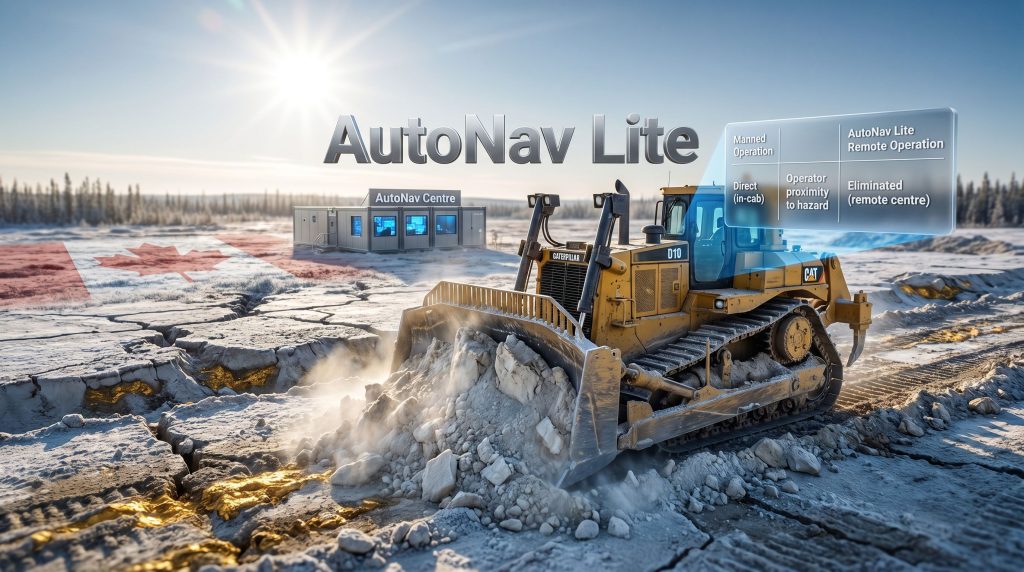
The recent deployment of AutoNav Lite technology in Northern Canada involved two Caterpillar D10 track-type dozers, each retrofitted with the full RCT tele-remote control system. The Caterpillar D10 is a purpose-built heavy earthmoving machine weighing approximately 73 tonnes in standard configuration, designed for large-scale dozing, pushing, and reclamation work in demanding terrain. Its size and ground-engaging capability make it well suited to the scale of ground stabilisation tasks common in northern gold mining operations.
The integration process involved RCT technicians working alongside Epiroc field staff and local site personnel. The key elements of the AutoNav Lite architecture in a typical dozer deployment include:
-
Machine-side control hardware retrofitted to the existing OEM equipment, including electronic interface modules that translate remote operator inputs into machine hydraulic and drive commands.
-
Camera systems providing the operator with sufficient situational awareness to manage blade angle, ground engagement, and proximity to terrain features from a remote position.
-
Communication infrastructure connecting the machine-side hardware to the AutoNav Centre workstations, requiring stable, low-latency connectivity across the operating zone.
-
Dual AutoNav Centres established on site, allowing two machines to be monitored and operated simultaneously from a controlled, safe environment.
The OEM-agnostic design of AutoNav Lite is a technically significant feature. Consequently, it means the retrofit capability is not locked to a single equipment manufacturer, enabling deployment across Caterpillar, Komatsu, Liebherr, and other major dozer platforms without requiring dedicated OEM integration agreements. For instance, RCT's AutoNav system has been deployed at narrow vein gold sites where conventional manned operation posed unacceptable risk levels, demonstrating the platform's versatility across diverse mining environments.
Commissioning Under Urgency: A Cross-Continental Logistics Achievement
One of the most operationally noteworthy aspects of this deployment was the compressed timeline from project approval to operational commissioning. Equipment was manufactured and assembled across RCT's facilities in Brisbane and Perth, Australia, before being shipped internationally to a remote Northern Canadian mine site. RCT's Global Operations Manager described the pace of the project as materially faster than the typical build-and-deploy cycle for comparable automation solutions.
This speed carries significant implications for how the industry thinks about automation deployment. The conventional assumption is that deploying mining automation at a remote site is a multi-quarter exercise in planning, procurement, and infrastructure development. This deployment challenges that assumption, suggesting that well-integrated semi-autonomous platforms with experienced commissioning teams can deliver operational readiness within compressed timeframes when operational necessity demands it.
On-site commissioning was led by RCT specialists Andrew Taylor, Keegan Koertzen, and Adam Gough, who managed installation, system integration testing, and operator transition training. The deliberate inclusion of structured operator training as a commissioning phase, rather than an afterthought, reflects the industry's growing understanding that technology adoption succeeds or fails at the operator interface level.
Operational Outcomes Beyond the Safety Headline
While the primary driver for this deployment was operator safety, the operational benefits of tele-remote dozer operation extend meaningfully into productivity and equipment management. The following table outlines the key operational differences between conventional manned dozer operation and AutoNav Lite remote operation across several performance dimensions:
| Parameter | Manned Operation | AutoNav Lite Remote Operation |
|---|---|---|
| Operator hazard proximity | Direct (in-cab) | Eliminated (remote workstation) |
| Shift continuity | Constrained by fatigue regulations | Greater scheduling flexibility |
| Operational tempo in hazard zones | Interrupted by safety stand-downs | Continuous where communications permit |
| Equipment wear monitoring | Primarily operator-sensory | Integrated system monitoring capability |
| Simultaneous multi-machine oversight | Not possible from one operator | Enabled via dual AutoNav Centre configuration |
Remote operation also removes one of the key variables that drives inconsistent machine performance in ground engagement tasks: operator fatigue and the micro-decisions made under physical discomfort and stress. Stabilisation work requires consistent, repeatable blade passes at precise depths and angles. A rested operator at a climate-controlled remote workstation is, by definition, operating with a different cognitive and physical baseline than a counterpart in a vibrating cab exposed to extreme temperature differentials.
Where AutoNav Lite Sits Within the Broader Mining Automation Landscape
To contextualise AutoNav Lite's position in the Canadian mining automation market, it is useful to compare it against other available platforms:
| Technology Platform | Automation Level | Primary Application | OEM Agnostic | Deployment Speed |
|---|---|---|---|---|
| AutoNav Lite (RCT/Epiroc) | Tele-remote semi-autonomous | Surface dozing, remediation | Yes | Rapid |
| Caterpillar MineStar Command | Full autonomous | Haulage trucks, drills | No (Cat-specific) | Extended |
| Epiroc Mobilaris | Situational awareness/assisted | Underground tracking | Yes | Moderate |
| Hexagon Mining Autonomy | Full autonomous | Surface drill and blast | Partial | Extended |
The critical insight this comparison surfaces is that full autonomy and semi-autonomy are not competing directly for the same operational applications. Full autonomous haulage systems like MineStar Command are designed for high-repetition, pre-mapped haul routes with predictable environments. They are not engineered for irregular, reactive ground remediation work in dynamically changing terrain conditions. AutoNav Lite occupies a functionally distinct space in the technology landscape, one where human judgement remains integral to moment-by-moment decision-making, but human physical presence in the hazard zone is eliminated.
This distinction is particularly relevant for Northern Canada's active gold project pipeline. However, the gold mining challenges facing many operations in this region are compounded by the fact that mid-tier or junior-scale operators often run mixed equipment fleets without the capital base to justify full autonomous system infrastructure. For these operators, agnostic tele-remote platforms represent a practical, scalable, and rapidly deployable risk management tool. In addition, AI-powered mining efficiency solutions are increasingly being layered alongside tele-remote systems to enhance decision-making at the site level.
The next major ASX story will hit our subscribers first
The Workforce and Safety Architecture Implications for Canadian Gold Operations
Deployments like this one carry implications that reach well beyond the immediate operational outcome. As semi-autonomous remote operation becomes more common in northern gold mining, several structural shifts are beginning to emerge across the industry.
The role of the dozer operator is evolving. Rather than a physically demanding role conducted in close proximity to hazardous ground conditions, remote operation positions the operator as a systems manager, monitoring equipment performance data, managing blade inputs via ergonomic control interfaces, and responding to situational alerts from a controlled environment. This shift changes the skills profile required, the physical demands of the role, and the accommodation and logistics costs associated with maintaining an experienced workforce at remote northern sites.
From a safety architecture perspective, reducing the number of personnel required in the immediate vicinity of active hazard zones changes how emergency response is planned and executed. Fewer people near unstable ground means fewer potential casualties in the event of a ground failure event, but it also means emergency response protocols need to account for the different risk profile of remote operators versus physically present personnel.
For institutional investors and gold producers tracking all-in sustaining cost metrics, automation adoption in ground management represents an increasingly quantifiable competitive variable. Operations that can deploy remote technology rapidly in response to ground hazard events maintain operational continuity during critical remediation periods, whereas operations relying entirely on manned equipment may face prolonged shutdowns when safety stand-down requirements are triggered. Canadian mining companies are increasingly betting on autonomous technology to make dangerous jobs safer, a trend that is only expected to accelerate as tele-remote platforms become more accessible and proven across northern operating environments.
Frequently Asked Questions: AutoNav Lite Technology in Gold Mining
What is AutoNav Lite and how does it differ from fully autonomous mining systems?
AutoNav Lite is a tele-remote semi-autonomous control system developed by RCT, powered by Epiroc, that enables mine operators to control heavy earthmoving equipment from a remote workstation rather than from within the machine cab. Unlike fully autonomous systems, which operate without real-time human input using pre-mapped environments and onboard decision logic, AutoNav Lite technology in Northern Canada gold mining retains the human operator as the decision-maker while eliminating their physical presence near ground hazards.
Can AutoNav Lite be integrated with equipment from different manufacturers?
The system is designed as an OEM-agnostic platform, meaning it can be retrofitted to equipment from multiple manufacturers, including Caterpillar, Komatsu, and others. This removes the requirement to standardise an entire fleet around a single OEM in order to achieve remote operation capability, which is a significant practical advantage for operators with existing mixed-fleet inventories.
How long does a typical AutoNav Lite deployment take?
Deployment timelines vary based on site communications infrastructure, equipment availability, and operator training requirements. The Northern Canada deployment documented here achieved commissioning materially faster than comparable automation solutions, demonstrating that with experienced commissioning teams and pre-assembled equipment, rapid operational readiness is achievable even at remote international sites.
What are the primary safety benefits of remote dozer operation?
The highest-order safety benefit is the complete elimination of operator proximity to ground hazard zones. Under the hierarchy of controls framework used in occupational health and safety engineering, elimination is ranked above engineering controls, administrative controls, and personal protective equipment. Tele-remote operation achieves true exposure elimination for the operator, which represents the most robust form of risk control available.
Is AutoNav Lite appropriate for smaller gold operations in Northern Canada?
The OEM-agnostic, retrofit-capable design of AutoNav Lite makes it accessible to operators who cannot justify the capital investment required for full autonomous systems. The ability to deploy on existing equipment, combined with demonstrated rapid commissioning capability, reduces both the financial barriers and the lead time barriers that have historically limited automation adoption among mid-tier and junior gold producers.
Disclaimer: This article is intended for informational purposes only and does not constitute financial, investment, or operational advice. References to deployment timelines, technology capabilities, and operational outcomes are drawn from publicly available sources. Readers should conduct independent due diligence before making any investment or operational decisions based on information contained herein. Technology performance outcomes may vary across different operating environments and equipment configurations.
Want to Stay Ahead of the Next Major ASX Gold Discovery?
Discovery Alert's proprietary Discovery IQ model delivers real-time alerts on significant ASX mineral discoveries — including in the gold sector — instantly transforming complex data into actionable insights for investors at every level. Explore historic examples of exceptional discovery outcomes and begin your 14-day free trial to position yourself ahead of the broader market.