May 12, 2026
The Fragile Architecture of Modern Finance and Why Gold Endures
Sovereign debt levels across the world's largest economies have reached thresholds that, historically, precede extended periods of currency debasement, monetary policy paralysis, and institutional stress. This is not a cyclical phenomenon that central banks can engineer their way out of through a few rate adjustments. It reflects a structural shift in how governments fund themselves, how central banks operate, and how much flexibility remains when the next crisis arrives. Understanding this architecture is fundamental to understanding why gold safe-haven demand and financial risks have become inseparable concepts for institutional investors navigating 2026.
When big ASX news breaks, our subscribers know first
Gold's Evolving Role: Beyond the Inflation Hedge Narrative
Why the Inflation Hedge Label Misrepresents Gold's True Function
For decades, retail investors were told a simple story: buy gold to protect against inflation. That framing, while not entirely wrong, fundamentally understates what gold actually does inside a well-constructed portfolio. Rhona O'Connell, Head of Market Analysis at StoneX, a global financial services company with roots dating back to 1923, articulated this distinction clearly in a recent market analysis discussion. Her perspective, shaped by more than four decades in precious metals markets beginning at Consolidated Gold Fields in 1981, reflects an insider understanding of gold that most retail commentary misses.
According to O'Connell, professional investors no longer position gold primarily as an inflation tracking instrument. Instead, they increasingly treat it as a systemic risk mitigator — a portfolio stabiliser whose greatest value appears during periods of broad uncertainty rather than simply when consumer prices are rising. A gold safe-haven investment thesis, consequently, rests on far deeper foundations than the inflation hedge narrative alone suggests.
"Treasury Inflation-Protected Securities offer more mathematically precise protection against inflation itself. Gold's deeper value lies in its capacity to reduce portfolio volatility during periods when the financial system faces structural stress, and those two things are not the same."
This distinction carries real consequences for portfolio construction. When investors size gold allocations based on the assumption that it tracks CPI precisely, they tend to underweight it during calm inflationary periods and then scramble to add exposure once systemic stress has already appeared. Understanding gold as a volatility mitigator changes the timing and sizing calculus entirely.
The Efficient Frontier: How Gold Improves Portfolio Risk-Adjusted Returns
The concept of the efficient frontier describes the optimal combination of assets that produces the highest possible return for a given level of risk, or equivalently, the lowest possible risk for a given return target. O'Connell noted that adding even a modest gold allocation to a traditional stock-and-bond portfolio can shift this frontier meaningfully, producing better risk-adjusted outcomes without requiring investors to sacrifice expected performance.
Portfolio allocation research generally supports allocations in the 5% to 15% range as generating measurable efficiency improvements, though the optimal percentage varies depending on the investor's time horizon, existing portfolio composition, and risk tolerance. The key insight is that gold's low correlation with equities during stress periods is where its portfolio value is most clearly demonstrated.
What Gold's Inflation-Adjusted Price History Actually Reveals
| Price Milestone | Nominal Value | Inflation-Adjusted (2025 USD) |
|---|---|---|
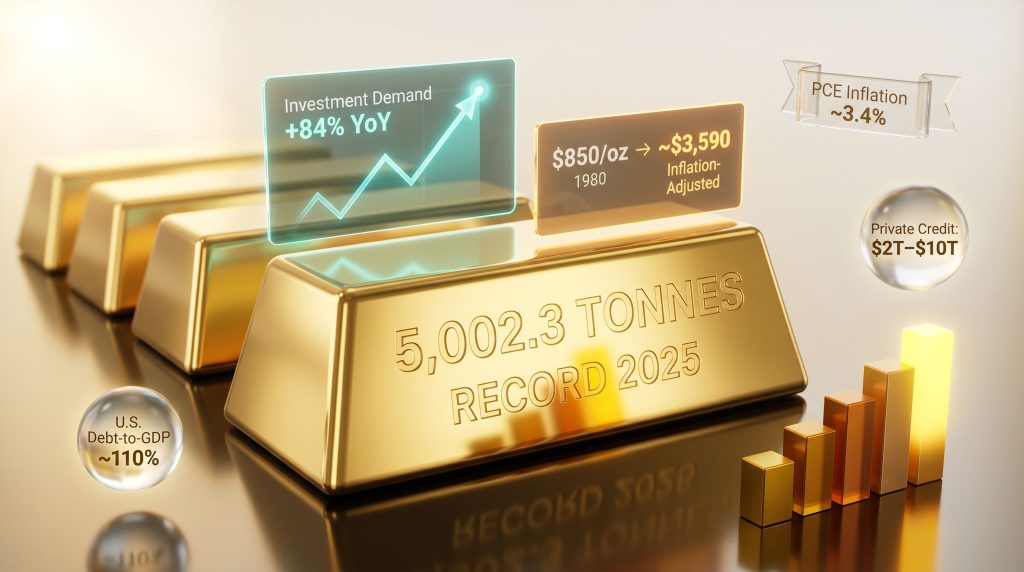
| January 1980 Intraday Peak | $850/oz | ~$3,590/oz |
| 2008 Financial Crisis Low | ~$720/oz | Lower in real terms |
| COVID-19 Rally High | $2,000+/oz | Below 1980 real peak |
| April 2025 New High | Record nominal level | Exceeded 1980 real peak |
O'Connell highlighted an analytically significant milestone: gold surpassed its inflation-adjusted 1980 peak in April 2025. For long-term holders who have been told the 1980 top represented a generational bubble, this real purchasing-power comparison reframes the story entirely. The nominal record-breaking headlines miss what the CPI-adjusted data reveals: that it took over four decades for gold to genuinely exceed, in real terms, the peak reached during the height of 1970s stagflation hysteria.
Systemic Financial Risks: The Structural Forces Beneath the Surface
Sovereign Debt at 110%: Why This Level Matters for Gold
U.S. debt-to-GDP has approached the 110% threshold, a level that significantly constrains policymakers' room to manoeuvre. Europe faces a structurally similar fiscal position with limited ability to expand spending or raise taxes without inflicting broader economic damage. O'Connell framed this as a compounding constraint: governments cannot cut spending meaningfully, cannot raise taxes without triggering political backlash and economic contraction, and cannot rely on inflation to erode debt without destabilising household purchasing power.
Historically, sustained gold demand cycles have coincided with prolonged periods of high sovereign debt and deteriorating fiscal flexibility. The mechanism is straightforward: when governments cannot credibly commit to long-term fiscal repair, confidence in fiat currencies weakens at the margin, and gold benefits as an asset whose supply cannot be expanded by political decree. Furthermore, global financial market risks compound these dynamics in ways that are increasingly difficult to isolate from one another.
The Federal Reserve's Policy Bind
The Federal Reserve faces a dilemma that has no clean resolution under current conditions. U.S. Personal Consumption Expenditures inflation is running near 3.4%, meaningfully above the 2% target. At the same time, raising rates further increases debt servicing costs on a balance sheet approaching 110% of GDP, risks deepening economic contraction, and threatens financial stability across sectors that borrowed heavily during the low-rate era.
O'Connell noted that while financial markets have priced in eventual rate cuts, another rate increase cannot be excluded if geopolitical developments drive energy prices materially higher. She also raised a structurally important question: whether the Federal Reserve's 2% inflation target remains genuinely achievable given the structural forces now embedded in the economy.
"If a geopolitical escalation drives energy prices sharply higher, central banks face a scenario where further tightening damages an already debt-burdened economy while inaction allows inflation to re-accelerate. Gold benefits structurally under both paths."
This policy bind is not a temporary misalignment. It reflects a fundamental tension between inflation control mandates and fiscal sustainability that has no precedent in the post-Bretton Woods era at current debt levels. The relationship between gold and bond dynamics is, consequently, central to understanding how these pressures ultimately resolve.
Shadow Banking and Private Credit: The Underestimated Vulnerability
Perhaps the most analytically distinctive risk O'Connell raised involves the rapid expansion of private credit and shadow banking. The private credit sector across the U.S. and Europe carries size estimates ranging from $2 trillion to $10 trillion, a range so wide it itself signals how opaque the sector remains.
| Risk Factor | 2007-2008 Subprime Crisis | 2026 Private Credit Concern |
|---|---|---|
| Estimated Market Size | ~$1.3T subprime exposure | $2T-$10T private credit |
| Regulatory Oversight | Low | Low to moderate |
| Liquidity Risk | High | Elevated and growing |
| Gold's Response | Rose from $872 to $1,900/oz by 2011 | Structural demand support ongoing |
O'Connell drew a direct parallel to the overlooked warning signs that preceded the 2007 subprime mortgage crisis, where complexity and opacity masked the true scale of systemic risk until liquidity evaporated. Federal Reserve Chair Jerome Powell has acknowledged private credit risks in Senate testimony, providing institutional validation that this concern extends beyond market commentary.
Unlike regulated banks, private credit funds face minimal requirements around capital buffers, liquidity stress testing, or counterparty risk disclosure. If a funding crisis emerges within this sector during a broader market downturn, the contagion potential to traditional financial institutions remains difficult to model precisely.
Central Bank Independence: The Emerging Confidence Risk
O'Connell identified political pressure on Federal Reserve governance structures as an underpriced systemic risk. Legal proceedings involving Federal Reserve Governor Lisa Cook have placed central bank institutional independence under scrutiny. The concern is not merely about specific personnel decisions. Even the perception that monetary policy could become subordinated to political objectives is sufficient to trigger confidence deterioration in U.S. Treasury markets and the dollar's international reserve role.
Gold is structurally positioned to benefit from this dynamic. As a non-sovereign asset, it operates outside the control of any government or central bank. Its value cannot be diluted by political appointment decisions, executive orders, or legislative interference. This characteristic becomes increasingly important as investors globally assess whether dollar-denominated assets carry an elevated institutional risk premium.
Why Gold Drops During Crises Despite Its Safe-Haven Status
The Liquidity Paradox Explained
One of the most misunderstood dynamics in precious metals markets is gold's tendency to fall during the acute phase of a financial crisis. This behaviour confuses investors who have positioned gold expecting it to rise precisely when everything else is collapsing.
O'Connell provided a mechanistic explanation: during market panics, margin calls force portfolio managers to liquidate assets rapidly to generate cash. Gold's extraordinary market depth — which sees daily trading volumes ranking second only to the S&P 500 and at times exceeding U.S. Treasury market activity — makes it the preferred asset for rapid forced liquidation. Illiquid holdings cannot be sold quickly enough; gold can. However, as safe-haven assets perform over a full cycle, the recovery consistently validates the long-term case.
The insurance policy analogy O'Connell used is instructive. During an acute financial emergency, some policyholders surrender policies temporarily to generate liquidity. That action does not invalidate the insurance policy's value. It reflects the mechanics of a liquidity crisis where quality assets are sold alongside distressed ones.
Historical Recovery Comparisons Across Asset Classes
| Asset Class | COVID-19 Drawdown | Recovery Timeline |
|---|---|---|
| Gold | ~7% | ~6 weeks |
| Industrial Metals | Significantly deeper | Several months |
| S&P 500 | Severe contraction | Extended period |
Gold's approximately 7% decline during the initial COVID-19 selloff in March 2020 recovered fully within roughly six weeks, a recovery pace that materially outperformed equities and industrial commodities. This speed differential is analytically important because it demonstrates that gold's temporary liquidation was not driven by fundamental deterioration in its value proposition, but by mechanical funding pressures that resolved quickly.
The Empirical Record Across Multiple Crisis Regimes
The safe-haven performance data across distinct crisis periods forms a compelling pattern:
- 1970s stagflation cycle: Gold appreciated from $35/oz to $850/oz by 1980 as dollar confidence collapsed and inflation accelerated beyond policy control
- 2008 Global Financial Crisis: Gold rose from approximately $872/oz to $1,900/oz by 2011, nearly tripling over the three-year recovery period
- COVID-19 pandemic: Gold surpassed $2,000/oz while equities collapsed, then maintained elevated levels as monetary stimulus accelerated
Research comparing precious metals performance during the COVID-19 period found that gold demonstrated stronger safe-haven properties than silver, platinum, and U.S. equities during the crisis phase. Silver's dual role as both an industrial and monetary metal exposed it to manufacturing demand concerns that amplified its volatility beyond gold's. Platinum's concentrated mining geography and industrial demand profile created similar complications.
Geopolitical Forces and Record-Breaking Global Demand
A Headline-Driven Market Environment
O'Connell described the current market environment as heavily headline-driven, where capital commitment decisions across asset classes are being deferred because geopolitical developments can reverse price direction almost instantaneously. The multi-risk environment investors face in 2026 is genuinely without modern precedent in its simultaneity: active military conflicts, expanding tariff regimes, persistent inflation, recession risk, and rapidly shifting political landscapes operating in parallel.
Sophisticated traders are now monitoring multiple volatility signals concurrently, including Treasury yields, the VIX equity volatility index, and the MOVE bond volatility index, waiting for signal clarity before making directional commitments. This hesitancy itself supports gold safe-haven demand and financial risks positioning as a parking ground for capital seeking preservation over appreciation.
During recent weeks of peak uncertainty, gold has traded within a 5% price range while silver moved within a broader 12% range, confirming the relative stability differential that characterises gold's monetary metal status versus silver's more volatile industrial-monetary hybrid profile.
2025 Global Gold Demand: Record-Breaking Numbers
| Demand Category | 2025 Volume | Notable Change |
|---|---|---|
| Total Global Demand | 5,002.3 tonnes | All-time record |
| Investment Demand | 2,175.3 tonnes | +84% year-over-year |
| Global ETF Inflows | 801.2 tonnes | Significant acceleration |
| U.S. ETF Holdings | 2,019 tonnes (~$280B AUM) | Multi-year high |
Global gold demand reached 5,002.3 tonnes in 2025, an all-time record. Investment demand surged 84% year-over-year to 2,175.3 tonnes, with record gold ETF inflows contributing 801.2 tonnes of that total. U.S.-listed ETFs alone added 437 tonnes, bringing total U.S. ETF gold holdings to 2,019 tonnes with assets under management of approximately $280 billion. These figures reflect institutional conviction, not speculative retail flows.
Real Yields and Dollar Dynamics: The Constraints on Gold's Upside
The Real Yield Ceiling
Gold's most reliable macro constraint is the level of real interest rates. When 10-year real yields rise above approximately 2%, the opportunity cost of holding non-yielding gold increases meaningfully for institutional portfolio managers operating against liability benchmarks. The inverse relationship between real yields and gold prices represents one of the most robust relationships in macro finance.
The current environment presents a tension: inflation remains above target, but the Fed's ability to raise rates is constrained by debt servicing concerns. This means real yields may remain structurally lower than the pre-2008 environment even if nominal rates stay elevated, which provides an ongoing structural floor beneath gold demand.
The Dollar's Competing Safe-Haven Role
The U.S. dollar retains its own safe-haven properties during acute geopolitical stress events, with the WSJ Dollar Index rising approximately 2.4% during periods of heightened Iran-related tensions. In the short term, dollar liquidity demand can outcompete gold's safe-haven appeal as institutional investors need dollars specifically to meet margin obligations and settlement requirements.
The longer-term structural argument, however, moves in gold's favour precisely when dollar confidence erodes. If domestic political developments, fiscal deterioration, or perceived monetary policy subordination reduces foreign central banks' willingness to hold dollar reserves, gold stands as the primary beneficiary. In addition, central bank gold demand has been demonstrating exactly this preference shift through sustained accumulation programmes.
ETF Financialisation and What It Means for Volatility
The proliferation of gold ETFs has fundamentally changed the investor base participating in the gold market. Physical-holding investors, whose decisions are driven by long-term wealth preservation, have been joined by portfolio-driven ETF holders whose allocation decisions are driven by quantitative models, risk parity frameworks, and fund flows.
This financialisation dynamic amplifies selling pressure during funding squeezes. When equity volatility spikes and portfolio models trigger risk reduction, gold ETF positions are mechanically reduced alongside equity exposure, creating short-term price pressure disconnected from gold's underlying fundamentals. This is a known structural feature of the modern gold market that investors should factor into tactical positioning decisions.
The next major ASX story will hit our subscribers first
Scenario Analysis: When Gold Outperforms and When It Faces Headwinds
| Macro Scenario | Gold Expected Behaviour | Primary Driver |
|---|---|---|
| Rising real yields, strong dollar | Underperforms | Opportunity cost and dollar competition |
| Geopolitical escalation | Outperforms | Flight-to-safety capital flows |
| Sovereign debt crisis | Strongly outperforms | Non-sovereign asset premium |
| Inflation above target, policy uncertainty | Outperforms | Purchasing power protection |
| Acute market panic (short-term) | Temporary decline | Forced margin liquidation |
| Post-crisis stabilisation | Rapid recovery | Re-entry buying and safe-haven re-rating |
| Central bank independence erosion | Strongly outperforms | Fiat currency confidence deterioration |
Frequently Asked Questions: Gold Safe-Haven Demand and Financial Risks
Is gold a reliable inflation hedge?
Gold provides partial inflation protection but does not track consumer prices with mathematical precision. Instruments such as TIPS offer more direct inflation linkage. Gold's greater portfolio value lies in its ability to protect against broader systemic uncertainty, currency confidence erosion, and institutional stress. Its surpassing of the 1980 inflation-adjusted peak in April 2025 confirms that long-term real purchasing power has been preserved, even if short-term inflation tracking is imprecise.
Why does gold fall during market crashes if it is a safe-haven asset?
Margin calls force institutional investors to liquidate the most liquid assets available to generate cash. Gold's exceptional market depth makes it the preferred instrument for rapid forced sales during acute stress. This selling is mechanical and temporary. Historical data consistently shows gold recovering faster than equities and industrial commodities following these forced liquidation episodes.
What is the private credit risk and why does it matter for gold?
The private credit sector across the U.S. and Europe carries size estimates between $2 trillion and $10 trillion, operates with minimal regulatory oversight, and presents systemic liquidity risks analogous to the pre-2008 subprime mortgage market. If liquidity stress emerges in this sector during a broader downturn, the resulting confidence erosion historically benefits gold as a non-sovereign store of value.
How does central bank policy affect gold?
Real interest rate decisions directly affect the opportunity cost of holding gold. Beyond rate decisions, uncertainty about future monetary policy direction itself increases gold safe-haven demand and financial risks positioning. There is also a structural layer: central banks globally are major gold purchasers, treating it as a reserve asset independent of any single currency. Their purchasing behaviour signals institutional recognition of gold's monetary role that extends beyond retail investor sentiment.
What role do central banks play in gold demand?
Central banks represent a significant and growing source of structural gold demand, accumulating the metal as a reserve diversification strategy independent of fiat currency systems. The People's Bank of China, major European central banks, and others have maintained sustained buying programmes. Their preference for gold over alternative reserve assets reflects both diversification logic and a hedge against geopolitical risks affecting dollar-denominated holdings.
The Structural Case for Gold Beyond 2026
The forces underpinning gold safe-haven demand and financial risks are not scheduled to resolve on any near-term horizon. Sovereign debt trajectories across major economies show no credible consolidation path that does not involve either inflation, financial repression, or structural economic contraction. All three scenarios have historically supported sustained gold demand.
Political pressure on central bank governance structures represents an emerging and analytically underpriced risk that is now materialising in the U.S. context. Shadow banking expansion continues to add systemic fragility that regulators have limited tools to address in real time. Furthermore, the financialisation of gold markets through ETF proliferation, while creating short-term volatility dynamics, has expanded the institutional investor base in ways that structurally support long-term demand.
O'Connell's career began at the height of the 1980 precious metals boom, when market participants believed gold at $850 represented unsustainable excess. Four decades later, having watched gold cycles across stagflation, credit crises, pandemics, and geopolitical upheaval, her perspective on gold's enduring monetary role carries the weight of lived market history: in a world defined by expanding debt, institutional fragility, and political uncertainty, gold remains the one globally recognised store of value that no government, no central bank, and no Supreme Court ruling can manufacture at will.
This article is for informational and educational purposes only and does not constitute financial advice. Past performance of any asset, including gold, is not indicative of future results. Investors should conduct their own due diligence and consult a qualified financial professional before making investment decisions. All forecasts and scenarios discussed represent analytical frameworks and should not be interpreted as guaranteed outcomes.
Want to Stay Ahead of the Next Major Mineral Discovery Amid Growing Financial Uncertainty?
While gold's structural role as a safe-haven asset endures, Discovery Alert's proprietary Discovery IQ model scans daily ASX announcements in real time, instantly identifying significant mineral discoveries across 30+ commodities — from gold to critical minerals — so subscribers can act on actionable opportunities before the broader market catches on. Explore historic discoveries and their exceptional returns to understand what's possible, then begin your 14-day free trial today and position yourself ahead of the market.