May 12, 2026
When Geopolitics Forces a Nation to Look Inward
Every few decades, an external shock exposes the structural fault lines of an import-dependent economy with unusual clarity. The combination of an elevated crude oil price environment, a surging precious metals import bill, and mounting current account deficit pressure creates exactly the kind of inflection point where government messaging takes on outsized economic significance. In May 2026, India found itself navigating precisely that scenario, and the Modi appeal to curb gold purchases and overseas travel was unconventional by any standard.
Understanding why that appeal landed with such force, and why corporate India moved so quickly to align with it, requires looking at the structural vulnerabilities that had been quietly building in India's external accounts long before the geopolitical disruptions of 2026 crystallised the urgency.
When big ASX news breaks, our subscribers know first
Why India's External Accounts Came Under Pressure
India's trade balance is shaped by three structurally dominant import categories: crude oil, precious metals, and edible oils. Together, these account for approximately 31% of the country's total import expenditure, creating a concentrated vulnerability to global commodity price cycles that domestic policy can only partially offset.
The energy dimension alone is formidable. India imports approximately 85% of its crude oil requirements, making it one of the most import-dependent major economies for energy among emerging markets. When Brent crude prices climbed to $107.67 per barrel as of mid-May 2026, representing an increase of roughly $43 per barrel compared to the prior year, the pass-through effect on India's foreign exchange reserve consumption was immediate and material. Furthermore, crude oil price trends in global markets have demonstrated how quickly geopolitical events can accelerate cost pressures for import-dependent economies.
The precious metals picture compounded that pressure significantly:
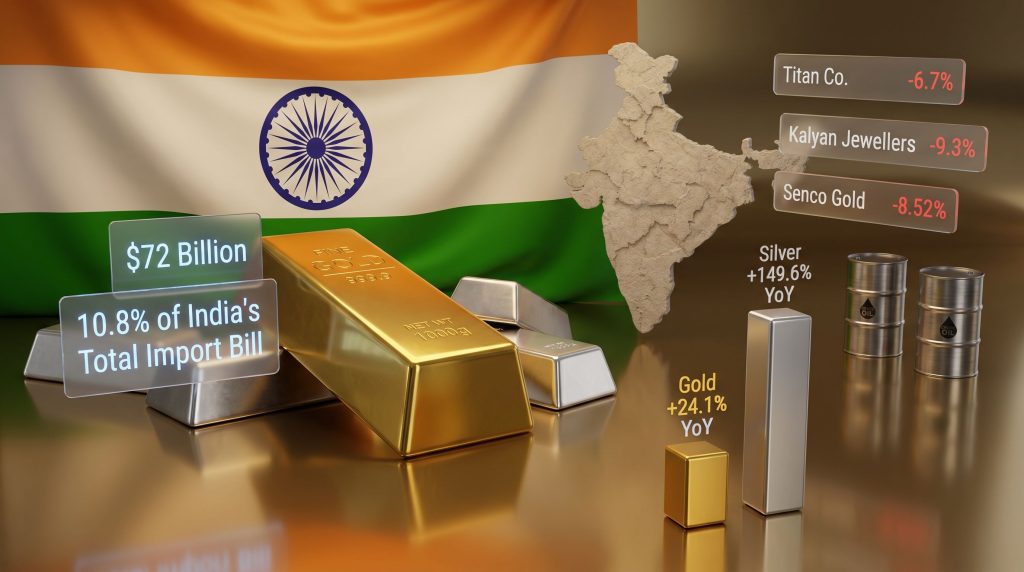
- Gold imports in FY26 reached $72 billion, a year-on-year increase of 24.1%
- Silver imports surged even more dramatically, rising 149.6% year-on-year to $12.1 billion
- Combined, gold and silver represented 10.8% of India's total import bill in the last fiscal year
- Gold itself was trading at approximately $4,717 per ounce by mid-May 2026, up roughly $1,473 from a year prior, amplifying the rupee cost of every tonne imported
India's foreign exchange reserves stood at approximately $691 billion at the time of the appeal. That figure represents genuine resilience, but reserve adequacy is always assessed relative to import coverage ratios and current account trajectories rather than in isolation. With oil prices elevated and precious metals imports running at record volumes and values, the directional pressure on reserves warranted a response.
The US-Iran Conflict as Catalyst
The escalating military tensions between the United States and Iran provided the immediate geopolitical trigger for the commodity price environment that pressured India's external accounts. Crude oil markets responded to supply disruption risks and regional instability with sustained price appreciation, creating an import cost environment that India's policymakers could not control through domestic levers alone.
For economies like India that sit at the downstream end of global energy supply chains, geopolitical conflicts thousands of kilometres away translate directly into forex reserve depletion, rupee depreciation pressure, and import-driven inflation. The structural nature of this vulnerability, rather than any single policy failure, explains why the Prime Minister's appeal targeted behavioural change rather than monetary or fiscal intervention.
The Modi Appeal to Curb Gold Purchases and Overseas Travel: What Was Actually Asked
On May 11, 2026, at a BJP rally in Hyderabad, Prime Minister Narendra Modi made a public appeal to Indian citizens that combined four distinct behavioural requests under a single framework of national economic responsibility.
| Measure Requested | Primary Economic Rationale | Key Context |
|---|---|---|
| Avoid gold purchases for one year | Direct reduction in $72B annual precious metals forex drain | India is the world's second-largest gold consumer, relying almost entirely on imports |
| Postpone overseas travel and destination weddings abroad | Reduces outbound forex consumption and remittance-equivalent spending | Growing middle-class trend driving rising outbound tourism expenditure |
| Reduce petrol and diesel consumption | Lowers petroleum import volume demand | Shift toward public transport, EVs, metros, and carpooling encouraged |
| Revive work-from-home practices | Reduces commuting-linked fuel consumption | Directly echoes operational flexibility demonstrated during COVID-19 |
The framing of the appeal was deliberately non-regulatory. No legislative changes, import duty adjustments, or quota mechanisms accompanied the message. Instead, Modi invoked the language of civic duty and patriotism, drawing an explicit parallel to the collective behavioural coordination that Indian society demonstrated during the COVID-19 pandemic. The concept of voluntary contribution to national economic stability served as the rhetorical architecture of the entire appeal.
This approach represents a calculated policy communication strategy: by targeting consumer and corporate behaviour through moral suasion rather than regulatory mandate, the government preserves policy flexibility, avoids triggering formal trade policy reviews, and tests whether national consensus can achieve economic objectives without coercion.
What makes this approach analytically interesting is its precedent value. India has a documented history of mass behavioural compliance during periods of national challenge, and the COVID-era experience demonstrated that the social infrastructure for coordinated voluntary action remains intact. The appeal essentially borrowed from that playbook, applying a public health compliance model to an economic stabilisation objective.
Corporate India's Rapid Alignment With the National Message
The speed and breadth of corporate India's response to the Modi appeal to curb gold purchases and overseas travel was notable. Within 24 hours of the May 11 announcement, senior executives across professional services, manufacturing, consumer goods, and industry associations had issued public statements of alignment.
Senior Business Voices at the CII Summit
Sunil Bharti Mittal, Chairman of Bharti Enterprises, addressed the Confederation of Indian Industry Annual Business Summit in New Delhi in the immediate wake of the appeal. His remarks positioned the Prime Minister's message as a call for a deeper structural reorientation of Indian industry: moving away from what he described as an obsession with importing gold, accelerating the transition toward renewable energy to reduce the nation's energy costs, and redirecting capital expenditure toward domestic investment rather than imported goods and services.
Mittal's framing added a dimension to the appeal that extended beyond immediate forex conservation. By linking gold import reduction to renewable energy acceleration and domestic capital expenditure, he articulated a long-term structural transformation agenda embedded within what might otherwise appear to be a short-term austerity message.
Rajiv Memani, Chairman of EY India, characterised the appeal at the same summit as a sensible and pragmatic request in the context of prevailing geopolitical challenges, signalling professional services sector alignment and contextualising the ask within the broader landscape of external shocks that India was navigating.
Corporate Policy Responses Across Sectors
The company-level responses documented across the corporate landscape revealed a pattern of calibrated alignment: affirming support for the PM's guidance while maintaining operational continuity through existing frameworks.
- KPMG India confirmed the announcement was under active evaluation, with commitments to balance people, business, and client obligations within its existing hybrid work structure
- Deloitte, EY, RPG Group, and Tata Motors all confirmed continuation of existing hybrid work models as the baseline response to the remote work dimension of the appeal
- Diageo India went further than most, with Chief HR Officer Chinmay Sharma confirming complete alignment with the Prime Minister's guidance as a matter of corporate principle
- Coca-Cola India confirmed continuation of its hybrid working model as consistent with the appeal's objectives
- The Federation of Associations in Indian Tourism and Hospitality, through General Secretary Rajiv Mehra, formally endorsed the sentiment behind reducing overseas leisure travel and destination weddings abroad
The pattern across corporate responses reflects something more strategically interesting than simple compliance: companies are signalling national alignment while avoiding material operational disruption, a form of political economy positioning that serves both reputational and relationship management objectives simultaneously.
The Gold Trade Sounds the Alarm: Market Reaction and Industry Fears
While corporate India aligned with the broader message, the jewellery sector experienced an immediate and material market reaction. The risk premium the market assigned to the Modi appeal to curb gold purchases was reflected in sharp single-session declines across listed jewellery stocks. Indeed, Bloomberg reported that the appeal hit jewellery stocks almost immediately after the announcement.
Stock Market Response
| Company | Share Price Decline |
|---|---|
| Titan Co. | -6.7% |
| Kalyan Jewellers | -9.3% |
| Senco Gold | -8.52% |
These declines reflected two layered concerns: first, the prospect of near-term demand suppression from consumers responding to the PM's voluntary appeal; and second, the possibility that the appeal represented a precursor to formal import duty increases on gold and silver.
The Import Duty Dilemma
The gold trade's anxiety about duty revision was not unfounded. India's current gold import duty sits at 6%, a level that was itself reduced in mid-2024 to stimulate legitimate trade and reduce smuggling activity. A reversal of that policy direction would carry significant implications for those who view gold as a strategic asset in their portfolios.
Surendra Mehta, Secretary of the India Bullion and Jewellers Association (IBJA), articulated the industry's central concern: that import duties could rise steeply from the current 6% to as high as 15%, and that such an increase would reliably stimulate a shadow economy for gold rather than reducing total consumption.
Joy Alukkas, Chairman of the Alukkas jewellery group, quantified the business impact, noting that an import duty revision of that magnitude could cause immediate revenue declines of approximately 15% across the industry.
A government official moved to contain the market reaction by confirming that the Centre currently has no plans to increase import duties on gold or silver, a clarification that partially but not completely reversed the market's negative response.
The Smuggling Paradox: A Structural Policy Problem
The gold trade's warning about smuggling deserves particular analytical attention because it reveals a structural paradox at the heart of gold import policy design.
When import duties on gold rise significantly, a portion of demand does not disappear; it migrates into informal and illicit supply chains. Historical data from India's own experience with the Gold Control Act era and the high-duty periods of the early 2010s demonstrates this pattern clearly. The very policy instrument designed to conserve forex can end up stimulating a shadow trade that bypasses official channels entirely, reducing net benefits to the current account while creating regulatory enforcement challenges.
This dynamic creates a policy trilemma for Indian policymakers: reducing gold consumption requires either demand-side behaviour change (the current approach), supply-side restriction through duties (which risks stimulating smuggling), or structural demand substitution through products like Sovereign Gold Bonds. All three levers have limitations, and the smuggling risk constrains the effectiveness of duty-based interventions more severely than is commonly appreciated in economic policy discussions. In addition, central bank gold demand globally continues to support elevated price levels, further complicating India's import cost outlook.
Historical Perspective: India Has Tried This Before
The 2026 voluntary appeal does not exist in a historical vacuum. India has a long track record of attempting to manage gold demand and import volumes through various policy instruments, with mixed results.
| Period | Measure Employed | Documented Outcome |
|---|---|---|
| 1962 (post-China war) | Precursor measures to Gold Control Act | Limited effectiveness; informal market activity rose |
| 1990-91 Balance of Payments Crisis | Gold pledged as IMF loan collateral | Temporary stabilisation; structural reform followed subsequently |
| 2015 | Gold Monetisation Scheme and Sovereign Gold Bond launches | Moderate but sustained uptake; gradual investment behaviour shift |
| 2024 | Import duty reduction from higher levels to 6% | Stimulated legitimate trade; reduced smuggling activity |
| 2026 | Voluntary behavioural appeal; no regulatory mandate | Corporate alignment rapid; market reaction immediate |
The 2026 approach is structurally different from all predecessors in one critical respect: it relies entirely on voluntary compliance through moral suasion rather than any regulatory or financial mechanism. It is the first time in India's modern economic history that a sitting Prime Minister has directly appealed to citizens to modify gold consumption behaviour as a matter of national economic patriotism, without any accompanying policy instrument.
Whether voluntary compliance at scale is achievable depends on several factors that historical precedent cannot fully resolve: the depth of patriotic sentiment among consumer demographics, the persistence of the appeal's messaging over a 12-month horizon, and whether corporate and media ecosystem amplification sustains the message beyond its initial news cycle.
The next major ASX story will hit our subscribers first
What This Means for India's Current Account Deficit Trajectory
The macroeconomic arithmetic of the appeal's potential impact is worth examining carefully. India's current account deficit is structurally sensitive to three primary variables: crude oil prices, precious metals import volumes, and remittance inflows. The appeal directly targets the second variable and indirectly addresses the first through fuel consumption reduction messaging.
If gold import volumes were to decline materially over a 12-month period against a $72 billion FY26 baseline, the forex savings potential would be measured in several billion dollars depending on the elasticity of demand response. Even a 10% reduction in gold import volume against that baseline would represent a saving of approximately $7 billion in forex outflows, before accounting for price appreciation effects.
The outbound travel dimension adds a further, if harder to quantify, dimension to the potential CAD improvement. India's growing middle class has driven significant expansion in outbound tourism expenditure over the past decade, and destination weddings abroad represent a culturally specific consumption pattern that carries material per-event forex costs.
Analysts have characterised the appeal as a defensive stabilisation strategy, designed to protect the rupee and manage the trade balance without resorting to capital controls or emergency monetary interventions. The choice of moral suasion over regulatory action suggests a government managing external vulnerabilities while seeking to avoid the market confidence signals that formal emergency measures would generate. This is also consistent with India's critical mineral strategy, where India's critical mineral strategy reflects a broader effort to reduce dependence on imported commodities across multiple sectors. Furthermore, India LNG import taxes illustrate how the country uses duty structures to manage energy import costs alongside these broader economic pressures.
The longer-term structural solution referenced by Mittal at the CII summit — accelerating the renewable energy transition to reduce crude oil import dependency — represents a more fundamental response to India's external account vulnerabilities. Reducing the 85% crude oil import dependency through domestic renewable energy capacity expansion would address the single largest driver of India's forex outflows and reduce the structural sensitivity that makes geopolitical commodity price shocks so damaging to India's economic position.
Disclaimer: This article contains forward-looking analysis, market projections, and economic scenario assessments based on information available at the time of writing. It does not constitute financial or investment advice. Readers should conduct independent research and consult qualified advisors before making financial decisions. Market data and economic figures cited reflect conditions as of May 2026 and are subject to change.
Want to Stay Ahead of the Next Major Mineral Discovery Driven by Shifting Global Commodity Dynamics?
As geopolitical pressures reshape commodity flows and precious metals markets remain volatile, Discovery Alert's proprietary Discovery IQ model delivers real-time alerts on significant ASX mineral discoveries — instantly translating complex market signals into actionable investment opportunities. Explore historic examples of exceptional discovery returns and begin your 14-day free trial today to position yourself ahead of the broader market.