
May 12, 2026
The Hidden Wealth Inside Closed Gold Mines: Why Secondary Recovery Is Changing the Industry
For most of mining history, the closure of a heap leach operation marked the end of a productive asset's commercial life. Once conventional irrigation could no longer justify its operating costs, the remaining metal in aged leach pads was effectively written off. Recovery rates plateaued, unit costs climbed, and mine managers shifted their focus toward rehabilitation planning rather than extraction optimisation. That assumption is now being challenged in a fundamental way.
The emergence of pressurised Yanacocha injection leaching as a commercially proven secondary recovery mechanism is rewriting the economic logic of end-of-life gold mining. Rather than accepting residual pad inventory as an irrecoverable sunk cost, this technology actively targets the fine-grained material zones that conventional drip irrigation systems could never adequately saturate. What was once classified as exhausted material is becoming a meaningful production source again, and the operational evidence from one of South America's most storied gold mines makes a compelling case for the wider industry to take notice.
When big ASX news breaks, our subscribers know first
What Yanacocha Injection Leaching Actually Does and Why It Works
Understanding why Yanacocha injection leaching delivers results requires first understanding the fundamental limitation it was designed to overcome. Conventional heap leach systems distribute cyanide solution across pad surfaces through drip emitters, relying on gravity and percolation to carry the solution through the ore mass. This works reasonably well through the active leaching phase, but over time, fine-grained particles within the pad matrix trap residual gold in zones that surface irrigation simply cannot reach with sufficient contact time or solution concentration.
The injection leaching approach eliminates this constraint by replacing surface distribution with subsurface delivery. Specially engineered wells are drilled directly into aged leach pad structures, and cyanide solution is delivered under pressure into targeted zones within the ore body. This pressurised delivery mechanism forces solution contact with fine-grained material that had effectively been bypassed for years, mobilising gold and silver that conventional methods had left behind.
The Key Mechanical Differences Between Conventional and Injection Leaching
The distinction between these two approaches is not merely operational; it is structural. The following comparison highlights the core differences:
| Feature | Conventional Heap Leach | Injection Leaching |
|---|---|---|
| Solution delivery method | Surface drip irrigation | Pressurised subsurface well injection |
| Material targeting | Bulk pad surface application | Targeted penetration of fine-grained zones |
| Applicability | Active ore processing | Residual recovery from aged pads |
| Infrastructure requirement | Surface emitter networks | Drilled well infrastructure within pad body |
| Fine particle recovery | Limited | Substantially improved |
The process unfolds across several operational phases. Pad areas are geologically assessed to map residual metal concentrations, wells are engineered and drilled into identified target sectors, cyanide solution is prepared and delivered under controlled pressure, and gold and silver-bearing pregnant solution is captured and routed to processing facilities. Wells are progressively activated across pad sectors in sequence, systematically working through the residual inventory before each sector is retired.
Environmental management runs parallel to extraction throughout. Yanacocha's injection leaching operations are conducted under the framework of the International Cyanide Management Code (ICMC), which requires independent third-party auditing of cyanide handling procedures, concentration management, and containment infrastructure. This certification provides a structured compliance backbone for secondary recovery activities at a site approaching closure.
From Declining Asset to Secondary Production Engine: Yanacocha's Transformation
Yanacocha's trajectory represents one of the most instructive case studies in end-of-life mine management currently available to the global gold industry. The operation, located in the Cajamarca region of northern Peru and operated by Newmont Corporation, was once one of the largest gold-producing mines in the world, with cumulative production exceeding 40 million ounces of gold since operations began in 1993. At its peak, the mine ranked among the top two gold producers globally, a position that made its subsequent production decline all the more strategically significant for Newmont's portfolio.
As primary mining activity wound down and ore grades declined, the economic pressure on the operation intensified. Fixed operational costs were being spread across a shrinking production base, driving unit cost metrics higher. The residual inventory sitting in the mine's aged leach pads represented enormous potential value, but conventional recovery methods had reached the limits of what they could achieve. Furthermore, understanding the relationship between gold price and mining equities helps contextualise why recovering every available ounce became a strategic priority.
According to operational details presented at an Instituto de Ingenieros de Minas del Perú (IIMP) event in May 2026, the outlook for Yanacocha had shifted dramatically once injection leaching was implemented. The narrative of imminent closure was replaced by measurable production extension and meaningful cost reduction (Reporte Minero, May 11, 2026).
The Numbers That Define the Transformation
The operational results achieved through Yanacocha injection leaching are difficult to overstate in their significance:
| Metric | Status Before Injection Leaching | Current Status (2026) |
|---|---|---|
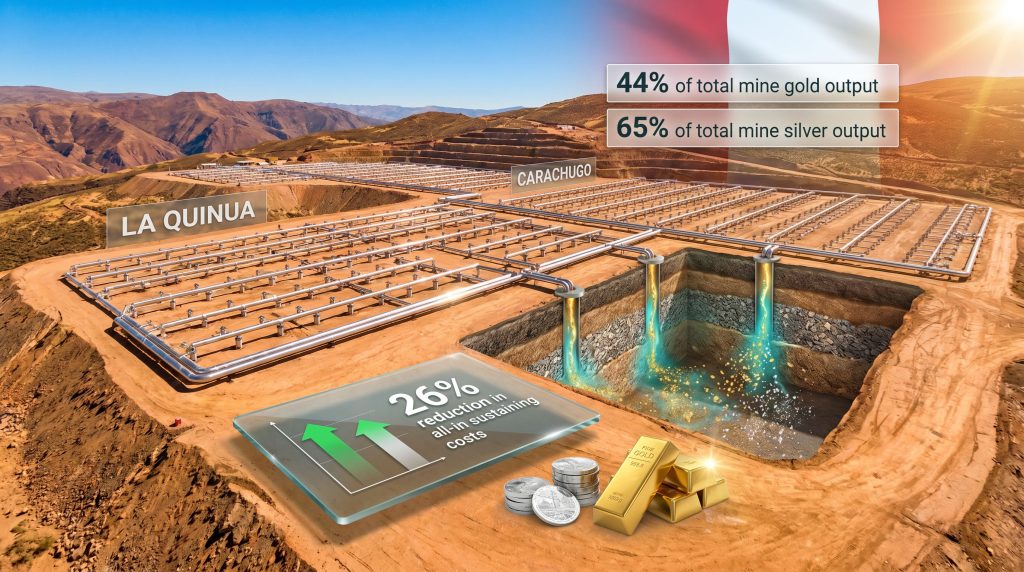
| Gold production contribution from pads | Minimal residual recovery | ~44% of total mine gold output |
| Silver production contribution from pads | Declining | ~65% of total mine silver output |
| Operational life extension | Near closure threshold | Extended by 4 to 5 additional years |
| All-in sustaining cost reduction | High cost base | 26% reduction |
These figures, reported by Fabio Loyola during the IIMP's "Jueves Minero" presentation series (Reporte Minero, May 11, 2026), represent a comprehensive revaluation of the mine's economic position. An operation that had been approaching the end of its productive life is now generating nearly half its total gold output from material that was previously considered unrecoverable.
Which Pad Areas Are Driving Recovery
The injection leaching program at Yanacocha spans multiple distinct pad areas, each at different stages of implementation:
-
La Quinua Pads (1 through 8): The primary zones where injection well infrastructure is most established and operational throughput is highest
-
Carachugo Pads (1 through 9): Secondary recovery areas integrated into the broader injection network, contributing to the overall production base
-
Yanacocha Norte: An emerging high-priority zone specifically identified as carrying significant residual silver inventory, now actively targeted for silver-focused recovery
The geographic distribution of these pad areas across the operation means that sector-by-sector sequencing can continue for years, with new well fields being activated as earlier sectors approach exhaustion.
The Economic Case for Injection Leaching at End-of-Life Operations
The financial logic underpinning Yanacocha injection leaching operates across three interconnected dimensions, each of which addresses a distinct challenge facing mature mining operations.
Revenue extension is the most visible benefit. By converting residual pad inventory from a write-off into active production, injection leaching defers the revenue cliff that would otherwise accompany mine closure. For a mine of Yanacocha's scale, extending productive life by four to five years represents a substantial continuation of cash flow generation.
Cost dilution addresses the unit economics problem that afflicts declining operations. When fixed costs are spread across a larger production base, per-ounce metrics improve. The 26% reduction in all-in sustaining costs at Yanacocha reflects this dynamic, alongside genuine operational efficiencies from eliminating surface irrigation infrastructure, reducing water consumption relative to drip systems, and achieving higher recovery rates per unit of cyanide solution consumed.
Closure cost offset is the least discussed but potentially most strategically valuable dimension. End-of-life mining operations face significant environmental rehabilitation obligations. Extended productive life generates cash flow that can be directed toward these obligations, reducing the financial burden on the parent company at closure. Injection leaching effectively converts residual metal inventory into rehabilitation funding. In addition, well-considered mine reclamation strategies can work in parallel with secondary recovery to optimise both commercial and environmental outcomes.
Comparing End-of-Life Strategies: Why Injection Leaching Outperforms Alternatives
| Strategy | Capital Requirement | Production Upside | Environmental Outcome |
|---|---|---|---|
| Injection Leaching | Moderate (well drilling + pressure infrastructure) | High: 44% gold, 65% silver at Yanacocha | Managed under ICMC framework |
| Conventional Pad Rinsing | Low | Minimal residual recovery only | Low complexity |
| Material Reprocessing and Retreatment | High | Variable, site-dependent | High complexity and cost |
| Immediate Mine Closure | None | Zero | Significant rehabilitation cost without offsetting revenue |
The capital investment required for injection leaching sits at a moderate level relative to the production uplift it generates. Well drilling, pressure delivery systems, and collection infrastructure represent meaningful expenditure, but the payback profile at Yanacocha's scale of operation is clearly favourable given the production contributions now being achieved.
Silver: The Strategic Dimension Being Underestimated
Gold recovery dominates the headlines around Yanacocha injection leaching, but the silver production story deserves separate strategic attention. The fact that injection leaching now accounts for 65% of total mine silver output compared to 44% of gold output is not coincidental. It reflects a structural characteristic of how silver behaves in aged heap leach pads. Broader gold and silver market trends indicate that supply constraints are also elevating the strategic value of secondary recovery programs like this one.
Silver mineralogy in heap leach environments tends to involve finer particle associations than gold in many ore types. This means that when conventional irrigation fails to penetrate fine-grained zones, silver is often retained at higher relative concentrations than gold in the bypassed material. Injection leaching's ability to specifically target these fine particle zones may therefore generate disproportionately high silver recovery rates compared to what conventional methods achieve.
The identification of Yanacocha Norte as a high-priority silver recovery zone adds a forward-looking dimension to this story. With significant residual silver inventory confirmed in this pad area and injection leaching actively targeting it, the silver contribution to total mine output could remain elevated or even grow as operations in this sector intensify. Given the favourable price environment for silver in international commodity markets during 2025 and 2026, the timing of this silver recovery focus is commercially significant.
The disproportionate silver recovery rate relative to gold at Yanacocha suggests that fine-grained material in aged leach pads may retain silver more persistently under conventional irrigation than gold, a structural characteristic that pressurised injection is uniquely positioned to exploit.
Water Management and Environmental Compliance: The Operational Backbone
Secondary recovery from aged leach pad infrastructure is not without environmental complexity. At Yanacocha, the ageing of leach pad infrastructure created water management challenges that required active engineering responses before injection leaching could operate sustainably at scale.
In 2021, interactions between heavy rainfall and residual chemical compounds in pad water contributed to acidification events, generating downstream environmental risks that required immediate intervention. Newmont, working with engineering partner Hatch, developed and commissioned a comprehensive water management program that included site-wide water rebalancing strategies to control chemical migration, acid flow treatment processes to neutralise affected water streams, and on-site sludge management and disposal infrastructure. The full program moved from concept to operational commissioning in approximately 12 months, a timeline that reflects both the urgency of the environmental situation and the capability of the project team (Hatch, 2025, Newmont's Yanacocha Water Transition Projects).
This engineering response is directly relevant to injection leaching operations because pressurised subsurface delivery of cyanide solution into aged pad structures creates additional demands on water management systems. The ability to control solution migration, capture pregnant solution effectively, and manage the chemistry of pad water across multiple active sectors simultaneously requires robust infrastructure.
ICMC Certification as an Operational Differentiator
The International Cyanide Management Code certification under which Yanacocha injection leaching operates provides more than regulatory compliance. It serves as an accountability framework that governs:
-
Cyanide solution concentration limits across all pad areas
-
Handling, transport, and storage procedures for cyanide reagents
-
Environmental containment protocols to prevent solution migration beyond pad boundaries
-
Independent third-party audit verification of all the above
For an operation conducting pressurised subsurface injection of cyanide solution into aged pad infrastructure, this certification framework is particularly important. The formal audit structure provides external verification that the operation is being conducted within established environmental and safety parameters, a consideration that carries weight with regulators, local communities, and institutional investors alike.
The next major ASX story will hit our subscribers first
Is the Yanacocha Model Scalable Across the Global Gold Industry?
The structural conditions that made Yanacocha injection leaching viable are not unique to this single operation. Across the global gold mining industry, large volumes of legacy heap leach pad inventory exist at operations in varying stages of decline. The question of whether the Yanacocha model can be replicated elsewhere involves both technical and economic criteria.
The gold mining stocks investment landscape is facing a well-documented structural tension between declining ore grades at existing operations and the capital intensity required to bring new deposits into production. Greenfield development timelines extending beyond a decade, combined with increasingly complex permitting environments and rising capital costs, have elevated the strategic value of production extensions at existing operations. Secondary recovery technologies that generate additional output without greenfield capital expenditure are gaining serious attention within corporate planning functions at major producers.
Key industry forces accelerating adoption of injection leaching and similar secondary recovery approaches include:
-
Rising all-in sustaining costs across major gold producers, increasing the value of any cost-reduction mechanism
-
Elevated gold and silver prices improving the economics of marginal recovery from previously uneconomic material
-
Tightening environmental standards around mine closure, raising the financial stakes of comprehensive closure planning
-
Growing regulatory and community scrutiny of new mine development, which increases the relative attractiveness of extending existing operations
-
Corporate ESG commitments requiring maximum resource efficiency and demonstrable environmental stewardship
What Technical Conditions Optimise Injection Leaching Outcomes
Not every end-of-life heap leach operation will generate results comparable to Yanacocha. The following site characteristics are understood to create favourable conditions for injection leaching:
-
Large-volume legacy pad inventory with documented residual metal content established through pad characterisation drilling and assaying
-
Fine-grained material composition in significant proportions, indicating that conventional irrigation penetration was incomplete during primary operations
-
Structural integrity of pad infrastructure sufficient to support well drilling without compromising liner systems or creating uncontrolled solution migration pathways
-
Existing cyanide management and processing infrastructure that can be adapted to handle pregnant solution from injection wells
-
Favourable metal price environment that justifies capital investment in well drilling and pressure delivery systems based on the expected production uplift
-
Robust water management capacity to handle the additional solution volumes and chemistry management demands of pressurised injection
Operations that meet most or all of these criteria represent genuine candidates for injection leaching feasibility assessment. The global inventory of large-scale heap leach operations that have been in production for more than a decade is substantial, and many would warrant technical evaluation against these criteria.
The Resource Stewardship Argument: Why Extracting the Last Ounce Matters Beyond Profit
The case for maximising recovery from legacy pad infrastructure extends beyond commercial optimisation. There is an environmental and ethical dimension to this argument that the mining industry is increasingly articulating in its sustainability frameworks. The broader gold industry challenges around closure liabilities and resource stewardship make this conversation more urgent than ever.
When recoverable metal is left in closed pad structures, the practical risks include informal or artisanal extraction activity in post-closure environments, often without environmental controls or safety management. This scenario creates exactly the kind of uncontrolled cyanide and metal exposure that formal mining operations invest heavily to prevent. There is also the ongoing risk of residual chemical leaching from pad compounds into surrounding hydrology as infrastructure ages, a long-term environmental liability that responsible closure should seek to minimise.
Fabio Loyola, presenting at the IIMP event in May 2026, framed this dimension in terms of producer responsibility: the obligation to extract recoverable resources efficiently before closure, because the alternative involves either economic waste or the risk of uncontrolled extraction by informal operators who lack the technical and environmental management capacity of a formal mining company (Reporte Minero, May 11, 2026).
This argument positions injection leaching not merely as a profit-maximisation strategy but as a component of responsible mine closure planning. Furthermore, the tailings storage innovations developed at Yanacocha demonstrate how integrated engineering solutions can address both recovery and environmental objectives simultaneously. The following table illustrates how the technology aligns with ESG frameworks:
| ESG Dimension | Injection Leaching Contribution |
|---|---|
| Environmental | Reduces residual chemical inventory in pad structures; supports managed, systematic closure |
| Social | Extends operational employment and community economic activity through transition period |
| Governance | Operates under ICMC certification with mandatory independent audit verification |
The alignment between secondary recovery, commercial interest, and environmental responsibility is a genuinely compelling combination, and it is increasingly recognised as such within the broader mining investment community.
Frequently Asked Questions About Yanacocha Injection Leaching
What is injection leaching at Yanacocha?
Yanacocha injection leaching is a secondary precious metal recovery method deployed by Newmont at its Yanacocha operation in northern Peru. It involves drilling purpose-built wells into aged heap leach pads and delivering pressurised cyanide solution into fine-grained material zones that conventional surface irrigation could not effectively penetrate, recovering residual gold and silver that would otherwise remain unextracted.
How much gold does injection leaching contribute at Yanacocha?
As of mid-2026, injection leaching accounts for approximately 44% of Yanacocha's total gold production and 65% of its total silver production, according to operational data presented at the IIMP's Jueves Minero event (Reporte Minero, May 11, 2026).
By how much has injection leaching extended Yanacocha's mine life?
The technology has extended the operation's productive life by an estimated four to five years beyond what would have been achievable through conventional recovery methods alone.
What cost reduction has injection leaching achieved?
Yanacocha injection leaching has contributed to a 26% reduction in all-in sustaining costs, achieved through improved recovery efficiency, reduced surface infrastructure requirements, lower water consumption relative to drip irrigation systems, and operational consolidation as pad sectors are progressively retired.
Is injection leaching environmentally regulated?
Yes. Operations at Yanacocha are conducted under International Cyanide Management Code (ICMC) certification, which mandates independent third-party auditing of cyanide handling, concentration management, containment protocols, and environmental monitoring. The operation also incorporates a comprehensive water management program developed and commissioned following earlier pad acidification challenges.
Can injection leaching be applied at other gold mines globally?
The technology is transferable to other operations, but outcomes depend heavily on site-specific factors including residual metal grades, material composition, pad structural integrity, and existing infrastructure. Yanacocha represents the most extensively documented large-scale implementation currently available as a reference case for the broader industry.
Key Takeaways: What Yanacocha Tells the Global Mining Industry
The Yanacocha injection leaching program delivers several lessons that extend well beyond this single operation:
-
Secondary recovery technologies are capable of fundamentally restructuring the production economics and operational timeline of mature gold mining operations, converting near-closure assets into meaningful production contributors
-
The 26% reduction in all-in sustaining costs demonstrates that injection leaching delivers genuine operational efficiency gains rather than simply adding production at high marginal cost
-
Silver recovery represents a strategically underappreciated dimension of injection leaching programs, with Yanacocha's 65% silver production contribution from pad recovery exceeding even its already significant gold contribution on a proportional basis
-
The Yanacocha Norte pad area highlights how individual zones within a large operation can carry disproportionate metal inventory, with targeted injection leaching offering a path to recovering value that would otherwise be permanently lost at closure
-
End-of-life mine management is increasingly a technical and strategic discipline requiring active innovation, not simply an administrative closure process driven by rehabilitation planning
-
The technology's alignment with ESG commitments, ICMC compliance frameworks, and responsible resource stewardship principles positions it as a credible component of modern mine closure strategy, not merely a last-resort production measure
Disclaimer: This article contains forward-looking statements and analysis based on operational data presented at the IIMP Jueves Minero event as reported by Reporte Minero on May 11, 2026. Historical production figures and mine ranking claims require independent verification against Newmont Corporation's official filings. The article is intended for informational purposes only and does not constitute financial or investment advice. Readers should conduct independent due diligence before making any investment decisions.
Want to Stay Ahead of the Next Major Mineral Discovery on the ASX?
Discovery Alert's proprietary Discovery IQ model delivers real-time alerts on significant ASX mineral discoveries, instantly transforming complex geological and commodity data into actionable investment insights for both short-term traders and long-term investors. Explore how historic discoveries have generated extraordinary returns and begin your 14-day free trial today to position yourself ahead of the broader market.