
July 21, 2026
The Sovereign Paradox: When a Government Tells You to Stop Buying Gold
Fiat currency systems carry an embedded contradiction that periodically surfaces in moments of macroeconomic stress. When a government issues its citizens money that loses purchasing power in response to external shocks, those citizens rationally convert that money into assets that retain value across time. Gold is the oldest and most universally recognised of those assets. The contradiction becomes acute when the same government that issues the depreciating currency begins publicly discouraging citizens from acquiring the alternative. That is precisely the situation unfolding in India as the India gold buying freeze of 2026 captures global attention and raises questions about what sovereign demand suppression actually signals to investors worldwide.
When big ASX news breaks, our subscribers know first
Two Freezes, One Market: Understanding What Actually Happened
The India gold buying freeze is not a single policy event. It is the convergence of two overlapping disruptions that arrived through entirely different mechanisms and carry different implications for market participants.
The first disruption is administrative in origin. Beginning April 1, 2026, India's bullion import market effectively seized up due to a cascade of bureaucratic failures with no deliberate policy intent behind them. Three compounding failures brought imports to a halt:
| Administrative Failure | Timeline | Market Consequence |
|---|---|---|
| Trade ministry delayed publishing the eligible importer list | Not published until April 17 | Shipments stranded at ports with no authorised recipient |
| Customs authorities failed to issue port and airport clearance orders | Ongoing into May | Physical gold locked in transit despite importer eligibility |
| Ambiguity over integrated GST exemptions on gold and silver | Unresolved through early May | Legal uncertainty preventing consignment release |
The result was a $20+ premium for domestically traded gold over global spot prices, the widest such spread recorded since February 2026. Jewellers attempting to restock inventory following the Akshaya Tritiya festival, one of the calendar's peak gold-buying periods, found supply channels blocked. Traders rerouted procurement through the India International Bullion Exchange (IIBX) in Gujarat's GIFT City, which recorded one-year trading volume highs in April 2026. However, IIBX routes carry structural friction costs: slower settlement timelines and elevated working capital requirements that squeeze mid-tier dealers.
The second disruption is political. On May 10, 2026, Prime Minister Narendra Modi addressed a public gathering in Hyderabad and made a direct appeal to Indian citizens: voluntarily defer non-essential gold purchases for a minimum of one year. The appeal extended to overseas travel and fuel conservation as well, framing it as a national austerity-of-consumption message in response to an acute foreign exchange crisis. With Brent crude trading near $126 per barrel following the West Asia conflict and the effective closure of the Strait of Hormuz, India's dollar reserves were under sustained pressure.
Critically, Modi's appeal carries no legal enforcement mechanism. There is no import ban, no statutory prohibition, and no penalty for non-compliance. It is moral suasion delivered in the language of patriotic duty.
Why Gold Is Structurally Central to India's Foreign Exchange Problem
India imports approximately 85% of its domestic crude oil consumption, paying for those shipments in U.S. dollars. When oil prices spike, the demand for dollars to cover quarterly import bills rises proportionally, placing the rupee under depreciation pressure as domestic currency is converted to meet USD obligations.
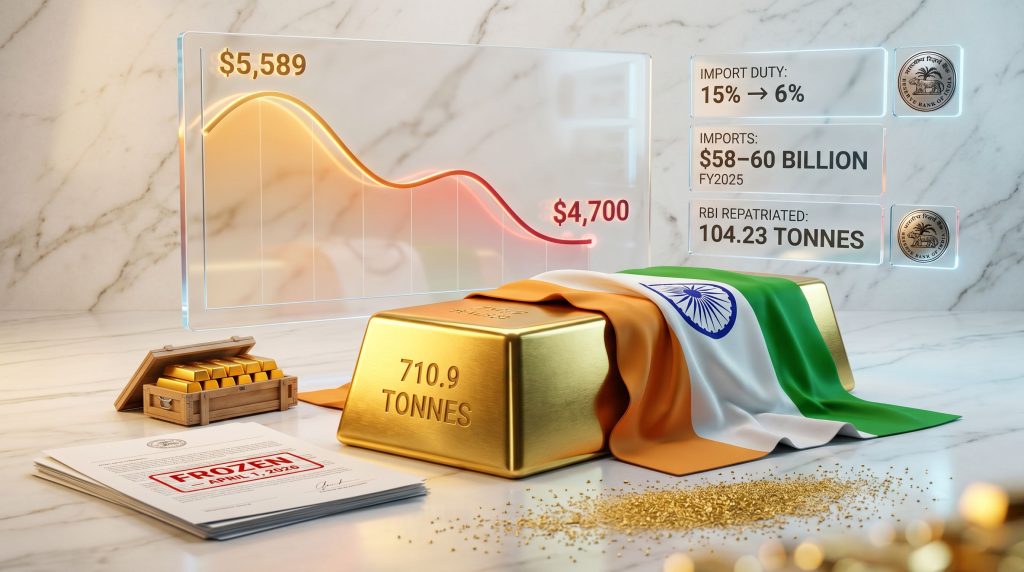
Gold operates as a compounding stressor within this dynamic. It ranks as India's second-largest import category after crude oil, representing over 9% of the country's total annual import bill. In FY2025, gold imports were valued at approximately $58 to $60 billion, among the highest annual figures ever recorded (World Gold Council, Gold Demand Trends Full Year 2025).
The 2024 duty liberalisation sits at the centre of this pressure. In July 2024, the government reduced customs duty on gold imports from 15% to 6% as a deliberate strategy to suppress smuggling networks and bring trade flows on to official balance sheets. The policy achieved its formalisation objective, but the accompanying demand surge amplified the current account deficit (CAD) pressure that the government is now attempting to manage through the 2026 appeal. The policy feedback loop is traceable and measurable.
The 2026 freeze is the direct consequence of the 2024 liberalisation. India's gold import architecture has cycled between restriction and opening for over a decade, and each phase carries predictable consequences for the next.
The structural conflict beneath all of this is worth stating plainly. Indian citizens have rational grounds for converting rupees into gold as a safe haven: the metal preserves purchasing power across inflationary periods and currency depreciations that fiat savings instruments cannot. Yet every tonne of gold imported to serve that rational savings impulse accelerates the foreign exchange drain that weakens the rupee in the first place. Government and citizen are operating from internally consistent but externally incompatible logic.
India's Scale: Why the Global Bullion Market Cannot Ignore This
The India gold buying freeze matters to global markets because of the raw consumption data underpinning India's position in the demand hierarchy.
| Metric | Figure | Source |
|---|---|---|
| India's 2025 gold consumption | 710.9 tonnes | World Gold Council, Full Year 2025 |
| 2026 forecast (pre-freeze) | 600 to 700 tonnes | World Gold Council, Q1 2026 India Focus |
| India's share of global jewellery demand, Q1 2026 | 22% | World Gold Council |
| India's global ranking in jewellery demand | 2nd (after China) | World Gold Council |
| India's global ranking in investment demand | 2nd globally | World Gold Council |
India's physical purchasing activity functions as a demand floor beneath global spot prices. When Indian offtake is robust, buyers exist at prevailing prices that prevent spot from falling below a structural support level. When Indian demand contracts, that floor weakens. Furthermore, the mechanism transmits through to COMEX futures contracts and record gold ETF inflows held by investors in the United States, Europe, and elsewhere, because these paper instruments are priced against global spot, which is partly anchored by physical purchasing in large consumer markets (World Gold Council, Gold Demand Trends Q1 2026 Outlook).
As of mid-May 2026, gold is trading near $4,700 per ounce, approximately 16% below its January 28, 2026 all-time high of $5,589 (CBS News). The India gold buying freeze is therefore arriving during a market already undergoing correction, which means the demand suppression effect compounds an existing downward trajectory rather than initiating one from elevated levels.
What the 2013 Precedent Actually Tells Us
The most instructive historical parallel for the 2026 India gold buying freeze is the 80:20 rule episode of 2013 and 2014. In July 2013, with India's current account deficit having peaked at 4.8% of GDP in FY2012-13, the government introduced a framework requiring gold importers to re-export 20% of every incoming shipment before additional imports could be cleared. Simultaneously, import duty was raised across three separate hikes during 2013, ascending from 4% to 10% over approximately eight months (World Gold Council, Bullion Trade: India Gold Market Series).
The policy produced a clear and measurable outcome sequence:
| Policy Outcome | Result |
|---|---|
| Official import volumes | Declined as intended by the government |
| Underlying consumer demand | Remained structurally unchanged |
| Smuggling activity | Surged to fill the supply gap left by official channels |
| Policy reversal | November 2014, 80:20 rule abandoned |
| Government acknowledgement | Scheme had created serious market distortions |
The critical analytical distinction that emerges from this episode is between supply suppression and demand suppression. Administrative restrictions reduced the volume of gold entering India through official channels. They did not reduce the volume of gold that Indian citizens wanted to acquire. Smuggling networks, particularly through Nepal and Sri Lanka, expanded to service the unsatisfied demand. When the policy was reversed in November 2014, official imports rebounded promptly (BusinessToday, December 2014).
The structural motivations behind Indian gold ownership did not shift during the restriction period: inflation protection, generational wealth transfer, wedding customs with centuries of cultural embedding, and in many rural communities, gold as the primary accessible savings vehicle outside the formal banking system. These drivers are not responsive to government appeals or bureaucratic friction. They are responsive to price, supply availability, and long-term purchasing power dynamics.
Deferred demand is not destroyed demand. The 2013 episode established empirically that Indian gold consumption is highly resilient to administrative pressure. The 2026 voluntary appeal operates with less coercive force than the 2013 statutory framework, suggesting its durable impact will be even more limited.
The RBI's Gold Strategy: A Revealing Contradiction
Perhaps the most analytically striking dimension of the 2026 India gold buying freeze is what India's own central bank has been doing simultaneously. The Reserve Bank of India (RBI) repatriated 104.23 metric tonnes of gold from the Bank of England in 2026, bringing India's onshore gold holdings to approximately 77% of total gold reserves. Gold now constitutes 16.7% of India's total foreign exchange reserves, up from 13.9% six months prior.
The RBI's repatriation programme is driven by documented strategic motivations, and central bank gold reserves worldwide have been reshaping in similar ways:
- Geopolitical risk reduction – Russia's 2022 foreign reserve freeze demonstrated that assets held in foreign custodian institutions can be made inaccessible through sovereign action; India is reducing that exposure
- Storage cost elimination – Repatriating gold from the Bank of England removes ongoing custodian fees from the RBI's operating costs
- Sovereign control – Ensuring physical access to national reserve assets during potential global financial crises, independent of bilateral relationships
- Reserve composition optimisation – Systematically increasing gold's share of total reserves as a hedge against dollar-denominated asset concentration risk
The contradiction is institutional but not accidental. The government needs to protect the rupee's purchasing power in international markets by limiting the dollar drain from retail gold imports. The RBI needs to protect India's balance sheet against sovereign risk, dollar concentration, and geopolitical asset vulnerability. Gold serves both objectives, but at different levels of the economic hierarchy. The citizen's gold purchase is a current account liability. The central bank's gold holding is a reserve asset. The government is discouraging one while the institution it oversees aggressively accumulates the other.
This divergence is not lost on informed market participants. When the world's most populous nation's central bank is among the most active acquirers of physical gold globally, the credibility of a voluntary consumer appeal to stop buying that same asset is structurally undermined. Consequently, central bank gold demand continues to set the broader tone for global sentiment, regardless of what retail consumers in any single market are doing.
The next major ASX story will hit our subscribers first
Import Duty Risk: The Policy Lever That Markets Are Pricing
Beyond the voluntary appeal, market participants are tracking a more consequential policy risk: the possibility that the government reverses the July 2024 duty liberalisation and raises import duty back toward pre-2024 levels. This represents the distinction between voluntary sentiment management and formal policy tightening with statutory effect.
The current 6% import duty is the lowest India has operated under in over a decade. A duty increase to 10% or above would materially increase the landed cost of gold for Indian consumers and dealers, creating genuine demand suppression rather than the temporary deferral a voluntary appeal produces.
Scenario analysis across potential duty outcomes:
| Scenario | Duty Level | Estimated Demand Impact | Historical Parallel | Market Signal |
|---|---|---|---|---|
| Status quo maintained | 6% | Minimal; voluntary appeal fades within weeks | None direct | Neutral to mildly bearish near-term |
| Moderate duty increase | 8 to 10% | Moderate suppression; smuggling risk rises | Partial 2013 parallel | Short-term bearish; medium-term rebound expected |
| Aggressive duty restoration | 12 to 15% | Significant official demand suppression | 2013 full parallel | Short-term bearish; smuggling surge likely |
Jewellery sector equities are already reflecting duty-increase risk. Shares in listed Indian jewellery companies including Kalyan Jewellers, Titan, and Senco Gold declined 5 to 7% following the May 10 announcement, pricing in the possibility of formal policy escalation beyond voluntary appeals. In addition, a five-week gold import freeze has already driven a 20% premium over global prices, illustrating how supply disruptions can compound market distortions even without statutory intervention.
What Sovereign Gold Suppression Actually Signals
Stepping back from the mechanics of the India gold buying freeze, the more enduring analytical insight is what the appeal itself reveals about the monetary system it is trying to defend.
A sitting head of government of the world's most populous nation publicly asked citizens to stop converting their earnings into gold — not into speculative assets, not into foreign securities, not into cryptocurrencies. Into gold, the asset that has functioned as a safe haven for over five thousand years of recorded economic history. The choice of target is the substantive message.
Governments do not issue appeals against assets that threaten currency stability unless those assets are working as intended. Gold is not the source of the rupee's weakness; it is the instrument measuring that weakness with precision that citizens can act on directly. Restricting access to the measure does not change the underlying reading.
This dynamic operates across monetary systems and is not unique to India. Post-crisis monetary history contains numerous instances of governments framing asset restriction in patriotic terms. These appeals share consistent characteristics:
- Voluntary framing with no statutory enforcement
- Explicit patriotic language linking personal financial decisions to national duty
- Short effective duration before social momentum overrides the appeal
- Limited durable impact on aggregate annual consumption
- Demand deferral followed by rebound once the appeal loses momentum
The 2013 episode provides the clearest empirical baseline for forecasting the 2026 appeal's trajectory. A statutory framework with actual enforcement mechanisms failed to suppress Indian gold demand durably. A voluntary appeal without enforcement mechanisms is unlikely to achieve a different outcome.
Global Price Implications Across Three Time Horizons
What Does the Immediate Term Look Like?
Immediate term (zero to four weeks):
The administrative import freeze is maintaining domestic prices at a $20+ premium over global spot, a supply scarcity premium that reflects genuine physical unavailability rather than demand destruction. The voluntary appeal adds a sentiment overhang to a market already operating 16% below its January 2026 record high.
How Quickly Could Demand Rebound?
Short term (one to three months):
Resolution of the administrative freeze, combined with the typical fading of voluntary appeal momentum, creates conditions for a demand catch-up effect. Deferred wedding season purchases, post-festival restocking by jewellers, and resumption of investment buying by retail participants historically produce sharp rebounds once restrictions ease, as documented through the 2013 to 2014 cycle.
What Do the Structural Drivers Suggest for the Longer Run?
Medium to long term (six to twenty-four months):
The structural drivers of the global gold bull market remain intact and independent of Indian retail demand dynamics. Central bank demand is characterised by the World Gold Council as reassuringly robust through Q1 2026, with global central banks having purchased 863 tonnes in 2025 (World Gold Council). The RBI's own repatriation programme reflects institutional conviction about gold's role in sovereign balance sheets. Geopolitical risk from the West Asia conflict remains unresolved, and inflation in major economies continues to support safe-haven allocation.
India's 710.9 tonnes of 2025 consumption represents a significant component of global jewellery demand, but it does not constitute the entirety of the structural bid supporting bullion prices. Central bank accumulation, Western investment demand through ETFs and futures, and China's parallel position as the world's largest gold consumer all provide concurrent support that insulates the global price from the full weight of Indian demand suppression.
The India gold buying freeze is a genuine short-term variable in the global price equation. However, it is not a structural inflection point for the bull market that carried gold from pre-2024 levels to a $5,589 all-time high on January 28, 2026. The gold price forecast for the medium term remains supported by the same macroeconomic forces that drove that record. History suggests the more relevant question for investors is not whether the freeze suppresses demand, but how sharply that demand rebounds once the appeal fades and India's 1.4 billion citizens resume treating gold the way they always have: as the most reliable store of wealth available to them.
This article is intended for informational and educational purposes only. It does not constitute financial or investment advice. Past price performance is not indicative of future results. Readers should consult a qualified financial adviser before making any investment decisions related to gold or precious metals.
Want to Know When the Next Major Gold Discovery Hits the ASX?
Discovery Alert's proprietary Discovery IQ model scans ASX announcements in real time, delivering instant alerts on significant mineral discoveries — including gold — so subscribers can act ahead of the broader market. Explore how historic discoveries have generated substantial returns on Discovery Alert's dedicated discoveries page, and begin your 14-day free trial today to position yourself at the forefront of the next major find.