July 21, 2026
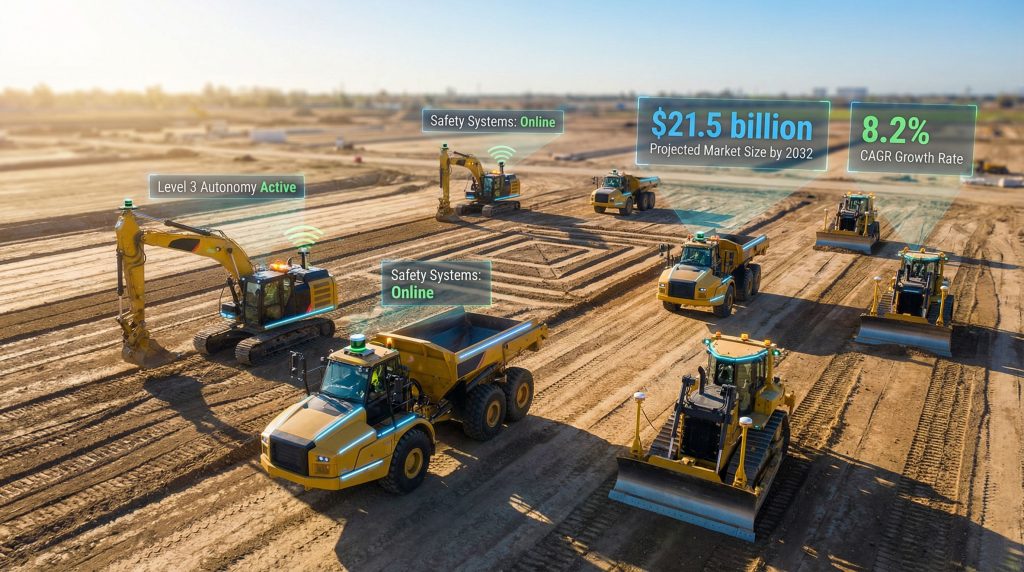
The construction industry stands at a technological crossroads where traditional manual operations are being redefined by advanced artificial intelligence systems. Modern jobsites now integrate sophisticated sensor arrays, machine learning algorithms, and edge computing networks that enable autonomous construction equipment to operate independently while maintaining precision and safety standards. This technological revolution extends far beyond simple remote control capabilities, establishing new paradigms for equipment coordination, predictive maintenance, and operational efficiency that fundamentally alter how construction projects are planned and executed.
The integration of autonomous capabilities into construction equipment represents a convergence of multiple technological disciplines, creating systems that can process environmental data, make real-time decisions, and coordinate complex multi-machine operations without continuous human oversight. Furthermore, these developments emerge from decades of research in artificial intelligence, sensor technology, and industrial automation, now reaching maturity levels that enable practical deployment across diverse construction environments.
Technical Foundation of Machine Intelligence Systems
Modern autonomous construction equipment operates through sophisticated classification frameworks that define operational capabilities across multiple independence levels. The Society of Automotive Engineers has established standardized autonomy levels ranging from Level 0 (manual operation) through Level 4 (full automation), with construction-specific adaptations addressing unique jobsite requirements and safety protocols.
Level 2 systems provide partial automation with human oversight, enabling automated functions like grade control while requiring operator supervision. In addition, Level 3 capabilities allow conditional automation where machines handle specific tasks independently but require human intervention for complex scenarios. Level 4 systems achieve full operational independence within defined parameters, processing sensor data and making operational decisions without human input while maintaining safety protocols and emergency override capabilities.
Real-Time Data Processing Architecture
Edge computing networks form the technological backbone of autonomous equipment operations, processing massive sensor data streams directly on individual machines rather than relying on external connectivity. This distributed processing approach enables instantaneous decision-making even in environments with limited communication infrastructure, consequently ensuring continuous operation across remote construction sites.
According to Caterpillar's technical specifications, autonomous systems integrate LiDAR technology, radar arrays, multi-frequency GPS positioning, and high-resolution camera networks to create comprehensive environmental awareness. These sensor arrays generate continuous 360-degree digital representations of jobsite conditions, updating in real-time to reflect changing obstacles, personnel locations, and operational parameters.
The artificial intelligence algorithms powering these systems draw from over 30 years of automation research and real-world deployment experience. However, machine learning models trained on millions of operational hours enable dynamic obstacle recognition, adaptive path planning, and predictive maintenance scheduling that optimizes equipment performance while minimizing downtime risks. These ai in mining operations advancements are now being adapted for construction applications.
| Processing Component | Function | Real-Time Capability |
|---|---|---|
| Edge Computing Units | Local data processing and decision-making | Sub-second response times |
| AI Algorithm Networks | Pattern recognition and predictive analysis | Continuous learning adaptation |
| Sensor Fusion Platforms | Multi-source data integration | 360-degree environmental mapping |
| Communication Systems | Machine-to-machine coordination | Fleet-wide operational synchronization |
When big ASX news breaks, our subscribers know first
Hardware Integration and System Redundancy
The hardware architecture enabling machine independence combines multiple sensor technologies into unified perception systems that maintain operational reliability under challenging construction conditions. Multi-sensor fusion platforms integrate positioning data from GPS networks with environmental scanning from LiDAR arrays, obstacle detection from radar systems, and visual processing from high-resolution camera networks.
Onboard computing units process terabytes of environmental data using specialized processors designed for industrial applications. These systems maintain operational capability in extreme temperatures, high vibration environments, and dust-heavy conditions typical of construction sites. Moreover, redundant safety systems ensure fail-safe operations through multiple independent monitoring networks that can trigger emergency stops or transfer control to human operators when anomalous conditions are detected.
Communication modules enable vehicle-to-vehicle coordination through standardised protocols that allow different equipment types to share operational data, coordinate travel paths, and optimise collective productivity. Fleet management systems like Cat VisionLink™ and Cat MineStar™ provide centralised oversight capabilities while maintaining individual machine autonomy for routine operations.
Advanced Sensor Technology Integration
LiDAR arrays provide precise distance measurement and spatial mapping capabilities that create detailed three-dimensional representations of jobsite terrain and obstacles. These systems operate effectively in various lighting conditions and weather environments, maintaining consistent accuracy for navigation and obstacle avoidance applications. The edge ai computing system technologies powering these sensors enable real-time processing at unprecedented speeds.
Radar technology enables relative velocity measurement and obstacle detection capabilities that complement visual sensor systems. Multi-frequency radar arrays can distinguish between stationary objects, moving equipment, and personnel, providing essential data for collision avoidance and path optimisation algorithms.
GPS positioning systems utilise multi-frequency receivers and differential correction networks to achieve sub-meter accuracy required for precision grading and material placement operations. Integration with inertial measurement units provides continuous position tracking even during temporary GPS signal interruptions.
Equipment Categories and Operational Applications
The deployment of autonomous construction equipment varies significantly across different machine types, with some categories achieving higher autonomy levels due to operational characteristics and safety requirements. Mining industry crossover has accelerated development in specific equipment categories, particularly haul trucks and excavators that share operational similarities between mining and construction applications.
Excavator Autonomy Capabilities
Autonomous excavators represent sophisticated integration of precision control systems with environmental awareness capabilities. These machines can perform autonomous trenching operations by following pre-programmed grade specifications while continuously monitoring for underground utilities and soil condition changes. Furthermore, loading operations require precise bucket positioning relative to haul trucks, demanding coordination between multiple machine control systems.
Precision grading applications utilise continuous blade height control relative to finished grade specifications, achieving tolerances measured in centimeters rather than traditional operator-dependent variations. Advanced excavator systems process real-time data from slope monitoring sensors, ground penetrating radar, and GPS positioning to maintain accuracy while adapting to changing soil conditions.
Haul Truck Automation Leadership
Haul truck automation represents the most mature segment of construction equipment autonomy, drawing from extensive mining industry deployment experience. Caterpillar's autonomous mining fleet has safely moved over 11 billion tonnes of material and traveled more than 380 million kilometers, demonstrating operational reliability under demanding conditions.
These systems excel in repetitive material transport cycles where routes and loading procedures follow predictable patterns. For instance, automated dumping cycles require precise positioning relative to dump sites, payload management optimisation, and traction control in variable terrain conditions. Advanced haul trucks coordinate with loading equipment to optimise cycle times and minimise idle periods.
Emerging Capabilities in Specialised Equipment
Dozer operations focus on precision grading and earthmoving applications that require significant obstacle awareness and terrain adaptation. Autonomous blade control systems maintain consistent material spreading and surface preparation while monitoring for underground obstacles and personnel safety zones.
Loader automation emphasises material handling efficiency and truck loading coordination. These systems optimise bucket fill factors, minimise cycle times, and coordinate with haul trucks to reduce waiting periods and improve overall fleet productivity.
Compactor systems provide automated surface preparation with consistent quality control that exceeds manual operator capabilities. Consequently, intelligent compaction systems monitor soil density, moisture content, and compaction patterns to ensure uniform surface preparation meeting specification requirements.
| Equipment Type | Primary Functions | Autonomy Level | Market Status |
|---|---|---|---|
| Haul Trucks | Material transport cycles | Level 4 | Commercial deployment |
| Excavators | Trenching, loading, grading | Level 2-3 | Advanced pilot programs |
| Dozers | Earthmoving, surface preparation | Level 3 | Expanding field trials |
| Loaders | Material handling, coordination | Level 2-3 | Early commercial adoption |
| Compactors | Surface finishing, quality control | Level 2 | Technology development |
Artificial Intelligence and Environmental Processing
Machine learning algorithms enabling autonomous operation draw from extensive datasets compiled over decades of equipment operation across diverse environments. Computer vision systems process high-resolution visual data to identify and classify dynamic obstacles including personnel, equipment, materials, and environmental hazards within construction site environments.
Adaptive path planning algorithms continuously reassess jobsite layouts and obstacle positions, automatically recalculating operational routes based on real-time sensor data without requiring operator intervention. However, these systems prioritise safety constraints while maximising cycle efficiency, balancing productivity goals with risk mitigation protocols.
Computer Vision and Obstacle Recognition
Advanced computer vision processing utilises deep learning models trained on millions of operational hours to recognise complex construction site scenarios. These systems distinguish between different obstacle types, assess threat levels, and determine appropriate response actions within milliseconds of detection.
Object classification capabilities enable identification of personnel, other equipment, material stockpiles, and environmental hazards. Machine learning models continuously improve recognition accuracy through operational experience, adapting to new obstacle types and environmental conditions encountered during deployment. The integration of data-driven operations principles enhances these recognition capabilities.
Dynamic scene understanding processes multiple sensor inputs simultaneously to create comprehensive situational awareness. Systems track multiple moving objects, predict collision risks, and optimise navigation paths while maintaining operational efficiency objectives.
Predictive Analytics and Optimisation
Fuel consumption optimisation algorithms analyse operational patterns, terrain conditions, and machine performance data to minimise energy usage while maintaining productivity targets. These systems adjust operational parameters including travel speeds, acceleration profiles, and idle management to achieve optimal fuel efficiency without compromising cycle times.
Predictive maintenance analytics process continuous equipment monitoring data to identify potential mechanical issues before failures occur. Sensor networks monitor hydraulic pressures, engine performance parameters, and component wear patterns to schedule maintenance activities during planned downtime periods.
Technical Performance Metrics
Autonomous systems demonstrate measurable improvements across multiple performance indicators:
• Operational consistency: Elimination of human fatigue variables
• Cycle time optimisation: Reduced idle periods and improved route efficiency
• Safety enhancement: Automated hazard detection and avoidance
• Maintenance scheduling: Predictive analytics reducing unplanned downtime
Market Economics and Return on Investment
The autonomous construction equipment market reflects convergence of technological maturity and economic necessity driven by labour shortages, safety requirements, and productivity demands. Investment decisions increasingly factor long-term operational cost reductions against higher initial equipment costs, with payback periods typically ranging from 18 to 36 months depending on application intensity and operational scale.
Labour cost reduction represents the most immediate economic benefit, with autonomous systems eliminating operator wage expenses while extending operational hours beyond traditional shift limitations. Furthermore, these systems operate continuously without fatigue-related performance degradation, maintaining consistent productivity levels throughout extended operational periods.
Economic Analysis Framework
Direct cost savings include operator wage elimination, reduced insurance premiums due to improved safety records, and decreased incident-related expenses. Autonomous systems demonstrate 15-25% reductions in direct labour costs while achieving 20-30% improvements in cycle efficiency through optimised operational patterns.
Productivity enhancement results from extended operational hours, consistent performance levels, and optimised coordination between multiple machines. Fleet-wide coordination systems eliminate idle time between coordinated operations while maintaining precision levels that exceed manual operator capabilities.
Equipment utilisation improvements enable extended operational schedules without operator fatigue concerns. For example, autonomous systems can operate continuously during suitable weather conditions, maximising equipment productive hours while reducing per-hour operational costs through increased utilisation rates.
Regional Market Development
North American markets lead autonomous equipment adoption due to advanced regulatory frameworks, established original equipment manufacturer presence, and significant infrastructure investment programs. Labour shortage pressures in skilled operator positions accelerate adoption rates across construction sectors.
Australian markets benefit from extensive mining industry automation experience that translates directly to construction applications. Regulatory environments supportive of autonomous technology deployment enable faster commercial adoption compared to more restrictive jurisdictions. The mining industry trends significantly influence construction equipment development.
European markets emphasise environmental compliance and safety regulations that favour autonomous system capabilities. However, strict emissions standards and worker safety requirements create economic incentives for autonomous equipment adoption that extend beyond simple labour cost considerations.
Safety Systems and Risk Mitigation
Safety protocol integration represents a fundamental design requirement for autonomous construction systems, addressing both equipment operator protection and jobsite personnel safety through multiple redundant monitoring systems. Geofencing technology creates programmable exclusion zones that prevent autonomous equipment from operating in areas with personnel activity or hazardous conditions.
Emergency stop systems incorporate multiple activation methods including remote wireless triggers, proximity sensors, and manual controls accessible to jobsite personnel. Visual and audible warning systems provide continuous notification of autonomous equipment operations to nearby workers while maintaining clear identification of machine operational status.
Human-Machine Interaction Protocols
Graduated autonomy systems allow seamless transition between autonomous operation and human control, enabling operators to assume manual control when complex situations exceed autonomous system capabilities. Override systems maintain human authority while preserving autonomous system benefits during routine operational periods.
Proximity monitoring utilises advanced sensor networks to detect personnel within equipment operational zones, automatically adjusting machine behaviour or halting operations to maintain safety clearances. These systems distinguish between personnel, equipment, and environmental obstacles to minimise unnecessary operational interruptions.
Communication protocols ensure continuous coordination between autonomous systems and human supervisors through standardised alert systems, status reporting, and exception handling procedures. Integration with existing jobsite management systems maintains familiar operational oversight while incorporating autonomous capabilities.
Risk Assessment and Mitigation Strategies
Environmental risk management addresses variable weather conditions, terrain instability, and visibility limitations that affect sensor performance. Consequently, autonomous systems incorporate weather monitoring capabilities and operational parameter adjustments that maintain safety margins during adverse conditions.
Cybersecurity protocols protect autonomous systems from external interference through encrypted communication networks, secure authentication systems, and isolated operational networks. Regular security updates and monitoring systems detect potential threats while maintaining operational availability.
System redundancy ensures continued operation during individual component failures through backup sensor networks, alternate processing pathways, and fail-safe operational modes that prioritise safety over productivity when system degradation occurs.
The next major ASX story will hit our subscribers first
Implementation Challenges and Solutions
Complex jobsite environments present significant challenges for autonomous system deployment, requiring advanced sensor processing capabilities and sophisticated decision-making algorithms. Multiple simultaneous activities, dynamic obstacle patterns, and varying operational priorities demand flexible autonomous systems capable of real-time adaptation to changing conditions.
Interoperability issues between different equipment manufacturers create integration challenges for mixed fleets, requiring standardised communication protocols and data sharing formats. Industry collaboration efforts focus on developing universal standards that enable seamless coordination between autonomous systems from multiple suppliers.
Technology Integration Strategies
Retrofit solutions enable autonomous capabilities on existing equipment fleets, reducing initial investment requirements while extending equipment service life. These systems integrate with existing machine control networks while adding autonomous functionality through supplemental sensor packages and computing systems.
Phased implementation approaches begin with controlled environments and predictable operational patterns before expanding to more complex applications. For instance, gradual deployment strategies reduce risk while enabling operational experience development and system optimisation before full-scale adoption.
Training program development addresses workforce transition requirements, focusing on equipment monitoring, maintenance procedures, and emergency response protocols. Comprehensive education programmes ensure personnel readiness for autonomous system supervision and maintenance requirements.
Technical Obstacle Resolution
Weather and visibility limitations affecting sensor performance require adaptive system responses and operational parameter adjustments. Advanced sensor fusion techniques combine multiple input sources to maintain operational capability during reduced visibility conditions while implementing safety margin increases. The deployment of autonomous construction equipment continues advancing despite these challenges.
Communication network reliability in remote construction sites demands robust wireless infrastructure and backup communication systems. Mesh network technologies and satellite communication integration ensure continuous system coordination and monitoring capability across challenging geographic locations.
Maintenance accessibility for complex autonomous systems requires specialised technical expertise and diagnostic equipment. However, service network development and remote diagnostic capabilities reduce maintenance complexity while ensuring system availability and performance optimisation.
Future Technology Development
Advanced autonomous capabilities under development include swarm intelligence systems that enable coordinated multi-machine operations optimised for complex construction projects. These systems coordinate activities across multiple equipment types simultaneously, optimising material flows, minimising conflicts, and maximising overall project efficiency through intelligent task allocation and scheduling.
Predictive maintenance evolution incorporates Internet of Things sensor networks that monitor thousands of system parameters continuously, enabling precise maintenance scheduling and component replacement optimisation. Machine learning algorithms analyse wear patterns, operational stresses, and environmental factors to predict maintenance requirements with increasing accuracy.
Next-Generation Interface Technologies
Augmented reality interfaces enable remote equipment supervision through immersive visualisation systems that provide operators with comprehensive situational awareness from remote locations. These systems combine real-time sensor data with digital overlay information to create intuitive control environments for complex autonomous operations. The integration with ai-powered fleet efficiency systems further enhances these capabilities.
Blockchain-based systems enable equipment sharing, utilisation tracking, and maintenance record management through distributed ledger technologies. These systems create transparent operational histories while enabling new business models for equipment access and utilisation optimisation across multiple construction projects.
Communication Network Evolution
5G network integration promises ultra-low latency communication enabling real-time remote control capabilities and massive IoT connectivity supporting thousands of sensors per jobsite. Enhanced video streaming capabilities enable detailed remote equipment monitoring while edge computing integration reduces data processing delays. The autonomous earthmoving equipment evolution demonstrates these technological advances.
Artificial intelligence advancement continues expanding autonomous system capabilities through improved environmental processing, enhanced decision-making algorithms, and adaptive learning systems that optimise performance through operational experience accumulation.
Future Development Timeline
Near-term (2026-2028): Enhanced sensor integration and improved weather operation capabilities
Medium-term (2028-2032): Swarm intelligence deployment and advanced coordination systems
Long-term (2032+): Fully integrated autonomous construction sites with minimal human intervention
Investment Landscape and Market Outlook
Original equipment manufacturers expand autonomous capabilities through both internal development and strategic partnerships with technology companies specialising in artificial intelligence and sensor systems. Traditional construction equipment producers leverage decades of mechanical engineering expertise while incorporating cutting-edge autonomous technologies through collaborative development programs.
Technology startups focus on retrofit solutions and fleet management software that enable autonomous functionality across existing equipment populations. These companies address market segments seeking gradual autonomous adoption without complete fleet replacement, providing upgrade pathways for established construction operations.
Financial Models and Return Analysis
Equipment-as-a-service models reduce upfront investment requirements while providing access to latest autonomous technologies through subscription-based arrangements. These financing structures enable smaller construction companies to access autonomous capabilities without significant capital expenditures while ensuring continuous technology updates and maintenance support.
Productivity-based contracts align equipment payments with performance outcomes, creating financial incentives for optimal autonomous system utilisation. These arrangements reduce financial risk for construction companies while providing equipment suppliers with long-term revenue streams tied to operational success.
Lease programmes specifically designed for autonomous equipment incorporate technology upgrade pathways and performance guarantees that address concerns about technological obsolescence and operational reliability. Furthermore, flexible lease terms enable construction companies to adapt autonomous capabilities to changing project requirements and market conditions.
Market Development Factors
Regulatory environment evolution continues supporting autonomous equipment deployment through updated safety standards, certification procedures, and operational guidelines. Government infrastructure investment programmes increasingly specify autonomous-capable equipment preferences, accelerating market adoption rates.
Insurance industry adaptation develops risk assessment models and coverage options specific to autonomous equipment operations. Premium reductions for demonstrably safer autonomous systems create additional economic incentives for adoption while addressing liability concerns for construction companies.
Skilled operator shortage pressures accelerate autonomous equipment adoption as construction companies struggle to maintain adequate staffing levels. Demographics trends indicating declining availability of experienced equipment operators create sustained market demand for autonomous alternatives.
Disclaimer: This analysis contains forward-looking statements and market projections that involve inherent uncertainties. Actual market development, technology adoption rates, and financial returns may differ significantly from presented scenarios due to economic conditions, regulatory changes, technological developments, and competitive factors beyond current prediction capabilities. Investment decisions should incorporate comprehensive due diligence and professional financial advice appropriate to specific circumstances and risk tolerance levels.
Want to Capitalise on the Next Wave of Construction Technology Innovation?
Discovery Alert's proprietary Discovery IQ model delivers instant notifications on significant ASX mineral discoveries that often drive the technological advances powering autonomous construction equipment development. Transform complex market data into actionable insights and position yourself ahead of major announcements by exploring Discovery Alert's historic discovery examples and beginning your 30-day free trial today.