July 22, 2026
Autonomous drilling technology represents a revolutionary advancement transforming industrial drilling operations across mining, oil and gas, and construction sectors. This sophisticated integration of artificial intelligence, sensor systems, and automated control mechanisms enables drilling platforms to operate independently while achieving unprecedented levels of precision, safety, and operational efficiency in diverse geological environments.
The convergence of technological evolution and operational necessity has created a paradigm shift that extends far beyond simple mechanisation. Furthermore, traditional drilling methods increasingly struggle to meet the demands of complex geological formations and heightened safety requirements across diverse industrial applications.
Disclaimer: This article discusses emerging technologies and industry trends. Performance metrics and technological capabilities mentioned may vary significantly based on specific implementations, geological conditions, and operational parameters. Readers should conduct independent research before making investment or operational decisions.
The transformation from manual to automated drilling represents more than incremental improvement in existing processes. It encompasses a comprehensive reimagining of how drilling operations integrate with broader mining innovation trends and real-time decision-making frameworks that operate across mining, oil and gas, and geotechnical sectors simultaneously.
Core Technological Components Driving Autonomous Drilling Innovation
Advanced Sensor Integration and Environmental Monitoring
Autonomous drilling technology relies on sophisticated sensor arrays that create comprehensive environmental awareness far exceeding human operator capabilities. LiDAR mapping systems generate three-dimensional terrain visualisations with millimetre-level precision, enabling drilling platforms to navigate complex underground environments where GPS signals cannot penetrate.
These systems integrate with inertial navigation frameworks that maintain positional accuracy through sophisticated gyroscopic and accelerometer arrays. Real-time monitoring extends beyond positional awareness to encompass comprehensive geological analysis through automated rock condition assessment systems.
These platforms analyse drilling resistance patterns, vibration signatures, and material displacement characteristics to identify formation changes instantaneously. Consequently, they adjust operational parameters without human intervention, providing capabilities that complement downhole geophysics insights for comprehensive subsurface understanding.
Pressure, temperature, and vibration monitoring arrays provide continuous feedback loops that enable predictive maintenance protocols and operational optimisation. Unlike traditional drilling operations where equipment stress indicators require manual monitoring, autonomous systems process thousands of data points per second to identify potential mechanical issues before they impact operational efficiency.
Artificial Intelligence and Machine Learning Integration
The foundation of autonomous drilling technology rests on physics-based drilling models that incorporate machine learning algorithms capable of adapting to changing geological conditions in real-time. These systems utilise pattern recognition capabilities that identify geological formation characteristics through drilling performance data.
Closed-loop control systems represent a significant advancement over traditional drilling approaches, where human operators must interpret geological conditions and adjust equipment settings manually. Modern autonomous platforms process geological data through adaptive learning algorithms that continuously refine their understanding of local formation characteristics.
The integration of artificial intelligence frameworks enables autonomous drilling systems to make complex operational decisions based on multiple variables simultaneously. These systems can optimise drilling trajectories, adjust bit selection protocols, and modify drilling parameters based on real-time geological data interpretation.
However, successful implementation requires integration with data-driven mining operations to maximise the potential of automated decision-making processes across the entire operational framework.
Navigation and Control System Architecture
Autonomous steering mechanisms for directional drilling operations represent perhaps the most sophisticated aspect of modern drilling automation. These systems can execute complex three-dimensional well trajectories without human intervention, maintaining precise directional control through automated bottomhole assembly management.
Obstacle avoidance algorithms designed for underground operations enable autonomous drilling platforms to navigate around existing infrastructure, geological hazards, and other underground obstacles using real-time environmental mapping. These systems integrate with remote operation capabilities that allow human oversight from safe distances.
Auto-drill bit selection and replacement protocols reduce operational downtime by automating equipment changes based on geological conditions and wear pattern analysis. These systems can predict optimal bit replacement timing and automatically execute changeover procedures without requiring surface crew intervention.
When big ASX news breaks, our subscribers know first
Industry-Specific Implementation Strategies and Applications
Oil and Gas Sector Autonomous Drilling Deployment
Directional Drilling Automation Capabilities
The petroleum industry has pioneered autonomous bottomhole assembly technologies through systems that can execute complex well trajectories with minimal human oversight. Recent industry implementations have demonstrated the capability to drill curve sections autonomously, utilising three-dimensional well path optimisation.
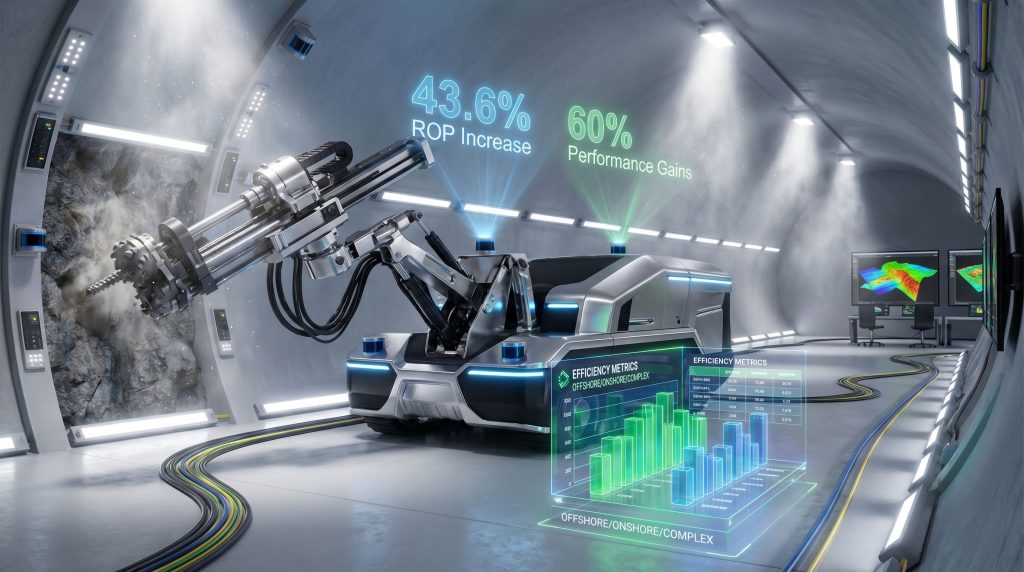
According to Halliburton's autonomous drilling technology, these systems respond to geological conditions faster than traditional drilling approaches. European pilot programmes have reported rate of penetration increases averaging 43.6%, while Brazilian offshore operations have documented performance gains reaching 60% compared to conventional drilling methods.
Performance Metrics and Operational Achievements
| Application Area | Efficiency Improvements | Safety Enhancements |
|---|---|---|
| Offshore Operations | 60% ROP enhancement | 16% CO2 emission reduction |
| Onshore Drilling | 39% drilling speed increase | Reduced personnel exposure |
| Complex Trajectories | 42% fewer directional adjustments | Minimised trajectory deviations |
| Pre-connection Operations | 32% time reduction | Enhanced operational safety |
These performance improvements translate directly into operational cost reductions and enhanced safety profiles. Reduced pre-connection time by 32% across multiple deployments has demonstrated the potential for autonomous systems to streamline drilling operations while maintaining safety standards.
Underground Mining Operations and Automation
Autonomous Rig Deployment Strategies
Underground mining operations present unique challenges for autonomous drilling technology implementation due to confined spaces, ventilation requirements, and the need for emission-free operation. Battery-electric drilling platforms have emerged as the preferred solution for underground environments.
Cabinless rig designs enhance safety protocols by eliminating the need for human operators in potentially hazardous underground locations. These systems can execute full-cycle automation from initial positioning through pattern completion, reducing human exposure to underground hazards.
In addition, modern systems incorporate AI in drilling & blasting processes to optimise the entire extraction workflow from drilling through material removal.
Navigation and Positioning Capabilities
Advanced mapping systems designed for underground tunnel networks enable autonomous drilling platforms to navigate complex mine layouts without GPS guidance. These systems utilise sophisticated inertial navigation combined with environmental mapping to maintain positional accuracy in GPS-denied underground environments.
Precision drilling patterns with sub-metre accuracy allow autonomous systems to execute complex blast hole patterns that optimise mineral extraction while maintaining structural stability. Automated tramming between drilling locations reduces cycle times and eliminates safety risks associated with human-operated equipment movement.
Performance Advantages and Operational Benefits
Quantifiable Efficiency Improvements
Rate of Penetration Enhancement Metrics
Industry data demonstrates significant rate of penetration improvements across diverse geological formations and operational environments. European pilot programmes have achieved 43.6% average ROP increases, while Brazilian offshore operations report 60% performance gains compared to conventional drilling methods.
These improvements result from continuous optimisation algorithms that adjust drilling parameters based on real-time geological data interpretation. Pre-connection time reductions of 32% across multiple deployments represent substantial operational efficiency gains that translate directly into cost savings.
Cost Reduction and Timeline Optimisation
Autonomous drilling technology implementation has demonstrated the potential to deliver wells 30% faster than conventional drilling methods through continuous optimisation and reduced downtime. These timeline improvements result from:
- Continuous operation capabilities that eliminate human shift changes and reduce operational interruptions
- Predictive maintenance protocols that minimise unplanned equipment downtime
- Automated decision-making that eliminates delays associated with human consultation processes
- Optimised drilling parameters that maximise drilling efficiency based on real-time geological data
Safety and Environmental Impact Reduction
Risk Mitigation and Safety Enhancement
Remote operation capabilities enable human oversight of drilling operations from safe distances, particularly valuable in hazardous underground environments or unstable geological formations. Automated emergency response systems can execute shutdown procedures and safety protocols faster than human operators.
Enhanced stringer detection and mitigation capabilities protect both equipment and personnel by identifying potential drilling hazards before they create dangerous situations. These systems can detect geological anomalies that might cause equipment damage or create unsafe working conditions.
Environmental Performance and Sustainability
Environmental impact reduction through autonomous drilling technology extends beyond immediate operational benefits to encompass broader sustainability considerations. Lower carbon footprint achievements result from optimised drilling patterns that reduce overall energy consumption and minimise site visits.
Energy-efficient battery-electric systems designed for underground operations eliminate diesel emissions while maintaining operational effectiveness. Precision drilling capabilities minimise environmental disturbance by reducing the surface footprint required for drilling operations.
Leading Technology Providers and Innovation Platforms
Major Autonomous Drilling Solution Providers
Integrated Platform Technologies
The autonomous drilling technology sector includes established equipment manufacturers who have developed comprehensive drilling automation solutions. Advanced bottomhole assembly technologies represent over 18 years of development investment, focusing on systems that can operate autonomously in complex geological formations.
Full-stand drilling capabilities enable systems to operate without continuous operator input, executing predetermined drilling programs while adapting to changing geological conditions. These platforms integrate multiple technological components into unified systems that can manage complex drilling operations autonomously.
Specialised Control and Navigation Systems
Directional control systems have evolved to include sophisticated platforms that optimise drilling performance through automated parameter adjustment. Advanced rotary steerable systems enable autonomous three-dimensional steering capabilities that can execute complex well trajectories without human intervention.
Real-time reservoir navigation capabilities represent a significant advancement in drilling precision, enabling autonomous systems to adjust drilling trajectories based on geological conditions encountered during drilling operations. These systems can modify planned well paths to optimise resource extraction.
Mining-Specific Automation Solutions
Underground mining requires specialised autonomous drilling solutions that address the unique challenges of confined spaces and emission-free operation. Battery-electric autonomous drilling platforms provide the power and mobility necessary for effective underground operations.
Recent industry developments include significant progress in testing driverless surface drilling capabilities, with mining operations receiving advanced autonomous technology for operation evaluation. Furthermore, major mining companies have ordered multiple autonomous drilling units, indicating growing industry confidence in the technology.
According to Sandvik's next-generation automation solutions, integrated navigation systems designed for GPS-denied environments enable autonomous drilling platforms to operate effectively in underground mining environments where satellite navigation is unavailable.
Implementation Challenges and Operational Considerations
Technical Integration Complexities
High initial capital investment requirements represent a significant barrier to autonomous drilling technology adoption, particularly for smaller drilling contractors and mining operations. System integration across existing drilling infrastructure requires substantial modifications to established operational procedures and equipment configurations.
Training requirements for technical personnel extend beyond traditional drilling operation knowledge to encompass sophisticated software systems, sensor technologies, and automated control systems. Maintenance protocols for sophisticated automated systems require specialised technical expertise that may not be readily available.
Operational and Regulatory Considerations
Regulatory compliance across different jurisdictions presents ongoing challenges as autonomous drilling technology outpaces existing regulatory frameworks. Quality assurance protocols for autonomous operations must demonstrate equivalent or superior performance compared to traditional drilling methods.
Backup systems for emergency manual override remain essential components of autonomous drilling implementations, ensuring that human operators can assume control when automated systems encounter unexpected conditions. Data security concerns for connected drilling platforms require robust cybersecurity protocols.
Future Technology Evolution and Industry Transformation
Advanced Technological Development Trajectories
Enhanced AI and Machine Learning Capabilities
Future autonomous drilling development focuses on enhanced geological prediction algorithms that can anticipate subsurface conditions based on regional geological data and drilling performance from adjacent wells. Improved real-time decision-making systems will enable autonomous platforms to execute complex operational decisions.
Integration with broader mine automation networks represents a significant opportunity for operational optimisation, enabling autonomous drilling systems to coordinate with other automated mining equipment. In addition, predictive maintenance through IoT sensor networks will reduce equipment downtime and extend operational life.
Expanded Application Scope and Market Penetration
Geothermal drilling automation for renewable energy projects represents a significant growth opportunity as the energy sector seeks to expand geothermal power generation capabilities. Water well drilling in remote locations could benefit from autonomous drilling technology that reduces logistical challenges.
Geotechnical investigation automation could streamline construction and infrastructure development projects by automating the drilling operations necessary for foundation design and site characterisation. Construction piling and foundation work represents another application area where the technology could improve efficiency.
Industry Transformation and Economic Impact
Workforce Evolution and Skills Development
The transition to autonomous drilling technology requires a fundamental shift from manual operators to system supervisors who manage automated drilling platforms rather than directly controlling drilling equipment. Enhanced technical training requirements focus on software systems, data analysis, and automated equipment maintenance.
Remote monitoring and control capabilities enable drilling operations to utilise specialised technical expertise more efficiently by allowing expert operators to supervise multiple autonomous drilling platforms from centralised control centres. Safety protocol redesign for automated environments must address unique challenges presented by the technology.
Economic Impact and Market Transformation
Reduced operational costs across drilling sectors result from improved efficiency, reduced personnel requirements, and optimised equipment utilisation. Enhanced safety records driving insurance cost reductions represent an additional economic benefit that supports the business case for adoption.
Accelerated project timelines through continuous operation capabilities enable drilling operations to complete projects faster while reducing the overall cost of drilling services. Improved resource extraction efficiency through precise drilling patterns and optimised well placement can enhance economic viability.
The next major ASX story will hit our subscribers first
Strategic Implementation Framework for Autonomous Drilling Technology
The transformation of drilling operations through autonomous drilling technology represents a fundamental shift in how the industry approaches operational efficiency, safety management, and resource extraction optimisation. Successful implementation requires comprehensive integration of advanced sensor systems, artificial intelligence frameworks, and automated control mechanisms.
The convergence of technological capabilities with operational necessities has created market conditions that favour rapid adoption of autonomous drilling solutions across multiple industry sectors. As regulatory frameworks adapt to accommodate the technology and technical expertise becomes more widely available, the industry can expect accelerated deployment.
Moreover, the integration of autonomous drilling technology with AI-powered mining efficiency systems will further enhance operational capabilities and economic benefits across the mining sector.
Understanding the technological components, implementation strategies, and operational benefits is essential for industry professionals seeking to optimise drilling operations while enhancing safety and environmental performance. The continued evolution of these systems will likely determine competitive advantages across multiple industrial sectors that depend on efficient drilling capabilities.
Ready to Capitalise on Mining Technology Breakthroughs?
Discovery Alert instantly notifies investors of significant ASX mineral discoveries using its proprietary Discovery IQ model, turning complex mining innovations into actionable investment insights. Explore how major technological advances can translate into substantial market returns by visiting Discovery Alert's dedicated discoveries page, then begin your 14-day free trial to position yourself ahead of the market.