May 23, 2026
Core Infrastructure Requirements for Autonomous Fleet Management
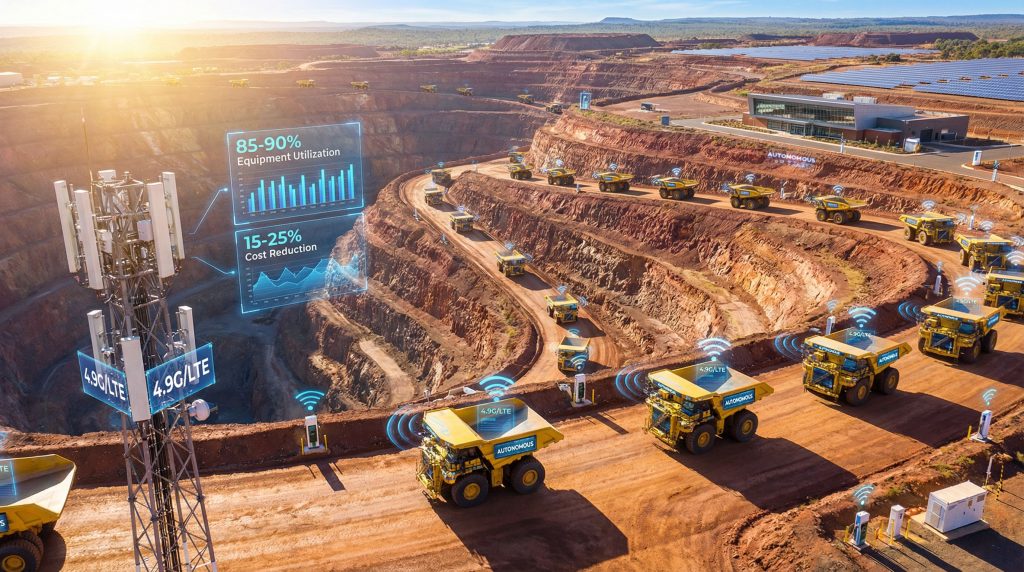
The foundation of successful autonomous mining operations rests on sophisticated telecommunications infrastructure that enables real-time coordination between unmanned equipment and centralised control systems. Modern autonomous mining facilities require dedicated communication networks capable of maintaining consistent data transmission rates, with industry standards typically targeting response times under 50 milliseconds for critical safety operations. These stringent latency requirements prevent dangerous delays in obstacle avoidance scenarios and ensure seamless equipment coordination across expansive mining sites.
Power distribution systems form another critical component of autonomous fleet infrastructure. The Minera Centinela autonomous operation demonstrates this through its newly energised DMC substation, featuring 120 MVA capacity with 220 kV input transmission and 23 kV distribution voltage for operational systems. This substantial electrical infrastructure supports not only the autonomous fleet but also the broader mining complex, including crushing and concentration equipment. The substation receives power through a 12-kilometre transmission line and incorporates renewable energy sources, aligning with modern sustainability requirements.
Equipment modification protocols ensure consistent autonomous capability across diverse mining machinery. At Centinela, this includes the integration of 11 trucks equipped with autonomous kits and 2 electric shovels that underwent comprehensive testing and assembly during 2025. The standardisation of these retrofit specifications enables mining operators to maintain uniform performance standards while scaling their autonomous operations systematically.
Remote operation centres serve as the nerve centres for autonomous mining coordination, providing operators with comprehensive oversight capabilities and intervention protocols when required. These facilities integrate multiple data streams from individual pieces of equipment, environmental sensors, and production monitoring systems to maintain operational efficiency whilst ensuring safety compliance.
Safety Protocol Integration in Unmanned Operations
Safety management in autonomous mining environments requires fundamentally different approaches compared to conventional operations. The elimination of human operators from immediate equipment proximity necessitates advanced sensor arrays and automated response systems that can detect and react to hazardous conditions faster than human operators could respond.
Proximity detection systems employ multiple sensor technologies working in coordination to create comprehensive awareness zones around autonomous equipment. These systems typically integrate LiDAR for precise three-dimensional mapping, radar for obstacle detection, GPS positioning for location tracking, and camera arrays for visual confirmation. The redundancy built into these sensor networks ensures continued safe operation even when individual components experience failures or degraded performance.
Emergency shutdown procedures in autonomous operations must account for scenarios where human intervention may not be immediately available. Automated halt mechanisms respond to environmental conditions such as severe weather, equipment malfunctions, or unexpected obstacles in operational areas. These systems can suspend operations across entire autonomous fleets within seconds when triggered by predetermined safety criteria.
The safety record achieved at Centinela's Nueva Centinela project demonstrates the potential effectiveness of these protocols, with 32 million hours worked without fatalities during the construction phase. This performance metric suggests that comprehensive safety planning and protocol implementation can achieve significant risk reduction in large-scale mining operations.
Maintenance access protocols require careful coordination between autonomous operations and human technicians. Scheduled downtime windows allow technical interventions whilst ensuring that autonomous equipment operates in predictable patterns that minimise interaction risks. These frameworks must balance operational efficiency with the practical requirements of equipment servicing and repairs.
When big ASX news breaks, our subscribers know first
Phased Implementation Methodology for Autonomous Fleet Scaling
Mining companies implementing autonomous operations typically follow structured scaling methodologies that minimise operational risk whilst building technical expertise and operational confidence. The Centinela autonomous expansion exemplifies this approach, beginning with a controlled pilot deployment before progressing to full fleet integration.
Table: Centinela Autonomous Fleet Scaling Timeline
| Phase | Equipment Count | Implementation Period | Operational Status |
|---|---|---|---|
| Initial Deployment | 6 haul trucks | February 2026 | Encuentro Sulfuros operational |
| Expansion Phase | 26 haul trucks | Throughout 2026 | Planned deployment |
| Full Integration | 53 total units | 2026+ completion | Mixed fleet coordination |
The pilot phase focuses on establishing operational procedures and validating safety protocols with a limited number of autonomous units. Centinela's approach of beginning with 6 autonomous haul trucks in the Encuentro Sulfuros pit allows operators to refine coordination protocols and identify potential operational challenges before committing additional resources to autonomous expansion.
Fleet expansion requires careful coordination of equipment deployment, operator training, and infrastructure scaling. The progression from 6 to 26 autonomous haul trucks throughout 2026 represents a more than four-fold increase in autonomous capacity, requiring proportional increases in communication infrastructure, maintenance protocols, and operational oversight capabilities.
Integration methodology leverages operational experience gained from previous autonomous implementations. Centinela's ability to replicate the operational model from Esperanza Sur, launched as their first completely autonomous pit in 2023, demonstrates how successful autonomous operations can serve as templates for subsequent deployments. This approach reduces implementation risk and accelerates deployment timelines by applying proven operational frameworks.
Full ecosystem integration encompasses diverse equipment categories beyond primary haul trucks. The projected 53-unit autonomous fleet at Encuentro Sulfuros includes electric shovels, hydraulic shovels, drilling rigs, graders, and light vehicles, creating a comprehensive autonomous mining ecosystem that requires sophisticated coordination protocols and integrated operational planning.
Equipment Categories and Specifications
Autonomous mining operations require careful integration of diverse equipment types, each with specific autonomous capabilities and operational roles. The equipment portfolio must balance productivity requirements with technological feasibility and safety considerations across different mining functions.
Primary extraction equipment forms the core of autonomous mining operations. Haul trucks represent the most commonly automated equipment category due to their repetitive operational cycles and well-defined travel routes. These vehicles typically feature advanced sensor suites, communication systems, and automated loading and dumping capabilities that enable continuous operation with minimal human intervention.
Material handling equipment includes autonomous-capable electric shovels and hydraulic shovels that coordinate with haul trucks for efficient loading operations. At Centinela, 2 electric shovels underwent assembly and testing during 2025, incorporating autonomous capabilities that enable coordinated operation with the autonomous haul truck fleet. The selection between electric and hydraulic shovels often depends on ore body characteristics and operational requirements specific to each mining area.
Support operations encompass drilling rigs, graders, and auxiliary vehicles that maintain operational infrastructure and prepare mining areas for extraction activities. While these equipment categories may not achieve full autonomous operation immediately, they increasingly incorporate remote operation capabilities and automated functions that integrate with broader autonomous fleet coordination.
Light fleet vehicles, including electric pickup trucks, serve inspection, maintenance, and supervisory functions within autonomous mining areas. These vehicles often require hybrid operational capabilities, functioning autonomously during routine operations whilst allowing manual control for specialised tasks or emergency interventions.
Economic Drivers and Investment Framework
The economic justification for autonomous mining operations stems from multiple cost reduction and productivity enhancement opportunities that compound over the operational life of mining assets. Understanding these economic drivers requires comprehensive analysis of capital expenditure, operational cost impacts, and long-term productivity gains, particularly as data-driven mining ops continue evolving industry practices.
Capital investment requirements for autonomous mining systems represent significant upfront expenditures that must be justified through operational improvements and risk reduction. Centinela's US$4.4 billion investment in the Nueva Centinela expansion, which includes autonomous operations infrastructure, demonstrates the scale of capital commitment required for comprehensive mining automation.
The specific investment in autonomous operations infrastructure includes specialised communication networks, equipment modifications, operator training, and control system integration. While exact figures for autonomous-specific investments are rarely disclosed separately from broader expansion projects, industry analyses suggest that autonomous capabilities typically require 15-25% premium over equivalent conventional equipment and infrastructure.
Operational Cost Impact Analysis
Labour cost optimisation represents one of the most significant economic drivers for autonomous operations. While autonomous systems do not eliminate human operators entirely, they enable centralised control of multiple pieces of equipment and reduce the number of operators required for equivalent production levels. This consolidation can achieve labour cost reductions whilst potentially improving working conditions by removing operators from hazardous environments.
Equipment maintenance costs may decrease through autonomous operations due to consistent operating parameters and reduced equipment abuse that can occur with human operators. Autonomous systems can maintain optimal operating speeds, avoid harsh acceleration and deceleration cycles, and coordinate movements to minimise equipment stress. However, the sophisticated sensor and communication systems required for autonomous operation introduce additional maintenance requirements that partially offset these benefits.
Fuel consumption optimisation occurs through route optimisation algorithms and consistent operating practices. Autonomous systems can calculate optimal routes in real-time, avoid unnecessary idle time, and maintain efficient operating speeds that minimise fuel consumption per tonne of material moved. These optimisations become increasingly valuable as fuel costs represent significant operational expenses for mining operations.
Productivity Enhancement Metrics
Equipment utilisation rates typically improve significantly in autonomous operations due to the elimination of shift changes, break periods, and human fatigue factors. Autonomous equipment can operate continuously during scheduled production periods, limited primarily by maintenance requirements and operational constraints rather than human limitations.
Cycle time optimisation through autonomous operations results from consistent operating practices and real-time route optimisation. Autonomous haul trucks can calculate optimal speeds for different route segments, coordinate with loading and dumping equipment to minimise waiting times, and adjust routes dynamically based on traffic conditions and operational priorities.
Predictive maintenance capabilities enabled by autonomous systems can significantly reduce unplanned downtime. The comprehensive sensor suites required for autonomous operation also provide detailed equipment performance data that enables early identification of potential mechanical issues before they result in equipment failures.
Safety incident reduction represents both a direct cost saving and a risk mitigation benefit. The elimination of human operators from immediate proximity to large mining equipment reduces the potential for serious injuries and fatalities, with corresponding reductions in workers' compensation costs, production disruptions, and regulatory penalties.
Technology Integration and Communication Protocols
Successful autonomous mining operations require sophisticated technology integration that enables seamless communication between equipment, infrastructure, and human operators. Furthermore, these systems must maintain reliability under challenging environmental conditions whilst providing the real-time responsiveness necessary for safe autonomous operation, aligning with broader mining evolution trends across the industry.
Vehicle-to-infrastructure communication protocols enable autonomous equipment to coordinate with fixed infrastructure elements such as loading stations, dumping locations, and maintenance facilities. These communications must maintain consistent connectivity across expansive mining sites whilst providing the low latency required for real-time coordination and safety systems.
Machine-to-machine communication allows autonomous equipment to coordinate directly with other pieces of equipment without relying on centralised control systems for every operational decision. This distributed intelligence approach can improve operational efficiency whilst providing redundancy in case of communication network disruptions.
Table: Communication Technology Requirements
| Technology Type | Latency Requirement | Coverage Area | Redundancy Level |
|---|---|---|---|
| Safety Systems | <50 milliseconds | Complete site | Triple redundant |
| Coordination | <100 milliseconds | Operational areas | Dual redundant |
| Monitoring | <500 milliseconds | Administrative zones | Single with backup |
| Maintenance | <2 seconds | Equipment locations | Standard protocols |
Human-machine interface systems provide operators with oversight and intervention capabilities for autonomous operations. These interfaces must present complex operational information in easily understandable formats whilst providing rapid response capabilities for emergency interventions or operational adjustments.
Cloud connectivity enables advanced analytics, machine learning optimisation, and remote monitoring capabilities that extend beyond immediate operational requirements. These connections support long-term operational optimisation and predictive maintenance whilst enabling expert support from locations remote from the mining site.
Sensor Technology and Environmental Monitoring
Sensor integration forms the foundation of autonomous mining safety and operational effectiveness. Multiple sensor technologies work in coordination to provide comprehensive environmental awareness that exceeds human sensory capabilities whilst maintaining consistent performance across varying environmental conditions.
LiDAR systems provide precise three-dimensional mapping capabilities that enable autonomous equipment to navigate complex mining environments and detect obstacles with high accuracy. These systems typically offer 200-metre detection ranges with millimetre-level precision, though performance can be affected by dust, precipitation, and extreme lighting conditions common in mining environments.
Radar detection systems complement LiDAR capabilities by providing reliable obstacle detection capabilities that maintain performance in adverse weather conditions. Radar systems typically offer 150-metre forward detection ranges and can detect obstacles that may not be visible to optical or LiDAR systems due to environmental conditions.
Global positioning systems provide location accuracy necessary for autonomous navigation and fleet coordination. Mining operations typically require dual or quad redundant GPS systems to maintain positioning accuracy even when individual satellites or receivers experience problems. These systems must maintain accuracy within mining environments that may include deep pits or areas with limited satellite visibility.
Camera arrays provide visual confirmation capabilities and support human operator oversight of autonomous operations. 360-degree camera coverage enables comprehensive visual monitoring whilst providing operators with familiar visual references for understanding autonomous equipment operations and environmental conditions.
Infrastructure Investment and Power Systems
Large-scale autonomous mining operations require substantial infrastructure investments that extend beyond individual equipment modifications to encompass power generation, distribution, and communication systems that support comprehensive autonomous operations. In addition, these investments often integrate advanced technologies such as ai in drilling & blasting to optimise operational efficiency.
Electrical infrastructure requirements for autonomous operations include high-capacity substations that can support both traditional mining equipment and the additional power requirements of autonomous systems. The DMC substation at Centinela demonstrates these requirements with its 120 MVA capacity designed to support autonomous fleet operations alongside broader mining operations.
Power distribution systems must provide reliable electricity across expansive mining sites whilst maintaining the redundancy necessary for safety-critical autonomous systems. The 12-kilometre transmission line connecting Centinela's main substation to the DMC facility illustrates the infrastructure scale required for autonomous mining operations in remote locations.
Renewable energy integration becomes increasingly important as mining operations scale autonomous systems that operate continuously. Solar and wind power integration can provide cost-effective electricity whilst supporting corporate sustainability objectives and reducing operational costs over the long term. This approach aligns with sustainable mining transformation initiatives across the industry.
Construction Infrastructure Scale at Centinela (2025 Completion):
• 11,500 tonnes of structural steel installed
• 8.5 million cubic metres of earthmoving completed
• 550 kilometres of electrical cabling installed
• 29 mining equipment units imported and assembled
Data management architecture supporting autonomous operations requires edge computing capabilities for real-time decision making and cloud storage for historical analysis and machine learning applications. These systems must maintain cybersecurity protocols that protect operational systems from potential disruption whilst enabling the connectivity necessary for advanced autonomous capabilities.
Battery charging infrastructure becomes critical as mining operations incorporate increasing numbers of electric vehicles and equipment. Fast-charging stations must be strategically located throughout mining sites to support continuous operations whilst backup power systems ensure that critical autonomous functions can continue during power distribution disruptions.
Regulatory Framework and Compliance Requirements
Regulatory compliance for autonomous mining operations involves navigating complex frameworks that address equipment certification, operational safety, and environmental protection. These requirements vary significantly between jurisdictions but generally focus on ensuring that autonomous systems meet or exceed the safety performance of conventional mining operations.
Equipment certification standards such as ISO 17757 provide technical requirements for autonomous machinery in earth-moving applications. This international standard covers safety requirements for autonomous or remotely controlled machines, establishing baseline technical specifications that autonomous mining equipment must meet to achieve regulatory approval.
Operational permits for autonomous mining activities require demonstration of safety protocols, emergency response procedures, and environmental protection measures. Regulatory authorities typically require extensive testing and validation before approving autonomous operations, particularly for operations that eliminate direct human supervision of heavy equipment.
Safety auditing requirements ensure ongoing compliance with autonomous operation standards through periodic assessments of system performance, maintenance protocols, and operational procedures. These audits may include both technical system evaluations and operational performance reviews to ensure continued safe operation.
Environmental monitoring requirements for autonomous operations focus on ensuring that automated systems do not increase environmental impacts compared to conventional operations. This may include monitoring of dust generation, noise levels, and habitat disruption that could result from continuous autonomous operations.
International best practice standards continue evolving as autonomous mining technology advances. The ANSI/RIA R15.08 standard for industrial mobile robot safety provides additional technical guidance that mining operations adapt for autonomous equipment deployment, whilst local mining codes provide jurisdiction-specific requirements that must be integrated into operational planning.
The next major ASX story will hit our subscribers first
Future Technology Integration and Industry Evolution
The trajectory of autonomous mining technology suggests continued evolution toward increasingly sophisticated systems that integrate artificial intelligence, advanced connectivity, and predictive analytics to optimise mining operations beyond current capabilities. However, successful implementation requires integration with ai in exploration integration methodologies to maximise operational effectiveness.
Artificial intelligence integration promises machine learning optimisation of mining processes that can adapt to changing geological conditions, equipment performance variations, and operational priorities in real-time. These systems may eventually enable autonomous operations to optimise production planning, maintenance scheduling, and resource allocation with minimal human intervention.
Digital twin technology enables virtual modelling of mining operations that can support predictive maintenance, operational planning, and training applications. These virtual representations of physical mining assets can enable testing of operational scenarios and optimisation strategies without disrupting actual mining operations.
Projected Technology Adoption Timeline:
| 2026-2028 | Multi-pit autonomous coordination systems | 15% of major global mining operations |
|---|---|---|
| 2029-2031 | AI-driven process optimisation | 35% of major global mining operations |
| 2032-2035 | Integrated autonomous ecosystems | 60% of major global mining operations |
Blockchain integration may provide supply chain transparency and equipment tracking capabilities that support autonomous operations whilst providing stakeholders with verified information about mining processes and product origins. These technologies could enable automated compliance reporting and stakeholder communication.
5G connectivity promises ultra-low latency communication that could enable more sophisticated autonomous coordination whilst supporting remote operation capabilities and advanced analytics applications. This connectivity may enable centralised control of autonomous operations across multiple mining sites from unified control centres.
Competitive Positioning and Market Impact
Early adoption of autonomous mining technology provides competitive advantages that extend beyond immediate operational improvements to encompass market positioning, talent attraction, and investor confidence. Consequently, mining companies that successfully implement autonomous operations may achieve sustainable competitive advantages over operations that rely on conventional mining methods.
Market positioning benefits include enhanced operational efficiency that can translate into lower production costs and improved profit margins. As commodity markets become increasingly competitive, the operational advantages provided by autonomous systems may determine which mining operations remain economically viable during market downturns.
Talent attraction advantages result from autonomous mining operations' appeal to technology-focused professionals who may prefer working with advanced systems rather than conventional mining equipment. This attraction can help mining companies recruit and retain skilled personnel in increasingly competitive labour markets.
Investor confidence in mining operations increasingly considers technological sophistication and operational efficiency as key factors in investment decisions. Companies demonstrating successful autonomous operation implementation may attract investment capital more easily whilst achieving higher valuations based on operational efficiency and risk reduction.
The integration of Esperanza, Esperanza Sur, and Encuentro Sulfuros at Centinela enables daily material movement between 1.2 and 1.5 million tonnes, potentially positioning Minera Centinela autonomous operation among the world's 15 largest copper producers. This scale demonstrates how autonomous technology can enable mining operations to achieve production levels that may not be economically feasible using conventional mining methods.
Long-term industry transformation will likely result in autonomous mining becoming the standard approach for large-scale mineral extraction, with conventional operations becoming increasingly uncompetitive. This transformation suggests that mining companies must develop autonomous capabilities to remain viable in evolving market conditions.
The successful implementation of autonomous mining operations at facilities like Centinela provides operational models that other mining companies can adapt to their specific geological and operational requirements. As autonomous technology becomes more standardised and cost-effective, broader industry adoption will likely accelerate, fundamentally changing how mineral extraction operations are planned, implemented, and managed.
Ready to Capitalise on Mining Technology Breakthroughs?
Discovery Alert's proprietary Discovery IQ model delivers instant notifications on significant ASX mining discoveries, including breakthrough technological developments that drive substantial market opportunities. Join the subscribers who gain actionable insights into mining industry evolution ahead of the broader market, and explore historic examples of how major discoveries generate exceptional returns. Begin your 14-day free trial today to secure your competitive advantage.