
July 17, 2026
The Hidden Mechanics Driving Copper's Most Dramatic Exchange Exodus in Over a Decade
When physical commodity markets enter periods of structural dislocation, the signals rarely announce themselves loudly. Instead, they emerge through technical market actions that only those fluent in exchange mechanics fully understand. The cancellation of LME warrants at scale is one such signal, and the Trafigura copper withdrawals from LME warehouses tell a story about cross-market arbitrage, shifting trade flows, and the growing influence of geopolitical risk premiums on industrial metal pricing that extends far beyond a single trading session.
Understanding what is currently unfolding in global copper markets requires stepping back from headline price moves and examining the underlying plumbing of how exchange-traded physical metal actually moves through the world. Furthermore, the broader context of copper tariff fears has accelerated the pace at which these structural dynamics are playing out.
When big ASX news breaks, our subscribers know first
The LME Warehouse System: How Physical Copper Actually Moves
The London Metal Exchange operates one of the world's most influential networks of approved warehouses, spread across dozens of locations globally, from New Orleans and Baltimore to Singapore, Busan, and Rotterdam. Metal stored within these facilities is represented by warrants, which function as transferable ownership certificates. Holding a warrant means holding title to a specific quantity of metal in a specific location.
When a warrant holder files a cancellation order, they are formally initiating the withdrawal process. The metal does not disappear from the world, but it does exit the visible exchange inventory system, and that distinction matters enormously for how market participants interpret supply availability.
What Warrant Cancellations Reveal About Market Intent
Cancelled warrants represent one of the most direct, real-time signals of physical demand intent available in base metal markets. A large-scale cancellation event communicates that a significant market participant has decided the metal is more valuable outside the exchange system than inside it, whether because a premium exists in another market, because a specific buyer needs delivery, or because a logistics window has opened.
Crucially, cancelled warrants are publicly reported by the LME on a daily basis, which makes them a closely watched leading indicator. When cancellation volumes spike dramatically, algorithmic trading systems and human analysts alike interpret the data as a signal of tightening physical availability, often triggering speculative buying that amplifies the initial price response.
The Psychological Weight of Visible Inventory
Exchange-registered stocks function as a psychological anchor for copper market participants. Manufacturers, traders, and speculators all monitor LME copper inventory levels as a proxy for near-term physical availability. When stocks are high, market psychology leans bearish. When they fall sharply, the narrative shifts toward tightness, and price momentum accelerates in response, often regardless of whether total global copper supply has actually changed.
This psychological dynamic is a critical feature of how exchange markets work, and it is one reason why large-scale withdrawal events have outsized price consequences relative to the actual volumes involved.
Breaking Down the Numbers: A Withdrawal Event of Historic Proportions
The scale of the most recent Trafigura copper withdrawals from LME warehouses places this event in a category occupied by only a handful of precedents in the exchange's modern history.
| Metric | Detail |
|---|---|
| Single-day withdrawal volume | 51,000+ tonnes |
| Total LME copper drawdown (2-month period) | 150,000+ tonnes |
| Resulting LME stock level | Lowest since 1974 |
| Estimated total value of Friday's withdrawal | Over $700 million |
| LME copper spot price at time of withdrawal | ~$13,660/tonne |
| Monthly copper price appreciation | ~13% |
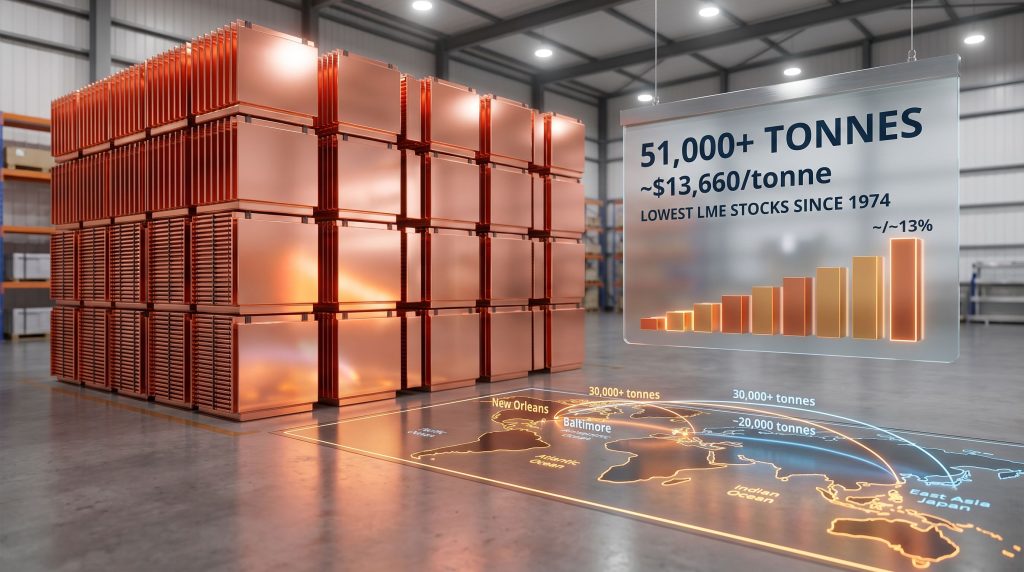
A single-session withdrawal exceeding 51,000 tonnes, valued at over $700 million at prevailing LME prices of approximately $13,660 per tonne, stands as the largest drawdown event recorded on the exchange since 2013. When placed in the context of a broader two-month trend that has stripped more than 150,000 tonnes from LME-registered inventory, the picture becomes even more striking.
The resulting stock level, the lowest recorded since 1974, must be interpreted carefully. The global copper market today is many times larger than it was five decades ago, meaning a 1974 comparison in absolute terms is not an apples-to-apples measure of scarcity. What the comparison does illustrate is the severity of exchange-visible inventory depletion relative to the modern era's norms.
The Comex-LME Price Divergence: Engineering a Cross-Market Profit Machine
The commercial engine driving the Trafigura copper withdrawals from LME warehouses is a structural price gap between two of the world's most liquid copper futures markets: the London Metal Exchange and New York's Comex. According to Bloomberg's coverage of the drawdown, this divergence has created one of the most sustained arbitrage opportunities seen in base metals in recent memory.
Why the Two Prices Diverge
LME copper prices reflect the cost of the metal delivered to an LME-registered warehouse, free of any US import duty considerations. Comex copper prices, by contrast, incorporate the anticipated cost of importing copper into the United States, including tariff risk. When the Trump administration began signalling the potential imposition of tariffs on copper imports, Comex contracts began pricing in that anticipated cost premium, creating a spread that has persisted and widened over the course of the past year.
This is not a supply-demand gap. It is a policy risk premium embedded in futures pricing, and it has been wide enough for long enough to generate one of the most sustained physical arbitrage opportunities in base metal markets in recent memory. The broader impact of US tariffs on copper supply has consequently reshaped trade flows on a global scale.
Step-by-Step: How the Arbitrage Trade Is Executed
-
Identify the viable spread – Monitor the differential between Comex front-month and LME three-month copper contracts. When the gap exceeds the combined cost of freight, insurance, warehousing, and logistics, a profitable trade exists.
-
Cancel LME warrants – File cancellation orders for copper held in strategically located LME warehouses, particularly those in North American or Asian ports with favourable shipping access.
-
Arrange physical logistics – Coordinate transport from LME warehouse locations toward either Comex-registered facilities in the US or direct delivery to US industrial buyers.
-
Deliver into Comex or negotiate direct sales – Capture the price premium embedded in the Comex contract or negotiate spot deals with US-based manufacturers at prices that reflect the tariff-inclusive rate.
-
Maintain positions while the spread persists – The trade remains commercially viable until either the Comex-LME spread narrows below logistics costs or tariff policy is formally resolved.
Record volumes of copper were shipped to the United States during the prior year as traders across the industry capitalised on this arbitrage, and the current withdrawal activity signals that the opportunity has not only persisted but may be intensifying.
Geographic Routing: Where Is the Metal Actually Going?
The geographic distribution of the withdrawal orders provides meaningful intelligence about the intended destinations of the copper leaving LME custody.
North American Withdrawals
More than 30,000 tonnes were ordered out of LME facilities in New Orleans and Baltimore. These locations are logistically proximate to Comex-registered storage facilities and major US industrial centres, making the likely destination either Comex warehouses or direct delivery to US end-buyers such as manufacturers in the electrical infrastructure, automotive, and construction sectors.
Asian Withdrawals
The remaining approximately 20,000 tonnes were pulled from Asian LME warehouse locations, introducing a second potential destination corridor. While the US represents one viable endpoint for this metal, rising copper premiums in China have simultaneously created a competing pull factor. The Chinese copper buying response to tightening domestic premiums means that Chinese industrial buyers may be competing with the Comex arbitrage for the same pool of available metal.
This dual-destination dynamic is a relatively sophisticated feature of the current market. Trafigura and similarly positioned global trading houses can assess real-time premium signals from both New York and Shanghai and route metal dynamically toward whichever market offers the superior margin at any given moment.
Geographic Breakdown:
- North America (New Orleans + Baltimore): 30,000+ tonnes withdrawn, likely destined for Comex warehouses or US industrial buyers
- Asia: ~20,000 tonnes withdrawn, with both China and the US as viable endpoints depending on prevailing physical premiums
What This Means for Industrial Copper Buyers
The consequences of rapidly falling LME visible inventory extend well beyond the trading strategies of commodity houses. Industrial manufacturers that depend on copper as a primary input face a tangible exposure when exchange stocks compress toward multi-decade lows.
When visible LME stocks decline sharply, spot premiums — the additional charge buyers pay above the futures price for immediate physical delivery — tend to widen. This creates a direct cost pressure for copper-intensive industries including:
- Electrical cable and transformer manufacturers
- Automotive wiring harness producers
- Renewable energy infrastructure developers
- Commercial construction contractors
- Electronics and semiconductor equipment makers
Warning for Industrial Buyers: Spot premiums can widen faster than procurement teams anticipate during rapid inventory drawdowns. Manufacturers without established forward purchase agreements or hedging programmes may find themselves paying significantly above the headline futures price during periods of exchange-visible stock tightness.
Historical precedents, including the LME copper squeeze events of the mid-1990s and the sharp inventory declines seen in 2021, demonstrate that once spot premiums begin widening during an inventory drawdown, they can remain elevated for extended periods even after exchange stocks stabilise. In addition, the emerging copper supply crunch adds further structural pressure on procurement costs across copper-dependent industries.
The next major ASX story will hit our subscribers first
Trafigura's Market Position and Why Scale Matters
Not every market participant possesses the capital base, logistics infrastructure, and counterparty relationships required to execute a single-session withdrawal exceeding $700 million in value. The following context helps frame why Trafigura's involvement carries particular significance.
| Factor | Context |
|---|---|
| Trafigura's global commodity rank | Among the world's largest independent commodity trading houses |
| Metals traded annually | Tens of millions of tonnes across base and industrial metals |
| LME market influence | Capable of moving significant visible inventory positions across multiple metals simultaneously |
| Comparable precedent | A prior large-scale zinc withdrawal by Trafigura also triggered a notable LME price surge |
The zinc precedent is particularly instructive. When Trafigura executed a comparable warrant cancellation strategy in zinc, LME zinc prices responded sharply, reinforcing the market's understanding that large-trader inventory repositioning across base metals is capable of generating meaningful price momentum independent of fundamental supply-demand changes. As reported by Mining.com, Trafigura played a central role in draining LME copper inventories throughout this period.
Tariff Policy Scenarios and What Each Means for Copper Flows
The persistence and direction of the Comex-LME spread is almost entirely dependent on how US trade policy on copper evolves. Three scenarios frame the range of outcomes.
Policy Scenario Analysis:
Tariffs confirmed at high rates: The Comex premium widens further, intensifying arbitrage incentives and accelerating further LME drawdowns as more physical copper is redirected toward the US market.
Tariffs paused or formally reduced: The Comex-LME spread narrows rapidly, the arbitrage trade loses its commercial rationale, and LME visible stocks may begin to rebuild as metal flows normalise.
Sustained policy uncertainty: Traders maintain optionality positions, holding the capacity to move metal in either direction depending on which market offers the better premium. LME drawdowns continue episodically, and price volatility remains elevated.
The third scenario is arguably the most challenging for industrial buyers and financial hedgers, since protracted uncertainty makes it difficult to price forward contracts, lock in procurement costs, or assess the fair value of copper inventories on the balance sheet.
Separating Exchange Inventory Signals from True Physical Scarcity
One of the most important analytical distinctions in copper market analysis is the difference between LME visible inventory and total global copper availability. Conflating the two can lead to significant misreading of market conditions.
LME-registered stocks represent only a fraction of total above-ground copper inventory. Substantial volumes of copper are held in:
- Producer stockpiles at mine sites and smelters
- Consumer warehouses maintained by industrial manufacturers
- Bonded warehouse facilities in Shanghai and other Chinese trade zones
- Private off-exchange storage arrangements not captured in any public inventory dataset
Critical Distinction: A dramatic fall in LME visible stocks can reflect sophisticated trader repositioning just as readily as it reflects genuine physical scarcity. Investors and analysts who interpret exchange inventory drawdowns as unambiguous signals of global supply tightness risk making pricing assumptions that do not reflect the actual balance of supply and demand.
That said, when LME drawdowns coincide with tightening Chinese domestic premiums, rising freight rates for copper shipments, and declining treatment and refining charges paid to smelters, the combined signal becomes considerably more credible as an indicator of real physical tightness. Monitoring these multiple data points in parallel provides a more reliable picture than any single metric alone.
Copper's Growing Correlation with Technology Investment
An additional structural dimension worth noting is copper's increasingly tight correlation with technology sector investment, particularly in artificial intelligence infrastructure. Data centre construction, high-voltage transmission upgrades required to support electrification, and EV charging network build-outs all represent capital-intensive copper demand drivers that are relatively insensitive to short-term price movements.
This demand profile tends to support copper prices even during periods where financial market volatility might otherwise compress commodity valuations, and it adds a long-duration demand narrative to what is already a supply-constrained market picture. Consequently, those developing copper investment strategies should factor in these structural technology-driven demand trends when assessing long-term positioning.
Multi-Metal Contagion Risk Across the LME Complex
The dynamics visible in copper are not isolated. The zinc precedent established by prior large-trader activity, combined with the current copper withdrawal event, raises legitimate questions about whether similar inventory repositioning strategies are being deployed or contemplated across other LME-traded metals.
Aluminium, nickel, and lead all trade through the same LME warehouse network and are subject to the same arbitrage mechanics when cross-market price differentials create sufficient incentive. The capacity of a small number of large commodity trading houses to simultaneously influence visible inventory levels across multiple metals creates a systemic volatility risk that extends well beyond any single metal market.
Market participants with exposure to multiple base metals would be well served by monitoring LME warrant cancellation data across the full complex, rather than focusing exclusively on copper, as a leading indicator of potential multi-metal price dislocations.
Frequently Asked Questions: LME Copper Withdrawals Explained
What is an LME warrant cancellation?
An LME warrant is a title document for metal stored in a registered warehouse. Filing a cancellation is the formal first step in removing that metal from the exchange system, and elevated cancellation rates are a reliable leading indicator of impending inventory drawdowns.
Why does the Comex-LME copper price difference matter?
The spread between New York Comex and London LME copper prices reflects anticipated import duty costs embedded in US futures pricing. When this gap exceeds the cost of physically moving metal from an LME warehouse to a US destination, a profitable arbitrage trade exists for entities with the logistical capacity to execute it.
How do warehouse withdrawals affect copper spot prices?
Falling visible exchange stocks reduce the apparent buffer of immediately available supply, typically pushing spot premiums higher and triggering additional speculative buying that amplifies the initial price move.
Are LME stocks a reliable measure of global copper supply?
Not in isolation. LME-registered inventory represents only a portion of global above-ground copper stocks. Significant volumes reside in off-exchange locations, including Chinese bonded facilities, and are not captured in LME reporting.
Could other trading houses replicate this strategy?
In principle, yes. Any LME warrant holder can cancel warrants and withdraw metal. However, executing a single-session withdrawal exceeding $700 million requires a level of capital, logistics infrastructure, and market access available to only a very small number of global commodity trading entities.
Key Takeaways
-
Trafigura copper withdrawals from LME warehouses have driven visible exchange stocks to their lowest level since 1974, with a single-session removal of more than 51,000 tonnes valued at over $700 million
-
The primary commercial driver is the Comex-LME price spread, which embeds anticipated US tariff costs in New York futures pricing while London prices remain duty-neutral
-
Over 30,000 tonnes were drawn from North American LME facilities, most likely destined for Comex warehouses or direct US industrial buyers
-
A competing pull from rising Chinese physical premiums means approximately 20,000 tonnes of Asian withdrawals may be routed toward either market depending on real-time premium dynamics
-
The broader 150,000-tonne drawdown over two months confirms this is a sustained structural trade, not an isolated arbitrage event
-
Industrial manufacturers with copper-intensive supply chains face widening spot premiums as exchange-visible buffer stocks compress
-
Similar dynamics in zinc and the potential for multi-metal contagion suggest that monitoring LME warrant cancellation data across the full base metals complex is increasingly important for risk management
Disclaimer: This article is intended for informational purposes only and does not constitute financial or investment advice. Commodity markets involve significant risk, and past price behaviour is not indicative of future results. Readers should conduct their own due diligence before making any investment or procurement decisions based on commodity market analysis.
Want To Capitalise on the Next Major Mineral Discovery Before the Market Moves?
Discovery Alert's proprietary Discovery IQ model delivers real-time alerts on significant ASX mineral discoveries, instantly transforming complex commodity data into actionable investment insights for both short-term traders and long-term investors — explore how historic mineral discoveries have generated substantial returns, then begin your 14-day free trial at Discovery Alert to position yourself ahead of the broader market.