May 22, 2026
The Governance Crisis Hiding Inside a Copper Production Number
Production statistics in large-scale mining are rarely just numbers. They are the primary language through which state-owned enterprises communicate operational health, justify capital allocation in copper decisions, and maintain credibility with international commodity markets. When those numbers prove unreliable, the consequences extend well beyond an internal accounting correction.
They raise foundational questions about institutional integrity, performance culture, and the quality of oversight structures that underpin some of the world's most strategically important mineral assets.
The revelation that Codelco copper production was overestimated by approximately 27,000 tonnes in 2025 sits precisely at this intersection of operational failure and governance breakdown. Understanding what happened, why it matters, and what it signals about the broader copper supply picture requires looking past the headline figure and examining the structural conditions that made such a misclassification possible in the first place.
When big ASX news breaks, our subscribers know first
Understanding What Was Actually Misclassified
The technical distinction at the heart of this episode is the difference between work-in-process inventory and finished production. In copper mining, material does not become finished production the moment it leaves the ground. It passes through a multi-stage processing pipeline:
- Ore extraction from the mine face or open pit
- Crushing and grinding to reduce particle size
- Concentrating through flotation or other separation processes to produce copper concentrate
- Smelting to convert concentrate into blister or anode copper
- Electrolytic refining to produce finished copper cathode, the standard tradeable commodity form
Material sitting anywhere in stages one through four remains work-in-process inventory. It only becomes finished production once it reaches a saleable, deliverable form. Recording intermediate-stage material as finished output is not a rounding error. It is a fundamental misrepresentation of where product sits in the value chain.
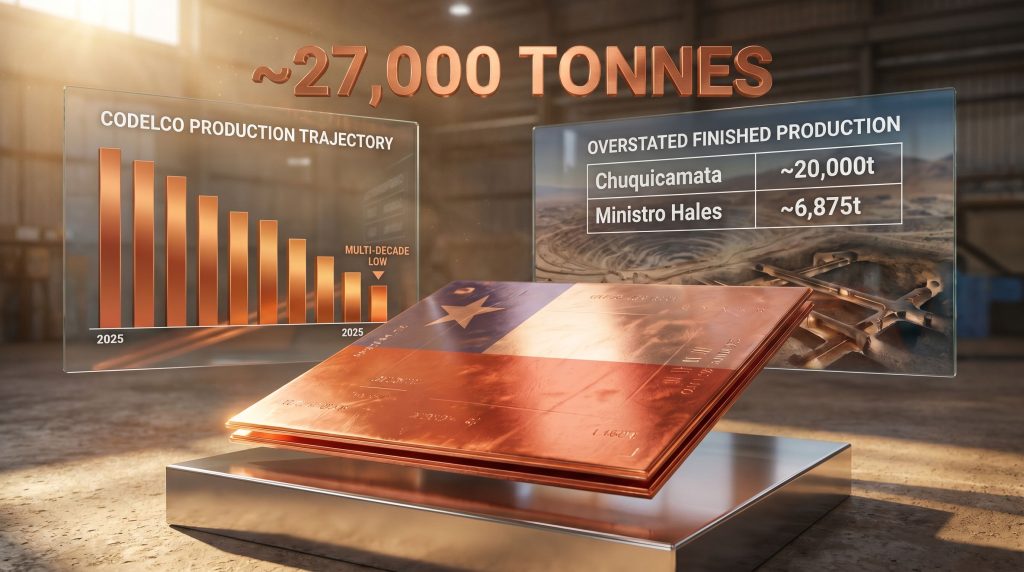
The breakdown of the disputed volume across Codelco's operations makes the scale of the misclassification clear:
| Operation | Disputed Volume (Tonnes) | Classification Issue |
|---|---|---|
| Chuquicamata | ~20,000 | Work-in-process recorded as finished output |
| Ministro Hales | ~6,875 | Work-in-process recorded as finished output |
| Total | ~26,875 | Overstated finished production |
The fact that this misclassification reportedly enabled Codelco to meet its December 2025 production target is the detail that transforms this from an internal audit finding into a governance problem with market consequences.
When a production target is reached through inventory reclassification rather than genuine throughput improvement, it masks the true operational condition of the underlying assets and delays the corrective interventions that structurally declining mines urgently need.
Why These Two Operations Are Particularly Significant
Chuquicamata: A Mine in Structural Transition
Chuquicamata is one of the largest copper mines ever developed, with a mining history stretching back over a century. The operation is currently executing one of the most complex transitions in modern mining: the conversion from a mature open pit into an underground block cave operation. This transition is capital-intensive, operationally disruptive, and creates genuine complexity in production measurement.
During transitional phases at mega-mines, ore processing pipelines frequently contain material from multiple production sources at different stages of completeness. This creates real ambiguity in production accounting and makes robust stage-gate inventory classification more important, not less. The presence of approximately 20,000 tonnes of misclassified material at Chuquicamata suggests that measurement controls were either inadequate or not applied with sufficient rigour.
Ministro Hales: High-Arsenic Complexity
Ministro Hales adds a different dimension of processing complexity. The orebody contains elevated arsenic concentrations, which require specialised smelting and treatment processes not applicable to standard copper concentrates. This creates processing bottlenecks and non-standard production pathways that introduce additional ambiguity in determining when material has genuinely completed its transformation into finished product.
This operational complexity does not excuse the misclassification. It does, however, illustrate how assets with unusual processing characteristics carry inherently higher reporting risk, and why independent verification at each production stage is essential rather than optional.
Codelco's Structural Production Decline: The Harder Context
The overstatement does not exist in isolation. It sits against a backdrop of multi-year copper production decline that has become one of the defining challenges for Chilean copper output. Codelco's 2025 production was already tracking near levels not seen in several decades, reflecting the combined pressure of:
- Ore grade deterioration across ageing pit operations, requiring more material to be processed per tonne of copper produced
- Ageing infrastructure at legacy mines that were designed for production regimes no longer achievable without substantial reinvestment
- Capital expenditure constraints that have periodically limited the investment needed to sustain and grow output
- Transitional disruption at Chuquicamata as underground development competes with remaining surface operations
Chile accounts for roughly 26-27% of global copper mine production, and the Codelco production outlook contributes the largest share of that national output. When the world's most significant copper-producing nation reports a revision of nearly 27,000 tonnes downward from an already historically low baseline, commodity analysts and supply-demand model builders cannot treat that as noise.
Furthermore, the broader copper market context amplifies this concern. Demand from energy transition sectors, including electric vehicles, grid infrastructure, and renewable energy installations, continues to grow at rates that existing mine supply is struggling to match. New large-scale copper projects face long lead times, permitting complexity, and capital requirements that make near-term supply growth difficult to deliver. In this environment, the credibility of reported output from major producers carries genuine price discovery implications.
Accountability: From Internal Audit to Criminal Referral
Codelco's institutional response to the audit findings has been notably serious. At least one senior executive was terminated following the internal review, with additional disciplinary proceedings initiated against further personnel. More significantly, the matter was referred to Chilean public prosecutors to assess whether the conduct in question rises to the level of criminal liability.
This escalation matters. Referral to public prosecutors moves the episode from an internal HR and governance matter into the domain of Chilean law, where mining production misreporting could potentially constitute a criminal offence depending on the circumstances and intent involved. The precedent implications for state-owned enterprise accountability in Latin American mining are material, particularly at a moment when sovereign mineral wealth governance is under increasing international scrutiny.
Leading global mining operators deploy multi-layer production reconciliation frameworks that span mine-to-mill, concentrator-to-smelter, and smelter-to-refinery stages, with independent verification applied at each transition point. The absence of equivalent controls at a producer of Codelco's scale raises foundational questions about institutional oversight architecture.
For context, major diversified mining companies listed on international exchanges are subject to continuous third-party assay reconciliation, independent stockpile surveys, and audit committee oversight of production reporting. State-owned enterprises operating outside these accountability frameworks can develop governance gaps that accumulate over time without triggering the external pressure that publicly listed peers face on a quarterly basis.
How Analysts and Investors Should Recalibrate
The Codelco episode provides a practical framework for how copper market participants should evaluate state-owned producer reporting going forward. Consequently, several early warning indicators deserve elevated attention:
- Production-to-shipment divergence: When reported output consistently exceeds independently verifiable shipment volumes, the gap warrants investigation
- Work-in-process balance movements: Sudden reductions in inventory balances coinciding with production target achievement periods deserve scrutiny
- Year-end reporting patterns: Production figures that exhibit unusually strong performance in final reporting periods, particularly when full-year targets are at risk, should be examined against underlying operational data
- Capital expenditure trajectories: Declining reinvestment alongside maintained production claims is a classic signal of deferred operational reality
From an investor perspective, this episode reinforces the state-owned enterprise risk premium that sophisticated commodity analysts apply when building supply-side models. Unlike publicly listed miners subject to securities law disclosure requirements and analyst coverage, state-owned producers can sustain reporting discrepancies for extended periods before independent verification surfaces the gap.
The next major ASX story will hit our subscribers first
Scenario Analysis: Three Pathways Forward
The copper market's ultimate response to this episode will depend heavily on how the institutional and legal processes unfold. Three distinct pathways are plausible:
Scenario 1: Contained Resolution. Codelco implements credible governance reforms, the criminal investigation concludes without expanding findings, and production figures are restated cleanly. Market confidence recovers within two to three reporting cycles, and the episode is absorbed as an isolated control failure.
Scenario 2: Prolonged Uncertainty. Ongoing legal proceedings, further audit scope expansion, or additional restatements extend the credibility gap. Analysts apply a persistent discount to the Chile copper outlook forecasts, and the episode becomes a structural reference point in sovereign mining risk assessments.
Scenario 3: Systemic Reform Catalyst. The findings drive a broader overhaul of Codelco's production governance framework and potentially influence how Chile structures oversight of state-owned mining assets more broadly. Near-term production targets are revised downward as genuine operational constraints are transparently acknowledged, but long-term institutional credibility is strengthened.
The third scenario would ultimately be most constructive for global copper market confidence, even if it requires absorbing near-term supply revisions. However, as historical production data illustrates, the gap between state-owned and private producer output has shifted considerably over time, underscoring why governance credibility matters so deeply.
Frequently Asked Questions
Why was Codelco copper production overestimated by 27,000 tonnes?
An internal audit determined that approximately 26,875 tonnes of copper material at Chuquicamata and Ministro Hales were recorded as finished production when they remained in the work-in-process stage of the production pipeline. This misclassification reportedly allowed the company to reach its December 2025 production target.
How material is ~27,000 tonnes in the context of total output?
The figure represents approximately 2% of Codelco's total 2025 production, which was already near a multi-decade low. While the absolute volume may appear modest, its significance lies in its connection to benchmark performance periods and the downstream effect on global supply model assumptions.
What disciplinary actions have been taken?
Codelco confirmed the termination of at least one senior executive, initiated further disciplinary proceedings against additional personnel, and referred the matter to Chilean public prosecutors to assess potential criminal liability.
What is the difference between work-in-process and finished production in copper mining?
Work-in-process refers to copper material undergoing transformation, such as concentrating, smelting, or refining, that has not yet reached a finished, saleable form such as refined cathode or deliverable concentrate. Recording this intermediate material as completed output inflates reported production figures without reflecting genuine finished supply availability.
Key Takeaways for Copper Market Participants
- The ~26,875-tonne overstatement represents a breakdown in production governance controls at one of the most strategically weighted copper producers in the world
- The involvement of two operationally complex assets and the connection to year-end target achievement suggests performance pressure may have been a contributing factor in the misclassification
- Codelco copper production was overestimated by approximately 27,000 tonnes at a time when output is already at structurally depressed levels, making accurate reporting more critical than ever as the market attempts to price genuine supply availability
- The criminal referral elevates this beyond an internal matter into a question of institutional integrity with potential sovereign credit and long-term investment implications
- Copper market participants should apply heightened scrutiny to state-owned producer reporting and seek independent verification data points when assessing copper supply crunch assumptions in global balance models
This article is intended for informational purposes only and does not constitute financial or investment advice. Forward-looking statements and scenario analysis reflect analytical frameworks and should not be interpreted as predictions of future market outcomes. Readers should conduct independent research before making any investment decisions.
Want To Capitalise On The Next Major Copper Discovery Before The Market Catches On?
Discovery Alert's proprietary Discovery IQ model scans ASX announcements in real time, instantly alerting subscribers to significant mineral discoveries — including copper — and translating complex data into actionable investment insights, so informed decisions can be made ahead of the broader market. Explore how historic mineral discoveries have generated substantial returns and begin a 14-day free trial to secure a market-leading edge.