May 22, 2026
The Geological Foundation Driving Oman's Underground Copper Ambitions
Few minerals tell the story of civilisational progress as vividly as copper. From the Bronze Age to the silicon economy, its conductivity, malleability, and corrosion resistance have made it indispensable. Today, the Oman underground copper mine financing deal sits within a bigger story: rising demand, tighter supply, and the move towards deeper, more complex ore bodies.
Oman's emergence as a meaningful copper producer is not accidental. The Sultanate sits atop the Samail Ophiolite, a vast sequence of ancient oceanic crust thrust above sea level more than 90 million years ago. Consequently, this unusual geology helps explain why the Al Ghuzayn project matters far beyond a single financing announcement.
Furthermore, sulphide mineralisation in this setting is concentrated at depths where underground extraction becomes not just viable, but necessary for accessing the highest-grade zones. In that context, the financing of Al Ghuzayn reflects both geological logic and market timing.
Why Underground Mining Is the Only Viable Path at Al Ghuzayn
The distinction between open-pit and underground copper mining is not simply one of method. Rather, it reflects the character of the ore body. Open-pit mining suits broad, shallow and lower-grade deposits, while underground mining is used when ore grades are high enough and mineralisation sits too deep for economical surface extraction.
| Parameter | Open-pit mining | Underground mining |
|---|---|---|
| Capital intensity | Lower upfront | Higher upfront |
| Ore grade requirements | Lower acceptable grades | Requires higher-grade deposits |
| Environmental footprint | Larger surface disruption | Smaller surface impact |
| Operational complexity | Lower | Significantly higher |
| Financing risk profile | Lower | Higher, requires specialist lenders |
| Suitable for Oman's geology? | Limited depth deposits | Deep high-grade copper seams |
The decision to pursue underground development at Al Ghuzayn suggests the deposit meets the demanding thresholds required for this approach. Typically, underground copper projects need grades of around 1.5% to 2% copper equivalent to remain commercially viable at depth.
In addition, underground operations involve more engineering complexity. Shaft sinking, decline development, ventilation, haulage systems and geotechnical controls all require specialist expertise and longer lead times. As a result, the Oman underground copper mine financing deal needed a syndicated structure rather than a straightforward bilateral loan.
Oman's ophiolite-hosted deposits also resemble volcanogenic massive sulphide deposits, which often contain concentrated high-grade metal zones. That feature makes selective underground mining especially suitable.
The Architecture of Shariah-Compliant Mining Finance
Conventional mining finance is usually built around senior secured debt backed by project assets and future cash flow. However, Islamic finance reaches similar economic outcomes through different tools, replacing interest with profit-sharing, lease-based or cost-plus structures.
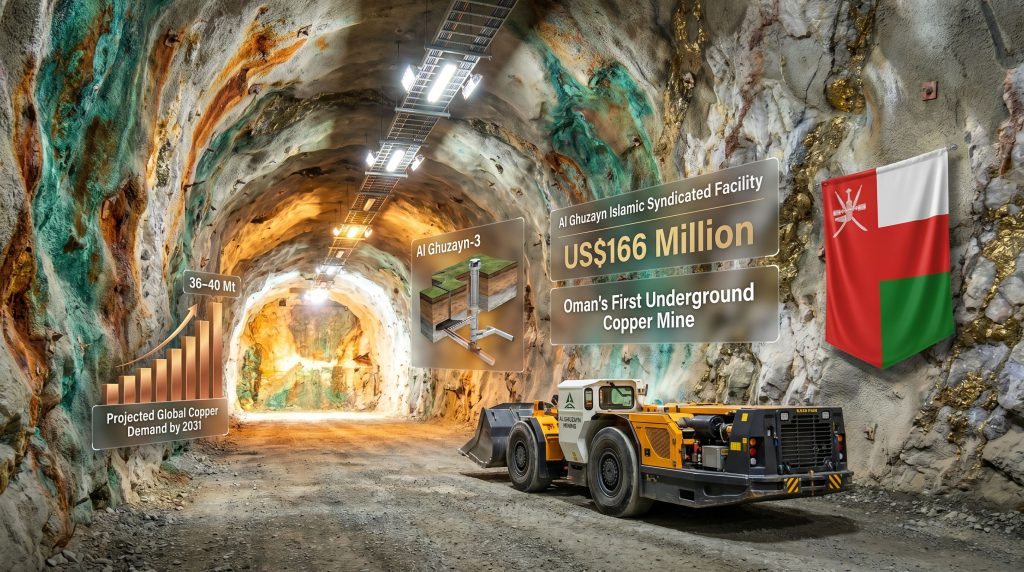
For Al Ghuzayn, the Shariah-compliant framework was led by Dhofar Islamic, the Islamic banking window of BankDhofar, acting as Mandated Lead Arranger. Ahli Islamic, the Islamic banking window of ahlibank, joined as a syndicate member. According to a reported financing agreement, the deal supports what has been described as Oman’s first underground copper mine.
This reflects a broader trend in the region, where lenders are becoming more comfortable with mining exposure. Moreover, Islamic banking windows allow conventional institutions to compete for these mandates while still using established credit infrastructure.
Key Islamic Finance Instruments
The instruments commonly used in mining finance include:
- Istisna'a for construction and development funding
- Ijarah for lease-based equipment financing
- Murabaha for cost-plus procurement of materials or machinery
These structures are relevant because underground mining projects require capital long before production begins. Therefore, aligning finance with asset creation is especially important.
This deal also sits within broader themes of ore deposit formation, where geology shapes not only extraction methods but also the financing model that makes development possible.
Oman's Copper Resource Base: The Numbers Behind the Case
The Oman underground copper mine financing deal does not stand alone. Instead, it forms part of a larger wave of capital allocation into the country’s copper sector.
| Metric | Figure |
|---|---|
| Concession agreements signed in recent years | 21 |
| Explored copper resources at Washihi-Mazzaza | Over 16 million tonnes |
| Mineable reserves at Washihi-Mazzaza | More than 10 million tonnes |
| New mining blocks offered for investment in 2026 | 3 |
| Al Ghuzayn Islamic loan facility | US$166 million |
| Separate Oman copper syndicated loan | US$270 million |
These figures matter because lenders assess long-term reserve life, not just construction costs. A reserve base of more than 10 million tonnes, for instance, supports stronger debt service modelling and improves project bankability.
Meanwhile, additional reports point to strong momentum across the sector. For example, ahlibank has also been linked to financing for an Oman copper mine, underlining wider institutional support.
Copper Demand and Why Timing Matters
The investment case for new copper mines is closely tied to a tightening global market. Demand is expected to reach roughly 36 to 40 million tonnes annually by the early 2030s. That outlook is being driven by several powerful forces:
- Electric vehicles, which use about 83 kilograms of copper each
- Grid expansion for renewables and transmission upgrades
- Data centres and AI infrastructure
- Industrial motors and transformers
At the same time, the supply side is under pressure. Ore grades have been declining globally for decades, meaning miners must process more material to produce the same amount of refined copper. Consequently, projects that can bring high-grade ore into production are attracting greater attention.
This is where the idea of a coming copper supply crunch becomes relevant. Oman's timing appears increasingly strategic as the world searches for new copper sources outside traditional producing regions.
A Cluster of Capital Across Oman's Copper Sector
One of the most important signals is not just the Al Ghuzayn financing itself, but the clustering of several sizeable deals in a short period. That pattern suggests growing lender confidence in Omani copper.
| Project / Entity | Financing Type | Facility Size | Key lender(s) |
|---|---|---|---|
| Al Ghuzayn-3 | Islamic loan | US$166 million | Ahli Islamic |
| Al Ghuzayn underground mine | Islamic syndicated facility | Structured amount | Dhofar Islamic, Ahli Islamic |
| Oman copper project | Dual-currency syndicated loan | US$270 million | ahlibank-led syndicate |
| Mazoon Copper Project | Project finance facility | Financial close achieved | Syndicated consortium |
In turn, each successful transaction may reduce perceived risk for the next one. That can help lower financing costs and broaden the pool of lenders willing to back future projects.
For investors watching the sector, these developments also strengthen the case for reviewing broader copper investment strategies tied to supply growth and project funding.
Workforce Development and Technical Spillovers
The Al Ghuzayn development has implications beyond finance. Underground mining requires a more specialised workforce than surface operations, creating demand for skills that can support Oman's wider industrial diversification.
Key capability areas include:
- Geotechnical engineering
- Mine ventilation management
- Underground maintenance
- Emergency response and rescue
- Drill and blast engineering
Furthermore, once these skills are established locally, they can support future copper and mineral projects across the Gulf. That gives the mine an economic legacy extending well beyond its production life.
FAQ: Oman Underground Copper Mine Financing Deal
What is the Al Ghuzayn copper mine?
Al Ghuzayn is an underground copper development in Oman operated by Mawarid Mining. It involves deep extraction infrastructure, including declines, underground haulage and associated support systems.
Who arranged the financing?
Dhofar Islamic acted as Mandated Lead Arranger, while Ahli Islamic joined the syndicate. Together, they structured a Shariah-compliant facility for the project.
How large is the financing?
The Al Ghuzayn-3 project secured US$166 million in Islamic financing. Separately, another Oman copper project has been supported by a US$270 million syndicated facility.
Why does Oman suit underground copper mining?
Oman's geology, particularly the Samail Ophiolite, hosts concentrated sulphide mineralisation at depth. That makes underground methods more suitable for extracting the most valuable zones efficiently.
Why is this financing significant?
The Oman underground copper mine financing deal is significant because it shows that regional lenders can back technically complex mining assets using Shariah-compliant structures. In effect, it may become a reference point for future project funding.
The Al Ghuzayn Deal as a Reference Point
Taken together, the technical, geological and financing elements behind Al Ghuzayn point to a major shift in Oman's mining sector. This is not simply a one-off loan. Rather, it is a signal that the country is building a credible project finance ecosystem for minerals.
For lenders, the transaction offers a live example of how Islamic structures can support complex mine development. For operators, it provides a framework that could be replicated on future projects, particularly once they reach the definitive feasibility study stage.
Ultimately, rising demand, a strong resource base and deepening financial capability have created unusual conditions in Oman. If more deals follow, Al Ghuzayn may be remembered as the transaction that helped establish the Sultanate as a serious new node in global copper development.
Want to Track the Next Major Copper Discovery Before the Market Moves?
Discovery Alert's proprietary Discovery IQ model scans ASX announcements in real time, instantly identifying significant mineral discoveries — including copper — and delivering actionable alerts to subscribers ahead of the broader market. Explore historic discovery returns that demonstrate just how transformative early positioning can be, and begin your 14-day free trial today to secure a genuine market-leading advantage.