August 24, 2026
The Geopolitical Premium Hidden Inside Every Copper Price
Commodity markets have long functioned as real-time voting machines for global stability. When diplomats talk, traders react. When ceasefires wobble, so do prices. However, copper occupies a uniquely exposed position in this dynamic, because it sits at the intersection of two entirely different market forces: short-term geopolitical sentiment and long-term structural demand. Understanding why the copper price retreats as traders weigh prospects of a US-Iran peace deal requires unpacking both layers simultaneously.
The metal's dual identity makes it unusually volatile during periods of diplomatic ambiguity. It is sensitive enough to macro fear to sell off alongside crude oil, yet fundamentally supported enough by electrification and artificial intelligence demand that institutional investors continue accumulating it even during drawdowns. That tension is precisely what is playing out in markets right now, and furthermore, it helps explain why copper market trends are attracting so much analytical attention at present.
When big ASX news breaks, our subscribers know first
What the Numbers Are Actually Saying
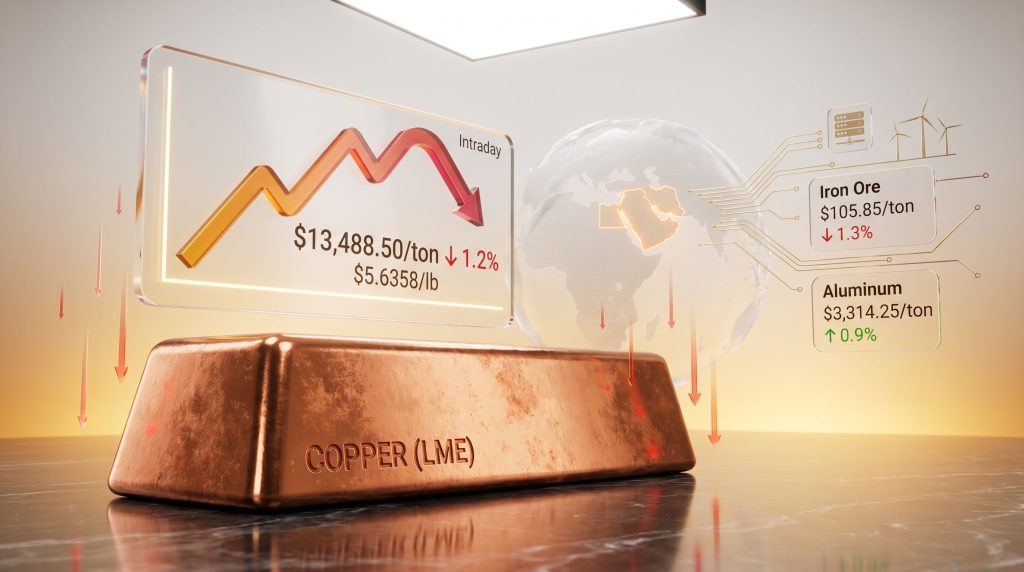
On the London Metal Exchange, copper declined 1.2% to $13,488.50 per tonne, with intraday weakness pushing the per-pound equivalent to $5.6358, reflecting a drop of approximately 1.3% at its lowest point during the session. That movement did not occur in isolation.
| Metric | Value | Direction |
|---|---|---|
| Copper (LME) | $13,488.50/tonne | ↓ 1.2% |
| Copper (per lb) | $5.6358/lb | ↓ ~1.3% intraday |
| Aluminum Futures | $3,314.25/tonne | ↑ 0.9% |
| Iron Ore (Singapore) | $105.85/tonne | ↓ 1.3% |
| Brent Crude Oil | $104.40/bbl | ↓ 4.21% |
The divergence within this snapshot tells a more nuanced story than any single headline can capture. Aluminum's modest gain of 0.9% while copper, zinc, and nickel all edged lower suggests sector rotation rather than a uniform industrial metals selloff. Investors appear to be selectively reducing exposure to metals perceived as most vulnerable to geopolitical sentiment shifts, while maintaining positions in those with more isolated supply dynamics.
Iron ore's decline of 1.3% to $105.85 per tonne in Singapore carries its own narrative weight. That session extended iron ore's losing run to six consecutive days — its longest such streak since February — driven by a combination of rising global seaborne shipments and slowing Chinese steel sales as the summer construction lull takes hold. Analysts at Chaos Ternary Futures flagged this supply-demand mismatch as a likely source of continued near-term downward pressure.
How Diplomatic Stagnation Becomes a Market Catalyst
The mechanism connecting Middle East diplomacy to base metal pricing is less direct than it appears on the surface, but no less powerful for that distance. Armed conflict in the region raises the spectre of sustained energy price inflation, which in turn forces central banks to reassess the pace of monetary tightening. Higher interest rates compress industrial activity, reduce financing appetite for infrastructure projects, and slow the kind of large-scale capital deployment that consumes enormous volumes of copper.
In the current episode, markets had already priced in a degree of de-escalation following earlier ceasefire developments. When confirmation of a concrete agreement failed to materialise on schedule, the embedded optimism began unwinding. For instance, copper prices at record highs just days prior had reflected precisely this kind of front-loaded diplomatic optimism.
"When geopolitical optimism is built into a commodity's price ahead of confirmed outcomes, any delay or ambiguity in diplomatic resolution tends to trigger a proportional reversal. That dynamic is clearly visible in copper's recent price action, where the metal had closed at a record high the prior week before surrendering ground as talks dragged."
Statements from both sides have added to the uncertainty. US President Donald Trump indicated that negotiations were in their final stages while simultaneously warning that military options remained on the table if agreement was not reached within days. Iran's supreme leader complicated matters further by signalling that the country's near-weapons-grade uranium stockpile should not be transferred abroad, a position that hardened negotiating constraints and left the timeline for any final agreement deeply unclear. Consequently, copper retreats as doubts escalate have become a recurring pattern throughout these negotiations.
The Record High That Preceded the Retreat
What drove copper to record highs?
To properly contextualise the current pullback, it is worth examining what drove copper to record highs just days earlier. Three overlapping forces were at work:
- Supply disruption anxiety linked to geopolitical instability in key mining jurisdictions and ongoing questions about major producer output.
- Tariff speculation creating a scramble to accumulate physical metal ahead of potential trade barriers that could restrict cross-border copper flows.
- AI and clean energy demand enthusiasm, which has increasingly positioned copper as a technology-adjacent bet rather than a purely industrial commodity.
This last point deserves particular attention because it represents a structural shift in how copper is perceived by institutional capital. Data centre construction for AI infrastructure requires substantial copper wiring. Electrical grid modernisation programmes across the United States and Europe are copper-intensive at a scale that dwarfs most historical infrastructure cycles. Electric vehicle production and the associated charging network buildout add another layer of sustained demand.
The result is that copper now responds to swings in technology stock valuations and AI investment sentiment in ways that would have seemed unusual just five years ago. Furthermore, the copper-price-rally driven by tariff fears earlier this year demonstrated how quickly these sentiment-driven moves can accelerate. When tech-heavy indices in Asia jumped on the same day that US equities adopted a more cautious tone, the divergence fed directly into the uncertainty surrounding copper's short-term direction.
Three Scenarios for What Comes Next
Investors and traders navigating this environment benefit from thinking in scenarios rather than point predictions. The copper price retreats as traders weigh prospects of a US-Iran peace deal precisely because the outcome distribution is genuinely wide.
| Scenario | Diplomatic Outcome | Expected Copper Price Impact |
|---|---|---|
| Bullish | Full peace agreement reached | Geopolitical risk premium removed; structural demand drivers reassert upward pressure |
| Neutral | Ceasefire holds, negotiations continue | Sideways range-bound trading; sentiment-driven volatility persists |
| Bearish | Talks collapse; hostilities escalate | Central bank tightening fears intensify; broad industrial metals selloff |
Each of these scenarios carries meaningfully different implications for commodity-linked portfolios. The bullish case would likely coincide with lower oil prices, easing inflation, and improved global growth expectations — all of which support industrial metal demand. The bearish case, however, introduces the kind of stagflationary pressure that historically punishes base metals far more severely than precious metals, explaining why gold and silver futures have been moving in a distinctly different direction during the same period.
Institutional Positioning: What Hedge Funds Are Actually Doing
Despite the near-term volatility, speculative positioning data reveals that institutional conviction in copper's longer-term outlook remains elevated. Hedge funds have boosted bullish copper wagers to a five-month high, a signal that the professional money remains structurally long even as prices pull back on diplomatic noise.
This creates an interesting market psychology dynamic. When speculative positioning is concentrated at multi-month highs while prices are simultaneously declining, it typically indicates one of two things:
- The smart money is absorbing the selloff as a buying opportunity, confident that the fundamental thesis remains intact.
- Positioning is becoming dangerously crowded, leaving the market vulnerable to a sharper correction if the bearish scenario materialises and forced selling accelerates.
Distinguishing between these two interpretations requires careful attention to both the diplomatic timeline and Chinese demand indicators, which remain the most powerful near-term variable in the copper market given the country's dominant share of global refined copper consumption. In addition, reviewing copper investment strategies that account for this volatility may help investors position more effectively during periods of diplomatic uncertainty.
The next major ASX story will hit our subscribers first
Supply-Side Wildcards That Could Amplify Any Price Move
How are supply constraints shaping the outlook?
While geopolitical sentiment is dominating the short-term narrative, supply-side developments have the potential to amplify whatever directional move emerges from the diplomatic resolution. Codelco, the world's largest copper producer, has faced significant internal scrutiny following audits pointing to output at a 27-year low, with governance questions adding complexity to an already constrained production environment.
Separately, Zambia's Konkola has been reopening the Chingola copper mine after an 18-year shutdown, with projected output of more than 200,000 tonnes of ore per month, though the ramp-up timeline introduces its own uncertainties. Furthermore, the copper supply gap in Chile remains a persistent structural concern that analysts consistently cite as a medium-term price support. The combination of supply constraints at legacy producers and slow-moving new supply additions creates a structural floor that market participants should not underestimate, even during sentiment-driven pullbacks.
Key Variables to Watch in the Coming Sessions
Traders and investors seeking to position around this uncertainty should monitor several interconnected indicators:
- Diplomatic statements from both Washington and Tehran, particularly any reference to uranium enrichment positions or conditional ceasefire terms that could extend or collapse negotiations.
- Chinese manufacturing PMI data and steel production figures, which serve as leading indicators for copper demand from the world's largest consumer market.
- US Federal Reserve communications on the trajectory of interest rates, given that tighter monetary policy directly reduces the attractiveness of non-yielding industrial commodities.
- LME warehouse inventory levels, which provide a real-time read on physical supply tightness independent of financial market positioning.
- Technology sector capital expenditure announcements, particularly from hyperscale data centre operators, which have become an underappreciated driver of copper demand expectations. Recent reports suggest copper reached a six-week high amid hopes for new US-Iran peace talks, underscoring just how quickly sentiment can shift.
Frequently Asked Questions: Copper Price and Geopolitical Risk
Why did the copper price retreat recently?
Copper pulled back as US-Iran diplomatic progress moved more slowly than markets had anticipated. Having already priced in de-escalation optimism following earlier ceasefire developments, traders began unwinding that embedded risk premium when a concrete agreement remained elusive. Consequently, the copper price retreats as traders weigh prospects of a US-Iran peace deal in a pattern that has become increasingly familiar during this diplomatic cycle.
What connects Middle East conflict to copper prices?
Armed conflict in the Middle East raises fears about global economic disruption, prompts central banks to consider monetary tightening, and creates sustained energy market uncertainty. All three dynamics weigh on industrial metals that depend on robust economic growth for sustained demand.
Why is copper increasingly sensitive to AI and technology sentiment?
Copper is a critical material in data centre construction, electrical grid infrastructure, EV manufacturing, and the broader digital economy. As AI investment accelerates, demand expectations for copper rise, creating a growing correlation between technology sector sentiment and copper price positioning that did not exist at the same intensity in previous market cycles.
What is a geopolitical risk premium in commodity pricing?
A geopolitical risk premium is the additional price component embedded in a commodity's market value due to uncertainty created by conflict, sanctions, or diplomatic instability. When that uncertainty resolves — or fails to resolve as quickly as markets expect — the premium adjusts accordingly, often sharply.
What are the long-term structural supports for copper demand?
Despite short-term volatility, copper's demand outlook over the medium to long term remains anchored by global electrification programmes, renewable energy infrastructure investment, EV production growth, AI data centre expansion, and strategic stockpiling by governments seeking to secure supply chains for critical materials.
This article is intended for informational purposes only and does not constitute financial or investment advice. Commodity markets are subject to rapid change, and past price behaviour is not indicative of future results. Readers should conduct their own due diligence before making any investment decisions.
Want To Capitalise On The Next Major Copper Discovery Before The Market Reacts?
Discovery Alert's proprietary Discovery IQ model delivers real-time alerts on significant ASX mineral discoveries — cutting through geopolitical noise to surface actionable copper and base metals opportunities the moment they hit the exchange. Start your 14-day free trial today, or explore historic discovery returns to understand just how transformative early positioning in major mineral finds can be.