May 21, 2026
The Geology Is Ready — But Is the System?
The mining industry has a well-worn saying: capital is cowardly. It flows toward certainty, retreats from ambiguity, and punishes jurisdictions that confuse bureaucratic complexity with rigorous governance. Nowhere does this dynamic play itself out more consequentially right now than in Peru, a country sitting atop one of the most extraordinary concentrations of undeveloped copper wealth on the planet — yet persistently failing to convert that geological inheritance into production at scale.
The question of whether Peru could become the world's leading copper producer is not, at its core, a geological question. The mineralisation is there. The Andes copper belt hosts deposit clusters of genuinely world-class scale, and by most reserve assessments, Peru's endowment rivals or exceeds that of any other single nation. The question is institutional. The variables that will determine Peru's copper trajectory over the next decade are not buried underground — they sit inside permitting offices, community consultation frameworks, and the policy environments that either attract or repel the long-horizon capital that large-scale mining demands.
When big ASX news breaks, our subscribers know first
Where Peru Stands in the Global Copper Hierarchy
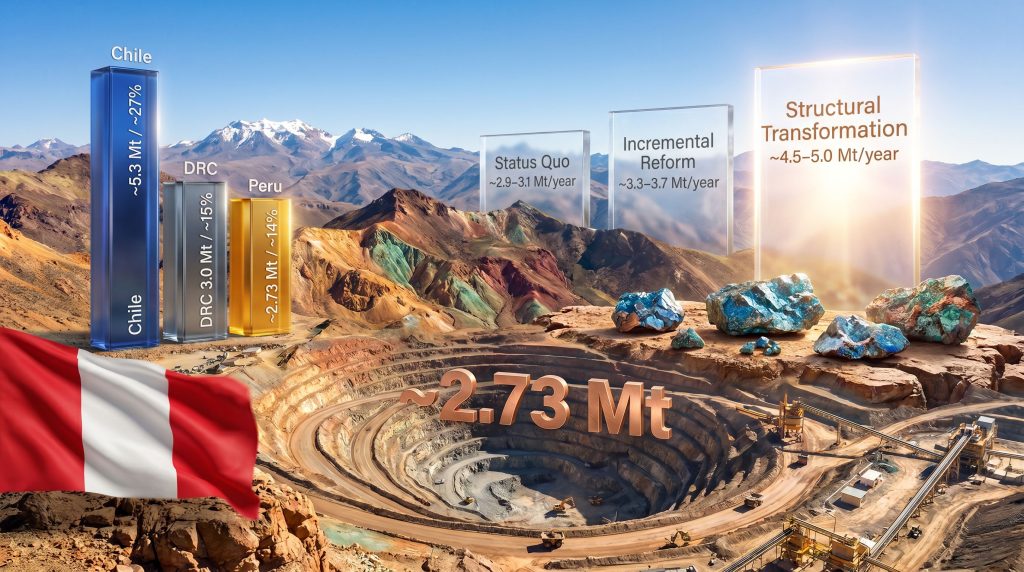
Peru currently ranks as the world's third-largest copper producer, generating approximately 2.73 million tonnes of refined copper equivalent annually as of 2024. That figure represents roughly 14% of global output — a substantial share, but one that leaves Peru well behind the two nations above it.
Global Copper Production Rankings (2024 Estimates)
| Rank | Country | Estimated Output (Mt/year) | Global Share |
|---|---|---|---|
| 1 | Chile | ~5.3 Mt | ~27% |
| 2 | Democratic Republic of Congo | ~3.0 Mt | ~15% |
| 3 | Peru | ~2.73 Mt | ~14% |
| 4 | China | ~1.9 Mt | ~10% |
| 5 | United States | ~0.9 Mt | ~5% |
Source: Industry production estimates, 2024. All figures approximate.
The gap between Peru and Chile is not marginal — it is structural. Chile produces more than double Peru's annual output, a disparity that has persisted for decades and reflects not just geological difference but the compounding effect of sustained investment flows into Chilean copper infrastructure over multiple generations. Closing that gap requires more than incremental improvement; it requires a fundamental re-rating of Peru's investment attractiveness relative to its peers.
What makes the competitive picture more complex is the DRC's rapid production growth. The Congo's copper output has surged dramatically in recent years, driven largely by Chinese-backed investment at operations such as Kamoa-Kakula. Peru now faces compression from both above and below in the global rankings — a dynamic that adds urgency to the reform agenda.
Key Context: Latin America collectively accounts for nearly 46% of global raw copper mining output, with Chile and Peru holding the world's largest combined copper reserves. The region's centrality to the energy transition demand makes Peru's institutional performance a matter of international strategic consequence, not merely domestic economic policy.
The Geological Case for Peru's Copper Ambition
Understanding why Peru's potential is so striking requires distinguishing between two concepts that are often conflated: reserves and resources. Reserves are deposits that are economically extractable under current conditions — they reflect what the industry can produce today. Resources represent total geological endowment, including material that is not yet economically viable but whose existence is geologically confirmed.
Peru's upside lies overwhelmingly in the resource category. The country hosts extensive porphyry copper systems across the Andean belt — the same geological architecture that made Chile's copper industry dominant. Porphyry deposits are characterised by large tonnage at moderate ore grades, typically ranging from 0.3% to 0.8% copper, making them amenable to large-scale, low-cost bulk mining methods. Furthermore, several of Peru's undeveloped systems sit at the higher end of this grade profile, which enhances their economic attractiveness at current copper prices.
Major copper systems elsewhere in South America demonstrate how significant these geological formations can be when institutional conditions align. Critically, industry analysis has noted that Peru's identified deposit base is sufficient, if brought into production, to support output levels that would challenge Chile's current dominance. The geology to support global leadership already exists. What is absent is the conversion mechanism — the permitting, investment, and social frameworks that translate resource endowment into mine production.
What Is Suppressing Peru's Copper Production Potential
The Permitting Timeline Problem
The most frequently cited structural constraint facing Peru's mining sector is the extraordinary length of time required to obtain exploration authorisations. Obtaining permits for a single exploration drill hole currently takes two to three years in Peru — a timeline that is internationally uncompetitive by almost any benchmark.
For context:
- Australia typically processes exploration permits within weeks to months under state-level regulatory frameworks.
- Chile has implemented streamlined environmental review processes that, while rigorous, operate on materially shorter timelines.
- Canada (at the provincial level) similarly maintains exploration approval pathways that are measured in months, not years.
The problem is not merely the duration of any single permit. It is the compounding effect across a project's lifecycle. When the regulatory burden at the exploration stage already spans years, every subsequent stage — resource definition, prefeasibility, environmental impact assessment, construction permitting — adds further delay. A project that might reach production in eight years in a peer jurisdiction can easily stretch to fifteen or beyond in Peru's current regulatory environment.
Compounding this, the total number of authorisations and approvals required to advance a mining project in Peru has multiplied significantly since 2011. This proliferation of required sign-offs, distributed across multiple agencies with overlapping mandates, creates a system where no single bottleneck can be identified and resolved. The problem is architectural.
Critical Insight: Regulatory complexity does not merely slow individual projects — it systematically shifts capital allocation decisions toward competing jurisdictions. Each year of delay represents foregone production during what may prove to be the highest-value period of the copper supply crunch in a generation.
Social Licence: The Invisible Barrier with Very Visible Consequences
Beyond regulatory timelines, Peru's copper sector faces a second structural challenge that is harder to quantify but equally consequential: the management of community relationships and social conflict.
The Tía María project stands as the most widely cited case study in Peru's social licence challenges. This copper project in the Arequipa region has faced persistent community opposition since its initial environmental impact assessment, resulting in multiple periods of suspension spanning well over a decade. The project's ore reserves are not in question — the deposit is technically viable and economically attractive. What has repeatedly blocked its advancement is the breakdown in trust between the project developer, local agricultural communities, and the Peruvian state as a mediating institution.
The economic consequences of these failures extend well beyond individual projects. When a major copper development is suspended due to social conflict, the signal transmitted to global capital markets is not project-specific — it is systemic. International mining companies managing multi-billion-dollar capital allocation decisions weigh social risk as a portfolio-level variable, and repeated high-profile conflicts in Peru elevate the risk premium applied to all Peruvian assets, including those with strong community relationships.
Political Instability and Sovereign Risk
Peru's political environment has added a third layer of uncertainty for mining investors. The country has cycled through multiple presidents and governments in rapid succession over the past decade, creating a policy environment that lacks the multi-cycle consistency that large-scale mining investment requires.
The relationship between institutional credibility and capital flows is not theoretical — it is directly measurable in risk-adjusted return calculations. When investors perceive that policy commitments made under one government may be reversed or renegotiated under a successor, the hurdle rate applied to Peruvian projects rises accordingly. This does not mean investment stops, but it does mean that Peru competes for capital from a structurally disadvantaged position relative to more stable peer jurisdictions.
Predictability as the Core Investment Variable
A perspective gaining traction among mining industry participants is that the solution to Peru's investment challenge does not require lowering environmental or social standards. The argument, increasingly well-supported by international evidence, is that process efficiency and outcome quality are not in tension — they are separable.
Jurisdictions that have successfully reformed their permitting frameworks demonstrate that it is entirely possible to maintain rigorous environmental review, genuine community consultation, and transparent decision-making while dramatically reducing the time and complexity required to reach decisions. The goal is not fewer protections but clearer, faster, and more predictable processes.
Investor Perspective: For capital allocators assessing Peruvian copper exposure, the key monitoring variables are permitting reform progress, resolution of flagship social conflicts, and policy consistency across electoral cycles. Improvement on any one of these dimensions is positive; structural improvement across all three would represent a material re-rating event for Peru's mining investment profile.
Credibility, stability, and predictability function collectively as the primary attractors of mining capital. In practical terms, this means that the word most relevant to Peru's copper ambition is not geology or grade or even price — it is trust. Trust between the state and the private sector. Trust between mining companies and host communities. Trust between the regulatory system and the investors asked to commit capital over decades-long project horizons.
Three Scenarios for Peru's Copper Output Through 2030
Scenario Modelling: Pathways to Production
| Scenario | Key Condition | Projected 2030 Output | Global Ranking Implication |
|---|---|---|---|
| Status Quo | No structural change | ~2.9–3.1 Mt/year | Remains #3, gap widens |
| Incremental Reform | Partial permitting improvement | ~3.3–3.7 Mt/year | Stable #3, DRC gap narrows |
| Structural Transformation | Full institutional reform | ~4.5–5.0 Mt/year | Credible #1–2 challenger |
Scenario 1 — Status Quo: If Peru's regulatory and social frameworks remain substantially unchanged, production growth will be modest. Output may reach approximately 2.9 to 3.1 Mt/year by 2030, driven largely by brownfield expansions at operating mines rather than new project development. Peru retains third place but loses ground relative to a growing DRC.
Scenario 2 — Incremental Reform: Targeted improvements to permitting timelines — reducing exploration authorisation periods by 30 to 40% — combined with resolution of specific high-profile social conflicts including Tía María, could push output to approximately 3.3 to 3.7 Mt/year by 2030. This scenario is achievable without comprehensive institutional transformation.
Scenario 3 — Structural Transformation: If Peru undertakes comprehensive reform — streamlined multi-agency permitting, institutionalised community benefit-sharing, and sustained policy consistency across electoral cycles — the full identified project pipeline could advance. Output approaching 4.5 to 5.0 Mt/year within a decade becomes geologically plausible. Peru would emerge as a credible challenger for the global number one or two position. This scenario is ambitious but not unrealistic given the scale of the underlying resource base. Indeed, industry analysts suggest Peru could lead global copper production if these conditions are met.
The next major ASX story will hit our subscribers first
The Energy Transition Multiplier: Why Timing Matters
Copper's role in the energy transition is structural and irreplaceable. Every electric vehicle requires approximately 83 kilograms of copper — roughly four times the copper content of a conventional internal combustion vehicle. Grid-scale battery storage systems, offshore wind installations, and solar photovoltaic arrays all demand copper in volumes that conventional demand projections, built around construction and industrial activity, significantly underestimate.
Industry consensus forecasts point toward a structural copper supply deficit emerging in the late 2020s, driven by the convergence of accelerating demand with a multi-year pipeline of delayed or cancelled mine development. The copper growth drivers underpinning this outlook are well-documented and increasingly reflected in long-term price forecasts. The timing creates a specific strategic window for Peru — but only if production growth can be unlocked during the period of highest demand pressure.
A less commonly appreciated dynamic is the grade decline problem affecting existing copper mines globally. Average ore grades at operating copper mines have been falling for decades as higher-grade mineralisation is progressively depleted. This means that maintaining flat production at existing operations requires processing ever-larger volumes of ore — a capital and energy-intensive proposition. New, higher-grade deposits command a quality premium that Peru's undeveloped Andean porphyry systems are well-positioned to supply. However, as obstacles to Peru's copper ambitions persist, this window of opportunity narrows with each passing year.
Speculative Consideration: If the structural supply deficit materialises as forecast and Peru fails to unlock its project pipeline, the country risks converting its geological advantage into a historical footnote — the nation that had what the world needed but couldn't organise itself to deliver it. This is not a foregone conclusion, but it represents the cost of institutional inaction at the worst possible moment in the copper demand cycle.
Frequently Asked Questions: Peru and the Global Copper Race
Is Peru currently the world's largest copper producer?
No. As of 2024, Peru ranks third globally with approximately 2.73 million tonnes of annual production, behind Chile at approximately 5.3 Mt and the Democratic Republic of Congo at approximately 3.0 Mt.
What is the biggest barrier to Peru expanding its copper output?
The primary structural constraints are regulatory complexity — with exploration permits taking two to three years to obtain — combined with social licence challenges at flagship projects and political instability that collectively suppress investment and delay project development timelines.
Could Peru realistically overtake Chile as the world's top copper producer?
In the near term, this is highly unlikely given the scale of the production gap. Over a longer horizon extending to 2030 to 2035, it becomes geologically plausible under a structural transformation scenario, but it requires comprehensive institutional reform and represents an ambitious rather than baseline projection.
Why has Peru's copper production not grown faster given its resource base?
The disconnect between resource endowment and production reflects the compounding impact of permitting delays, social conflict, and political uncertainty. Capital that could fund new mine development is being allocated to competing jurisdictions with more predictable regulatory environments, regardless of their relative geological endowment.
What new projects could drive Peru's copper growth?
Key assets in Peru's development pipeline include Tía María and a range of brownfield expansion programmes at existing operations. Progress on these assets is contingent on resolving the social and regulatory barriers that have historically stalled advancement.
The Strategic Verdict
Peru's geological endowment is genuinely world-class. The resource base to support global copper leadership exists. The Andes have already delivered it — it remains to be unlocked. However, the constraint on Peru's copper ambition is not mineralogical; it is institutional.
The energy transition creates an unprecedented demand environment that amplifies the cost of every year of delay. Each permit that takes three years instead of three months, each community conflict left unresolved, each policy reversal that erodes investor confidence represents foregone production during the highest-value period of the copper demand cycle that this generation of mining executives is likely to witness.
The path to Peru could become the world's leading copper producer runs through institutions, not geology. The deposits are ready. The question is whether the systems designed to activate them are ready too.
Disclaimer: This article contains forward-looking scenarios and production projections based on publicly available industry data and analytical modelling. These figures are estimates and should not be relied upon as forecasts or investment advice. Readers should conduct independent research before making any investment decisions.
Want to Stay Ahead of the Next Major Copper Discovery?
Discovery Alert's proprietary Discovery IQ model scans ASX announcements in real time, instantly identifying significant mineral discoveries — including copper — and delivering actionable alerts before the broader market reacts. Explore how historic discoveries have generated extraordinary returns and begin your 14-day free trial at Discovery Alert to position yourself at the forefront of the next major find.