May 21, 2026
The Geological Argument That AI Just Made Impossible to Ignore
For decades, one of the most compelling structural arguments in African mineral exploration has gone largely untested: that the geological architecture connecting Namibia's Damara Belt northward through Botswana toward the DRC-Zambia Copperbelt represents one of the last great underexplored copper corridors on the continent. The reason it remained untested was not geological scepticism, but economics. Systematically processing the volume of geophysical, geochemical, and structural data required to prioritise targets across this corridor was simply beyond what conventional exploration budgets could justify.
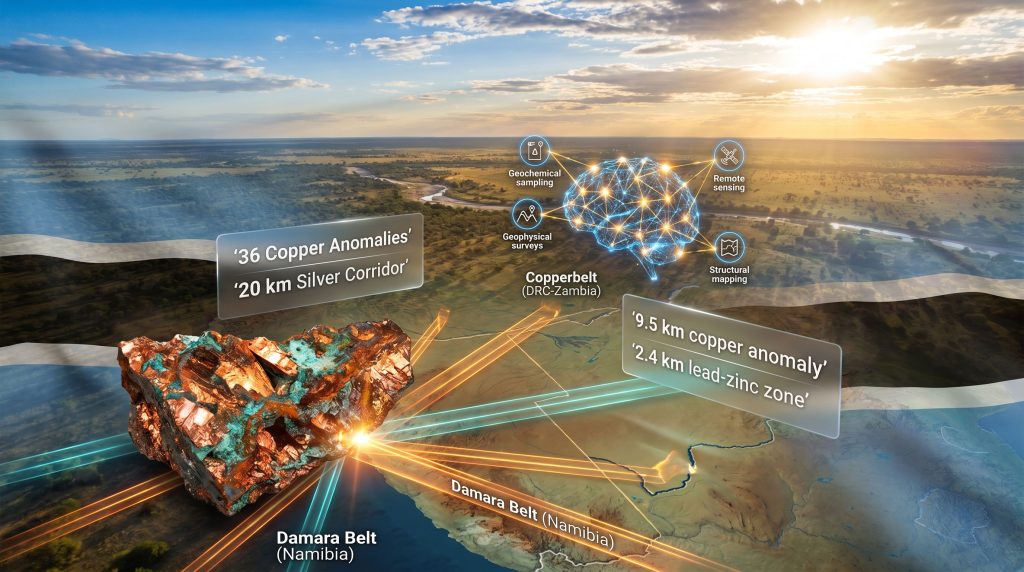
That calculus has now changed. The Botswana Minerals AI study uncovers 36 copper anomalies across just two of the company's eight northern Botswana licences, deploying Planetary AI's Xplore platform to do in weeks what traditional methods would have taken years to attempt. The results are not a discovery, but they are something arguably more valuable at this stage: a credible, data-ranked target pipeline in a jurisdiction that has barely been tested by modern exploration methods. Understanding the mineral exploration importance of this region helps contextualise just how significant this development is.
When big ASX news breaks, our subscribers know first
Northern Botswana's Geological Position: Why This Corridor Matters
The Structural Architecture Connecting Three Copper Regions
The Damara Belt is a Neoproterozoic orogenic system, formed during the assembly of Gondwana roughly 550 to 750 million years ago. It extends from central Namibia northeastward through Botswana's Ngamiland region, eventually linking with the structural framework that hosts the Central African Copperbelt in Zambia and the DRC. This architectural continuity is not coincidental.
The same sedimentary sequences and structural deformation events that localised copper mineralisation in Namibia's Tsumeb district and in Zambia's Copperbelt also affected rocks across northern Botswana. Furthermore, what makes this corridor particularly compelling from a deposit-hunting perspective is the diversity of mineralisation styles it can accommodate.
Sediment-hosted stratiform copper (SSC) deposits, the dominant style of the Central African Copperbelt, form within reduced carbonaceous shales sandwiched between oxidised redbed sequences. Structurally controlled polymetallic systems, such as Tsumeb's pipe-vein architecture, form where faults intersect favourable lithologies. IOCG deposits, which can form large-tonnage targets at crustal-scale structural intersections, have also been flagged as prospective within this corridor based on the AI-assisted analysis.
Africa's Copper Geography and Botswana's Untested Position
To appreciate the significance of the Botswana Minerals AI study, it helps to map northern Botswana against Africa's copper geography. The continent hosts two of the world's most productive copper regions:
- The Central African Copperbelt (DRC and Zambia), which accounts for roughly 10% of global copper production and contains deposits such as Kamoa-Kakula, the world's highest-grade large-scale copper mine
- Namibia's Tsumeb district, a historically significant polymetallic producer with exceptionally high-grade copper, lead, and silver mineralisation
Northern Botswana sits geologically between these two regions yet has received a fraction of their cumulative exploration investment. The primary historical barrier was not geological unfavourability but rather the economic threshold required to conduct systematic multi-dataset analysis across large, frontier licence areas.
How the Xplore Platform Transforms Target Generation
The Five-Layer Data Architecture Behind the AI Analysis
Planetary AI's Xplore platform operates by ingesting and cross-correlating multiple geological dataset categories simultaneously. For the Botswana Minerals study, this integrated framework drew from:
- Geological mapping and structural interpretation covering the regional architecture of the Damara Belt
- Geophysical surveys including gravity, magnetics, and electromagnetic data that reveal subsurface lithological and structural contrasts
- Geochemical sampling datasets capturing surface expression of mineralised systems
- Remote sensing and hyperspectral imagery identifying iron oxide alteration halos and clay mineral assemblages associated with mineralised systems
- Historical deposit databases used for analogue matching against global copper deposit signatures
The critical innovation is not the individual datasets, each of which was available to conventional explorers, but the machine learning framework that identifies multi-variable patterns across all five layers simultaneously. A geologist interpreting these datasets manually would process them sequentially, introducing cognitive bias and missing cross-layer correlations that ML models detect statistically. The broader role of AI in mineral exploration is rapidly reshaping how junior explorers approach frontier target generation.
Conventional vs. AI-Assisted Exploration: A Comparative View
| Exploration Method | Datasets Processed | Time to Target Generation | Analogue Matching Capability |
|---|---|---|---|
| Conventional Geological Survey | 1 to 2 datasets | Months to years | Manual, limited scope |
| AI-Assisted Platform (ML-based) | 5+ integrated datasets | Weeks | Global deposit database |
Technical context: AI-driven exploration platforms compress the reconnaissance phase by processing datasets in parallel rather than sequentially. Critically, they do not replace geological field validation — they redirect it by eliminating low-probability areas and concentrating resources on statistically anomalous targets.
What the Machine Learning Model Is Actually Trained On
One detail that is often lost in reporting on AI exploration is the nature of the training data itself. ML models used for copper target generation are trained on the known geochemical halos, structural settings, lithological associations, and alteration mineralogy signatures of confirmed world-class copper deposits.
The model then searches for statistical similarities in unexplored datasets, a process sometimes called deposit analogue fingerprinting. According to reporting from Mining Weekly, AI platforms are increasingly pinpointing major anomalies that would have taken years to identify through conventional methods.
For the Botswana study, the deposit analogues explicitly referenced in the AI assessment include Kamoa-Kakula in the DRC, one of the highest-grade copper discoveries in history, and Tsumeb in Namibia, a polymetallic system notable for its exceptionally concentrated copper-lead-silver-arsenic mineralisation. This does not imply that the Botswana targets are equivalent in scale or grade. It means the AI identified geological features in northern Botswana that share structural and geochemical characteristics with those deposits at the reconnaissance level.
Dissecting the 36 Anomalies: Structure, Scale, and Mineralisation Models
Six Corridors Across Two Licences
The 36 copper anomalies identified across two of Botswana Minerals' eight northern licences are not scattered randomly across the landscape. Their organisation into six distinct exploration corridors is a geologically meaningful observation. Corridor-style anomaly clustering typically signals structurally controlled mineralisation, where faults, shear zones, or stratigraphic contacts have focused fluid flow and metal precipitation along linear trends.
This architecture is consistent with both SSC-style and structurally hosted polymetallic systems, and it significantly enhances the economic case for the target inventory. A cluster of anomalies sharing a common structural corridor can be systematically tested with a single traversing drill programme, improving the return on exploration expenditure compared with isolated targets requiring individual programmes. For context, a similarly promising major copper system has demonstrated how corridor-organised anomalies can translate into compelling drill targets.
Polymetallic Signatures: Beyond Copper
The anomaly inventory extends well beyond copper alone. Within the Ngamiland licence area, the AI-assisted analysis has delineated:
- A 9.5 km copper anomaly zone representing one of the most spatially extensive individual features in the dataset
- A 20 km silver corridor, notable for both its strike length and its co-location with the copper-dominant system
- A 2.4 km lead-zinc zone consistent with MVT (Mississippi Valley Type) mineralisation
Two primary mineralisation models have emerged from this data:
Model 1: A copper-silver-nickel-cobalt system consistent with sediment-hosted stratiform copper mineralisation, where metals were precipitated from basinal brines migrating through permeable host rock sequences.
Model 2: An MVT-style lead-zinc corridor, where carbonate-hosted fluid systems deposited base metal sulphides in structural traps. MVT systems are geologically and genetically distinct from SSC deposits but can co-occur in the same regional basin architecture.
Deposit Analogues Referenced in the AI Assessment
| Analogue Deposit | Location | Mineralisation Style | Relevance to Botswana Targets |
|---|---|---|---|
| Kamoa-Kakula | DRC | Sediment-hosted stratiform copper | Structural and lithological similarities |
| Tsumeb | Namibia | Polymetallic pipe and vein system | Proximity to Damara Belt geology |
Important disclaimer: Analogue comparison in exploration is a target prioritisation tool. The identification of geological similarities between Botswana targets and world-class deposits does not constitute evidence of equivalent mineralisation grades, tonnages, or economic viability. All targets require field validation and drilling before any resource assessment is possible.
The Three-Phase Pathway from Anomaly to Drill Decision
Phase 1: Fieldwork Mobilisation Within Three Months
Initial ground-based activities are scheduled to commence within three months of the announcement. The primary objectives at this stage are to confirm that AI-identified anomalies have recognisable surface expressions, collect first-pass geochemical samples for laboratory analysis, and map structural features that may control mineralisation trends. This phase represents the critical bridge between desktop analysis and physical evidence.
Phase 2: Target Ranking Through Deeper AI Integration
Following initial fieldwork, the programme enters a second analytical cycle in which field results are fed back into the Xplore platform. This iterative process, sometimes described as supervised learning refinement, allows the AI model to recalibrate its confidence rankings based on ground-truth observations. The 36 anomalies will consequently be ranked by geological confidence, structural position, anomaly dimensions, and polymetallic complexity.
Phase 3: Drill Programme Design
Drilling decisions will be driven by the ranked target inventory, with priority given to anomalies that demonstrate large footprints, multi-element signatures, and favourable structural settings. In frontier exploration contexts, the timeline from anomaly identification to first drill hole typically spans 18 to 36 months, accounting for permitting, logistics, and field preparation. Techniques such as downhole geophysics will also play a critical role in validating subsurface targets ahead of resource definition drilling.
AI Exploration Economics: Changing the Cost Structure of Frontier Discovery
What AI Genuinely Reduces in Exploration Risk
The economic case for AI-assisted exploration in frontier jurisdictions rests on a straightforward cost argument. Conventional greenfield programmes in underexplored regions generate relatively few drill-ready targets per dollar spent, because the reconnaissance phase consumes a disproportionate share of the exploration budget. AI platforms compress this phase by screening large areas computationally, delivering a higher density of ranked targets per unit of expenditure.
For junior explorers operating in frontier jurisdictions with constrained drilling budgets, this represents a structural improvement in capital efficiency. The cost per prioritised target drops substantially, even if the total exploration cost to resource definition does not change materially. As Further Africa reports, Botswana Minerals' deployment of AI to sharpen copper targets in the Damara Belt exemplifies this emerging shift in frontier exploration economics.
What AI Cannot Eliminate
Equally important for investors is understanding what machine learning cannot resolve:
- Subsurface geological uncertainty: AI models interpret surface and near-surface datasets; they cannot image ore grades, deposit geometry, or mineralisation continuity at depth
- Metallurgical unknowns: mineralisation style and associated penalty elements, which affect processing economics, cannot be predicted from surface signatures alone
- Resource conversion risk: the pathway from anomaly to measured resource involves multiple validation stages, each carrying its own failure probability
The next major ASX story will hit our subscribers first
Botswana as an Exploration Jurisdiction: Stability and Mineral Endowment
Beyond Diamonds: Base Metals in a Diversifying Mining Economy
Botswana has long been defined by its diamond sector, with the Orapa and Jwaneng mines making the country one of the world's largest diamond producers by value. This dominance has historically meant that systematic base metals and critical minerals exploration received limited capital allocation relative to the country's geological prospectivity.
The northern Botswana copper corridor exploration represents part of a broader diversification trend in the country's mineral development landscape. Botswana's regulatory framework for mining and exploration is, however, widely regarded as transparent and investor-friendly by sub-Saharan African standards, with clear licensing processes and a track record of supporting foreign exploration capital.
Jurisdiction Comparison: How Botswana Stacks Up
| Jurisdiction | Political Stability | Regulatory Clarity | Infrastructure Maturity | Exploration Activity Level |
|---|---|---|---|---|
| Botswana | High | Well-established | Moderate | Emerging |
| DRC | Variable | Complex | Limited in frontier zones | High in established belts |
| Zambia | Moderate | Evolving | Moderate | High in Copperbelt |
Botswana's combination of institutional stability and geological prospectivity positions northern Botswana as a structurally compelling exploration address. This is particularly relevant as exploration capital increasingly seeks frontier exposure in stable jurisdictions as an alternative to the operational and regulatory complexity of the DRC.
Key Takeaways for Investors and Industry Observers
- The Botswana Minerals AI study uncovers 36 copper anomalies across two licences in a geologically underexplored corridor between two of Africa's most productive copper regions
- Anomalies are organised into six exploration corridors, with polymetallic signatures spanning copper, silver, lead, zinc, nickel, and cobalt
- The Xplore platform used for the study combines ML pattern recognition with expert geological interpretation across five integrated dataset categories
- Deposit analogues referenced include Kamoa-Kakula and Tsumeb, used for structural and geochemical fingerprinting only, not as grade or tonnage benchmarks
- Initial fieldwork is planned within three months, followed by iterative AI ranking and eventual drill programme design
- These anomalies represent a target pipeline, not a confirmed mineral resource; all estimates and forward-looking characterisations carry material uncertainty
This article contains forward-looking statements and references to exploration targets that have not been confirmed by drilling or resource estimation. Readers should not interpret the identification of geological anomalies as evidence of economically viable mineralisation. Independent geological and financial advice should be sought before making investment decisions.
Want to Track the Next Major Mineral Discovery Before the Market Does?
Discovery Alert's proprietary Discovery IQ model delivers real-time alerts the moment significant ASX mineral discoveries are announced, transforming complex geological data into actionable investment insights for both short-term traders and long-term investors — begin your 14-day free trial today, or explore historic discoveries and their returns to understand just how transformative a timely discovery alert can be.