June 20, 2026
The Global Copper Supply Crunch and Why One Australian State Holds the Cards
Copper sits at the intersection of virtually every major infrastructure trend reshaping the global economy. Electric vehicles require roughly four times more copper than their internal combustion counterparts. Offshore wind turbines consume several tonnes of the metal per megawatt of installed capacity. The copper supply crunch is intensifying as grid-scale battery storage, EV charging networks, and data centre buildouts all place escalating demand on a metal whose new supply pipeline has failed to keep pace with consumption growth for more than a decade.
Against this backdrop, the structural significance of South Australia's copper endowment becomes difficult to overstate. The state holds approximately two-thirds of Australia's proven copper reserves, concentrated primarily within the ancient geology of the Gawler Craton, a Precambrian shield province that has produced some of the most mineralised terrain on Earth. Within this single jurisdiction sit Olympic Dam, Prominent Hill, and Carrapateena, three operating copper mines that together form what BHP now formally designates its Copper SA Province.
The finalisation of a modernised bilateral framework between the South Australian Government and BHP to govern this province arrives at precisely the moment when regulatory certainty and capital commitment are most consequential for global copper markets.
When big ASX news breaks, our subscribers know first
Understanding the Gawler Craton: Geology That Commands Attention
The Gawler Craton is not simply a collection of mineral deposits. It represents one of the world's most geologically distinctive copper-gold terranes, characterised by Iron Oxide Copper-Gold (IOCG) mineralisation, a deposit style that is relatively rare globally but disproportionately represented in South Australia. Furthermore, IOCG deposits are notable for their scale and their polymetallic character.
Olympic Dam, the world's largest known uranium deposit and one of the largest copper-gold deposits on Earth, exemplifies this deposit type. The ore body contains copper, gold, silver, and uranium in a single vertically extensive system that extends hundreds of metres below the current mining envelope. This multi-commodity profile creates economic resilience, because the mine's financial performance is not solely dependent on copper pricing.
Revenue contributions from uranium, gold, and silver provide a natural hedge that most single-commodity copper operations simply cannot replicate.
What is less widely appreciated is the sheer scale of Olympic Dam's resource base relative to its current production rate. The deposit contains resources measured in billions of tonnes, and the current operation extracts only a fraction of what the mineralised system theoretically contains. This gap between reserve life and current throughput is precisely why the production ambitions attached to the modernised indenture are described in generational rather than decadal terms.
What the South Australia BHP Olympic Dam Agreement Actually Changes
The original bilateral framework governing Olympic Dam and the Stuart Shelf region was established approximately 40 years ago. At the time, it was a pioneering instrument designed to attract capital to a remote and technically challenging development. Four decades later, that same framework had become structurally misaligned with the scale of operations now envisaged, the environmental standards that apply to modern mining, and the heritage obligations that institutional capital increasingly treats as non-negotiable.
The South Australia BHP Olympic Dam agreement addresses these misalignments across several dimensions simultaneously.
Key Reforms at a Glance
| Reform Area | Previous Framework | Updated Framework |
|---|---|---|
| Approval Pathways | Legacy bilateral process | Streamlined under modernised Mining Act |
| Aboriginal Heritage | Older heritage legislation | Transition to current Aboriginal Heritage Act |
| Water Extraction | Existing guidelines | Stricter extraction parameters |
| Financial Assurances | Limited formal mechanisms | Mandated financial assurance structures |
| Local Jobs Commitment | Informal expectations | Binding contractual commitments |
| Mine Integration | Site-by-site approvals | Province-wide integrated framework |
The shift to a province-wide approval framework is arguably the most commercially significant structural change. Previously, each expansion project within BHP's South Australian operations required discrete regulatory engagement. The updated framework establishes a consolidated pathway that treats Olympic Dam, Prominent Hill, and Carrapateena as an integrated operational system rather than three separate mines, each requiring its own bespoke regulatory process.
The transition to the current Aboriginal Heritage Act represents a material governance upgrade. Modern heritage legislation is increasingly treated by institutional investors and potential joint venture partners as a baseline requirement rather than a virtue. Mining operations that continue to operate under outdated heritage frameworks carry reputational and legal risk that can affect financing costs and partnership attractiveness. Formalising this transition within the indenture removes that overhang.
Binding local employment and procurement commitments shift what were previously informal expectations into contractual obligations, providing both community confidence and measurable accountability.
The Roxby Downs township, which exists as the residential hub supporting Olympic Dam operations, is also formally protected under the updated agreement, an important social licence consideration for a remote operation that depends on a stable residential workforce.
Crucially, the modernised indenture must still be ratified by the South Australian Parliament before it takes legal effect, making parliamentary approval the next critical milestone on the path to implementation.
The Royalty Story: Record Numbers That Quantify the Stakes
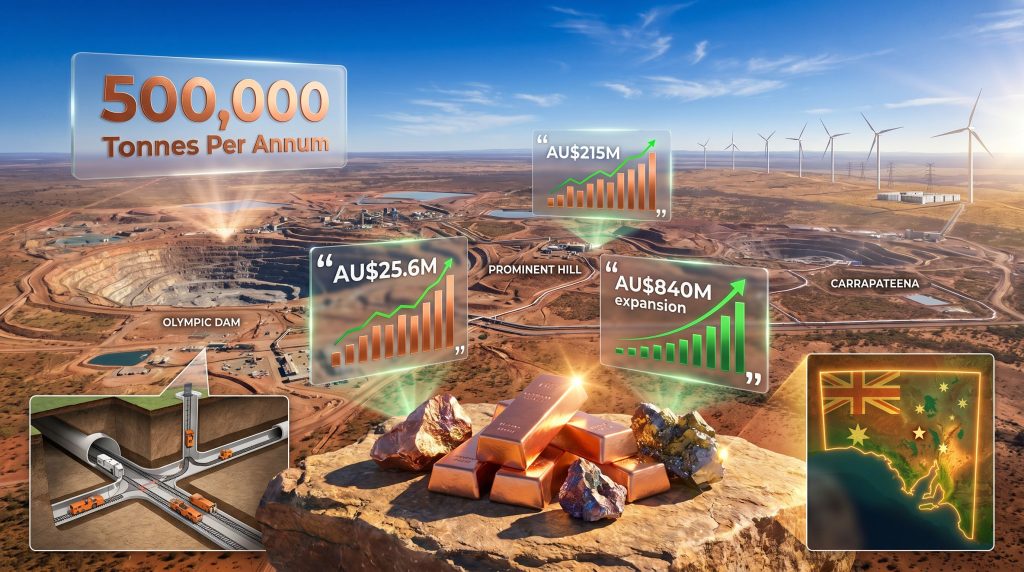
One of the clearest indicators of Olympic Dam's current operational momentum is its royalty generation profile. The AU$25.6 million monthly royalty payment recorded for April represents the largest single monthly royalty payment ever received by South Australia's Department of Energy and Mining.
At its current run rate, Olympic Dam is on track to deliver more than AU$215 million in total royalties to South Australia for the full financial year, a figure that illustrates the fiscal multiplier effect that production expansion would generate for the state's public finances.
Understanding what drives royalty revenue requires a brief explanation of how mining royalties are structured. In South Australia, royalties are typically calculated as a percentage of the net value of minerals extracted. This means royalty revenue scales with both production volume and commodity price. When copper prices are elevated and throughput is high, the royalty yield increases on both dimensions simultaneously, compounding the revenue benefit for the state.
This dynamic creates a direct fiscal incentive for the South Australian Government to facilitate regulatory conditions that support production expansion. Every additional tonne of copper produced through a streamlined approval pathway generates incremental royalty revenue without requiring additional state capital expenditure. The investment case for regulatory modernisation is therefore not merely industrial policy; it is fiscal arithmetic.
BHP's Capital Commitment and the Production Expansion Blueprint
BHP has already committed approximately AU$840 million to an initial expansion programme at Olympic Dam. In addition, BHP's copper expansion plans signal growing industry-wide confidence in long-term demand. This capital allocation covers:
- A new underground access tunnel to deepen the operational envelope
- Expansion of the underground rail network for ore haulage
- New rolling stock to increase underground transport capacity
- An oxygen plant to support the smelting process
These investments are not standalone projects. They are foundational infrastructure elements designed to physically enable higher ore extraction rates, establishing the platform from which further production scaling becomes technically feasible.
BHP's longer-term production ambition involves scaling copper output toward 500,000 tonnes per annum, with a ceiling target discussed at approximately 650,000 tonnes per annum. To contextualise that ambition, current Olympic Dam production operates at a fraction of those targets. The production gap between current output and the long-term target is substantial, and bridging it requires not just underground infrastructure but a material expansion of surface processing capacity, particularly the smelter and refinery complex.
The Smelter Bottleneck: The Critical Path Item Often Overlooked
A detail that receives less attention in mainstream coverage of Olympic Dam expansion is the role of the on-site copper smelter as the binding constraint on ultimate production capacity. Unlike most copper operations globally, Olympic Dam is an integrated mine-to-refined-metal facility. Ore is extracted, processed, smelted, and refined on a single site, producing finished copper cathode rather than copper concentrate.
This vertical integration model provides significant commercial advantages, including control over the full value chain and the ability to capture refining margins rather than paying them to third-party smelters. However, it also means that the smelter's throughput capacity sets an absolute ceiling on how much finished copper the operation can produce. Any production expansion beyond a certain threshold requires either a smelter upgrade or a new smelting facility, a capital-intensive undertaking that represents a distinct investment decision from underground mining expansion.
This is why BHP's longer-term production targets are described as aspirational rather than committed, and why the modernised indenture is framed as establishing a clearer pathway for further expansion negotiations rather than a guaranteed expansion outcome.
Renewable Energy Integration: The 70 MW Baseload Deal With Neoen
BHP's agreement with Neoen to supply 70 megawatts of renewable baseload electricity to Olympic Dam from July 2025 addresses one of the more technically complex challenges in industrial decarbonisation: the difference between intermittent renewable generation and the continuous, stable power supply that large-scale industrial operations require. Consequently, renewable energy in mining is rapidly evolving from a peripheral consideration to a core operational requirement.
| Energy Metric | Detail |
|---|---|
| Contract Partner | Neoen |
| Contracted Capacity | 70 MW renewable baseload |
| Commencement | July 2025 |
| Power Sources | Goyder South Stage 1 wind farm + Blyth Battery storage |
| Coverage of Site Demand | ~50% of Olympic Dam's electricity needs |
| Supply Model | 24/7 renewable baseload (not intermittent) |
The critical distinction in this arrangement is the 24/7 baseload delivery model. Wind generation is inherently variable, but by pairing the Goyder South Stage 1 wind farm with battery storage capacity from the Blyth Battery, the arrangement is structured to smooth generation variability and deliver continuous power. For a copper smelter, which operates continuously and cannot economically tolerate power interruptions, this reliability characteristic is essential.
Covering approximately half of Olympic Dam's total electricity consumption with renewable baseload has implications that extend well beyond environmental reporting. Downstream copper purchasers in Europe and Asia, operating under increasingly stringent supply chain emissions obligations, are beginning to apply pricing differentials to copper based on its carbon intensity profile. Low-carbon-intensity copper commands a structural premium in premium markets, and Olympic Dam's decarbonisation trajectory is therefore a commercial positioning decision as much as an ESG commitment.
The next major ASX story will hit our subscribers first
South Australia's Competitive Position in the Global Copper Landscape
The competitive dynamics of global copper supply are worth examining as context for the South Australia BHP Olympic Dam agreement's significance. The world's largest copper-producing nations, Chile and Peru, dominate global output but face escalating operational challenges including water scarcity, declining ore grades, community opposition, and increasing regulatory complexity. The Democratic Republic of Congo, the other major copper jurisdiction, carries governance and supply chain risk profiles that constrain its attractiveness to ESG-conscious capital.
South Australia's value proposition sits in sharp contrast to these dynamics:
- Sovereign stability: Australia's regulatory and political environment is among the most stable globally for resource investment
- ESG compliance: Aboriginal heritage transitions, environmental safeguards, and renewable energy integration are embedded in the indenture framework
- Grade quality: IOCG deposits like Olympic Dam carry polymetallic revenue streams that improve project economics relative to simple copper porphyry deposits
- Infrastructure: Existing processing and port infrastructure reduces the capital intensity of incremental expansion compared to greenfield development in remote frontier jurisdictions
Furthermore, the surge in critical minerals demand underscores why South Australia's integrated copper province is attracting global attention. One often underappreciated aspect of Olympic Dam's competitive position is its uranium by-product. As nuclear energy attracts renewed interest as a low-carbon baseload power source, uranium's contribution to Olympic Dam's revenue profile may increase materially, providing an additional demand tailwind that pure copper miners do not benefit from.
Risk Factors Investors and Observers Should Not Overlook
A balanced assessment of the South Australia BHP Olympic Dam agreement requires acknowledging the risk landscape alongside the opportunity narrative.
Parliamentary ratification remains an unresolved step. The indenture has no legal force until it passes through the South Australian Parliament, and any delay or amendment in that process creates timeline uncertainty for BHP's capital allocation schedule.
Engineering complexity at the scale required for 500,000 to 650,000 tonnes per annum output is formidable. Underground expansions of the depth and scale contemplated at Olympic Dam involve significant geotechnical and logistics challenges that are difficult to fully de-risk until development is underway.
Water management in South Australia's arid environment is a persistent operational constraint. The stricter extraction guidelines embedded in the modernised indenture reflect the genuine environmental sensitivity of water use in this region, and compliance with those guidelines adds operational management complexity.
Commodity price sensitivity affects the internal economics of every major capital commitment. The AU$215 million royalty projection and the multi-billion-dollar expansion business case are both sensitive to copper pricing. A sustained copper price correction could alter the timing and scale of investment decisions, even within a modernised regulatory framework.
Disclaimer: The financial projections, production targets, and investment figures referenced in this article are based on publicly available information and company statements. They involve forward-looking assumptions that are subject to material uncertainty. This article does not constitute financial advice. Readers should conduct independent due diligence before making any investment decisions.
A Replicable Framework for Critical Minerals Governance?
The structural design of the modernised Olympic Dam and Stuart Shelf Indenture raises a broader question relevant to Australian resource policy: whether indenture-style bilateral agreements offer a replicable model for unlocking large-scale critical minerals investment in other jurisdictions.
The indenture model provides something that standard regulatory processes often struggle to deliver at the scale of projects like Olympic Dam: a long-term, negotiated certainty framework that addresses the specific operational, environmental, and community parameters of a single province or project. For an investment decision that involves committing billions of dollars over multiple decades, this bespoke certainty has quantifiable value.
Western Australia has historically used indenture-style agreements for major iron ore developments. Queensland and the Northern Territory have employed analogous frameworks for specific large-scale resource projects. However, whether the South Australian model, with its integrated province-wide approach and its explicit incorporation of renewable energy, modern heritage legislation, and binding community commitments, offers refinements worth adopting elsewhere is a question likely to attract growing attention from policymakers and mining companies alike.
The Olympic Dam story is ultimately about the intersection of geology, policy design, capital discipline, and timing. South Australia holds the geological endowment. The modernised agreement provides the regulatory architecture. The capital commitment is forming. Whether that combination delivers on its generational potential depends on execution quality, commodity markets, and the parliamentary process still ahead.
Ready to Identify the Next Major Copper Discovery Before the Market Does?
Discovery Alert's proprietary Discovery IQ model scans ASX announcements in real time, delivering instant alerts on significant mineral discoveries — including copper — so subscribers can act on actionable opportunities ahead of the broader market. Explore historic discoveries and their extraordinary returns to understand what's at stake, then start your 14-day free trial at Discovery Alert and position yourself at the forefront of the next major find.