June 24, 2026
Africa's Deepwater Frontier Is Rewriting the Rules of Offshore Development
The economics of ultra-deepwater oil development have always followed a simple but unforgiving logic: scale justifies cost, and complexity demands coordination. Nowhere is this principle being tested more rigorously than in the pre-salt and post-salt zones off Angola's Atlantic coastline, where water depths exceed a mile and subsea architectures must function flawlessly for decades. Against this backdrop, the sanctioning of the Azule Energy Greater PAJ Project Angola represents something genuinely novel, not just in scale, but in structural design. It is a project that breaks from conventional single-block development thinking and offers a template that could reshape how African deepwater assets are commercialised going forward.
When big ASX news breaks, our subscribers know first
Angola's Offshore Landscape and the Strategic Value of Block 31
Angola consistently ranks among Sub-Saharan Africa's largest crude oil producers, with offshore output serving as the backbone of the country's export revenue. The country's deepwater and ultra-deepwater blocks, particularly those in the Lower Congo Basin, have attracted sustained investment from the world's largest international oil companies precisely because of their proven geological productivity and fiscal frameworks designed to incentivise long-cycle capital deployment.
Block 31, operated under Angola's national licensing framework and administered with the involvement of Sonangol EP, has long been regarded as one of the most prospective ultra-deepwater concessions on the African continent. Its pre-salt carbonate formations and post-salt clastic reservoirs have yielded multiple significant hydrocarbon accumulations. The adjacent Block 31/21 holds complementary resources that, when viewed in isolation, might struggle to justify standalone development economics at current crude oil prices.
This is precisely the insight that underpins the Greater PAJ Project's architectural logic.
Breaking Down the Greater PAJ Development: Five Fields, Two Blocks, One Integrated Concept
The Field Portfolio and Geological Rationale
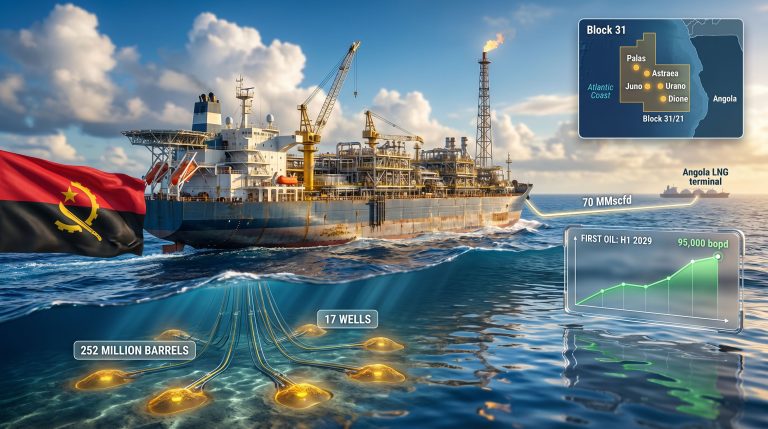
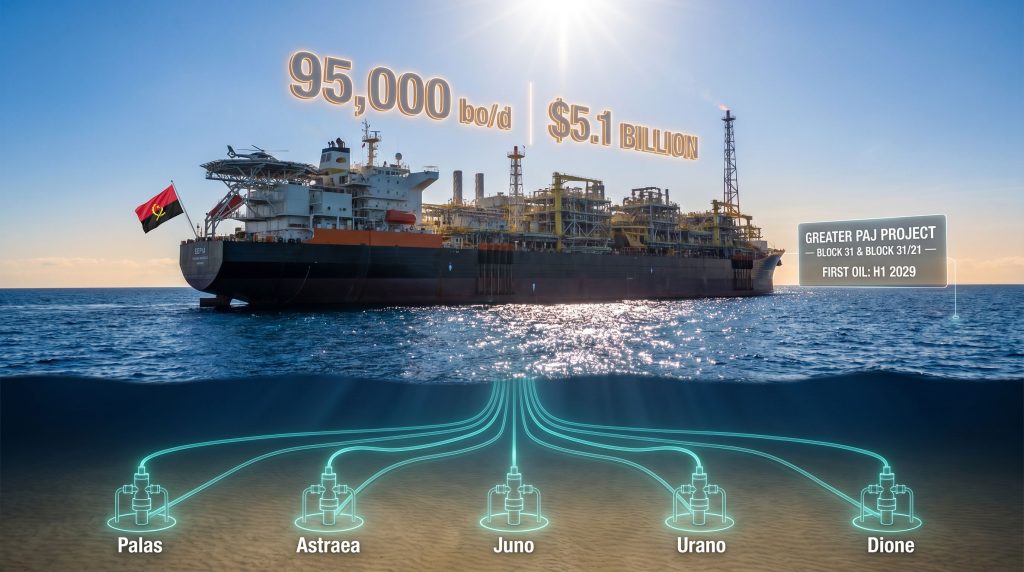
The Greater PAJ Project consolidates five discrete hydrocarbon accumulations under a single development concept. Three of those fields, Palas, Astraea, and Juno, sit within Block 31, while the remaining two, Urano and Dione, are located in the adjacent Block 31/21 concession.
The geological case for integration is compelling. These accumulations share broadly similar reservoir characteristics, with deepwater turbidite sands representing the primary productive intervals. While each field has its own pressure regime and fluid properties, the spatial proximity and stratigraphic similarities across the two concessions made a single subsea tieback architecture technically viable and economically superior to any multi-development alternative.
What makes this particularly significant is that combining resources across two separately licensed concession areas required coordinated regulatory approvals from Angolan authorities simultaneously across both agreements, a process with no direct precedent in Angola's upstream history.
Core Technical Specifications
The project's technical parameters reflect its ambition and complexity.
| Parameter | Specification |
|---|---|
| Total Capital Investment | $5.1 billion |
| Water Depth | ~5,250 feet (ultra-deepwater) |
| Subsea Production Wells | 17 wells |
| FPSO Oil Capacity | 95,000 barrels per day |
| Gas Export Capacity | 70 MMscfd |
| Gas Destination | Angola LNG (ALNG) plant |
| First Oil Target | First half of 2029 |
| Blocks | Block 31 and Block 31/21 |
| FID Date | June 2026 |
At approximately 5,250 feet of water depth, the project operates firmly within ultra-deepwater territory, a classification that brings specific engineering challenges around riser design, flow assurance, and subsea equipment reliability. The selection of a single new-build FPSO as the central processing and offloading hub, rather than a multi-FPSO concept or fixed platform approach, reflects both the reservoir distribution across the two blocks and the preference for a unified production management system that simplifies operations and reduces long-term opex exposure.
FPSO Configuration and Subsea Architecture
The new-build FPSO will anchor the entire development, receiving production from all 17 subsea wells across both concession areas via a tieback architecture that spans the Block 31 and Block 31/21 boundary. The vessel's nameplate oil processing capacity of 95,000 barrels per day positions it as a substantial production unit by any measure, while its gas handling capability of 70 MMscfd is specifically designed to monetise associated gas rather than flare it.
Gas will travel through a newly constructed dedicated export pipeline, which will connect into the existing Block 31 gas export network before ultimately routing production to the Angola LNG plant. This infrastructure-sharing approach avoids the capital cost of building an entirely separate gas export system from scratch, further improving the project's overall economics. Furthermore, Saipem has been awarded a key offshore contract in connection with the Greater PAJ development, underscoring the scale of supply chain mobilisation now under way.
Ultra-deepwater tieback projects at depths beyond 5,000 feet require sophisticated flow assurance engineering to manage hydrate formation, wax deposition, and slugging across long subsea flowline distances. These technical constraints heavily influence well count, tie-in geometry, and FPSO sizing decisions.
Ownership Structure and Azule Energy's Operator Role
How Azule Energy Came to Lead Greater PAJ
Azule Energy was established as a 50/50 joint venture between Eni S.p.A. and bp PLC, combining both companies' Angolan upstream portfolios into a single consolidated operator entity. The rationale for this structure centred on operational efficiency, cost consolidation, and the ability to pursue larger-scale capital projects with a unified balance sheet and decision-making framework.
As Angola's largest independent operator with 18 licensed blocks across the country, Azule Energy brings a level of in-country operational depth that few other entities could replicate. Taking FID as operator on the Azule Energy Greater PAJ Project Angola, rather than through either parent company acting independently, reflects the JV's maturation into a fully functioning operator with its own strategic agenda.
Joint Venture Partner Breakdown
| Partner | Role |
|---|---|
| Azule Energy (Eni S.p.A. and bp PLC JV) | Operator |
| Sonangol EP | National oil company partner |
| Equinor ASA | Non-operating partner |
Sonangol EP's participation reflects Angola's standard co-investment model, through which the state oil company maintains an economic interest in major upstream developments to maximise domestic resource capture. Equinor's presence as a non-operating partner aligns with the Norwegian company's long-standing strategic focus on African deepwater assets, where it has built considerable technical expertise across multiple basins.
What an FID Actually Means in Ultra-Deepwater Project Development
The Journey From Concept to Capital Commitment
A Final Investment Decision is not a single event but the culmination of a multi-year process involving engineering progression, commercial negotiation, and board-level capital allocation. For a project of Greater PAJ's scale and complexity, that journey typically follows a structured sequence:
-
Pre-FEED (Pre-Front-End Engineering and Design): Concept selection, technical screening, and initial cost estimation across development options.
-
FEED Phase: Detailed engineering, vendor engagement, contractor tendering, and refined cost and schedule development.
-
Commercial Alignment: Joint venture partner approvals, host government fiscal term confirmation, and regulatory permitting across both concession areas.
-
FID Gate: Final board-level commitment from all equity partners, unlocking full project execution funding.
For Greater PAJ, the June 2026 FID represents the successful navigation of all four stages, including the unprecedented challenge of achieving simultaneous regulatory alignment across two separate Angolan concession agreements. Earlier industry timelines had anticipated an FID as early as end-2024 with first oil potentially achievable in 2026, however the complexity of the cross-block integration mechanism and the thoroughness of the FEED process pushed the schedule to its current configuration: FID in June 2026 and first oil targeted in the first half of 2029.
A $5.1 billion capital commitment in the current oil price environment is a meaningful signal of long-term confidence. Ultra-deepwater projects of this size require operators to believe in sustained demand for crude oil well into the 2030s and beyond, implicitly reflecting a view that the energy transition will be gradual rather than abrupt for oil-producing economies.
Disclaimer: Statements regarding future production timelines, capital costs, and project economics represent forward-looking estimates subject to technical, commercial, and macroeconomic risks. Readers should not rely on these figures as guarantees of future outcomes.
Angola's First Cross-Block Development: What Makes Greater PAJ Structurally Unique
The Innovation Behind the Cross-Block Model
In Angolan concession law, each licensed block is governed by a separate production sharing agreement with its own contractual terms, partner configurations, and regulatory obligations. Developing resources that straddle two such agreements under a single integrated concept requires negotiating the legal and commercial interfaces between two distinct contractual frameworks, coordinating capital allocation across different fiscal regimes, and securing simultaneous consent from all relevant parties including the host government and Sonangol EP.
Greater PAJ's designation as Angola's first integrated cross-block development is not marketing language; it reflects a genuine structural achievement that required legal creativity, commercial flexibility, and regulatory coordination that simply had not been attempted in Angola before. Consequently, the model now being applied here could influence how African energy geopolitics and resource governance evolve across the continent more broadly.
The Economic Case for Integration
The capital efficiency argument for consolidating five fields across two blocks into one development is straightforward when examined at the project level:
-
Shared FPSO infrastructure eliminates the need to build two separate floating production units, potentially saving hundreds of millions of dollars in hull and topsides capital.
-
Consolidated drilling programmes allow well planning and rig scheduling to be optimised across all 17 wells simultaneously, reducing rig idle time and improving execution efficiency.
-
Shared gas export infrastructure routes 70 MMscfd through the existing Block 31 network rather than constructing a duplicate export system for Block 31/21.
-
Unified reservoir management enables coordinated pressure maintenance and production optimisation across adjacent accumulations that might otherwise compete for shared aquifer or drive energy support.
The precedent-setting nature of this structure matters beyond Greater PAJ itself. Across Angola's offshore acreage, there are likely other adjacent block configurations where stranded or sub-commercial accumulations could be unlocked through a similar cross-block integration model. Greater PAJ, furthermore, provides the regulatory and commercial template for those future conversations.
The next major ASX story will hit our subscribers first
Gas Monetisation and Angola's Flaring Reduction Commitments
Why 70 MMscfd of Gas Export Capacity Matters
Associated gas management has historically been one of the more contentious operational challenges in African deepwater development. Flaring associated gas at scale carries both environmental consequences and represents a direct destruction of resource value. The Greater PAJ project's gas export design, routing 70 MMscfd through a new pipeline tied into the existing Block 31 gas export network and ultimately to the Angola LNG plant, reflects a deliberate commitment to full gas monetisation rather than reinjection or flaring.
Angola LNG, located at Soyo, has served as a critical offtake facility for associated gas production from multiple Angolan offshore blocks since it reached initial production. Its role in the Greater PAJ gas value chain underscores how new deepwater developments are increasingly being designed with gas commercialisation as an integrated component from the outset rather than an afterthought.
For context, 70 MMscfd represents a meaningful contribution to Angola LNG's feedgas supply, and its reliable delivery from a new, long-life production hub adds stability to the plant's operational base case. In addition, this commitment to gas monetisation aligns Angola with broader industry efforts to address energy transition pressures by reducing routine flaring across major producing regions.
Production Timeline: From FID to First Oil
Key Milestones Between June 2026 and H1 2029
The approximately three-year window between FID and first oil is consistent with, though at the faster end of, typical ultra-deepwater FPSO-based project execution timelines. Key activities across this period include:
-
FPSO contract award and commencement of new-build construction at a shipyard.
-
Subsea equipment procurement, including trees, manifolds, flowlines, and umbilicals.
-
Fabrication of the gas export pipeline and associated subsea infrastructure.
-
Offshore drilling campaign across all 17 production wells.
-
FPSO sailaway, offshore installation, and hook-up to the subsea network.
-
Commissioning, start-up, and ramp-up toward plateau production capacity of 95,000 barrels per day.
The ramp-up phase following first oil is typically the most operationally intensive, as reservoir deliverability, FPSO process stability, and subsea system performance are validated against design assumptions in real-world conditions.
Strategic Implications for Azule Energy and Angola's Upstream Future
What Greater PAJ Signals About Angola's Investment Environment
A $5.1 billion capital commitment by a major joint venture into Angola's ultra-deepwater sector in 2026 communicates a clear message about international operator confidence in the country's upstream regulatory and fiscal framework. For Angola, which remains heavily dependent on oil revenues to fund government expenditure and foreign exchange earnings, sustaining the pipeline of new project sanctions is a macroeconomic priority.
However, this confidence does not exist in isolation. Volatile market conditions, including shifts in the oil price rally driven by geopolitical and trade policy forces, add a layer of complexity to any long-cycle capital commitment of this magnitude. Operators sanctioning ultra-deepwater developments must, therefore, build robust downside price scenarios into their project economics from the outset.
Greater PAJ also reinforces Azule Energy's position as a genuinely independent operator with the financial and technical capacity to sanction multi-billion-dollar projects under its own mandate, rather than deferring those decisions to either Eni or bp individually. With 18 licensed blocks across Angola, Greater PAJ is likely the first of several major capital commitments the JV will make across its portfolio in the coming decade.
For Equinor and Sonangol EP, the project delivers continued exposure to high-quality, long-life deepwater production assets in a basin they both understand well. OPEC's market influence over long-term supply dynamics also remains a relevant backdrop for how Angola's production growth feeds into global balance considerations going forward.
Greater PAJ Project: Key Facts at a Glance
| Metric | Detail |
|---|---|
| FID Date | June 2026 |
| Total Investment | $5.1 billion |
| Fields | Palas, Astraea, Juno, Urano, Dione |
| Blocks | Block 31 and Block 31/21 |
| Water Depth | ~5,250 feet |
| FPSO Oil Capacity | 95,000 bo/d |
| Gas Export Capacity | 70 MMscfd |
| Gas Destination | Angola LNG plant |
| Production Wells | 17 subsea wells |
| First Oil Target | H1 2029 |
| Operator | Azule Energy (Eni and bp JV) |
| Partners | Sonangol EP, Equinor ASA |
| Structural Milestone | Angola's first integrated cross-block development |
Frequently Asked Questions: Azule Energy Greater PAJ Project Angola
What is the Greater PAJ Project?
The Greater PAJ Project is an integrated ultra-deepwater oil and gas development offshore Angola, combining five hydrocarbon fields across two concession blocks, Block 31 and Block 31/21, under a single new-build FPSO with a production capacity of 95,000 barrels of oil per day and 70 MMscfd of gas. First oil is targeted for the first half of 2029.
Who owns and operates the Greater PAJ Project?
Azule Energy, a 50/50 joint venture between Eni S.p.A. and bp PLC, serves as operator. Joint venture partners include Sonangol EP and Equinor ASA.
How much does the Greater PAJ Project cost?
The total capital investment is $5.1 billion, committed at FID in June 2026.
What makes Greater PAJ unique among Angolan offshore developments?
It is Angola's first integrated cross-block development, consolidating resources from two separately licensed concession areas under a single FPSO and shared gas export infrastructure, a structural first in Angolan upstream history.
When will Greater PAJ produce first oil?
First oil is targeted for the first half of 2029, approximately three years after the June 2026 FID.
How will associated gas from Greater PAJ be monetised?
A new dedicated export pipeline will connect to the existing Block 31 gas export network, routing 70 MMscfd of associated gas to the Angola LNG plant for liquefaction and export, avoiding routine flaring.
Want to Spot the Next Major Resource Discovery Before the Market Does?
While large-scale offshore developments like Greater PAJ attract billions in capital, some of the most significant investment opportunities emerge from early-stage mineral discoveries on the ASX — and Discovery Alert's proprietary Discovery IQ model delivers real-time alerts the moment those discoveries are announced, turning complex data across 30+ commodities into clear, actionable insights. Explore historic examples of exceptional discovery returns and begin your 14-day free trial today to position yourself ahead of the broader market.