August 23, 2026
Deepwater Africa at an Inflection Point: Why Cross-Block Integration Is Reshaping Offshore Development Economics
For decades, deepwater development in West Africa followed a familiar playbook: identify a reservoir, secure a block license, deploy an FPSO, and extract. The model worked well when individual fields held enough recoverable volume to justify standalone infrastructure. However, as legacy deepwater assets mature and remaining discoveries grow more geologically complex, that single-block logic is increasingly being replaced by something more sophisticated. Integrated multi-field, multi-concession development frameworks are emerging as the next structural evolution in how sub-Saharan Africa manages its offshore resource base, and the Greater PAJ project offshore Angola is the most concrete expression of this shift yet sanctioned.
When big ASX news breaks, our subscribers know first
Understanding the Architecture of Greater PAJ
Five Fields, Two Blocks, One Unified Development
The Greater PAJ project offshore Angola represents a fundamental departure from conventional deepwater concession management. Rather than treating adjacent licensed areas as discrete commercial silos, the project formally integrates five separate discoveries spanning two concession areas into a single development system anchored by one shared FPSO.
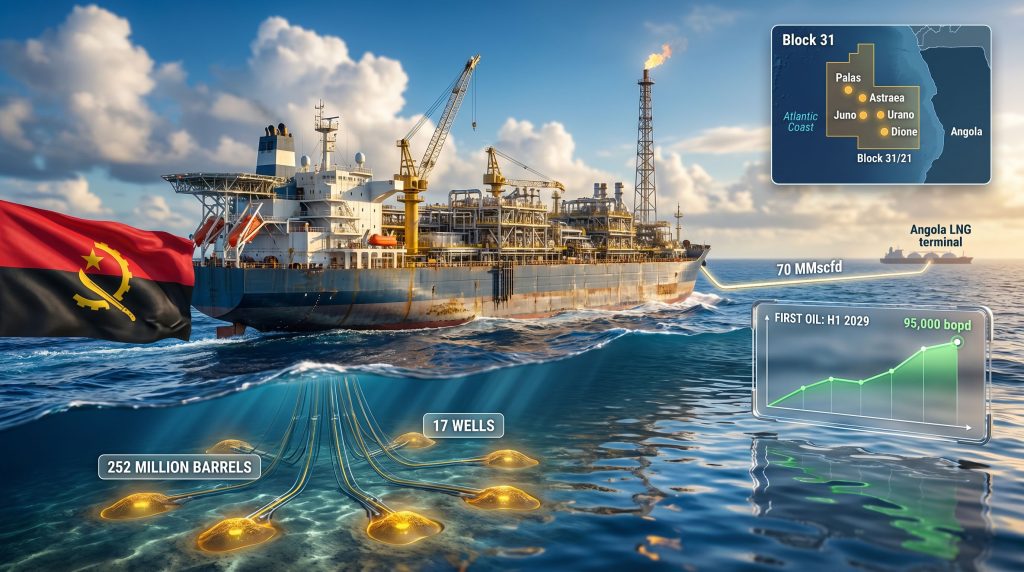
The five constituent fields break down across two deepwater blocks off Angola's Atlantic coast:
- Block 31: Palas, Astraea, and Juno
- Block 31/21: Urano and Dione
By tying all five reservoir systems back to a single floating production unit, the project eliminates the need for duplicate surface infrastructure that would otherwise be required under separate block-by-block development. This shared infrastructure logic directly compresses per-barrel capital intensity, which carries significant implications for commodity prices and project economics at a time when deepwater breakeven costs remain under scrutiny by both operators and their capital market counterparts.
The Regulatory Innovation Underpinning Cross-Block Development
What makes this project genuinely novel is not the engineering, which reflects proven West African deepwater practice, but rather the regulatory and contractual framework required to enable production coordination across two separately licensed concessions. Historically, block boundaries in Angola, as in most petroleum jurisdictions, have served as hard commercial and legal dividing lines. Coordinating reservoir drainage, well planning, and revenue allocation across those lines requires deliberate institutional architecture.
Angola's national hydrocarbon authority, ANPG, participates directly as an equity partner in Greater PAJ alongside Sonangol E&P, Equinor, and operator Azule Energy. This structure is notable because ANPG's dual role as both regulator and participant creates a built-in alignment of interests in making the cross-block framework function. Furthermore, whether this model becomes a template for future multi-concession proposals elsewhere in West Africa will depend on how effectively it performs operationally and commercially over the project's early production life.
Technical Specifications: How the Development Actually Works
FPSO Design and Production Capacity
The central infrastructure node for Greater PAJ is a newly constructed FPSO vessel with a nameplate oil processing capacity of 95,000 barrels of oil per day. This vessel will receive production from all five fields via subsea tieback connections and will handle initial processing, storage, and offloading functions.
Beyond crude oil, the FPSO is engineered to export up to 70 MMscfd of associated natural gas, a specification that reflects the project's deliberate design around zero routine flaring. In modern deepwater developments, gas handling capacity is no longer an afterthought. It is a core design parameter driven by both commercial opportunity and ESG commitments that now materially affect access to international financing. The broader push toward decarbonisation economics is increasingly shaping how operators structure these gas handling commitments from the outset.
Subsea Infrastructure and Well Program
The development program encompasses 17 wells distributed across both concession areas. These wells will be connected to the FPSO through subsea tieback architecture, with the Urano and Dione fields in Block 31/21 linked into the established Block 31 subsea network rather than requiring an entirely new infrastructure corridor.
This tieback strategy delivers two compounding efficiency benefits:
- Capital cost reduction by avoiding duplication of subsea manifolds, flowlines, and control systems across block boundaries.
- Reduced environmental footprint per barrel by concentrating surface infrastructure on a single vessel rather than spreading it across multiple platforms or FPSOs.
Key Technical Specifications at a Glance:
Metric Detail Total Fields 5 (Palas, Astraea, Juno, Urano, Dione) Concession Areas Block 31 and Block 31/21 Total Well Count 17 wells FPSO Oil Capacity 95,000 bopd Gas Export Capacity 70 MMscfd Gas Destination Angola LNG (ALNG) facility FID Date June 2026 First Oil Target H1 2029
Gas Monetisation via Angola LNG
Associated gas from Greater PAJ production will travel through a new export pipeline connecting into the existing Block 31 gas export network, ultimately routing to the Angola LNG processing facility. The Angola LNG plant, located near Soyo at the mouth of the Congo River, has historically processed associated gas from deepwater Block 18 and Block 31 operations. Greater PAJ's integration into this existing corridor avoids stranded gas scenarios and gives the project a clear commercial pathway for its hydrocarbon stream beyond crude oil.
This matters strategically because Angola has faced repeated criticism over historical routine flaring practices. A project that routes its associated gas to a functioning LNG terminal rather than burning it represents a measurable improvement in emissions intensity per barrel of oil equivalent produced. In addition, the energy transition in resource projects is placing increasing pressure on operators to demonstrate credible flaring reduction commitments as a condition of accessing international capital.
Reserve Base and Production Economics
A Resource Position That Commands Attention
Recoverable reserves across the five Greater PAJ fields are estimated at approximately 252 million barrels of oil. That volume positions this project among Angola's most consequential deepwater sanctions of the current decade and provides the reserve foundation against which the $5.1 billion capital program can be evaluated.
A straightforward development cost calculation yields an implied capex intensity of roughly $20 per recoverable barrel before accounting for operating expenditure. For context, deepwater developments in West Africa have historically ranged from the high teens to above $30 per barrel depending on water depth, reservoir complexity, and infrastructure proximity. Greater PAJ's figure, if it holds through execution, sits at a competitive point within that range.
According to Azule Energy's company presentation, the project represents one of the most significant capital commitments in Angola's deepwater sector this decade.
It is important to note that these development cost estimates represent pre-FID projections and are subject to cost escalation, execution delays, and reservoir performance uncertainty. Investors and analysts should treat forward-looking production and cost figures as indicative rather than guaranteed.
Production Timeline and Commercial Longevity
The project's development schedule is structured around a sub-three-year path from FID to first oil, with the June 2026 sanction decision targeting first production in the first half of 2029. This timeline is achievable in a deepwater context primarily because much of the subsea infrastructure leverages existing Block 31 systems, reducing new-build scope and associated procurement lead times.
Production Lifecycle Summary:
Milestone Timing Final Investment Decision June 2026 First Oil Target H1 2029 Peak Production Forecast Around 2028-2029 Projected Commercial Life End Through 2054
A production horizon extending to 2054 is a particularly significant data point for long-cycle capital planning. It means Greater PAJ is not simply a near-term production replacement tool; it is a decades-long revenue-generating asset that will span multiple commodity price cycles. This longevity underpins the investment rationale for all equity participants, including international oil companies managing portfolio decline rates and Angola's national institutions managing sovereign revenue forecasts.
It is also worth noting that earlier preliminary estimates from 2024 referenced a smaller version of the project, sometimes described as the PAJ Complex, with a capital cost around $4.18 billion and an earlier first oil target of 2026. The June 2026 FID confirms a materially expanded scope at $5.1 billion, incorporating broader field integration across both blocks. The cost increase reflects the addition of Urano and Dione in Block 31/21 and the associated subsea and pipeline infrastructure required to connect them.
Angola's Deepwater Context: Why Greater PAJ Arrives When It Does
Addressing Structural Production Decline
Angola's crude oil output has faced persistent downward pressure as its flagship deepwater fields, many of which came online between 2005 and 2015, move through their natural production decline curves. The country's OPEC production quota has at times been difficult to meet not because of policy constraints but because of reservoir depletion at existing assets.
New deepwater FIDs therefore carry significance beyond individual project economics. Each sanction decision represents a future production increment that Angola's government is counting on to sustain export revenues, which remain the primary funding mechanism for the national budget. Greater PAJ's 95,000 bopd nameplate capacity is a meaningful contribution in this context, representing a production addition that could partially offset decline at aging assets in the deeper portion of the production curve.
What the Cross-Block Model Could Mean for West Africa
The regulatory framework enabling Greater PAJ's cross-block integration has potential implications that extend beyond this single project. Several West African petroleum jurisdictions hold discovered resources that are subeconomic as standalone block developments but could become viable if adjacent block operators were permitted to pool infrastructure and coordinate development planning.
Furthermore, the shifting geopolitical landscape in mining and resource extraction across sub-Saharan Africa is prompting national governments to look more favourably upon frameworks that maximise resource utilisation while retaining meaningful state equity participation.
If Greater PAJ demonstrates that cross-concession integration can be executed efficiently, it could encourage Angola's regulators and peers elsewhere in the region to develop standardised contractual mechanisms for multi-block development proposals. This is a speculative but plausible pathway, and it represents one of the less-discussed dimensions of why this project carries significance beyond its own production numbers.
Azule Energy and the Partner Ecosystem
Angola's Largest Independent Producer Takes the Lead
Azule Energy was formed in 2022 through the full combination of Eni and bp's Angolan upstream portfolios, creating a single operating entity that became Angola's largest independent oil and gas producer from day one. Current production through Azule's existing portfolio runs at approximately 115,000 barrels of oil per day.
Greater PAJ at peak output could add up to 95,000 bopd on top of that base, implying a potential increase of more than 80% relative to Azule's current production footprint assuming all other portfolio variables remain constant. In practice, natural decline at existing assets will partially offset any incremental production gain, but the order of magnitude signal remains meaningful.
Azule's project pipeline in Angola extends beyond Greater PAJ to include the Agogo FPSO development and participation in the New Gas Consortium, which is designed to supply additional volumes to Angola LNG. Greater PAJ's gas export arrangements are consequently not isolated but fit within a broader, coordinated gas monetisation strategy across Azule's Angola portfolio.
Partners Aligned Around a $5.1 Billion Program
The structure of joint ventures and asset sales across West Africa's resource sector has evolved considerably in recent years, and Greater PAJ's partner ecosystem reflects this trend toward multi-party risk distribution on large-scale capital programmes.
| Partner | Role |
|---|---|
| Azule Energy (Eni + bp JV) | Operator |
| Sonangol E&P | Equity partner, national interest representative |
| Equinor | Equity partner |
| ANPG | Equity partner and regulatory authority |
Equinor brings deepwater operational experience from its Norwegian Continental Shelf heritage and a track record in West African deepwater environments. Sonangol E&P serves as both commercial co-investor and the vehicle through which the Angolan state retains equity exposure to production revenues. The multi-party structure distributes development risk across the $5.1 billion capital program while aligning all participants behind a common execution timeline.
The next major ASX story will hit our subscribers first
Frequently Asked Questions: Greater PAJ Project Offshore Angola
What is the Greater PAJ project offshore Angola?
It is a $5.1 billion deepwater oil and gas development integrating five separate field discoveries across Blocks 31 and 31/21 offshore Angola. The project uses a single FPSO as its central production hub, with 17 subsea wells tied back from both concession areas.
When is first oil expected from Greater PAJ?
The project targets first oil in the first half of 2029, approximately two and a half to three years following the June 2026 Final Investment Decision.
Who operates Greater PAJ and who are the partners?
Azule Energy operates the project. Equity partners include Sonangol E&P, Equinor, and ANPG. Azule Energy is itself a joint venture formed from the merger of Eni and bp's Angolan upstream businesses in 2022.
How much oil can Greater PAJ produce?
The FPSO has a nameplate processing capacity of 95,000 barrels of oil per day. Total recoverable reserves across all five fields are estimated at approximately 252 million barrels.
How does the project handle associated natural gas?
Associated gas is exported through a new pipeline connecting into the existing Block 31 gas export network, routing ultimately to the Angola LNG facility. This eliminates routine flaring and creates a second commercial revenue stream alongside crude oil.
What makes Greater PAJ Angola's first cross-block development?
It is the first project in Angola to formally coordinate hydrocarbon production, subsea infrastructure, and development planning across two separately licensed deepwater concessions under a single unified framework. The structure required deliberate regulatory accommodation and contractual innovation between the equity partners and Angola's national institutions.
Greater PAJ in Summary: Key Parameters
Project Fundamentals at a Glance:
Parameter Detail Total Sanctioned Investment $5.1 billion Operator Azule Energy (Eni + bp JV) Equity Partners Sonangol E&P, Equinor, ANPG Recoverable Reserves ~252 million barrels Peak Oil Production Capacity ~95,000 bopd Gas Export Capacity 70 MMscfd First Oil Target H1 2029 Production Life Through 2054 Development Innovation Angola's first integrated cross-block deepwater project
The Greater PAJ project offshore Angola signals something broader than a single capital allocation decision. It demonstrates that Angola's deepwater fiscal and regulatory environment continues to attract multi-billion-dollar, long-cycle investment commitments from major international operators even as energy transition narratives place increasing pressure on long-dated oil developments globally. For the deepwater sector across West Africa, Greater PAJ offers both a technical template and a commercial proof of concept: that integrating adjacent concessions under shared infrastructure can unlock resource volumes that would otherwise remain stranded behind the artificial lines of block boundaries.
This article contains forward-looking statements regarding production timelines, reserve estimates, and development costs. These projections are subject to material risks including commodity price volatility, execution delays, reservoir performance uncertainty, and regulatory changes. Nothing in this article constitutes financial or investment advice.
For ongoing coverage of Angola's deepwater energy sector and upstream developments across Africa, World Oil's Africa coverage at worldoil.com provides regularly updated industry reporting.
Want to Stay Ahead of the Next Major Resource Discovery?
Discovery Alert's proprietary Discovery IQ model scans ASX announcements in real time, instantly identifying significant mineral discoveries and turning complex data into actionable investment insights — explore historic discoveries and the returns they generated, then begin your 14-day free trial to position yourself ahead of the broader market.