
July 18, 2026
India's Coal Heartland: How One Conglomerate Is Reshaping Chhattisgarh's Resource Landscape
Few forces reshape a region's ecological and economic character as profoundly as large-scale coal extraction. Across India's central plateau, where dense forests overlap with some of the country's most significant thermal coal deposits, a quiet but consequential transformation has been underway for over a decade. Chhattisgarh sits at the centre of this story, and the expanding footprint of Adani subsidiaries mining projects in Chhattisgarh has become one of the most closely watched developments in Indian energy and environmental policy.
Understanding what is actually happening across these projects requires moving beyond headline figures. The architecture of subsidiary structures, the mechanics of forest diversion law, and the ecological sensitivities embedded within each mine site all tell a far more layered story than aggregate reserve numbers alone.
When big ASX news breaks, our subscribers know first
The MDO Model: Private Capital, Public Ownership, and Operational Control
The Mine Developer and Operator framework is the structural mechanism that has enabled Adani subsidiaries mining projects in Chhattisgarh to expand without requiring direct ownership of coal block allocations. Under this arrangement, a public sector undertaking or state-linked utility retains nominal title to the coal block, while the private MDO partner assumes full responsibility for project development, capital expenditure, workforce deployment, and day-to-day operations.
For large conglomerates, the MDO model offers a distinct set of strategic advantages:
- It bypasses the competitive commercial auction process for coal block allocation
- It creates long-term contractual revenue arrangements with state power utilities
- It reduces direct regulatory exposure associated with block ownership
- It enables rapid scaling across multiple projects within a single state using a consistent operational template
The primary vehicle for this strategy is Adani Mining Pvt Ltd, a wholly owned subsidiary of Adani Enterprises Limited, though several project-specific entities have also been established for individual blocks. Furthermore, Adani Enterprises' mining operations span multiple states, with Chhattisgarh representing the most operationally complex geography in the portfolio.
What makes the MDO structure particularly significant from an analytical perspective is the cross-state complexity it generates. A Rajasthan state power utility can own a coal block in Chhattisgarh, operated by a Gujarat-headquartered conglomerate's subsidiary, supplying power to consumers in an entirely different region. This arrangement is not incidental — it is the deliberate architecture of India's coal supply system, and it creates accountability gaps that regulators and environmental bodies continue to navigate.
Chhattisgarh Coal Portfolio: Seven Blocks, Two Districts, Enormous Scale
The full scale of Adani subsidiaries' coal operations across Chhattisgarh only becomes apparent when the projects are mapped together. The portfolio spans two primary districts, Surguja in the north and Raigarh in the east, with each cluster presenting distinct operational, ecological, and regulatory profiles.
| Coal Block | District | Status | Mineable Reserves | Peak Capacity | Operating Entity |
|---|---|---|---|---|---|
| Parsa East & Kanta Basan (PEKB) | Surguja | Operational (since 2013) | 452 million MT | 15 MMTPA | Adani Mining (MDO for RRVUNL, 74% JV) |
| Parsa | Surguja | Under Development | 184 million MT | 5 MMTPA | Adani Mining (MDO for RRVUNL) |
| Kente Extension | Surguja | Exploration Phase | 170 million MT | 7 MMTPA | Adani Mining (MDO for RRVUNL) |
| Gidhmuri Paturia | Raigarh | Under Development | 158 million MT | 5.6 MMTPA | Gidhmuri Paturia Collieries Pvt Ltd (Adani 74%) |
| Gare Pelma-I | Raigarh | Conditional LOI Received | 427 million MT | 15 MMTPA | Adani Natural Resources (MDO for CSPGCL) |
| Gare Pelma-II | Raigarh | Environmental Clearance Granted (Aug 2024) | 655 million MT | 23 MMTPA | Gare Palma II Collieries Pvt Ltd (MDO for MAHAGENCO) |
| Gare Pelma-III | Raigarh | Operational (since 2019) | 134 million MT | 5 MMTPA | Gare Pelma III Collieries Ltd (MDO for CSPGCL) |
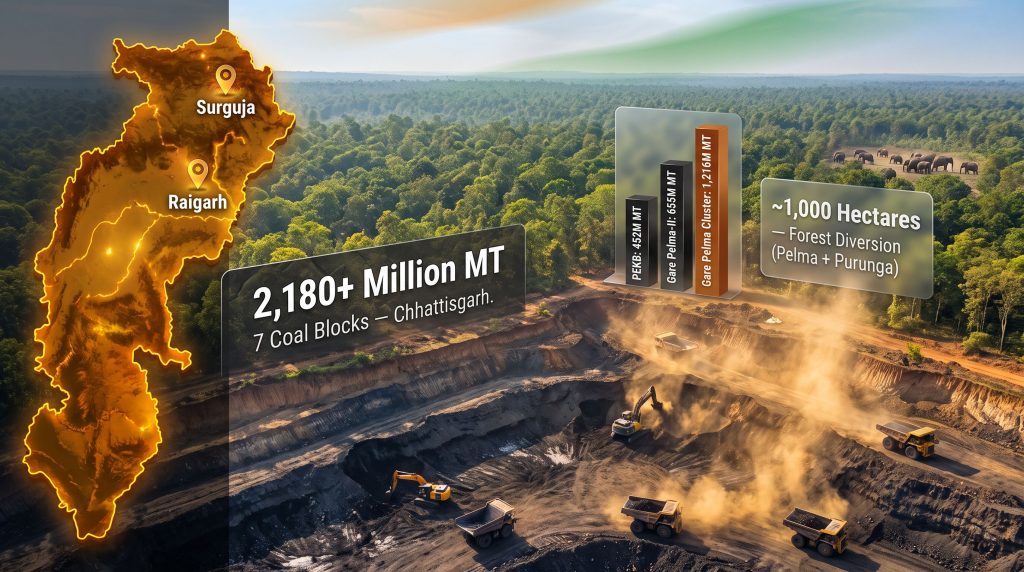
The combined mineable reserves across these seven blocks exceed 2,180 million metric tonnes, with a theoretical peak combined production capacity of more than 70 MMTPA. The Gare Pelma cluster alone, comprising three blocks in Raigarh's Tamnar tehsil, holds over 1,216 million MT of mineable coal, making it one of the most reserve-rich coalfield concentrations under any private MDO arrangement in the country.
The Gare Pelma-II block, at 655 million MT of mineable reserves and a sanctioned peak capacity of 23 MMTPA, is individually comparable in scale to entire coalfield regions in some states.
The Pelma Open Cast Mine: Forest Diversion in a High Conservation Value Zone
The Pelma open cast mine in Raigarh's Tamnar tehsil represents the most ecologically complex of the recently approved projects. The Forest Advisory Committee of the Ministry of Environment, Forest and Climate Change recommended Stage-I in-principle approval for the diversion of over 360 hectares of forest land at its July 7, 2026 meeting.
What Makes the Pelma Site Ecologically Significant?
The classification of the Pelma site as a High Conservation Value (HCV) zone is not a routine designation. HCV classification indicates that the forest patches proposed for diversion are very dense and ecologically significant, placing the project in a category that typically triggers heightened scrutiny during the approval process.
Several overlapping ecological risk factors are documented in FAC meeting records:
- Mining operations will require the felling of more than 52,000 trees
- The project boundary sits directly adjacent to the Kelo River, creating documented risk to riparian ecosystems and groundwater recharge zones
- Active elephant movement has been recorded in and around the proposed diversion area, raising wildlife corridor disruption concerns
- The forest patches to be cleared include very dense natural cover, not plantation or degraded secondary forest
The FAC accepted the state government's submission that the project is inherently site-specific, meaning no alternative location exists for an open cast mine tied to a fixed geological deposit. This reasoning has been applied consistently across multiple Chhattisgarh coal approvals and reflects an established interpretive principle within Indian forest diversion jurisprudence.
Stage-I vs. Stage-II: What Approval Actually Authorises
A persistent misconception in public discourse around forest clearances is that Stage-I approval permits physical forest clearance to begin. It does not. The two-stage process works as follows:
- The project proponent submits a forest diversion proposal through the state government to the MoEFCC
- The Forest Advisory Committee reviews the proposal, including wildlife assessments and site visit reports
- Stage-I (In-Principle) Approval is issued, subject to binding conditions including compensatory afforestation and NPV deposit
- The project proponent must demonstrably satisfy all Stage-I conditions before Stage-II can be applied for
- Stage-II (Formal Diversion Approval) is the clearance that actually authorises physical land clearance and tree felling
- Only after Stage-II is granted may construction and surface preparation activities commence on forest land
The Pelma and Purunga projects are currently at Stage-I. Physical forest clearance, including the felling of the 52,000-plus trees at Pelma, cannot lawfully commence until Stage-II approval is formally granted.
The Purunga Underground Block: Ambuja Cements, Captive Coal, and Subsidence Risk
The second project to receive FAC Stage-I recommendation involves the Purunga underground coal block, proposed for operation by Ambuja Cements Limited, an Adani Group subsidiary. The project requires diversion of over 620 hectares of forest land, making it the larger of the two projects by forest impact area.
Vertical Integration Through Captive Mining
The Purunga block's strategic function within the broader Adani ecosystem is worth examining separately from its environmental parameters. By securing a captive coal source for cement manufacturing, Ambuja Cements reduces its structural dependence on Coal India Limited linkages and open market coal procurement. This vertical integration model directly lowers input cost volatility for cement operations — a significant competitive consideration given that energy costs represent a substantial share of cement manufacturing expense.
Captive coal blocks for non-power industrial users have become increasingly sought after in India's post-2015 reformed coal allocation environment, and the Purunga block represents a textbook application of this strategy. Consequently, the assessment of mining project feasibility across these developments must account for both the regulatory and ecological complexity involved.
The Tensile Strain Problem: A Technical Risk Less Commonly Understood
Underground mining creates a category of surface risk that receives far less public attention than open cast forest clearance: tensile strain. As underground coal extraction creates voids beneath the surface, the overlying earth layer does not simply collapse vertically — it also stretches horizontally, a process technically described as tensile strain.
For the Purunga block, FAC documentation records a projected tensile strain of 4.48 mm/m. In practical terms, this means every one metre of surface ground above the underground workings could deform by more than four millimetres of horizontal displacement.
At 4.48 mm/m, the Purunga block's projected tensile strain falls within a range that requires engineered surface protection protocols and ongoing monitoring. Unlike open cast tree felling, subsidence-related damage can emerge progressively over years, affecting forest cover and drainage patterns in ways that are difficult to reverse.
The FAC has attached specific contingency conditions to address this risk:
- Appropriate mitigation measures must be implemented by the state government, funded by Ambuja Cements as the project proponent
- If actual subsidence exceeds modelled predictions, the proponent must pay the Net Present Value (NPV) of the ecologically diverted forest area
- Compensatory afforestation under MoEFCC guidelines must be conducted if subsidence-related damage materialises
- The project proponent must coordinate with the Chhattisgarh Forest Department for any additional safety measures required
Understanding NPV in the Forest Diversion Context
Net Present Value, as applied in Indian forest diversion law, is not a financial investment metric in this context. It refers to the monetised ecological value of the forest area being diverted, calculated based on the ecosystem services that forest provides: carbon sequestration, biodiversity support, water regulation, and soil protection.
Project proponents must deposit NPV amounts as a form of financial penalty for ecological loss. Environmental economists have consistently noted that existing NPV calculation methodologies systematically undervalue complex natural forest ecosystems — a concern closely tied to how natural capital in mining contexts is assessed globally, particularly in biodiversity-rich zones like those across Chhattisgarh's central coalfields.
Combined Forest Impact: Nearly 1,000 Hectares and What It Actually Means
| Environmental Metric | Pelma Mine | Purunga Block | Combined |
|---|---|---|---|
| Forest land for diversion | 360+ hectares | 620+ hectares | ~1,000 hectares |
| Mining method | Open Cast | Underground | Mixed |
| Trees confirmed for felling | 52,000+ | Not yet specified | 52,000+ (minimum) |
| Ecological zone | High Conservation Value | Forest land | Mixed designation |
| Adjacent water body | Kelo River | Not specified | Kelo River (Pelma) |
| Wildlife corridor concern | Elephant movement documented | Not specified | Documented at Pelma |
The combined forest diversion figure of approximately 1,000 hectares must be understood in the context of what compensatory afforestation can realistically achieve. Indian forest law mandates planting on equivalent or double the area of diverted land. However, plantation forestry and natural forest are ecologically non-equivalent.
Mature natural forest in Chhattisgarh's HCV zones contains multi-layered canopy structures, complex soil mycorrhizal networks, and wildlife habitat values that take decades or centuries to develop. A plantation of saplings on degraded land, however well maintained, cannot replicate the carbon sequestration density, biodiversity, or watershed functions of the forest it replaces within any policy-relevant timeframe. The mining sustainability transformation agenda globally faces precisely this challenge — compensatory mechanisms that are structurally inadequate to the ecological losses they are intended to offset.
The next major ASX story will hit our subscribers first
Hasdeo Aranya: The Longest-Running Flashpoint in India's Coal Forest Debate
No analysis of Adani subsidiaries mining projects in Chhattisgarh is complete without addressing Parsa East and Kanta Basan (PEKB), the project that has defined national debate around coal mining in ecologically sensitive forests since it commenced production in 2013.
Located within the Hasdeo Aranya forest, a biodiversity corridor spanning approximately 1,70,000 hectares in Surguja district, PEKB operates through a joint venture in which Adani Mining holds a 74% stake. The mine functions as an MDO for RRVUNL (Rajasthan Rajya Vidyut Utpadan Nigam Limited), illustrating the cross-state complexity described earlier.
Key documented facts about the PEKB project's ecological footprint include:
- Over 3.68 lakh trees are affected across the project's full operational area
- The site sits within a critical elephant migration corridor
- The National Green Tribunal has previously intervened to halt operations or review environmental clearances
- The central government reaffirmed project approval in late 2022 despite sustained opposition from tribal communities and environmental groups
- Adani's afforestation program has planted approximately 1.6 million trees, though this has not resolved the ecological and tribal rights concerns associated with the project's forest impact
The PEKB project also illustrates a wider tension in India's coal policy. The state's simultaneous commitments to energy security, forest conservation, and tribal rights and mining under legislation such as the Forest Rights Act and the Panchayats (Extension to Scheduled Areas) Act (PESA) cannot always be reconciled without one set of interests yielding to another.
Iron Ore Operations: The Bailadila Case and the Limits of MDO Contracts
Beyond coal, Adani subsidiaries hold two iron ore mining contracts in Chhattisgarh. The Bailadila Deposit No. 13 mine, held under an MDO contract with NMDC in Nandiraj Hill, was suspended by the state government in 2020 following large-scale protests by tribal communities asserting rights under the Forest Rights Act and PESA.
The Bailadila case is analytically important because it demonstrates that MDO contract execution is not insulated from state-level political dynamics. Despite holding a valid operational contract, Adani has not commenced mining at Bailadila, and the project remains suspended in publicly available records.
This outcome challenges a common assumption that MDO arrangements with PSU counterparties provide unconditional operational security. Furthermore, Adani's coal mining agenda more broadly has faced similar dynamics in other geographies, where tribal mobilisation, state government decisions, and judicial oversight remain capable of halting projects that have otherwise satisfied central regulatory requirements.
Regulatory Architecture: Why the Process Matters as Much as the Outcome
The forest and environmental clearance framework governing these projects is not merely procedural. Each stage of the approval process generates legally binding conditions that shape project costs, timelines, and operational risk profiles.
For investors and analysts tracking Adani subsidiaries mining projects in Chhattisgarh, three regulatory variables carry particular weight:
- Stage-I to Stage-II transition timelines: Projects can remain in the Stage-I condition fulfilment phase for years, particularly where compensatory afforestation land identification is contested or delayed
- NPV deposit requirements: Large-scale forest diversions generate significant NPV obligations that represent real capital outflows before any production revenue is earned
- Post-approval litigation risk: Environmental clearances and forest diversion approvals have historically attracted NGT challenges, which can pause or revoke operational permissions even after Stage-II is granted
In addition, the broader implications for resource and energy exports globally are worth noting — regulatory bottlenecks in one major coal-producing nation invariably influence supply expectations and pricing dynamics across international energy markets.
This article contains factual reporting based on publicly available regulatory documents, FAC meeting records, and environmental clearance data. It does not constitute financial advice. Readers should conduct independent due diligence before making investment decisions related to any entity mentioned.
Want to Stay Ahead of the Next Major Mineral Discovery?
Discovery Alert's proprietary Discovery IQ model scans ASX announcements in real time, instantly identifying significant mineral discoveries across more than 30 commodities — from coal to iron ore and beyond — and delivering actionable insights directly to subscribers. Explore how historic discoveries have generated extraordinary returns and begin your 14-day free trial today to position yourself ahead of the broader market.