July 18, 2026
The Chemistry Quietly Disrupting How the World Recovers Critical Metals
For most of the industrial era, recovering metals from discarded electronics has followed the same fundamental logic as primary mining: apply enormous heat, use aggressive chemistry, and accept significant environmental consequences as the cost of doing business. Pyrometallurgical smelting, which operates at temperatures exceeding 1,200°C, has long been the dominant pathway for processing complex e-waste streams. Hydrometallurgical methods, while cooler, rely on hazardous acid leaching systems that generate substantial toxic waste. Both approaches are capital-intensive, centralised, and difficult to replicate at scale outside major industrial processing hubs.
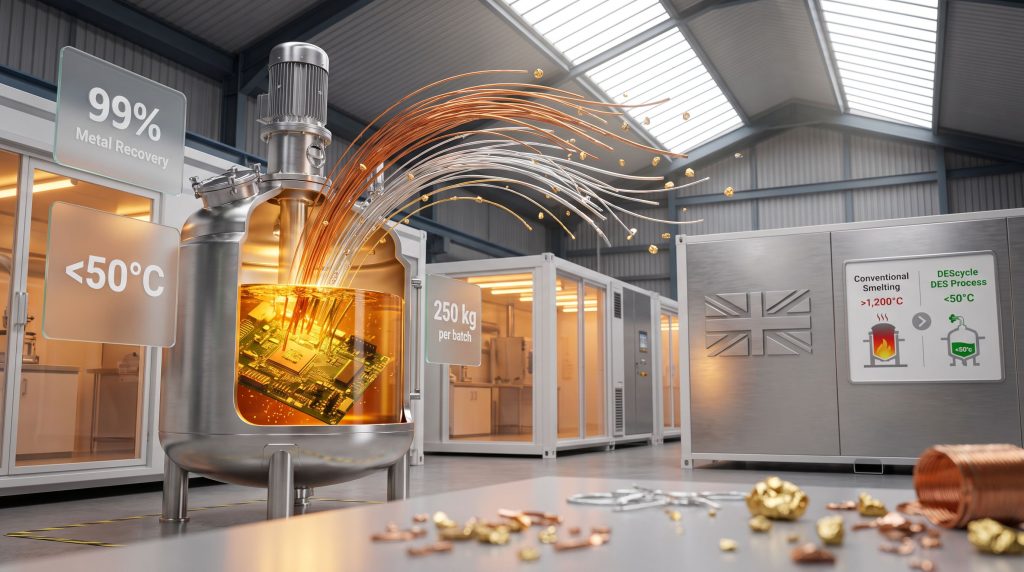
What happens when the fundamental assumption changes? What if metals can be dissolved, separated, and recovered at temperatures below 50°C, in under 15 minutes, without producing toxic byproducts? That is the premise behind deep eutectic solvent (DES) chemistry, and it is the technology now operating inside the DEScycle UK e-waste recycling plant at the Wilton Centre in Teesside, northeast England.
The implications extend well beyond one demonstration facility.
When big ASX news breaks, our subscribers know first
Britain's E-Waste Equation: Value Leaving the Country
Every discarded smartphone, decommissioned server rack, or obsolete circuit board contains measurable quantities of copper, gold, silver, palladium, tin, and aluminium. At the volumes the UK generates, the aggregate material value is substantial. The problem is structural: the UK has historically lacked sufficient domestic processing infrastructure to capture that value before it leaves British shores.
E-waste is routinely exported for overseas processing, transferring not just raw material value but also processing expertise and strategic material control to foreign jurisdictions. UK Waste Minister Mary Creagh has been direct on this point, stating publicly that recovering critical metals domestically is essential for supply chain resilience, resource security, and achieving the country's climate objectives. She has also expressed strong support for homegrown innovation that builds circular economy capacity and reduces reliance on fragile overseas supply chains.
The numbers behind the target are significant. Furthermore, the UK government has set an objective of sourcing 20% of its annual critical minerals demand through domestic recycling by 2035. Meeting that target requires not incremental improvement to existing infrastructure but the development of genuinely new processing capabilities.
How Deep Eutectic Solvents Actually Work
Understanding why the DEScycle UK e-waste recycling plant represents a technological departure requires a brief look at the chemistry involved.
Deep eutectic solvents are formed when two or more solid compounds, typically a hydrogen bond donor and a hydrogen bond acceptor, are combined in specific molar ratios to produce a mixture with a melting point substantially lower than either individual component. The resulting liquid is a non-aqueous, non-toxic solvent capable of selectively dissolving target metals from complex matrices at low temperatures.
This selectivity is commercially important. In a printed circuit board, multiple metals coexist in close physical proximity. A process that can dissolve copper without prematurely attacking gold, or that can be tuned to prioritise specific metal recovery sequences, offers significant downstream processing advantages over brute-force smelting, which indiscriminately melts everything together and requires subsequent separation.
The DEScycle process achieves metal recovery rates exceeding 99% within 15 minutes of processing, at operating temperatures below 50°C and at standard atmospheric pressure. The contrast with conventional alternatives is stark. In addition, approaches such as flash joule heating recycling are also emerging as disruptive alternatives to traditional smelting methods:
| Criteria | Conventional Smelting | Hydrometallurgy | DEScycle DES Process |
|---|---|---|---|
| Operating Temperature | >1,200°C | Variable, often elevated | <50°C |
| Pressure Requirements | High | Moderate to high | Atmospheric |
| Toxic Byproducts | Yes (slag, fumes) | Yes (acid waste) | None reported |
| Water Consumption | Moderate | High | Low |
| Metal Recovery Rate | Variable | Variable | >99% |
| Processing Time | Hours to days | Hours | <15 minutes |
| Carbon Emissions | High | Moderate to high | Significantly lower |
| Scalability Model | Centralised | Centralised | Distributed/modular |
The energy implications alone are considerable. The thermal energy required to sustain smelting at 1,200°C represents one of the largest cost and emissions drivers in conventional e-waste processing. Eliminating that requirement fundamentally changes the economics of metals recovery.
Inside the Teesside Demonstration Plant
The DEScycle UK e-waste recycling plant at the Wilton Centre processes feedstock in 250 kg batches with an annual throughput capacity of 50 to 100 metric tonnes during its demonstration phase. The facility currently holds Technology Readiness Level 7 (TRL7) status, meaning it operates as a system prototype in an operational environment — the critical step between laboratory validation and commercial deployment.
Initial feedstock consists primarily of printed circuit boards sourced through GAP Group, DEScycle's UK joint venture partner. The metals being recovered in this first phase are copper, gold, silver, and palladium, with development work underway to extend recovery capabilities to tin, iron, and aluminium. This e-waste recycling facility model reflects a broader shift in how the UK approaches domestic metals recovery.
The Wilton Centre's history as an industrial research and development hub makes it a strategically appropriate location for a demonstration-scale advanced materials facility. The site provides access to industrial infrastructure, technical expertise, and the kind of operational environment necessary to generate commercially meaningful performance data.
The Teesside facility is designed to function as an operational blueprint, not just a proof-of-concept. Every batch processed generates data that will directly inform the engineering and commercial parameters of the planned commercial-scale plant in Gateshead.
A Three-Pillar Business Model Built for Replication
DEScycle's commercial architecture is structured around three interdependent functions that must operate simultaneously for the model to work:
- Feedstock Supply – Securing consistent, high-value e-waste streams from corporate and industrial sources
- Modular Metals Recovery – Operating standardised processing units that can be replicated across industrial clusters without bespoke engineering at each site
- Downstream Sales and Offtake – Connecting recovered metals to verified end-markets with transparent pricing and supply chain documentation
Each of the three current partnerships tests a different pillar of this model in parallel. GAP Group handles feedstock supply in the UK. Cisco Systems, headquartered in Silicon Valley, is trialling the platform on decommissioned enterprise hardware, testing the feasibility of corporate electronics end-of-life programmes at industrial scale. Mitsubishi Corporation is conducting an offtake study evaluating potential markets for metals produced at Teesside, directly testing the downstream sales component.
The Cisco partnership is particularly significant from a market development perspective. Enterprise hardware refresh cycles have accelerated considerably in recent years, driven by cloud migration, data centre expansion, and AI infrastructure investment. The volumes of decommissioned networking and computing equipment entering the secondary market are increasing, and most existing recycling infrastructure is not optimised to extract the full metal value from complex enterprise electronics. A proven, low-temperature DES recovery process could address that gap at scale.
Mitsubishi's involvement carries different strategic weight. Japan is one of the world's most sophisticated e-scrap processing markets, with well-established urban mining traditions and significant domestic demand for recovered critical metals. An offtake study by a major Japanese trading house validates not just that DEScycle's process produces metals, but that those metals are of sufficient purity and provenance to be commercially marketable in demanding international markets. For context on how larger corporations are approaching critical minerals recycling, the strategic logic is strikingly similar.
The Funding Landscape Supporting UK Critical Minerals Recovery
DEScycle closed a £10.2 million Series A funding round in 2025 to finance the Teesside demonstration plant, with backing from both institutional investors and strategic corporate partners including Cisco and Mitsubishi Corporation. DEScycle's Series A raise marks a significant milestone for deep-tech e-waste ventures in the UK.
In parallel, UK Industry Minister Chris McDonald unveiled a broader £50 million (~$67 million USD) critical minerals investment package during a visit to the Teesside facility. The allocation is structured as follows:
| Allocation | Amount (GBP) | Amount (USD Approx.) | Purpose |
|---|---|---|---|
| Critical mineral extraction, processing and recycling | £25 million | ~$33.5 million | Domestic supply chain development |
| Critical minerals demand consolidation | £5 million | ~$6.7 million | Industry demand aggregation |
| National rare earth magnets hub | £20 million | ~$26.8 million | Magnet supply chain infrastructure |
| Total | £50 million | ~$67 million | UK critical minerals strategy |
The allocation is instructive. Half of the total package is directed at extraction, processing, and recycling, placing secondary supply on equal strategic footing with primary extraction in UK government minerals policy. This represents a meaningful shift from previous frameworks that treated recycling primarily as an environmental compliance issue rather than a supply security instrument.
It is important to note that the £50 million package represents a broader government investment in UK critical minerals strategy rather than direct funding allocated specifically to DEScycle's facility.
The next major ASX story will hit our subscribers first
From Teesside to Gateshead: The Commercial Scale-Up Pathway
The Teesside demonstration plant is explicitly designed as a stepping stone rather than an endpoint. DEScycle's published roadmap outlines a phased expansion strategy. Consequently, the critical minerals processing sector is watching this scale-up trajectory closely.
Phase 1 – Demonstration (Current, 2026)
- Teesside plant operational at 50 to 100 tonnes per year
- Processing batches from GAP Group, Cisco, and other partners
- Generating operational data to validate commercial parameters
- TRL7 status confirming industrial-environment operation
Phase 2 – Commercial Deployment (Target: 2028)
- Gateshead facility targeting 5,000 metric tonnes per year
- Approximately 50 to 100 times the demonstration plant's current throughput
- Informed by Teesside performance data and Mitsubishi offtake study findings
- Designed as a replicable template for international rollout
Phase 3 – International Expansion
- Target markets include the United States, Europe, and Japan
- Modular design enables deployment across diverse industrial cluster environments without bespoke engineering
- Cisco and Mitsubishi partnerships provide early commercial anchors in key target markets
The jump from 100 tonnes to 5,000 tonnes per year is not a trivial engineering exercise. Scaling DES-based processes requires careful management of solvent regeneration cycles, metal separation downstream, and waste stream handling. One of the primary functions of the Teesside plant is to generate the performance data that will answer those engineering questions before they become commercial liabilities at Gateshead.
Why the Modular Model Changes the Strategic Calculus
The conventional assumption in metals processing is that scale drives efficiency, and that scale requires centralisation. Large smelters concentrate enormous processing volumes at single locations, justifying capital investment through throughput. The DEScycle model inverts this logic by designing for distributed replication rather than centralised concentration.
A modular DES processing unit that can be deployed at existing industrial sites, connected to local e-waste streams, and operated without specialist high-temperature infrastructure changes who can participate in critical minerals recovery. It opens processing capacity to industrial clusters that would never justify a smelter but can accommodate a modular recycling installation. Chemical Engineering Online's coverage of the Teesside opening highlights precisely why this modular approach has drawn such significant industry attention.
This has meaningful implications for supply chain resilience. A distributed network of recovery installations is inherently less vulnerable to single points of failure than a handful of centralised smelters. It also reduces the logistics burden of moving e-waste long distances to processing hubs, which itself carries both cost and environmental consequences.
As the UK, European Union, and United States each intensify efforts to reduce dependence on concentrated critical mineral supply chains, the policy environment for distributed, low-impact domestic recovery technologies is likely to become increasingly supportive through the remainder of the decade.
This article contains forward-looking statements regarding commercial timelines, processing capacities, and expansion plans. Actual outcomes may differ materially from projections based on technical, commercial, regulatory, and market factors. This content is informational only and does not constitute financial or investment advice.
For further coverage of technology metals, processing innovation, and critical mineral supply chain developments across global markets, visit Metal Tech News.
Want to Track the Next Big Critical Minerals Discovery Before the Market Does?
Discovery Alert's proprietary Discovery IQ model delivers real-time alerts on significant ASX mineral discoveries, instantly turning complex data across 30+ commodities into clear, actionable insights — explore Discovery Alert's discoveries page to see the historic returns major discoveries have generated, then begin your 14-day free trial to position yourself ahead of the broader market.