July 17, 2026
Africa's LNG Frontier and the Industrial Policy Crossroads
Every major resource boom in history has presented a binary outcome for the host nation: transformative domestic industrialisation or the perpetuation of an extractive economy that exports raw wealth while importing finished capability. Mozambique now stands at precisely this junction, with a legislative framework that could redefine how African nations negotiate the terms of energy investment — but only if the private sector rises to meet the opportunity on commercial terms.
The Mozambique LNG local content law enacted in 2026 is not the beginning of this story. It is, rather, the product of decades of incomplete policy experiments across Africa's resource corridor, each one attempting to answer the same fundamental question: how does a developing economy capture durable value from a finite natural endowment? Understanding this context is essential when evaluating the industry evolution trends that now shape Mozambique's legislative approach.
When big ASX news breaks, our subscribers know first
The Rovuma Basin: Scale, Geology, and Global Significance
The Rovuma Basin's emergence as a world-class gas province was not accidental. Located in deep offshore waters off Mozambique's northern Cabo Delgado province, the basin benefits from a geological configuration that concentrated enormous volumes of natural gas within relatively accessible reservoir structures. The Atum and Mamba field complexes, central to both Area 1 and Area 4 developments, contain recoverable gas resources estimated in the range of 100 trillion cubic feet combined, placing them among the most significant offshore discoveries made anywhere in the world during the past two decades.
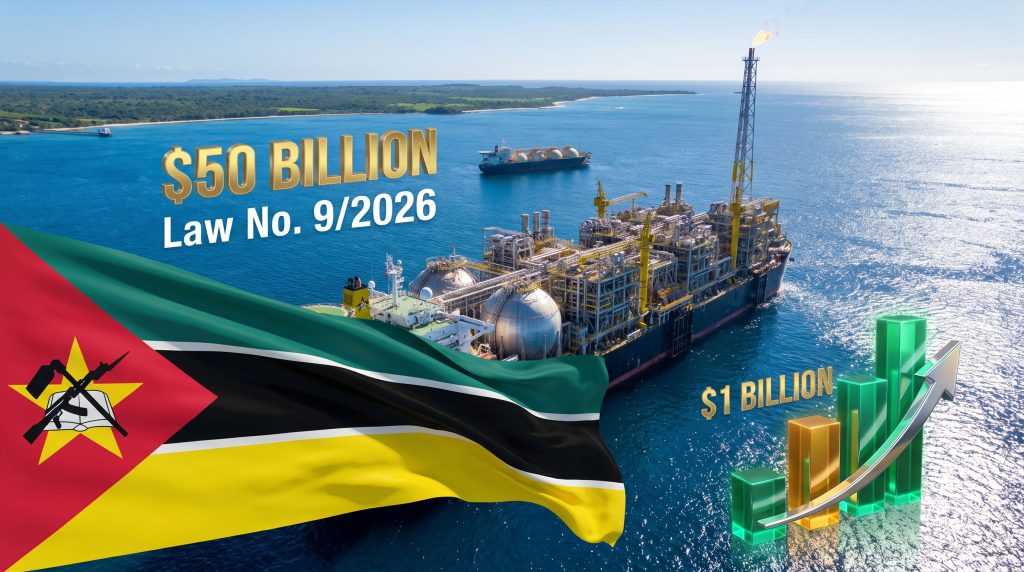
This geological endowment has attracted a concentration of supermajor capital that is almost without precedent for a sub-Saharan African country outside Nigeria or Angola. Total planned investment across Rovuma Basin projects now exceeds $50 billion, spanning four major development schemes at various stages of execution. Furthermore, the LNG supply outlook for the region positions Mozambique as a critical node in the global energy transition.
Active and Upcoming LNG Projects in the Rovuma Basin
| Project | Operator | Status | Key Metric |
|---|---|---|---|
| Coral Sul FLNG | Eni | Operational since 2022 | First LNG exports established |
| Coral Norte FLNG | Eni | Under development | $7.2 billion; production targeted from 2028 |
| Mozambique LNG (Area 1) | TotalEnergies | Resuming after security disruptions | $20 billion project |
| Rovuma LNG | ExxonMobil | Advancing development plans | Significant reserve base |
The Coral Sul floating LNG facility deserves particular attention as a technical and commercial milestone. Floating LNG technology, or FLNG, involves processing, liquefying, and storing gas entirely offshore on a purpose-built vessel, eliminating the need for onshore processing infrastructure in regions where security, logistics, or environmental constraints complicate land-based development. For Mozambique, where the Cabo Delgado insurgency disrupted onshore operations significantly from 2017 onward, the FLNG model demonstrated a critical pathway to production continuity.
The success of Coral Sul in beginning exports in 2022 effectively proved the basin's commercial viability and provided the political and economic foundation upon which Mozambique's local content legislative push has since been built.
What Law No. 9/2026 Actually Changes and Why It Matters
Prior to the passage of Mozambique's new legislation, local content obligations in the extractive sector existed primarily as a fragmented collection of instruments. Decree-Law 2/2014 and Ministerial Diploma DM 55/2024 addressed specific procurement and employment requirements, while concession-specific conditions embedded in the Special Legal and Contractual Regime governed Area 1 and Area 4 operations. The critical deficiency of this architecture was its inconsistency: obligations varied by project, enforcement was diffuse, and international operators faced no unified accountability mechanism.
Law No. 9/2026, approved by Mozambique's National Assembly on 3 June 2026 and subsequently signed into law by President Daniel Chapo, resolves this fragmentation by establishing a single enforceable statute that applies universally across oil, gas, and LNG operations. For the first time in the country's legislative history, the mandatory participation of national companies and workers is codified with the force of law rather than embedded in project-specific contractual conditions.
Core Compliance Requirements Under the New Framework
| Compliance Dimension | Specific Obligation |
|---|---|
| National Labor Recruitment | Preferential hiring of Mozambican workers with embedded knowledge transfer requirements |
| Local Procurement Priority | Mozambican-produced goods and services must receive preference over equivalent international alternatives |
| Exclusivity Qualification | Eligible for exclusive local procurement if: national inputs ≥80%, or Mozambican ownership ≥40%, or predominantly national payroll |
| Annual Local Content Plan | Mandatory submission to the Local Content Agency each year |
| State Participation Floor | Minimum 15% state participation across covered projects |
| Domestic Market Quota | Mandatory 25% domestic market allocation embedded in the regulatory structure |
| Technology Transfer | Explicit mandates for knowledge transfer and structured training in megaproject contexts |
The exclusivity qualification framework is among the most technically sophisticated elements of the law. By defining eligibility through measurable thresholds tied to ownership structure, input sourcing, and payroll composition, the legislation creates objective criteria that reduce the scope for opportunistic compliance by nominally local entities that are, in practice, foreign-controlled.
The Enforcement Architecture: Agency Powers and Penalty Structures
Legislative intent is only as effective as the institutional machinery built to enforce it. Law No. 9/2026 establishes a dedicated Local Content Agency with certification authority, compliance monitoring responsibility, and meaningful enforcement powers. This is architecturally distinct from previous arrangements in which enforcement was distributed across multiple sectoral regulators without a unified oversight mandate. Indeed, the draft law foreseeing the creation of this agency was debated for nearly a decade before reaching its final form.
The Agency's certification function is commercially significant: Mozambican suppliers seeking preferential or exclusive procurement consideration must obtain formal certification, creating a structured qualification pathway that raises the overall quality standard within the domestic supplier base over time.
Regulatory Warning: The penalty regime introduced under Law No. 9/2026 represents a material escalation in enforcement severity. Non-compliant operators face:
- Financial penalties of up to USD 300,000
- Contract cancellations affecting active project participation
- Loss of applicable tax benefits embedded in concession agreements
- Exclusion from future procurement processes
- Suspension of operating licenses
The cumulative commercial exposure from these combined sanctions extends well beyond the headline penalty figure. For operators managing multi-billion-dollar project budgets, the reputational and contractual consequences of licence suspension or exclusion from future bidding could represent costs orders of magnitude larger than the direct financial penalty.
The Competitiveness Imperative: Why Legal Access Is Not Commercial Participation
The most intellectually honest assessment of Mozambique's local content legislation acknowledges a gap that no law can close by itself. Eni Mozambique's General Manager, Marica Calabrese, articulated this tension directly at the 21st Annual Private Sector Conference (CASP) in Maputo, making the case that domestic businesses cannot treat legislative protection as a substitute for commercial competitiveness. Her position was that each company must invest in its own capability development rather than relying on regulatory mandates to guarantee contract access.
This perspective reflects a structural reality that international energy project operators face regardless of local content law. The qualification standards applied by supermajors across their global supply chains are not arbitrary: they exist because LNG megaprojects operate under engineering tolerances, safety protocols, and delivery schedules where contractor underperformance can translate into billions of dollars in delay costs and, in the worst cases, catastrophic safety incidents.
The practical implication for Mozambican businesses is sobering: gaining a position on an approved vendor list and retaining a contract through performance delivery are two entirely different commercial challenges. Consequently, the energy transition demand dynamic places additional urgency on building genuine domestic capability at pace.
Where Mozambican Businesses Have Already Demonstrated Capability
The $1 billion in contracts awarded to Mozambican companies through Eni's operations, including work tied to the Coral Sul FLNG facility, is commercially and symbolically important. It demonstrates that the capability gap, while real, is not absolute. Domestic firms have successfully delivered services for a technically complex world-class LNG development operating under international engineering and safety standards.
What the $1 billion figure also reveals, when set against the total investment scale of the Rovuma Basin, is the proportional challenge ahead. Against $50 billion in planned investment, $1 billion in locally awarded contracts represents approximately 2% of total project spending. Closing that gap to levels observed in more mature local content regimes, such as Nigeria's target of 70% local participation across key categories, would require an order-of-magnitude expansion in Mozambican business capability.
Three Structural Barriers That Legislation Cannot Remove
Barrier One: Capital Access for Small and Medium Enterprises
Many Mozambican businesses seeking to participate in LNG supply chains face a fundamental financing constraint. Pre-qualification for multinational operator contracts often requires demonstrated financial capacity, including minimum balance sheet thresholds, performance bond capability, and the ability to fund equipment procurement and payroll before receiving contract payments. For companies without access to long-term project finance products or development finance institution support, these requirements create structural exclusion regardless of their technical competence.
Barrier Two: Specialist Technical Skills Development
The LNG sector demands competencies that are not produced by general engineering education programmes. Subsea pipeline integrity, cryogenic process operations, dynamic positioning systems for FLNG vessels, HSE management systems aligned with international standards, and offshore logistics coordination are all domain-specific skill areas where Mozambique's domestic labour market currently has limited depth. Training programme mandates under Law No. 9/2026 address this over a multi-year horizon, but the near-term capability gap remains a genuine constraint on participation rates.
Barrier Three: The Integration Paradox
Mozambique's Minister of Mineral Resources and Energy, Estêvão Pale, identified what might be called the integration paradox at the CASP conference in Maputo: training workers and developing capable businesses produces limited economic outcomes if structured pathways into active project roles are not engineered simultaneously. His call for stronger partnerships between international operators and domestic businesses, alongside a more active role for financial institutions, reflects recognition that capability development and opportunity access must be built in parallel rather than sequentially. These resource export challenges are not unique to Mozambique, however, and parallel dynamics are visible across other resource-dependent economies.
The next major ASX story will hit our subscribers first
How Mozambique's Law Compares Across African LNG Regimes
| Country | Key Instrument | Enforcement Body | Notable Distinction |
|---|---|---|---|
| Mozambique | Law No. 9/2026 (2026) | Dedicated Local Content Agency | First standalone LNG local content law; exclusivity thresholds |
| Nigeria | Nigerian Oil and Gas Industry Content Development Act (2010) | Nigerian Content Development and Monitoring Board | 70% local content targets across specified categories |
| Tanzania | Written Laws Amendments Act 2017 | PURA and sector regulators | Mandatory local equity participation |
| Ghana | Petroleum (Local Content) Regulations 2013 | Petroleum Commission | Graduated ownership thresholds by activity type |
Mozambique's law is distinctive in two respects that comparative analysis highlights. First, the creation of a standalone dedicated agency with certification powers moves beyond the shared-regulator models common in earlier African frameworks. Second, the measurable exclusivity qualification criteria tied to input sourcing percentages and ownership thresholds represent a more precise compliance architecture than the aspirational targets found in several predecessor instruments.
The Resource Curse as a Live Investment Risk
Analytical Perspective: The resource curse is not a historical curiosity. It is a documented pattern in development economics in which resource-rich nations with weak institutional capacity and limited domestic industrial depth consistently fail to translate commodity export revenues into broad-based economic growth.
For investors and analysts evaluating Mozambique's long-term economic trajectory, the critical variable is not LNG export volume but rather domestic supply chain penetration depth. Furthermore, global supply chain risks add an additional layer of complexity for operators seeking to balance international procurement with local content obligations. The two scenario pathways diverge significantly on this dimension:
High-Compliance Scenario: Mozambican firms meet exclusivity thresholds, scale technical capability through structured training, and progressively capture higher-value contract categories across Coral Norte and Mozambique LNG construction phases. Local financial institutions develop LNG-sector project finance products. Mozambican contractors establish performance track records that enable them to compete for energy contracts elsewhere in Africa.
Low-Compliance Scenario: International operators satisfy minimum legal requirements while routing technically complex and high-value contracts to established foreign suppliers. Domestic businesses remain concentrated in lower-margin service categories. Export revenues accumulate at the sovereign level without generating proportionate domestic industrial transformation.
The $50 billion investment cycle will run regardless of which scenario materialises. The difference between them is measured not in LNG export volumes but in the number of internationally competitive Mozambican enterprises that exist when the construction phase ends and operational contracts begin.
Key Takeaways: What the Mozambique LNG Local Content Law Means in Practice
- $50 billion in Rovuma Basin investment creates an unprecedented procurement window, but legislative access and commercial competitiveness operate on different timelines
- Law No. 9/2026 establishes Mozambique's first unified, enforceable local content statute with a dedicated oversight agency and meaningful penalty authority
- The USD 300,000 penalty ceiling is less significant than the combined commercial exposure from contract cancellation, tax benefit loss, and licence suspension
- The $1 billion already awarded to Mozambican companies through Eni's operations provides a proof-of-concept foundation, but represents a small fraction of total basin investment
- Three structural barriers — specifically access to capital, specialist skills depth, and integration pathway design — require solutions that extend beyond legislative design
- Long-term success metrics should include domestic supply chain penetration rates and the international competitiveness of Mozambican businesses, not solely LNG export volumes
- The resource curse remains a structurally credible risk; Law No. 9/2026 provides the legal architecture for a different outcome, but implementation quality will determine whether that architecture is used effectively
Disclaimer: This article contains forward-looking scenarios and analytical projections based on currently available information. These represent analytical frameworks rather than confirmed outcomes. Readers should conduct independent research before making any investment or business decisions related to Mozambique's LNG sector.
Want to Track the Next Major Resource Discovery Before the Market Moves?
Discovery Alert's proprietary Discovery IQ model delivers real-time alerts on significant ASX mineral discoveries, transforming complex geological data into actionable investment insights for both short-term traders and long-term investors. Explore historic examples of major discovery returns on Discovery Alert's dedicated discoveries page, and begin your 14-day free trial today to position yourself ahead of the broader market.