
July 17, 2026
Africa's Fuel Security Rethink: Why States Are Reclaiming Control of Petroleum Supply Chains
Across sub-Saharan Africa, a quiet but consequential shift is reshaping how governments think about energy security. The era of delegating critical commodity supply chains entirely to private actors is giving way to a more interventionist posture, driven by the hard lessons of post-pandemic disruption, geopolitical market volatility, and the structural fragility exposed when dollar liquidity dries up faster than fuel tanks empty. Mozambique's decision to establish the Mozambique fuel import state firm ENAPP sits squarely within this evolving regional dynamic, and understanding what it means requires looking beyond the policy announcement itself.
When big ASX news breaks, our subscribers know first
What Broke the Old System? Understanding Mozambique's Fuel Market Vulnerabilities
For nearly three decades, Mozambique's fuel import architecture rested on a consortium model anchored by Imopetro, or Importadora Moçambicana de Petróleos. On paper, the arrangement distributed procurement responsibility across private operators. In practice, it created a system with no centralised crisis response mechanism, no redundancy in supplier relationships, and no direct government lever to pull when things went wrong.
The structural weaknesses were not hidden. A detailed assessment by the Foundation for the Competitiveness of Mozambican Companies (FUNDEC), covering the period from 2019 through May 2026, concluded that the fuel market strains Mozambique experienced during this window were driven primarily by a shortage of foreign currency rather than any physical unavailability of petroleum products. In other words, the country had the demand and the international supply was accessible, but the financial infrastructure to execute timely payments to overseas cargo suppliers repeatedly failed.
This distinction matters enormously. A physical supply shortage calls for one set of solutions. A liquidity and payment-execution failure calls for an entirely different toolkit, and it is a toolkit that the Imopetro consortium was never designed to deploy.
The vulnerabilities that FUNDEC identified can be summarised as follows:
| Structural Weakness | Core Problem |
|---|---|
| Complete import dependence | No domestic refining capacity; 100% of petroleum products sourced internationally |
| Foreign currency scarcity | Dollar shortages repeatedly disrupted payment execution to foreign suppliers |
| Banking system constraints | Domestic financial infrastructure lacked the depth to support timely international transactions |
| Single-channel procurement | Imopetro's consortium structure had no built-in redundancy or fallback mechanism |
| Supplier concentration | Narrow international supplier relationships amplified exposure to geopolitical shocks |
Compounding these structural factors, Mozambique's macroeconomic environment deteriorated sharply during the reform period. Inflation climbed to 10.23% during 2022 and 2023, prompting the Bank of Mozambique to raise its MIMO policy rate to 17.50%. Elevated borrowing costs cascaded through the economy, suppressing investment appetite, weighing on consumer spending, and narrowing the fiscal space available to address supply-side emergencies.
The fuel market did not exist in isolation from these pressures; it absorbed them. Furthermore, supply chain disruptions at the international level compounded domestic vulnerabilities, leaving Mozambique particularly exposed when conditions tightened simultaneously across multiple fronts.
The April and May 2026 supply crisis brought these accumulated vulnerabilities into sharp relief. Disruptions linked partly to Middle East conflict dynamics triggered severe fuel shortages across the country, demonstrating that the Imopetro model lacked the institutional agility to respond to rapid international market shifts. The case for structural reform had been building for years. The crisis, however, accelerated its political inevitability.
ENAPP Explained: Architecture, Authority, and Operational Boundaries
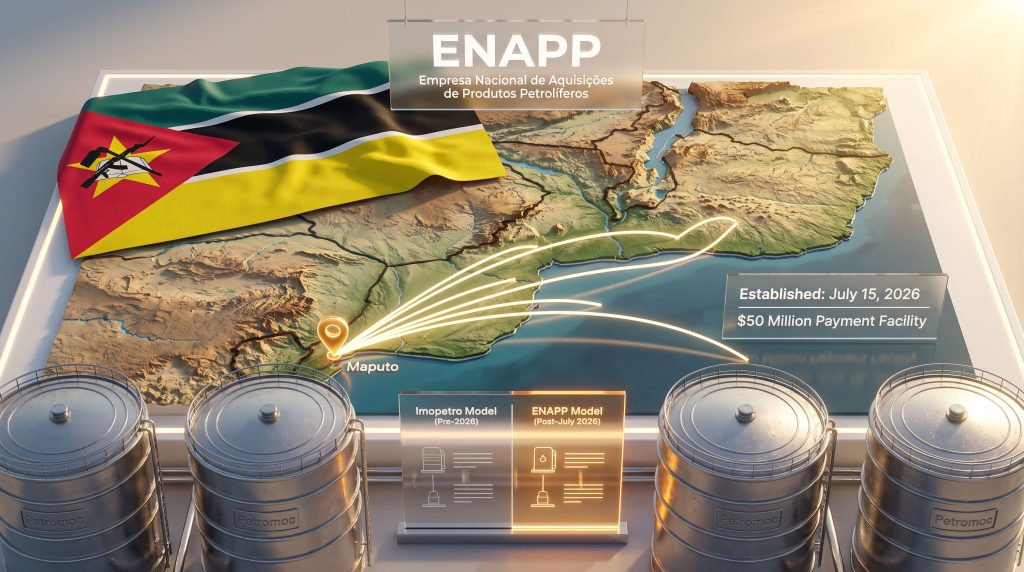
On July 15, 2026, Mozambique's Council of Ministers formally established the Empresa Nacional de Aquisições de Produtos Petrolíferos, universally referred to as ENAPP. The entity carries full legal independence, operating with administrative, financial, and asset autonomy from the broader government apparatus. Its creation marks one of the most significant reversals of fuel sector liberalisation seen in sub-Saharan Africa in recent years.
Understanding exactly what ENAPP is, and critically what it is not, requires separating its strategic coordination function from the commercial execution layer that sits beneath it. According to reporting from Zitamar News, the new framework is explicitly designed as a single procurement gateway, consolidating what was previously a fragmented and commercially managed arrangement.
| Feature | Detail |
|---|---|
| Full Name | Empresa Nacional de Aquisições de Produtos Petrolíferos |
| Established | July 15, 2026, by the Mozambican Council of Ministers |
| Legal Status | Independent entity with administrative, financial, and asset autonomy |
| Core Mandate | Exclusive coordination of national fuel procurement and supply monitoring |
| Trading Prohibition | Barred from producing, distributing, or selling fuel directly |
| Funding Source | Draws from the commission previously collected by Imopetro within regulated fuel pricing |
ENAPP's authorised functions centre on four pillars:
- Assessing national fuel demand and calculating procurement volumes required to meet it
- Negotiating and contracting with international fuel suppliers on behalf of the state
- Monitoring domestic supply operations across the distribution network
- Acting as the exclusive procurement gateway through which all national fuel sourcing is coordinated
What ENAPP cannot do is equally important to understand. The agency is explicitly prohibited from:
- Producing or refining petroleum products
- Distributing fuel to end markets or retail customers
- Engaging in direct fuel trading of any kind
- Acting as the legal importer of record for cargo shipments
This last prohibition is particularly significant. Licensed private distributors and state-owned Petromoc remain the legal importers who bear payment obligations to foreign cargo suppliers. ENAPP constructs and manages the procurement architecture; it does not hold title to fuel or execute the final financial transaction with overseas sellers. The separation of strategic coordination from commercial execution is a deliberate design feature intended to preserve private sector participation in distribution while concentrating procurement authority within the state.
Ministerial Approval: The Governance Shift That Changes Everything
Perhaps the most consequential governance change embedded within the Mozambique fuel import state firm ENAPP framework is the requirement for personal ministerial approval over international supplier contract awards. Under the Imopetro consortium model, supplier selection was a commercially managed process. Under ENAPP, the energy minister holds direct approval authority over which international counterparties receive fuel contracts.
This introduces a layer of strategic and political accountability that was entirely absent from the previous arrangement. Proponents argue it provides the government with a direct lever to manage supplier relationships during crises. Critics will note that embedding political discretion into commercial contracting decisions raises legitimate questions about transparency, competitive neutrality, and the potential for governance risks over time. Both perspectives deserve serious consideration as the model matures.
Comparing the Old and New Models: What Changed and What Stayed the Same
| Dimension | Imopetro Model (Pre-2026) | ENAPP Model (From July 2026) |
|---|---|---|
| Control Type | Private consortium coordination | State-owned procurement agency |
| Supplier Selection | Market-driven, consortium-managed | Requires ministerial approval |
| State Oversight | Limited and indirect | Direct, embedded at executive level |
| Emergency Response | Reactive; no dedicated mechanism | Centralised coordination authority |
| Commercial Trading Rights | Consortium members could participate | ENAPP explicitly prohibited from trading |
| Duration of Prior Model | Approximately 30 years | New architecture as of mid-2026 |
The reform does not eliminate the private sector from Mozambique's fuel supply chain. What it does is fundamentally redefine the division of responsibility between state coordination and private commercial execution. Distributors retain their import licences and market participation. What they lose is the coordination function that Imopetro previously performed on their behalf.
The $50 Million Payment Facility: Addressing the Root Cause of Supply Disruption
Six days before ENAPP's formal establishment, on July 9, 2026, the Council of Ministers approved a separate but complementary financial mechanism: a $50 million payment facility specifically designed to secure liquid fuel imports. This facility is managed by Petromoc, the state-owned oil distribution company that holds an estimated 42 to 51 percent of the domestic fuel market.
The facility's purpose is straightforward but addresses the most fundamental vulnerability FUNDEC identified: the inability to execute timely payments to international suppliers during periods of dollar scarcity in the domestic banking system. By pre-positioning liquidity, it functions as a buffer that ensures procurement commitments can be honoured even when foreign currency availability tightens.
It is important to distinguish the payment facility from ENAPP's procurement mandate. The two mechanisms are operationally separate:
- ENAPP coordinates procurement, negotiates supplier contracts, and monitors supply operations
- The $50 million facility, managed by Petromoc, provides the liquidity infrastructure to execute payments against those contracts
Together, they represent a two-layer response to Mozambique's fuel supply problem: strategic coordination on one side, financial execution capacity on the other.
Long-Term Questions the ENAPP Model Must Answer
The structural logic behind the Mozambique fuel import state firm ENAPP is coherent, but the model carries real implementation risks that deserve honest assessment.
Procurement efficiency is the first test. International fuel markets are fast-moving, and competitive pricing requires speed, market intelligence, and established counterparty relationships. For a broader sense of how volatile those markets currently are, consider the crude oil market overview for 2025, which illustrates the complexity ENAPP will need to navigate in real time. Imopetro spent three decades building these capabilities within a private-sector context. ENAPP will need to develop equivalent expertise rapidly, without the commercial incentives that typically drive private operators to optimise aggressively.
Governance transparency is the second critical issue. Ministerial sign-off over supplier contracts represents a significant concentration of decision-making authority. Without robust procurement rules, public disclosure requirements, and independent audit mechanisms, the framework could create conditions for preferential contract allocation. The design of these safeguards will determine whether ENAPP operates as a genuine supply security mechanism or becomes a vehicle for political discretion.
Capacity building presents a third challenge. ENAPP inherits an institutional mandate that Imopetro accumulated over roughly 30 years. Recruiting procurement specialists with international fuel market expertise, establishing functional relationships with overseas suppliers, and building the financial management systems needed to operate at scale will all take time and investment.
Regulatory clarity is the fourth structural requirement. The rules governing how ENAPP interacts with private distributors, Petromoc, and international fuel suppliers must be precise and predictable. Ambiguity in the operational boundaries between these actors risks market distortion, disputes over contract authority, and confusion among international counterparties about who holds what commercial obligation.
Had ENAPP been operational during the April and May 2026 supply crisis, centralised procurement authority would theoretically have allowed the energy minister to fast-track alternative supplier arrangements without requiring consensus across a private consortium. The concurrent $50 million payment facility would have provided the liquidity to execute those arrangements immediately, potentially compressing the duration of the shortage significantly.
The next major ASX story will hit our subscribers first
Mozambique's Reform in Regional Context: A Pattern Worth Watching
Mozambique's move is not occurring in isolation. Across the African continent, a growing number of governments have moved to reassert strategic control over critical commodity supply chains in the years following the pandemic-era disruptions that exposed the fragility of purely market-driven arrangements. The justification varies by country, but the underlying logic is consistent: when supply security becomes a national emergency issue, governments reach for direct control rather than market mechanisms.
In addition, oil price shocks experienced elsewhere have demonstrated how rapidly procurement models can be stress-tested by external forces, reinforcing the case for structural resilience over commercial flexibility alone. The broader pattern of commodity market volatility across global energy markets further underscores why governments in resource-dependent economies are seeking greater insulation from external price and supply disruptions.
What distinguishes Mozambique's approach is the deliberate preservation of private sector participation in distribution and importation, even as coordination authority is centralised. This hybrid model attempts to capture the supply security benefits of state control without entirely displacing the commercial efficiency that private operators bring to market participation. As reported by Club of Mozambique, the reform has attracted significant regional attention as a potential model for other fuel-import-dependent economies. Whether that balance holds in practice will depend heavily on how ENAPP is governed and resourced over the next several years.
Disclaimer: This article presents factual reporting and analytical commentary based on publicly available information. It does not constitute financial or investment advice. Forward-looking assessments and scenario analyses reflect considered perspectives on policy design and should not be read as predictions of specific outcomes.
Frequently Asked Questions About ENAPP and Mozambique's Fuel Import Reform
What does ENAPP stand for?
ENAPP stands for Empresa Nacional de Aquisições de Produtos Petrolíferos, translating to the National Petroleum Products Procurement Company. It was formally established by the Mozambican Council of Ministers on July 15, 2026.
Why did Mozambique replace Imopetro with ENAPP?
The Imopetro consortium model proved structurally inadequate in responding to fuel supply disruptions, particularly those driven by foreign currency shortages and geopolitical supply shocks affecting international markets. Analysis by FUNDEC confirmed that the primary driver of market strain between 2019 and May 2026 was a shortage of US dollars for import payments, not a physical lack of fuel availability.
Can ENAPP sell or distribute fuel?
No. ENAPP is legally prohibited from producing, distributing, or selling petroleum products. Its mandate is restricted to procurement coordination and supply monitoring. Licensed private distributors and Petromoc retain all distribution and importation responsibilities.
Who pays for the fuel that ENAPP procures?
Licensed distributors remain the legal importers and bear the payment obligation to foreign suppliers. ENAPP arranges the procurement framework but does not take title to fuel cargo or execute direct payments to overseas sellers.
What is the $50 million facility and how does it relate to ENAPP?
The $50 million payment facility, approved on July 9, 2026, is managed by Petromoc and is operationally distinct from ENAPP. It provides liquidity to fund fuel import payments and directly addresses the foreign currency constraints that have historically disrupted Mozambique's supply continuity.
How is ENAPP funded?
ENAPP draws its funding from the commission that Imopetro previously collected within Mozambique's regulated fuel pricing structure. Consequently, no new charges are being introduced for consumers to finance the agency's operations.
Want to Stay Ahead of Major Commodity and Resource Discoveries in Real Time?
Discovery Alert's proprietary Discovery IQ model instantly identifies significant ASX mineral discoveries across more than 30 commodities — from energy-linked resources to major exploration plays — delivering actionable insights directly to subscribers before the broader market reacts. Explore historic discoveries and the returns they generated, then begin your 14-day free trial to position yourself at the forefront of the next major find.