July 17, 2026
The Industrial Logic Behind America's Recycled Aluminium Renaissance
The economics of aluminium manufacturing are undergoing a structural realignment. Across the United States, the calculus that once favoured large-scale primary smelting, powered by cheap hydroelectric or coal-fired electricity and fed by imported bauxite, is giving way to a new industrial paradigm: decentralised, scrap-fed, low-carbon production located close to both raw material supply and end-market demand. This shift is not merely driven by environmental sentiment. It is being driven by procurement mandates from automakers, sustainability commitments from beverage brands, and the growing recognition that recycled aluminium carries a dramatically lower carbon footprint than its primary counterpart.
Within this broader transformation, the Aluminum Dynamics recycled aluminium slab facility in Mississippi represents one of the most strategically coherent manufacturing investments announced in the U.S. metals sector in recent years. However, understanding why this project matters requires looking well beyond the headline figures.
When big ASX news breaks, our subscribers know first
Why the Slab Comes Before the Sheet: Understanding Vertical Integration in Aluminium
The Feedstock Problem at the Heart of Flat-Rolled Aluminium Production
Producing flat-rolled aluminium sheet at scale requires a consistent, high-quality feedstock. In a primary aluminium supply chain, that feedstock arrives as molten metal or ingot from a smelter. In a recycled content model, it arrives as cast slab, produced from post-consumer scrap that has been sorted, shredded, melted, and cast into a standardised form the rolling mill can process.
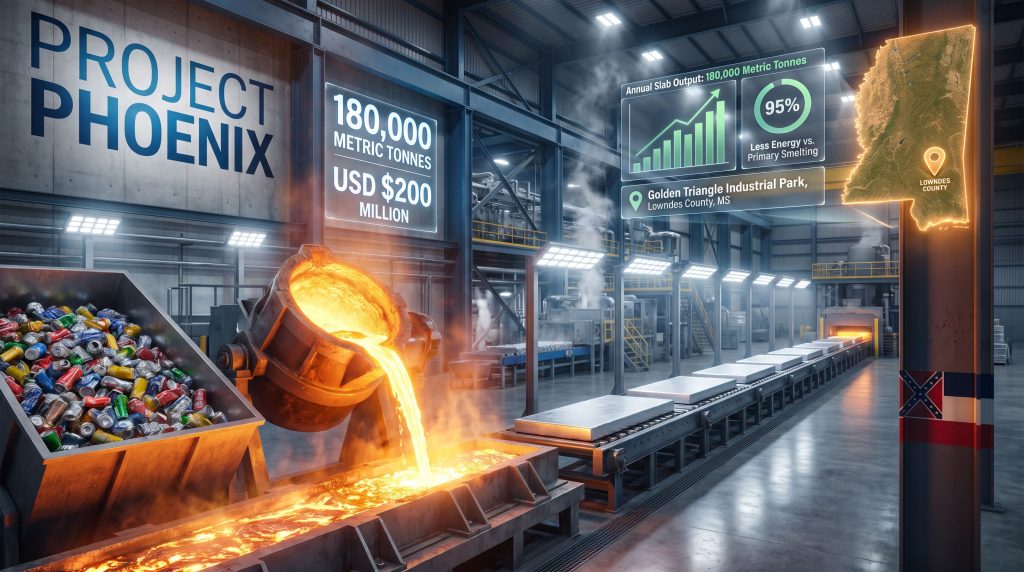
This is precisely the function the new Lowndes County facility is designed to perform. Aluminum Dynamics LLC, a subsidiary of Steel Dynamics Inc. (SDI), plans to invest more than USD $200 million in a dedicated recycled aluminium slab centre within the Golden Triangle Industrial Park. The facility will process aluminium-bearing input materials, primarily used beverage cans (UBCs), into 180,000 metric tonnes of recycled aluminium slab annually. Operations are targeted to commence in the first half of 2027.
What makes this investment structurally significant is not just its scale, but its function within a larger integrated system. The slab centre is engineered as a purpose-built feedstock supplier for SDI's flat-rolled aluminium rolling mill, already under commissioning in Columbus, Mississippi, which is expected to produce up to 650,000 tonnes of aluminium sheet per year once fully ramped. The two facilities, separated by only a short distance within the same regional industrial footprint, form the backbone of what could become one of the most vertically integrated recycled aluminium value chains in North America.
Steel Dynamics Inc.'s Aluminium Platform: Capital Deployed at Scale
SDI's entry into aluminium has been deliberate and capital-intensive. The broader aluminium platform, encompassing rolling mill infrastructure, recycled slab production capacity, and associated supply chain investments, represents a total capital commitment in the range of $2.5 to $2.7 billion. This positions SDI not as a peripheral participant in the aluminium market, but as a vertically integrated producer competing directly with established players in automotive sheet and beverage can stock.
The Columbus rolling mill shipped its first coil in June 2025, a milestone that marked the transition from construction to commercial operations. SMS Group, the German equipment supplier responsible for providing rolling technology for the facility, confirmed the project entered its final commissioning phase, with ongoing work covering rolling operations, automation systems, coil logistics, quality inspection, and sustainability integration measures.
The recycled slab centre in Lowndes County is not, therefore, a standalone investment. It is the missing upstream link in a supply chain that is already partially operational. Furthermore, among aluminium industry leaders, this level of vertical integration in recycled production remains relatively rare at this scale.
The Numbers Behind the Mississippi Investment
| Investment Metric | Detail |
|---|---|
| Total Capital Commitment | More than USD $200 million |
| Projected Annual Output | 180,000 metric tonnes of recycled aluminium slab |
| Employment Created | 100 direct new jobs |
| Expected Operational Date | First half of 2027 |
| Facility Designation | Project Phoenix (MDEQ records) |
| Primary Input Material | Used beverage cans and aluminium-bearing scrap |
| Facility Location | Golden Triangle Industrial Park, Lowndes County, MS |
What 180,000 Tonnes of New Slab Capacity Actually Means
To contextualise 180,000 metric tonnes of annual output, consider that the U.S. consumed roughly 4.5 million tonnes of aluminium in 2024 across all end-use segments. Recycled aluminium accounted for a growing share of domestic supply, but domestic recycled slab capacity has historically lagged behind rolling mill demand, creating a structural gap that required supplementary imports of primary ingot or semi-fabricated products.
A facility of this scale meaningfully tightens that gap. It also increases the domestic absorption rate for post-consumer aluminium scrap, particularly UBCs, which are among the highest-value recyclable streams in the aluminium system. The U.S. UBC recycling rate has historically hovered well below the rates achieved in Europe and Japan, in part because domestic remelting infrastructure has not kept pace with collection volumes. New slab capacity of this magnitude creates additional pull-through demand for collected cans, potentially improving collection economics across the supply chain.
From Can to Coil: The Technical Mechanics of Recycled Slab Production
Why Used Beverage Cans Are the Premium Scrap Input
Not all aluminium scrap is created equal. The alloy composition, contamination levels, and physical form of scrap material all affect the complexity and cost of the remelting process. Used beverage cans occupy a favoured position in the scrap hierarchy for several reasons:
- UBCs are composed primarily of 3xxx and 5xxx series alloys, which are directly compatible with the alloy specifications required for can sheet and certain automotive applications.
- Their relatively uniform composition reduces the need for alloying additions during remelting, lowering processing costs and improving consistency.
- The high surface-area-to-mass ratio of shredded cans allows for rapid melting, improving furnace throughput.
- UBCs carry no embedded iron or copper contamination at meaningful levels, unlike mixed industrial scrap, which simplifies melt quality management.
The slab casting process itself involves shredding and delacquering incoming scrap to remove coatings, followed by charging into a large reverberatory or twin-chamber melting furnace. The molten aluminium is then treated for impurity removal, alloyed to specification, and cast into slab form using either direct chill (DC) casting or continuous casting technology. DC casting produces slabs with tightly controlled internal structure, making it the preferred method for producing feedstock destined for automotive or high-specification can sheet rolling.
The Energy Equation: Why Recycling Wins on Carbon
Recycling aluminium from post-consumer scrap requires approximately 95% less energy than producing primary aluminium from bauxite ore. This figure has become a central pillar of sustainability arguments across the aluminium value chain, and it carries real commercial weight as manufacturers face mounting pressure to reduce Scope 3 emissions.
Primary aluminium production involves the Bayer process to refine bauxite into alumina, followed by the Hall-Heroult electrolytic reduction process to produce metal. The latter is extraordinarily electricity-intensive, consuming roughly 13 to 15 megawatt-hours per tonne of aluminium produced. A recycled slab facility processing post-consumer scrap requires only a fraction of that energy input, with thermal energy for melting constituting the dominant operating cost rather than electricity for electrolysis.
This distinction is becoming commercially material. As corporate supply chains adopt Scope 3 emissions accounting, downstream buyers of aluminium, from car manufacturers to packaging companies, face increasing pressure to demonstrate the carbon intensity of their purchased materials. Low-carbon slab certification, verified through lifecycle assessment methodologies, is transitioning from a marketing differentiator to a procurement requirement in certain sectors. In addition, initiatives such as a low-carbon aluminium venture between major producers illustrate how the broader industry is responding to this shift.
The Arizona Detour: What Project Relocation Costs and Signals
A $16 Million Lesson in Stakeholder Engagement
The Mississippi facility did not emerge from a clean-sheet site selection process. SDI had originally planned to locate this recycled slab centre in Arizona, where permitting work and site preparation had already begun. The project was ultimately cancelled in that state following what SDI described as irreconcilable differences with state officials that introduced unacceptable construction and operational risks.
Community opposition was also substantial. A petition opposing the Arizona plant gathered more than 3,700 signatures, reflecting the kind of organised local resistance that has increasingly disrupted industrial siting processes across the U.S. Sun Belt, particularly for facilities handling scrap material or involving thermal processing.
The financial consequence was concrete: SDI recorded a USD $16 million charge in Q2 2026 to write down assets associated with the abandoned Arizona project. This figure, while manageable within the context of a multi-billion dollar capital programme, illustrates the tangible cost of misaligned stakeholder engagement during the early phases of industrial development.
For capital-intensive manufacturing investors, the Arizona-to-Mississippi pivot offers a pointed illustration of how community opposition and regulatory friction can transform an approved industrial project into a stranded asset, and why site selection must increasingly incorporate social licence risk alongside traditional infrastructure and logistics criteria.
Why Mississippi Won the Relocation Decision
The relocation to Lowndes County was not arbitrary. SDI already operates a scrap-fed electric arc furnace steel mill in the same region, and the Columbus rolling mill is co-located nearby. Reinvesting in a geography where operational relationships, workforce familiarity, and infrastructure connections already exist significantly de-risks a greenfield industrial build.
Mississippi Development Authority Executive Director Bill Cork described the reinvestment as the clearest possible signal of confidence in a location, noting that a company choosing to expand where it already has established operations represents a meaningful endorsement of that business environment.
The state is supporting the project through road and rail infrastructure improvements coordinated through the Mississippi Development Authority. The facility will also qualify for tax incentives available under the Mississippi Major Economic Impact Authority programme, a statutory framework designed to support major manufacturing investments meeting defined employment and capital thresholds. Lowndes County is providing additional local-level support to facilitate project development.
End Markets: Who Buys Recycled Aluminium Slab and Why It Matters
The Two Dominant Demand Drivers
| End Market | Key Driver | Carbon Sensitivity |
|---|---|---|
| Automotive Sheet | Lightweighting and OEM sustainability mandates | Very High |
| Beverage Can Stock | Circular economy commitments by major brands | High |
| General Industrial | Cost competitiveness | Moderate |
Automotive lightweighting remains one of the most powerful structural demand drivers in the aluminium market. Vehicle manufacturers face regulatory pressure to improve fleet fuel economy and, increasingly, to reduce the lifecycle carbon footprint of the vehicles they produce. Aluminium sheet used in body panels, hoods, and structural components is lighter than steel alternatives, and when produced from recycled content, carries a significantly lower embodied carbon figure. OEM procurement teams are increasingly specifying minimum recycled content thresholds in their aluminium supply contracts.
Beverage can sheet operates on a different but equally compelling logic. Major beverage brands, under pressure from investors and consumers to demonstrate circular economy commitments, have made public pledges to increase the recycled content of their packaging. The aluminium can is already among the most recycled packaging formats globally, but improving closed-loop recycling infrastructure, where cans become cans again rather than being downcycled into lower-value applications, requires exactly the kind of UBC-to-slab-to-sheet capacity that the Aluminum Dynamics recycled aluminium slab facility in Mississippi is designed to provide.
The next major ASX story will hit our subscribers first
The Broader Competitive Landscape for U.S. Recycled Aluminium
Capacity, Players, and the Integration Advantage
The U.S. recycled aluminium sector has historically been fragmented, with independent secondary smelters producing standard ingot or remelt alloy sold into casting markets rather than wrought product supply chains. The shift toward producing rolling-grade recycled slab, rather than casting alloy ingot, is a more technically demanding proposition requiring tighter quality controls and closer coordination with downstream rolling mills.
Facilities capable of producing rolling-grade recycled slab at scale remain relatively rare in North America. The combination of a dedicated slab centre operating in close proximity to a large flat-rolled mill represents a degree of vertical integration that standalone recyclers cannot easily replicate. This integration creates operational efficiencies in scheduling, quality specification alignment, and logistics, while also providing the rolling mill with greater security of feedstock supply independent of spot market volatility.
The entry of SDI's aluminium platform into this space, at a scale of 180,000 tonnes of slab capacity feeding a 650,000-tonne rolling mill, establishes a new competitive benchmark for integrated recycled aluminium production in the United States. Consequently, alumina market pressures and ongoing US aluminium tariffs are adding further urgency to investments in domestic recycled capacity across the sector.
Frequently Asked Questions About the Aluminum Dynamics Mississippi Facility
What exactly will the Aluminum Dynamics facility in Mississippi produce?
The facility will produce recycled aluminium slab, a semi-fabricated product cast from remelted post-consumer scrap, primarily used beverage cans. The slab is then fed into a rolling mill to produce flat-rolled aluminium sheet for automotive and packaging end markets.
When will the Lowndes County recycled aluminium slab facility begin operations?
Commercial operations are targeted to begin in the first half of 2027, subject to construction progress and commissioning timelines.
How many jobs will the new Mississippi facility create?
The project is expected to create 100 direct new jobs in Lowndes County. Indirect and induced employment effects in the surrounding regional economy will likely be higher, reflecting supply chain and service sector activity generated by the facility.
What happened to the original Arizona aluminium recycling plant?
SDI cancelled the Arizona project following disputes with state officials and significant community opposition, including a petition with over 3,700 signatories. The cancellation resulted in a $16 million asset write-down in Q2 2026.
Who owns Aluminum Dynamics and how does it connect to Steel Dynamics Inc.?
Aluminum Dynamics LLC is a subsidiary of Steel Dynamics Inc., a major U.S. steel producer that has diversified into aluminium through a multi-billion dollar integrated platform encompassing recycled slab production and flat-rolled aluminium manufacturing.
What is the Golden Triangle Industrial Park and why was it chosen?
The Golden Triangle Industrial Park is an established industrial corridor in Lowndes County, Mississippi, that already hosts SDI's electric arc furnace steel mill and Columbus rolling mill operations. The site was selected for the slab facility due to existing infrastructure, workforce familiarity, and its proximity to the rolling mill it is designed to supply.
What government incentives is the facility receiving in Mississippi?
The Mississippi Development Authority is funding road and rail infrastructure improvements to support the project. The facility qualifies for tax incentives under the Mississippi Major Economic Impact Authority programme. Lowndes County is also providing local-level support as part of the overall deal structure.
How does recycled aluminium slab production differ from primary aluminium manufacturing?
Primary aluminium production involves mining bauxite, refining it into alumina, and then reducing alumina to metal through an energy-intensive electrolytic process consuming 13 to 15 megawatt-hours per tonne. Recycled slab production melts post-consumer scrap using thermal furnaces, consuming roughly 95% less energy per tonne of metal produced and generating substantially lower greenhouse gas emissions.
What This Investment Signals for the Next Wave of U.S. Recycled Aluminium Capacity
The Vertical Integration Playbook as a Durable Competitive Moat
The structural logic of the Aluminum Dynamics Mississippi investment points toward a broader trend: integrated slab-to-sheet operations are becoming the preferred model for competing in recycled aluminium at scale. Standalone recyclers selling into spot markets face margin pressure from commodity price cycles and lack the supply chain visibility that OEM customers increasingly demand. Integrated producers, by contrast, can offer traceability, consistent quality, and verified recycled content data across the entire chain from scrap to finished sheet.
Mississippi's Emerging Position in Low-Carbon Metals Manufacturing
The concentration of SDI aluminium assets in Lowndes County is beginning to establish the Golden Triangle region as a meaningful node in the U.S. low-carbon metals manufacturing landscape. With a scrap-fed steel mill, a flat-rolled aluminium rolling mill, and now a dedicated recycled slab centre all operating within the same industrial corridor, the region offers a rare combination of integrated metals infrastructure, skilled workforce depth, and established logistics connections that few alternative locations can match.
For instance, Gladstone aluminium repowering efforts in Australia demonstrate how established producers globally are pursuing similar low-carbon manufacturing strategies, further validating the direction SDI has chosen in Mississippi.
For investors and industry observers tracking the evolution of U.S. aluminium manufacturing, the Aluminum Dynamics recycled aluminium slab facility in Mississippi is not simply a capacity addition. It is a proof of concept for a vertically integrated, domestically sourced, low-carbon aluminium value chain, and a template that other producers are likely to study closely as they plan their own next moves in a rapidly reshaping market. Recycling Today's coverage of the site selection decision provides further context on the logistical factors that ultimately favoured Lowndes County over competing locations.
Disclaimer: This article contains forward-looking statements and projections related to capital investment timelines, production capacities, and market trends. These are subject to change based on operational, regulatory, and market conditions. Nothing in this article constitutes financial or investment advice. Readers should conduct their own due diligence before making investment decisions.
Want to Track the Next Major ASX Mineral Discovery Before the Market Moves?
Discovery Alert's proprietary Discovery IQ model delivers real-time alerts on significant ASX mineral discoveries across aluminium, lithium, copper, and more than 30 other commodities — turning complex geological data into actionable investment insights the moment announcements hit the exchange. Explore historic discoveries and the returns they generated, then begin your 14-day free trial to position yourself ahead of the broader market.