August 24, 2026
The Structural Flaw at the Heart of Australia's Critical Minerals Ambition
The global race to secure critical minerals processing capacity has exposed a fundamental contradiction in how resource-rich nations approach industrial strategy. Countries that extract vast quantities of strategic materials often find themselves structurally dependent on foreign processors to convert those raw materials into usable industrial inputs. This paradox sits at the very centre of Australia's industrial identity, and nowhere is it more starkly illustrated than in the permanent Liberty Bell Bay manganese smelter closure in George Town, northern Tasmania.
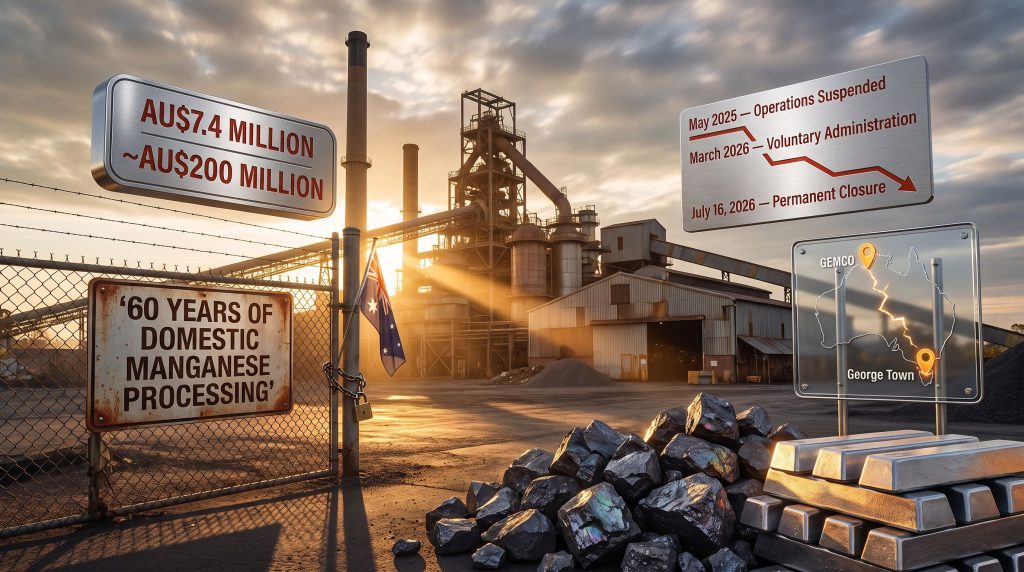
On July 16, 2026, administrators EY Parthenon confirmed what many had feared for months: the rescue process had failed, and Australia's last domestic manganese alloy processing facility would cease operations immediately. The closure does not merely represent the loss of a single industrial site. It marks the complete elimination of Australia's sovereign capacity to convert manganese ore into the ferroalloys that underpin steelmaking, defence manufacturing, and an increasingly important role in battery technology supply chains.
When big ASX news breaks, our subscribers know first
Six Decades of Industrial History, Erased Overnight
For more than 60 years, the Liberty Bell Bay facility stood as Australia's sole manganese alloy smelter, occupying a critical position in the nation's domestic steel supply chain. Located in George Town in northern Tasmania, the plant converted raw manganese ore into ferromanganese and silicomanganese, two distinct ferroalloy grades with very different but equally vital industrial applications.
Understanding What Ferromanganese and Silicomanganese Actually Do
These two products are worth understanding in detail, because their loss from domestic production has consequences that extend well beyond Tasmania's regional economy.
Ferromanganese typically contains between 70% and 80% manganese combined with iron, and is added directly to molten steel during production. It acts as a deoxidiser, removing oxygen that would otherwise create brittle inclusions in the final product, while simultaneously improving the steel's hardness and tensile strength. Without it, the structural steel used in buildings, bridges, and industrial equipment would be significantly weaker.
Silicomanganese carries a lower manganese content, typically around 60 to 70%, but combines manganese with silicon. It serves a dual deoxidising and alloying function in steelmaking, and is particularly important in the production of high-strength low-alloy steels used in automotive and heavy equipment manufacturing.
The distinction matters because Australia must now import both grades from international producers. Furthermore, South African ferroalloy supply, alongside output from China, India, and Georgia, each carries its own geopolitical and logistical risk profile.
At its operational peak, Liberty Bell Bay employed approximately 200 to 217 workers, making it one of northern Tasmania's most significant sources of industrial employment. The closure eliminates those positions permanently, with only a skeleton crew retained temporarily to manage decommissioning, asset disposal, and environmental compliance obligations.
A Cascade of Failures: How a 60-Year Facility Reached the Point of No Return
The Liberty Bell Bay manganese smelter closure was not the result of a single catastrophic event. It was the end product of a multi-year accumulation of ownership instability, natural disaster, regulatory non-compliance, and ultimately a private capital market that declined to underwrite the facility's survival.
The GFG Alliance Problem
GFG Alliance, the industrial conglomerate controlled by UK-based businessman Sanjeev Gupta, acquired Liberty Bell Bay as part of a broader global acquisition strategy that relied heavily on unconventional financing arrangements. When those financing structures came under pressure, the operational consequences cascaded through every asset in the group's portfolio, including the Tasmanian smelter.
The company failed to lodge statutory annual financial reports for four consecutive fiscal years, covering 2021 through 2024. This was not a paperwork oversight. The failure to file created regulatory exposure, destroyed the facility's commercial credibility with potential partners and buyers, and ultimately triggered Australian Securities and Investments Commission winding-up proceedings. GFG Alliance also defaulted on a AU$20 million Tasmanian government loan in January 2026, accelerating the spiral toward administration.
How Tropical Cyclone Megan Broke the Ore Supply Chain
Overlapping with the ownership crisis was a significant physical disruption to the smelter's ore supply. The GEMCO manganese mine in the Northern Territory, operated by South32 and one of the world's largest manganese producers, sustained major infrastructure damage during Tropical Cyclone Megan in March 2024. GEMCO had historically supplied a significant portion of Australia's domestic manganese ore, and its extended shutdown created an acute raw material shortage for downstream processors including Liberty Bell Bay.
Smelting operations were suspended in May 2025 as a direct consequence of the ore supply disruption. From that point forward, the facility was generating costs without producing revenue, a financially unsustainable position that no amount of government support could fully offset indefinitely.
| Failure Stage | Timeline | Key Driver |
|---|---|---|
| Ownership deterioration | Pre-2025 | GFG Alliance financial instability |
| Ore supply suspension | May 2025 | GEMCO cyclone damage |
| Regulatory pressure | 2025 to 2026 | ASIC winding-up proceedings |
| Voluntary administration | March 2026 | EY Parthenon appointed |
| Sale process collapse | July 2026 | Consortium funding withdrawal |
The Failed Sale: Why AU$50 Million in Government Support Was Not Enough
The administration process produced a moment of genuine optimism in May 2026, when a buyer consortium agreed to acquire the facility. Both state and federal governments had extended substantial financial commitments to support a transition to new ownership.
| Support Mechanism | Value | Provider |
|---|---|---|
| Worker wage support | ~AU$10 million | Federal and Tasmanian governments |
| Proposed buyer start-up package | AU$20 million | Federal and Tasmanian governments |
| On-site ore purchase loan | AU$20 million | Tasmanian government |
| Concessional 10-year power agreement | Ongoing | Tasmanian government |
Despite this, the deal collapsed in three stages. In June 2026, a key financial backer identified as Adroit Capital withdrew from the consortium, citing funding difficulties. By July 15, the remaining consortium members formally notified administrators they were exiting. The following day, EY Parthenon announced permanent and immediate closure.
The administrators cited a volatile global economic environment as compounding the difficulty of structuring a commercially viable transaction. Three structural barriers ultimately proved insurmountable: an unfilled financing gap left by the departing backer, an inability to secure critical operational arrangements including supply contracts and logistics infrastructure, and broader macroeconomic conditions that made the projected returns insufficiently attractive to private capital.
The administrators determined that without both a commercially viable transaction and adequate operational funding, an orderly closure was the only responsible path forward. EY Parthenon announced the decision on July 16, 2026.
This outcome raises a question that transcends Liberty Bell Bay: when combined public commitments exceed AU$50 million and a facility still cannot attract private capital, what does that reveal about the true economics of domestic ferroalloy processing in the current global market?
The Human Cost: 200+ Jobs and AU$7.4 Million in Outstanding Entitlements
The immediate human consequences of the Liberty Bell Bay manganese smelter closure are severe for a regional community with limited alternative industrial employment opportunities.
Approximately 200 to 217 workers face permanent job losses. Outstanding wages and entitlements owed to the workforce total more than AU$7.4 million, a figure whose recovery depends entirely on the outcome of the administration and asset liquidation process. If the administration estate cannot satisfy these obligations in full, workers may need to rely on the federal government's Fair Entitlements Guarantee scheme as a financial backstop.
The FORGE AHEAD Retraining Program
The Tasmanian government's response to worker displacement is the FORGE AHEAD program, developed in partnership with Master Builders Tasmania. The initiative offers affected workers nationally recognised training credentials to transition into commercial and residential construction roles.
While the program represents a genuine policy response to acute regional employment displacement, it raises a deeper industrial skills concern. The workers leaving Liberty Bell Bay possess specialised metallurgical knowledge, pyrometallurgical process expertise, and high-temperature furnace operation skills that took decades to develop within Australian industry. Retraining those individuals for general construction work, however pragmatically necessary, represents a permanent loss of highly specialised industrial human capital that cannot be easily rebuilt if Australia ever seeks to restore domestic ferroalloy processing capability.
Australia's Critical Minerals Paradox: A World-Class Ore Exporter With No Processing Capacity
Perhaps the most analytically striking aspect of the closure is what it reveals about the structural gap in Australia's critical minerals and energy security value chain.
Australia holds significant manganese ore reserves and remains a meaningful producer of raw ore through operations such as GEMCO in the Northern Territory and Groote Island more broadly. Yet as of July 16, 2026, the country has zero domestic capacity to process that ore into manganese alloys.
This means Australian steel producers, defence manufacturers, and advanced materials companies must now source all ferromanganese and silicomanganese from international suppliers. The primary alternative sources carry distinct risk profiles:
- South Africa holds the world's largest manganese ore reserves and is a dominant ferroalloy producer, but faces ongoing electricity supply constraints through Eskom that periodically disrupt smelting operations
- China controls a significant share of global ferromanganese and silicomanganese output and has historically used commodity export restrictions as a geopolitical instrument
- India is a growing ferroalloy producer but faces its own infrastructure and energy cost pressures
- Georgia has emerged as a smaller but notable silicomanganese producer serving European markets
None of these alternatives provide the supply chain certainty that domestic processing would offer. In addition, critical minerals demand growth projections suggest these supply pressures will only intensify through the decade ahead.
The Battery Technology Dimension
A dimension of the closure that receives insufficient attention in standard industrial reporting is manganese's growing relevance in battery technology. Manganese-based cathode chemistries, particularly lithium manganese iron phosphate formulations, are gaining traction as lower-cost alternatives to lithium iron phosphate in electric vehicle and grid storage applications. The closure eliminates any possibility of Australia leveraging its ore production into battery-grade manganese processing in the near term, a missed opportunity as global demand for these materials is projected to grow substantially through the 2030s.
The next major ASX story will hit our subscribers first
The AU$200 Million Rehabilitation Liability: A Hidden Public Risk
Beyond the immediate employment and supply chain consequences, the Liberty Bell Bay manganese smelter closure carries a long-tail financial risk for taxpayers. Environmental rehabilitation of a heavy industrial smelting site of this scale and age is an extremely costly undertaking. Estimated remediation costs for the Liberty Bell Bay site could reach approximately AU$200 million if full rehabilitation is required.
If no financially solvent responsible party remains at the conclusion of the administration process, this liability has the potential to fall on government, representing a significant long-term fiscal consequence that extends well beyond the immediate AU$50 million in support already committed.
This rehabilitation risk is characteristic of legacy heavy industry sites and underscores why the economics of industrial closure are rarely as simple as they appear at the moment of announcement.
What the Closure Demands of Australian Industrial Policy
The permanent closure of the Liberty Bell Bay facility is not simply a Tasmanian story. It is a national industrial policy stress test, and the results are instructive.
A structurally important facility with more than 60 years of operating history, serving defence, construction, and manufacturing supply chains, proved unable to attract sufficient private capital for continuation despite material government financial support. The logical conclusion is that market mechanisms alone are insufficient to preserve strategically significant industrial assets when the economics of those assets are structurally challenged.
Comparable situations in other countries have prompted more direct structural intervention. The United Kingdom, Germany, and the United States have all employed government-backed preservation mechanisms for strategically important steelmaking and ferroalloy facilities, recognising that the cost of losing such capabilities permanently exceeds the cost of temporary support. Furthermore, proposals such as a critical minerals strategic reserve have gained traction as a policy lever to buffer against precisely this kind of domestic processing collapse.
Developments such as the Butcherbird manganese expansion in Western Australia highlight that upstream ore production continues to attract investment, however, the downstream processing gap exposed by this closure remains unaddressed. For Australia, this event may ultimately serve as the catalyst for a more explicit downstream processing mandate within the nation's critical minerals policy framework. The current approach, which emphasises upstream extraction incentives, leaves the value-added processing layer exposed to exactly the kind of market failure demonstrated here.
The ore remains in the ground. The processing knowledge, the workforce, and the industrial infrastructure do not. That asymmetry is the real legacy of the Liberty Bell Bay manganese smelter closure, and it deserves serious policy attention before the next strategic facility reaches the same endpoint.
This article is intended for informational purposes only and does not constitute financial or investment advice. All figures cited are sourced from publicly available reporting and official administrator statements. Readers should conduct independent research before making any decisions based on information contained herein.
Want to Stay Ahead of the Next Major ASX Mineral Discovery?
Discovery Alert's proprietary Discovery IQ model delivers real-time alerts on significant ASX mineral discoveries — including critical minerals like manganese — instantly transforming complex data into actionable investment insights for both short-term traders and long-term investors. Explore how historic discoveries have generated extraordinary returns on Discovery Alert's dedicated discoveries page, and begin your 14-day free trial today to position yourself ahead of the broader market.