July 17, 2026
The Engineering Case for Modernising Lignite Material Handling at Scale
Across Southeast Asia, the infrastructure underpinning baseload electricity generation is quietly reaching a critical inflection point. Decades-old crushing and conveying systems, originally engineered for the production demands of the 1970s and 1980s, are now straining under modern throughput expectations. The cost of patching ageing equipment grows with every maintenance cycle, and at mine-mouth power operations where material handling feeds directly into electricity generation, that cost is measured not just in maintenance budgets but in grid reliability. The EGAT and MMD Mae Moh Sizer Stations project offers one of the most instructive case studies in how large-scale energy infrastructure operators are navigating this challenge.
When big ASX news breaks, our subscribers know first
Mae Moh and the Energy Stakes Behind the Upgrade
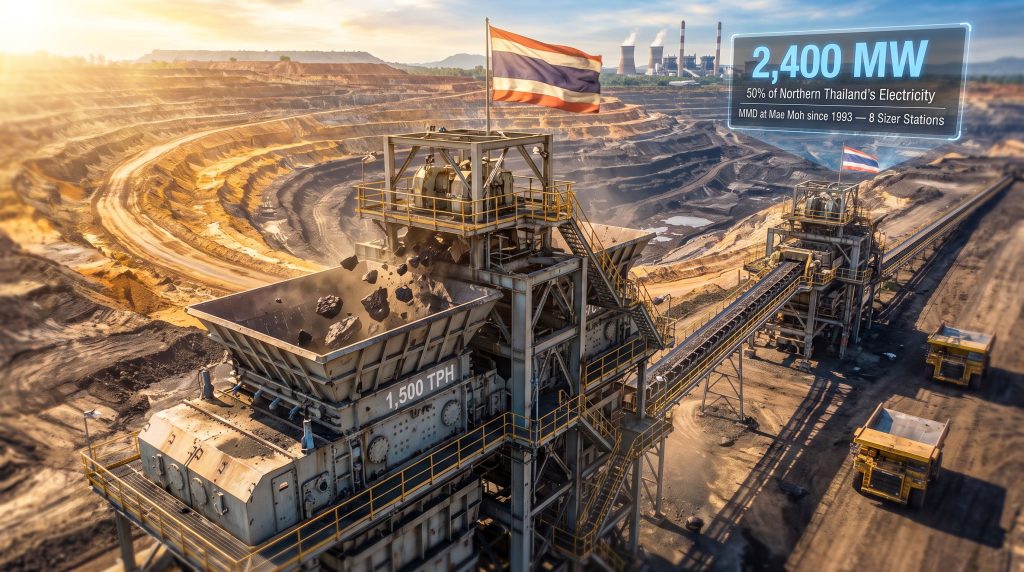
The Mae Moh lignite mine in Lampang Province, northern Thailand, is not simply a large open-cut mining operation. It is a critical component of Thailand's national electricity system. The mine feeds directly into the adjacent Mae Moh Power Plant, which operates with a total installed capacity of 2,400 MW and supplies an estimated 50% of electricity consumed across Thailand's northern region.
This direct link between material handling performance and regional power supply continuity makes equipment reliability a matter of national energy security, not merely operational efficiency. The Electricity Generating Authority of Thailand (EGAT), a state-owned enterprise responsible for national power generation, manages both the mine and the power plant, giving the organisation a uniquely integrated stake in ensuring that lignite is processed reliably, continuously, and cost-effectively.
Understanding why the EGAT and MMD Mae Moh Sizer Stations project matters requires understanding this operational context. When in-pit material handling fails or underperforms at a mine-mouth power operation, the consequences propagate directly into electricity output. Scheduled downtime becomes a grid management challenge. Unplanned failures carry consequences that extend well beyond the mine boundary.
Furthermore, broader conversations around resource and energy exports across the Asia-Pacific region illustrate just how interconnected regional energy infrastructure has become, making reliability at individual operations a concern that resonates far beyond national borders.
Why Lignite Behaves Differently and Why Sizing Matters
Lignite presents distinct material handling challenges that separate it from harder mineral commodities. As the lowest-rank coal, lignite carries relatively high moisture content, lower energy density, and a friable, softer structure compared to sub-bituminous or bituminous coals. These physical characteristics make it particularly poorly suited to high-impact crushing methods.
Conventional roll and impact crushers rely on compressive or impact force to achieve size reduction. With moisture-sensitive materials like lignite, this approach generates excessive fines, increases dust management requirements, and accelerates wear on contact surfaces. Sizer technology approaches the problem from a fundamentally different mechanical philosophy.
The twin-shaft design of the MMD 1000 Series Sizer works by inducing controlled fracture along natural material cleavage planes rather than applying brute compressive force. This produces a more consistent, cuboid product with fewer fines, lower dust generation, and substantially reduced wear rates on the sizing elements themselves. For a material like lignite, the alignment between the technology's mechanical approach and the material's physical characteristics is direct and measurable.
What In-Pit Sizing and Conveying (IPSC) Actually Achieves
The IPSC methodology deployed at Mae Moh eliminates a historically costly step in open-cut mining operations: hauling run-of-mine material from the pit face to a surface crushing facility before it can be conveyed to the processing destination.
Key operational benefits of IPSC over conventional truck-haul-and-crush configurations include:
- Elimination of long-haul truck cycles for oversized material, reducing fuel consumption and tyre wear
- Fewer material transfer points, which reduces spillage, dust generation, and conveyor belt degradation
- More consistent feed to downstream conveying systems due to controlled product sizing
- Reduced labour requirements across the material handling chain
- Lower total cost per tonne of lignite processed over the equipment lifecycle
At Mae Moh, each of the two newly commissioned Sizer Stations processes an average of 1,500 tonnes per hour, reducing run-of-mine feed material with a maximum dimension of 1,500 x 1,200 x 1,000 mm down to a tightly controlled cubic product of 300 x 300 x 300 mm. That reduction ratio, achieved in a single pass within the pit itself, represents a significant advance over what the legacy double-roll crusher configuration could deliver in terms of product consistency and operational overhead.
A Twelve-Year Evaluation: How EGAT Validated Its Technology Choice
The formal technology evaluation that led to the EGAT and MMD Mae Moh Sizer Stations handover began in 2014, more than a decade before Sizer Stations 6 and 7 were commissioned on 19 June 2026. This timeline reflects the extraordinary deliberateness required when upgrading infrastructure that underpins regional electricity supply.
The evaluation process was not a simple vendor comparison exercise. It involved structured benchmarking against specific operational criteria, including maintenance frequency reduction, power consumption profiles, output consistency, and long-term reliability data from comparable operating environments.
The single most influential factor in EGAT's eventual commitment to full-scale MMD Sizer deployment was the observable performance of the technology at the Hongsa Power project, a large-scale lignite mine-mouth power operation located near the Thailand-Lao border. Hongsa represented a closely analogous operating environment: similar lignite characteristics, comparable equipment duty profiles, and mine-mouth power generation as the operational purpose.
Performance data gathered from Hongsa over an extended operating period demonstrated:
- High equipment availability with reduced unplanned downtime relative to conventional crusher configurations
- Lower power draw per tonne of material processed
- Substantially reduced maintenance intervention frequency
- Consistent product sizing supporting reliable downstream conveyor performance
This real-world operational reference site functioned as a de-risking mechanism for a procurement decision of considerable financial and strategic significance. In government procurement environments, particularly those involving critical energy infrastructure, observable proof-of-concept at comparable scale carries more decision-making weight than theoretical performance modelling.
Technical Profile: The MMD 1000 Series Sizer Stations at Mae Moh
The two stations delivered under the latest project phase represent the current apex of MMD's in-pit sizing capability deployed at Mae Moh. Their technical specifications reflect the throughput and reliability demands of one of Southeast Asia's most operationally demanding lignite mining environments.
| Specification | Detail |
|---|---|
| Stations Commissioned | Sizer Station 6 and Sizer Station 7 |
| Handover Date | 19 June 2026 |
| Processing Rate | 1,500 tonnes per hour (average, per station) |
| Sizer Model | MMD 1000 Series (twin-shaft) |
| Maximum Feed Dimension | 1,500 x 1,200 x 1,000 mm |
| Controlled Product Dimension | 300 x 300 x 300 mm |
| Scope | In-pit sizing with integrated feeding and conveying systems |
The twin-shaft mechanical architecture is central to why the MMD 1000 Series achieves performance characteristics that conventional double-roll crushers cannot replicate at comparable throughput. Rather than applying high compressive loads to material, the counter-rotating shafts with pick-style teeth grip and fracture material progressively. This generates far lower peak stress loads on the machine frame, reduces vibration transfer to the surrounding structure, and produces a more uniform output product.
For downstream conveying systems, the consistency of a 300 mm cubic product translates directly into reduced belt wear, more predictable load distribution, and fewer transfer chute blockages. In a high-throughput operation processing millions of tonnes annually, these secondary benefits compound into significant lifecycle cost savings.
Three Decades of Continuous Fleet Development at Mae Moh
The EGAT-MMD partnership at Mae Moh is not a recent commercial relationship. It represents one of the longest-running continuous technology supply arrangements in Southeast Asian mining. The following timeline illustrates how the fleet has developed across successive project phases:
| Period | Development Milestone |
|---|---|
| 1993 | First MMD Sizer Station delivered to Mae Moh |
| 1993 to 2025 | Multiple successive Sizer Station installations across mine expansion phases |
| June 2026 | Handover of Sizer Station 6 and Sizer Station 7 |
| Current Fleet | 8 MMD Sizer Stations and 2 MMD Atlas Transporters (500-tonne capacity rating) |
The MMD Atlas Transporters operating alongside the Sizer Stations represent another dimension of the in-pit material handling system. These self-propelled machines, rated at 500-tonne capacity, enable the repositioning of heavy mining equipment within the pit without disassembly, reducing the downtime associated with equipment relocation as the mine progresses through successive benches.
This accumulated fleet depth also carries an important knowledge management dimension. Over 33 years of continuous operation across multiple installation phases, MMD has developed a detailed engineering dataset specific to Mae Moh's geology, lignite characteristics, and operational patterns. Each successive installation benefits from this compounding institutional knowledge, reducing commissioning risk and accelerating the path to rated performance.
The next major ASX story will hit our subscribers first
MMD's Regional Market Position: What 77% Market Share Signals
Since beginning operations at Mae Moh in 1993, MMD has supplied 20 of the 26 heavy Sizer Stations installed across the Southeast Asian region, representing approximately 77% of the total regional installed fleet. This concentration of market share in a capital equipment category characterised by long asset lives and complex technical requirements tells a specific story about technology adoption cycles in resource-intensive industries.
When a technology achieves dominant installed base status in a regional market, several dynamics reinforce that position:
- Parts and service network density increases, reducing lead times and field service costs for operators
- Operator familiarity with maintenance procedures, wear part specifications, and performance benchmarks reduces training costs
- Reference site availability expands, making it easier for prospective customers to conduct due diligence
- Engineering database depth allows the supplier to tailor solutions to regional geology with higher precision
For mining operators evaluating capital equipment for large greenfield or brownfield projects, the risk calculus strongly favours technologies with proven regional track records. This is especially true in government-owned operations where procurement decisions carry additional accountability requirements. Indeed, the broader mining industry evolution underway globally reinforces why operators are placing greater emphasis on long-term reliability credentials rather than unit price alone.
Delivering a Government-Grade Project: The Execution Framework
The delivery model for the Mae Moh Sizer Station project combined MMD's international engineering and manufacturing network with substantial local execution capability in Thailand. Structural steel fabrication and specialist electrical control system integration were handled by Thai partners, while engineering design and major manufactured components were coordinated across MMD's global network.
This hybrid delivery model is not simply a commercial arrangement. It reflects a practical requirement of operating successfully within government procurement environments. EGAT's project framework carries documentation standards, regulatory compliance requirements, and structured approval processes that demand locally embedded technical expertise to navigate efficiently.
Montree Pichayathana, Managing Director of MMD Thailand, noted that the project reflects the confidence built through years of successful operational performance, and that the Sizer Station performance at nearby operations was instrumental in demonstrating the reliability, maintenance efficiency, and long-term value EGAT sought.
The ability of MMD's local engineering team to resolve technical challenges in real time, without the delays inherent in international escalation processes, was a critical success factor. Government mining projects typically operate within fixed milestone frameworks where delays carry contractual and reputational consequences. On-site engineering competence is not a differentiator in this environment; it is a baseline requirement.
Broader Implications for Southeast Asian Mining Modernisation
The Mae Moh upgrade is a leading indicator of a broader infrastructure renewal cycle that is beginning to emerge across Southeast Asian mining operations. Across the region, lignite and coal mining operations established in the 1970s and 1980s are approaching the end of their original equipment lifecycles. The double-roll crushers that EGAT operated for approximately 40 years before transitioning to sizer technology are representative of a generation of equipment now due for replacement across multiple regional operations.
Several factors are converging to accelerate this renewal cycle:
- Rising maintenance costs on ageing mechanical infrastructure with declining spare parts availability
- Increasing productivity expectations driven by power demand growth across ASEAN economies
- Growing operator awareness of the total cost of ownership advantages offered by modern IPSC configurations
- The expanding reference site network for sizer technology across the region, reducing perceived technology risk
In addition, growing interest in renewable energy in mining is reshaping long-term planning horizons, with operators increasingly seeking equipment configurations that can integrate with cleaner energy sources as the regional grid evolves.
The Mae Moh project, given its scale, duration, and the prominence of EGAT as a national energy authority, functions as a reference case that other regional operators will study carefully. The 12-year evaluation-to-deployment cycle demonstrates the level of rigour appropriate for critical energy infrastructure decisions, while the performance outcomes at Hongsa illustrate the importance of comparable operating environment data in technology validation.
For capital equipment suppliers operating in Southeast Asia's mining sector, the Mae Moh model underscores a fundamental commercial reality: long-term relationships built on demonstrated operational performance are more durable competitive advantages than product specifications alone.
Furthermore, the parallels with mining decarbonisation benefits being realised in other regions suggest that infrastructure modernisation and efficiency gains are becoming mutually reinforcing priorities across the global mining industry.
Key Takeaways for the Mining Equipment Sector
The EGAT and MMD Mae Moh Sizer Stations project delivers several insights relevant to operators, engineers, and capital equipment procurement specialists across the mining industry:
- Evaluation cycles for critical infrastructure are measured in years, not months. EGAT's 12-year process from initial engagement to full deployment reflects the appropriate standard for equipment that feeds baseload electricity generation.
- Reference site performance is the most powerful procurement tool available to suppliers. Hongsa Power served as the operational proof point that converted a multi-year evaluation into a confirmed commitment.
- IPSC technology has reached maturity in Southeast Asian lignite mining. MMD's 77% share of the regional heavy sizer fleet indicates a technology that has moved well past the early adoption phase.
- Local execution capability is structurally essential in government project environments. Technical excellence delivered from international engineering centres must be paired with on-the-ground regulatory, documentation, and commissioning expertise.
- Material handling reliability at mine-mouth power operations is a national energy security issue. When processing continuity determines grid stability for millions of electricity consumers, equipment uptime standards must reflect that elevated responsibility.
Consequently, projects of this nature demonstrate that the intersection of green iron production ambitions and conventional energy infrastructure modernisation will define the next decade of capital investment across Asia-Pacific resource operations. For further context on how lignite and coal operations are evolving technically, the World Coal Association provides detailed industry research, while the International Energy Agency's coal reports offer authoritative data on regional consumption and infrastructure trends.
This article is informational in nature and does not constitute financial or investment advice. Readers should conduct independent research before making any investment or procurement decisions related to companies or technologies discussed herein.
Want to Stay Ahead of Significant ASX Mineral Discoveries in the Resources Sector?
Discovery Alert's proprietary Discovery IQ model delivers real-time alerts on significant ASX mineral discoveries, instantly translating complex data across 30+ commodities into clear, actionable insights for both short-term traders and long-term investors. Explore historic examples of major mineral discoveries and their market returns, then begin your 14-day free trial at Discovery Alert to position yourself ahead of the broader market.