July 17, 2026
Why Khor Mor Is the Linchpin of Kurdistan's Power Supply
Energy infrastructure in conflict-adjacent territories operates under a fundamentally different risk calculus than facilities in stable environments. The variables that determine whether a gas field runs at full capacity or sits dormant are not purely geological or commercial — they are geopolitical, security-driven, and subject to forces that no expansion project or production milestone can fully insulate against. Nowhere is this dynamic more visible right now than in northern Iraq, where the Dana Gas Khor Mor gas field shutdown has plunged Kurdistan's electricity grid into crisis and raised urgent questions about the region's structural energy vulnerability.
Kurdistan's electricity architecture was never designed with redundancy as a core principle. Over time, the region came to rely on a single gas field — Khor Mor — as its dominant fuel source for power generation, a dependency that reflected the field's scale and accessibility but embedded a dangerous concentration of risk into the grid's foundations. This situation, furthermore, is emblematic of wider global energy security risks that have intensified across conflict-adjacent regions in recent years.
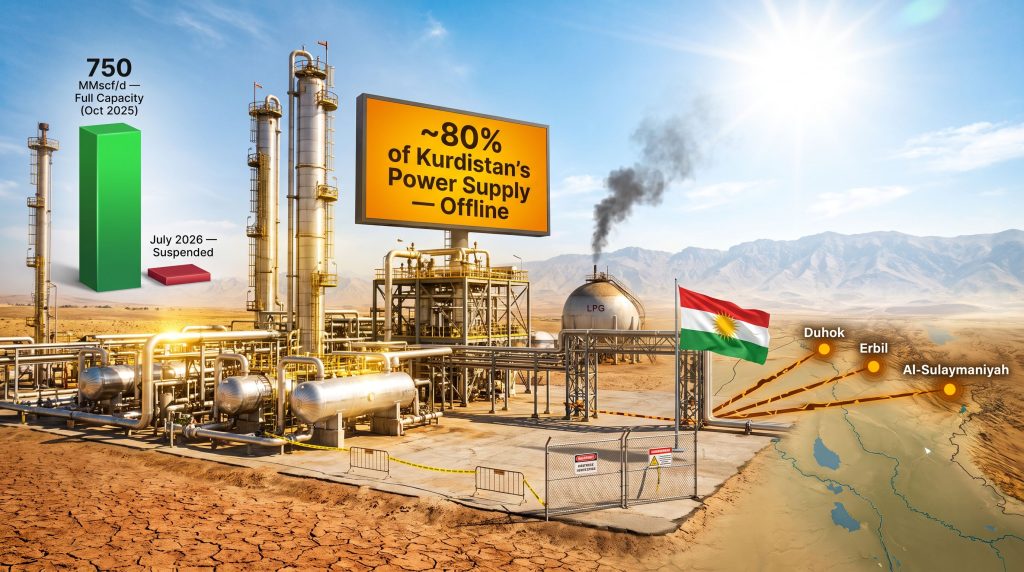
At full capacity following the completion of the KM250 expansion project in October 2025, Khor Mor was capable of producing 750 million cubic feet of gas per day (MMscf/d). That output underpinned an estimated 2,500 to 3,000 megawatts of electricity generation capacity, which in practical terms meant the field was responsible for up to 80% of Kurdistan's total power supply. The three major governorates of Al-Sulaymaniyah, Erbil, and Duhok all drew from gas supplies originating at Khor Mor.
The KM250 expansion was intended to be transformative — a capital-intensive project designed to close Kurdistan's chronic electricity deficit and establish the region on firmer energy footing. The timing of what followed made the investment outcome acutely painful. Within months of reaching peak productive capacity, the field became a high-value security target in a deteriorating regional threat environment, illustrating one of the most persistent paradoxes in conflict-zone energy investment: expanded capacity does not automatically translate into sustained operational continuity.
The completion of a major capacity expansion just months before a full suspension of operations is a textbook demonstration of how rapidly geopolitical conditions can neutralize infrastructure investment gains in politically contested operating environments.
When big ASX news breaks, our subscribers know first
The Dana Gas Khor Mor Shutdown: Security Incidents and Escalating Threats
The Dana Gas Khor Mor gas field shutdown did not occur without precedent. It was the culmination of a deteriorating security pattern that had been building in frequency and severity since at least 2024. Understanding the trajectory of incidents at Khor Mor is essential to grasping why this particular suspension is qualitatively different from earlier disruptions. Consequently, the energy infrastructure vulnerability exposed here extends well beyond a single operator's risk profile.
A Chronology of Security Incidents at Khor Mor
| Incident Period | Nature of Threat or Attack | Operational Impact |
|---|---|---|
| April 2024 | Armed attack on facility | Production halted; four workers killed |
| January 2025 | Security incident at the field | Temporary suspension of output |
| November 2025 | Rocket strike igniting LPG storage tank | Emergency shutdown triggered |
| March 2026 | Staff evacuation following regional threat escalation | Precautionary operational pause |
| July 2026 | Credible security threats and escalating regional tensions | Full suspension of main production facilities |
Each incident represented a ratcheting up of threat severity. The April 2024 attack, which resulted in the deaths of four workers, marked a serious escalation from the nuisance-level security risks typical of earlier operational periods. Dana Gas evacuated Khor Mor staff in March 2026 following Iranian threats, foreshadowing the full suspension that followed months later. By the time of the July 2026 suspension, Dana Gas had made the decision to shut down main production facilities entirely — not simply reduce throughput or implement defensive protocols while maintaining output.
This distinction is operationally significant. A partial curtailment suggests manageable risk. A full suspension of primary production facilities signals that the operator's threat assessment has crossed a threshold where continued operations cannot be justified under any reasonable duty-of-care or commercial risk framework.
Dana Gas confirmed the shutdown was driven by credible security threats and escalating regional tensions, and that the company was actively monitoring the situation. The decision was taken in coordination with Kurdistan Regional Government (KRG) ministries responsible for natural resources and electricity, as well as relevant federal Iraqi authorities — indicating the concern was institutional in scale, not limited to the company's own risk calculations.
Critically, the facility was not decommissioned or mothballed. It was placed in a purged, operationally ready state — a deliberate configuration designed to enable rapid recommissioning once security conditions are deemed acceptable. This operational posture distinguishes the current situation from abandonment, but it also underscores the uncertainty: the field is ready to restart, but the external environment needed to justify doing so remains unpredictable.
Quantifying the Electricity Crisis Across Kurdistan's Governorates
The human impact of the Dana Gas Khor Mor gas field shutdown is measured in megawatts and population centres simultaneously. With gas deliveries to power stations serving Sulaymaniyah, Erbil, and Duhok halted, the region has lost the supply that powered the overwhelming majority of its grid capacity.
Supply Conditions: Before and After the Shutdown
| Metric | Normal Operations | Post-Shutdown Conditions |
|---|---|---|
| Khor Mor gas output capacity | 750 MMscf/d | Suspended |
| Electricity generation supported | ~2,500 to 3,000 MW | Near zero contribution from Khor Mor |
| Share of Kurdistan total power supply | Up to 80% | Effectively eliminated |
| Governorates receiving gas supply | Sulaymaniyah, Erbil, Duhok | All impacted |
The scale of this disruption has no close precedent in the region's recent energy history. Kurdistan has experienced recurring electricity shortfalls over the years, but those were typically the result of insufficient generation capacity relative to demand growth. What the current crisis represents is the near-total collapse of existing supply from a single source — a fundamentally different and more acute problem.
The KRG's Ministry of Electricity has characterised the suspension as temporary, a framing that reflects political urgency rather than confirmed timelines. Dana Gas has not announced a resumption date. Firm security guarantees remain the stated precondition for restarting operations. Notably, Dana Gas restarted production at the Khor Mor complex following earlier disruptions, offering some precedent for a potential return to operations — though the current situation is considerably more severe.
Three Resumption Scenarios: How the Situation Could Resolve
Modelling the possible paths forward for Khor Mor requires examining both the security environment and the institutional dynamics between Dana Gas, the KRG, and federal Iraqi authorities. Three plausible scenarios emerge:
Scenario A: Rapid Resumption (within 1 to 4 weeks)
- Regional security conditions stabilise sufficiently for Dana Gas to accept the joint committee's assurances
- The facility's operational readiness allows power restoration to Sulaymaniyah, Erbil, and Duhok within days of restart
- Enhanced physical security measures are deployed as a condition of resuming output
- This scenario requires the external threat environment to shift meaningfully in a short timeframe — a condition dependent on factors well beyond any single stakeholder's control
Scenario B: Prolonged Suspension (1 to 3 months)
- Ongoing regional hostilities prevent credible security clearance
- Kurdistan activates emergency power import arrangements or alternative generation sources to partially offset the deficit
- Dana Gas absorbs revenue pressure from sustained downtime while the KRG faces mounting political consequences domestically
- This scenario tests both operator financial resilience and government legitimacy
Scenario C: Structural Reassessment (beyond 3 months)
- Repeated security incidents prompt Dana Gas to seek fundamental renegotiation of security arrangements and potentially contract terms
- Force majeure provisions may be invoked, with cascading implications for revenue flows and contractual relationships
- Investor confidence in Kurdistan's energy sector as an operational jurisdiction suffers material, potentially lasting, damage
- Accelerated discussion of alternative gas sources and grid diversification moves from policy aspiration to operational necessity
Disclaimer: The above scenarios are analytical constructs based on available information and general risk modelling frameworks. They do not constitute forecasts or investment advice. Actual outcomes will depend on geopolitical developments that are inherently unpredictable.
The Concentration Risk Problem: Kurdistan's Structural Energy Vulnerability
The Khor Mor crisis exposes a vulnerability that energy security frameworks have long identified as a primary systemic risk: single-point-of-failure dependency in electricity supply architecture. In addition, the broader geopolitical risk landscape across the Middle East has made this structural weakness increasingly difficult to ignore.
Standard energy security doctrine recommends that no single generation source account for more than 30 to 40% of a grid's total supply. This threshold reflects the point at which a single disruption transitions from a significant inconvenience to a grid-destabilising event. Kurdistan's arrangement, where one gas field has accounted for up to 80% of power supply, represents a concentration level roughly double the upper bound of what resilience-focused energy planners would consider acceptable.
For private operators like Dana Gas, the risk calculus in conflict-adjacent jurisdictions involves considerations that go well beyond standard commercial exposure. Security incidents translate directly into:
- Production economics: every day of downtime represents lost revenue against fixed operational costs
- Evacuation logistics: staff safety protocols and emergency procedures carry both financial and reputational implications
- Insurance implications: repeated security incidents can affect coverage terms, premiums, and exclusions
- Force majeure provisions: contract terms in conflict-zone operating agreements typically include triggers tied to security conditions, which can restructure payment and obligation frameworks
The broader question this situation raises is at what point a pattern of recurring security disruptions fundamentally alters long-term investment appetite for a jurisdiction. The Khor Mor case has now accumulated multiple severe incidents across a two-year window. Each successive event narrows the gap between episodic risk and structural risk — and investors are acutely sensitive to that distinction.
Regional Escalation and the Wider Energy Security Context
The Dana Gas Khor Mor gas field shutdown cannot be fully understood in isolation from the broader Middle East security environment in 2025 and 2026. The same regional energy market pressures that produced heightened threats to Gulf energy infrastructure — involving confrontations between major powers and the targeting of energy assets as strategic leverage — created the conditions that made Khor Mor vulnerable.
Drone and rocket attacks on energy infrastructure have become a recurrent feature of regional conflict dynamics, targeting civilian power supply as a mechanism for generating political and economic pressure. Kurdistan's geographic position, as a semi-autonomous region within Iraq sharing extensive borders with multiple states, exposes it to cross-border threat vectors that are difficult for any host government security apparatus to fully neutralise.
The International Energy Agency has warned publicly about the risks to global energy security from sustained regional instability, with particular attention to chokepoints and critical infrastructure. The Khor Mor situation fits within a broader pattern of energy facility vulnerability across the region — from maritime threats at the Strait of Hormuz to drone strikes on production and storage infrastructure across multiple countries.
Iraq's federal-KRG relationship adds a further layer of complexity. The jurisdictional dynamics between Baghdad and Erbil affect how security coordination for energy facilities is structured and how quickly response mechanisms can be mobilised. Ongoing disputes over pipeline infrastructure, including questions around the Kirkuk-Ceyhan pipeline capacity, illustrate that the governance environment for energy assets in Iraq remains contested at multiple levels simultaneously.
The next major ASX story will hit our subscribers first
What Meaningful Resilience Looks Like for Kurdistan's Energy Sector
The path toward genuine energy security for Kurdistan requires confronting the structural dependency that the Khor Mor shutdown has laid bare. However, addressing these challenges also intersects with natural gas price trends that are shaping investment decisions across the broader region. Several policy and investment directions are relevant:
- Supply diversification: developing additional gas sources capable of contributing meaningfully to the power generation mix, reducing reliance on any single field
- Renewable energy integration: solar and wind capacity can provide baseload diversity that reduces the grid's vulnerability to gas supply disruptions, though Kurdistan's current renewable penetration remains limited
- Emergency interconnection: formal power import agreements with neighbouring systems that can be activated rapidly when primary supply is disrupted
- Security investment frameworks: host government security commitments need to be operationally meaningful rather than declaratory — the gap between assurance and verifiable protection is where investor confidence is lost
For energy sector stakeholders and investors assessing Kurdistan as an operating environment, the Khor Mor situation offers a clear signal: resource potential and operational reliability are not the same thing, and the gap between them in conflict-adjacent jurisdictions can be wide, persistent, and expensive.
Frequently Asked Questions: Dana Gas Khor Mor Shutdown
What is the Khor Mor gas field and who operates it?
Khor Mor is a major natural gas field in Iraq's Kurdistan Region, operated by Dana Gas, a UAE-based energy company. It is the primary gas supply source for power generation across Kurdistan's main governorates.
Why did Dana Gas shut down Khor Mor?
Dana Gas suspended main production operations citing credible security threats and escalating regional tensions, in coordination with KRG ministries and Iraqi federal authorities.
How much electricity has been lost?
The shutdown removed approximately 2,500 to 3,000 megawatts of generation capacity, representing up to 80% of Kurdistan's electricity supply, affecting Sulaymaniyah, Erbil, and Duhok.
When will operations resume?
No confirmed restart date has been announced. The facility is maintained in operational readiness and Dana Gas has indicated firm security guarantees are required before production resumes.
What is the KM250 expansion project?
The KM250 project, completed in October 2025, expanded Khor Mor's production capacity to 750 MMscf/d, making the field's subsequent shutdown particularly consequential given the scale of the investment and the timing of the disruption.
Has the field been targeted before?
Yes. Khor Mor experienced a fatal armed attack in April 2024, a rocket strike on an LPG tank in November 2025, and a precautionary staff evacuation in March 2026, among other incidents, establishing a clear pattern of escalating security risk prior to the July 2026 suspension.
Want to Stay Ahead of the Next Major Resource Discovery?
Discovery Alert's proprietary Discovery IQ model delivers real-time alerts on significant ASX mineral discoveries, transforming complex resource data into actionable investment insights — ideal for investors navigating volatile, geopolitics-driven commodity markets. Explore the historic returns major mineral discoveries have generated and begin your 14-day free trial today to position yourself ahead of the broader market.