July 17, 2026
The Hidden Cost of Losing a Nation's Last Ferroalloy Furnace
Every industrial economy rests on a quiet hierarchy of dependencies. At the base of that hierarchy sit the alloys that nobody talks about until they are gone. Ferromanganese is one of them. It is not a glamorous material. It does not feature in energy transition headlines or battery metal investment theses. Yet without it, steel cannot be hardened, deoxidised, or made fit for purpose in defence applications, civil construction, or heavy mining equipment. When the last domestic furnace capable of producing it shuts permanently, the absence is felt not in a single dramatic moment but across a long tail of cost, vulnerability, and industrial fragility.
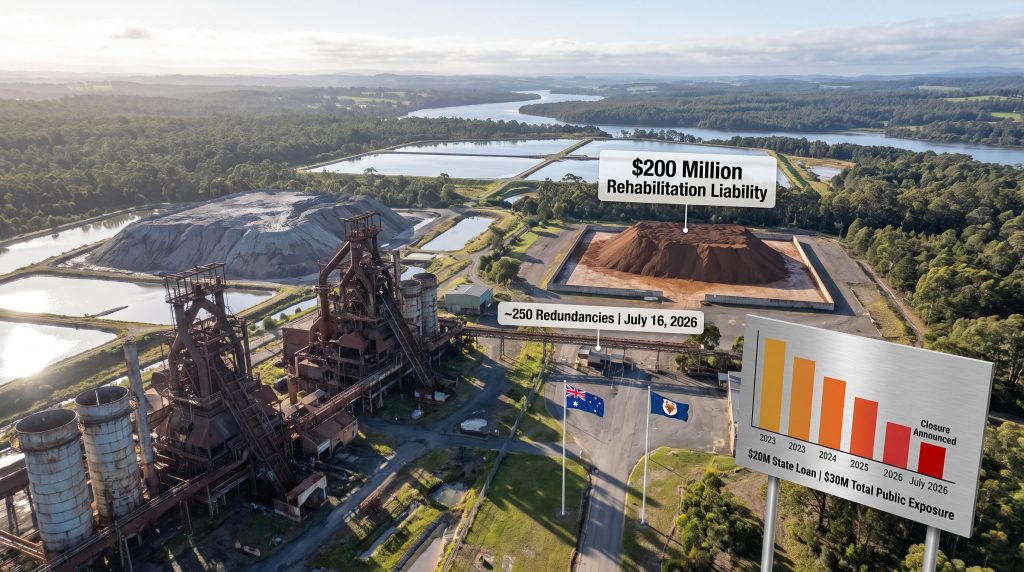
That is precisely the situation Australia now faces following the permanent Liberty Bell Bay smelter closure in northern Tasmania on July 16, 2026.
When big ASX news breaks, our subscribers know first
Understanding Ferromanganese: The Alloy Australia Can No Longer Make
Ferromanganese is a binary alloy of manganese and iron, typically containing between 74% and 82% manganese by weight in its high-carbon form. Its primary function in steelmaking is twofold: it acts as a deoxidising agent, removing dissolved oxygen from molten steel during the refining process, and as a strengthening additive, improving tensile strength, hardness, and wear resistance.
The production process is anything but simple. Raw manganese ore must first pass through a sintering plant, where fine particles are agglomerated into a feedstock suitable for the smelting furnace. The ore is then reduced in a submerged arc furnace at temperatures exceeding 1,400 degrees Celsius, where carbon reacts with manganese oxides to produce the metal alloy. Each stage generates significant waste streams, including slag stockpiles, fume emissions, and contaminated leachate, all of which require active and ongoing environmental management.
"Ferromanganese is not a specialty product limited to niche applications. It is a foundational industrial input consumed in bulk by every steel producer that manufactures structural steel, rail, automotive components, or defence-grade plate."
What made Liberty Bell Bay uniquely significant was its position as the sole domestic producer of ferromanganese from ore in Australia. No other facility in the country was capable of converting raw manganese ore into the finished alloy. Consequently, with its permanent closure, that integrated processing chain no longer exists on Australian soil.
A Six-Decade Industrial Asset Reduced to a Liability
Liberty Bell Bay was commissioned in 1962, making it one of the oldest continuously operating ferroalloy facilities in the Southern Hemisphere at the time of its operational suspension. Located in the Tamar Valley industrial corridor roughly 50 kilometres north of Launceston, the facility sat within Bell Bay's established heavy industrial precinct, which also hosts aluminium smelting and other energy-intensive processing operations.
The sequence of events that led to permanent closure unfolded across multiple ownership failures, funding collapses, and regulatory escalations. Administrators confirmed the closure despite millions in taxpayer-funded rescue loans having already been committed to the facility's survival.
| Date | Milestone |
|---|---|
| 2023 | GFG Alliance, controlled by Sanjeev Gupta, enters financial distress, destabilising the facility |
| May 2025 | Ore reduction operations suspended due to ore supply disruptions and volatile market conditions |
| August 2025 | Tasmanian government provides a $20 million loan to fund a manganese ore shipment purchase |
| January 2026 | GFG Alliance defaults on the state loan agreement; receivers appointed over the 23,000-tonne ore stockpile |
| March 2026 | Liberty Bell Bay enters voluntary administration |
| April 2026 | EPA Tasmania issues a formal compliance notice over environmental obligation concerns |
| May 2026 | A consortium enters exclusive sale negotiations with administrators |
| July 15, 2026 | Consortium withdraws, citing unresolvable funding and operational barriers |
| July 16, 2026 | Administrators announce immediate permanent closure; approximately 250 redundancy notices issued |
The collapse of the consortium sale is particularly significant. Exclusive negotiations had been underway for nearly two months, suggesting the buyer group initially believed a viable restart path existed. Their withdrawal — attributed to an inability to secure adequate funding and the scale of enabling capital requirements — points to a structural problem in the economics of domestic ferroalloy production, not merely a transactional one.
The $200 Million Environmental Liability Nobody Wants to Own
When industrial facilities of this scale close permanently, the financial conversation rapidly shifts from operational losses to rehabilitation costs. At Liberty Bell Bay, that conversation is exceptionally uncomfortable.
A report prepared by William Buck, administrators for GFG Alliance's Whyalla Ports entity, estimated in late 2025 that permanent closure would crystallise an environmental rehabilitation liability of approximately $200 million. This figure encompasses the full decommissioning and remediation scope required under Tasmanian environmental law.
The infrastructure requiring active management includes:
- Submerged arc furnaces requiring specialist industrial decommissioning
- Fume dams containing concentrated processing byproducts with long-term containment obligations
- Sinter plant infrastructure with embedded contamination from ore pre-processing
- Stormwater and leachate management systems posing active pollution risk to surrounding waterways
- Slag stockpiles requiring long-term capping, monitoring, and stabilisation
- Dust emission controls that must be maintained even after all productive activity has ceased
EPA Tasmania's regulatory position on this point is unambiguous. Director Catherine Murdoch confirmed in April 2026 that environmental pollution flows from the site do not cease when smelting activity stops. The agency's compliance notice specifically flagged that reduced staffing levels during administration created a material risk of critical environmental controls going unmaintained, with contaminated wastewater discharge into the adjacent Tamar River identified as the primary near-term concern.
"The EPA's position reflects a principle that is sometimes underappreciated in insolvency proceedings: environmental obligations do not pause during administration. A site of this complexity generates ongoing pollution risk regardless of whether a furnace is running, and that risk requires funded, active management by a legally accountable party."
The critical policy gap is that the $200 million rehabilitation liability sits with administrators and site owners who, by definition, are operating in insolvency. The gap between available assets and the remediation cost creates a scenario where rehabilitation obligations may ultimately fall on the state, even though the Tasmanian government has explicitly stated it does not intend to absorb those costs.
Tasmanian Minerals, Manufacturing and Energy Council (TMEC) CEO Ray Mostogl has noted publicly that decommissioning and rehabilitation costs are likely to exceed the capital required to restart the smelter. That observation has significant policy implications: it suggests the economic argument for keeping the site in mothball rather than pursuing accelerated rehabilitation may have merit, provided a credible future operator can be identified.
Taxpayer Exposure: Breaking Down the $30 Million in Public Funds
The government's financial involvement in Liberty Bell Bay's final chapter is substantial and partially unresolved.
| Funding Component | Amount | Status |
|---|---|---|
| Tasmanian government loan for ore purchase | $20 million | Secured against 23,000-tonne ore stockpile; recovery confidence expressed |
| State and federal worker wage support | ~$10 million combined | Largely disbursed; limited recovery prospects |
| Total public financial exposure | ~$30 million | Partially secured |
The government's position on the ore loan rests on its claimed senior-ranking security over both the ore stockpile and the broader site. Tasmanian Resources Minister Felix Ellis has stated publicly that the ore has retained its market value and that the state is confident of recovering the loan principal through that security.
However, the practical recovery pathway is more complex than a simple asset sale. The 23,000-tonne manganese ore stockpile sitting on site was specifically held in reserve to give any future operator the fastest possible restart timeline. Liquidating it as a raw commodity means the ore would likely be exported to an overseas processor, adding logistical costs and creating exposure to manganese spot price movements. As of the closure announcement, no confirmed third-party ore buyer had been publicly identified.
Australia's Sovereign Industrial Gap: Mining Is Not Processing
One of the most important analytical distinctions that tends to get lost in public commentary around the Liberty Bell Bay smelter closure is the difference between resource extraction and industrial processing. Australia's position in global manganese markets has not fundamentally changed in terms of mining capacity. The country retains substantial manganese ore deposits and beneficiation capability. What has changed, permanently and completely, is the domestic ability to convert that ore into a usable industrial metal.
| Capability | Post-Closure Status |
|---|---|
| Manganese ore mining | Retained |
| Ore concentration and beneficiation | Retained |
| Domestic ferromanganese smelting | Permanently lost |
| Domestic ferromanganese supply to steelmakers | 100% import dependent |
Dr Tim Werner, Senior Lecturer in Energy Transition at the University of Melbourne, has framed this distinction clearly: Australia retains the ability to mine and concentrate manganese, but the ore will now travel overseas for conversion into a usable alloy before being returned to Australian steelmakers as an imported product. That round-trip adds cost, logistical complexity, and exposure to decisions made by foreign governments and processors.
Which Countries Now Supply Australia's Ferromanganese?
The key geopolitical dimension is that global ferromanganese production is concentrated among a relatively small number of supplier nations. Each carries a distinct risk profile:
- China exerts significant influence over global pricing and has demonstrated willingness to use export controls as a policy lever across other mineral categories
- South African ferroalloys production is subject to periodic energy supply disruptions from Eskom's load-shedding regime
- India's export policies have historically fluctuated with domestic steel demand cycles
- Norway represents a more stable but geographically distant supply source
TMEC's Ray Mostogl has characterised Australia's new position plainly: the country is now more exposed to pricing decisions and supply availability choices made in foreign capitals, with direct implications for the competitiveness of domestic steel production and the industries that depend on it.
The next major ASX story will hit our subscribers first
The Policy Credibility Problem
The timing of the Liberty Bell Bay closure sits awkwardly against the backdrop of Australia's stated critical minerals processing ambitions. In March 2026, the federal government released more than $50 million in funding designed to help build domestic critical metals refining capacity. The Liberty Bell Bay closure occurred within months of that announcement.
Furthermore, Australia's critical minerals strategy has repeatedly emphasised the importance of onshore processing as a sovereign capability. However, the smelting economics that defeated Liberty Bell Bay — specifically high energy costs and volatile ore supply — are not unique to that facility. They represent systemic challenges facing any energy-intensive processing operation in Australia.
Dr Werner has raised the question of whether Australia's ambitions to become a meaningful domestic metals producer are commercially realistic given the structural competitiveness of overseas processors, particularly those with access to cheaper energy, lower labour costs, and integrated supply chains. This creates a credibility problem for industrial policy. Public funding directed at building new refining capacity must grapple with the same fundamental barriers that made sustaining an existing, operationally mature facility commercially unviable over a 60-year period.
In addition, resource export challenges more broadly continue to expose the structural tension between Australia's resource-rich identity and its limited downstream processing ambitions. Meanwhile, the broader critical minerals policy environment internationally is shifting rapidly, placing further pressure on Australia to clarify its sovereign industrial intentions.
Regional Consequences: The Tamar Valley's Industrial Anchor Is Gone
Beyond the macro policy dimensions, the closure has immediate and severe consequences for the communities and businesses directly dependent on its operation. The axing of 250 jobs at the facility represents one of the most significant single-site redundancy events in Tasmanian industrial history in recent years.
Approximately 250 workers face formal redundancy, with notices expected to be served from July 20, 2026. A small retention workforce will remain on site to manage the complex environmental compliance and decommissioning obligations, but this represents a fraction of the former headcount.
The supply chain impact extends well beyond direct employees:
- Specialist engineering and maintenance contractors servicing the furnace and sinter plant
- Logistics and transport providers handling ore movements and product distribution
- Equipment suppliers and consumables vendors integrated into the facility's operations
- Professional service firms providing legal, environmental, and technical support
Mostogl's characterisation of this as a potential domino effect through the Tamar Valley reflects the economic reality of anchor employer closures in regional industrial precincts. When a facility of this scale exits, it removes the demand base that supported an entire ecosystem of supporting businesses, many of which may not have sufficient alternative revenue streams to survive the loss.
Bell Bay has historically functioned as Tasmania's primary heavy industrial precinct. Consequently, the closure of its largest active industrial employer raises long-term questions about the precinct's future orientation and the economic diversification strategy available to the Tamar Valley region. The broader imperative for mining sustainability transformation has never felt more urgent in this context.
Can the Site Ever Return to Production?
The Tasmanian government has explicitly avoided closing the door on a future operator. Minister Ellis has confirmed that while short-term restart is not possible, the possibility of a future smelter operator acquiring and recommissioning the site remains open.
For that scenario to materialise, the following conditions would all need to be satisfied simultaneously:
- Site acquisition through the liquidation process at a price that makes restart economics viable
- Full environmental baseline resolution meeting current EPA Tasmania standards
- Securing a stable, long-term manganese ore supply arrangement — a challenge that contributed directly to the original operational suspension
- Access to competitive electricity pricing at sufficient scale for the energy-intensive smelting process
- Adequate working capital to sustain operations through a full manganese alloy market cycle
- Regulatory clearance from EPA Tasmania and Tasmanian planning authorities
The restart cost calculus is informative when set alongside the rehabilitation liability:
| Pathway | Estimated Cost Range | Key Variables |
|---|---|---|
| Full site rehabilitation | ~$200 million | Regulatory scope, contractor availability, site complexity |
| Smelter recommissioning | Not publicly quantified | Ore supply, energy pricing, capital access, market conditions |
| Partial asset liquidation | Market-dependent | Scrap values, ore stockpile price, land disposition |
The observation from TMEC that rehabilitation likely costs more than restart is, counterintuitively, one of the stronger arguments for preserving restart optionality rather than pursuing immediate decommissioning. If that cost differential is material, and if manganese alloy market conditions improve, the net present value case for a future operator may be more favourable than current circumstances suggest.
Disclaimer: Any reference to future restart scenarios, rehabilitation cost estimates, or investment considerations in this article is speculative and informational in nature. No investment decisions should be based on this analysis. All financial figures cited are sourced from publicly available reports and statements by named officials.
Key Questions Answered
What is ferromanganese and why does it matter for Australian steel?
Ferromanganese is a manganese-iron alloy used as a deoxidising and strengthening agent in steel production. It is essential across defence manufacturing, civil construction, and heavy industrial equipment. With the Liberty Bell Bay smelter closure, Australian steelmakers must now source this material entirely from overseas suppliers.
Why did the consortium sale collapse?
The prospective buyer group was unable to secure viable funding arrangements and could not resolve the enabling operational requirements — including environmental compliance capital and restart costs — that were conditions of a viable acquisition.
What is the Tasmanian government's financial exposure?
The state loaned $20 million to fund a manganese ore purchase that was never processed. Combined with approximately $10 million in joint state-federal worker wage support, total public financial exposure reaches around $30 million. The government holds senior security over the 23,000-tonne ore stockpile and the site.
What is the estimated rehabilitation cost?
An administrator's report from late 2025 estimated that permanent closure would crystallise a rehabilitation liability of approximately $200 million, covering furnace decommissioning, fume dams, sinter plant remediation, leachate management, and slag stockpile stabilisation.
Is future production at the site possible?
The Tasmanian government has not ruled it out, but has confirmed that short-term restart is not viable. Any future production would require new ownership, fresh capital, regulatory clearance, and a resolved ore supply arrangement.
A Structural Reckoning for Australian Industrial Policy
The Liberty Bell Bay smelter closure is not simply a corporate insolvency event that happened to involve a strategically important asset. It is, however, a case study in the compounding difficulty of sustaining energy-intensive, capital-heavy processing infrastructure in an environment of volatile commodity markets, concentrated global competition, and high domestic operating costs.
The three numbers that define the legacy of this closure are instructive in combination: a $200 million environmental rehabilitation liability that no credible party is positioned to fund, approximately $30 million in public financial exposure whose recovery remains uncertain, and zero domestic ferromanganese production capacity remaining in Australia.
For policymakers, the questions now are practical and urgent. Who bears legal and financial responsibility for the rehabilitation of an insolvent industrial site with a $200 million remediation price tag? What is the realistic timeline and mechanism for recovering the government's ore loan? And most fundamentally, does Australia's critical minerals processing strategy account for the structural gap between the ambition to build new refining capacity and the demonstrated difficulty of maintaining existing capacity that has operated for more than six decades?
The Tamar Valley has lost its industrial anchor. Australia has lost its only ferromanganese producer. And the policy frameworks designed to prevent exactly this outcome are, at minimum, overdue for a frank reassessment.
Want to Stay Ahead of Australia's Next Major Mineral Discovery?
Discovery Alert's proprietary Discovery IQ model delivers real-time alerts on significant ASX mineral discoveries, instantly converting complex geological data into actionable investment insights — precisely the kind of market intelligence that matters when sovereign industrial gaps create new commodity opportunities. Explore historic discoveries and their returns on Discovery Alert's dedicated discoveries page, and begin your 14-day free trial today to position yourself ahead of the broader market.